NASA’s Solar Dynamics Observatory (SDO) is our premiere source for data on the sun. In honor of its five-year anniversary, NASA released this beautiful video compiling some of the highlights among the 2600 terabytes of data the spacecraft has recorded. SDO has captured some truly stunning footage over the years of sunspots, prominences, and eruptions. The latter two are examples of plasma flows and visible magnetohydrodynamics. SDO’s observations are also helping researchers determine what goes on just beneath the sun’s surface, where convection and buoyancy are major forces in the transport of heat generated from fusion in the star’s core. Incidentally, SDO’s launch featured some uncommonly stunning fluid dynamics as well. (Video credit: NASA Goddard)
Tag: plasma

Plasma
For those of us who are Earthbound, it’s easy to think of liquids and gases as being the most common fluids. But plasma–the fourth state of matter–is a fluid as well. Plasmas are essentially ionized gases, which, thanks to their freely flowing electrons, are electrically conductive and sensitive to magnetic fields. Their motions are described by a combination of the Navier-Stokes equations–the usual equations of motion for a fluid–and Maxwell’s equations–the equations governing electricity and magnetism. Studies of plasma motion often fall under the subject of magnetohydrodynamics and can include topics like planetary auroras, sunspots, and solar flares. (Video credit: SciShow)

Saturnian Auroras

Earth is not the only planet in our solar system with auroras. As the solar wind–a stream of rarefied plasma from our sun–blows through the solar system, it interacts with the magnetic fields of other planets as well as our own. Saturn’s magnetic field second only to Jupiter’s in strength. This strong magnetosphere deflects many of the solar wind’s energetic particles, but, as on Earth, some of the particles get drawn in along Saturn’s magnetic field lines. These lines converge at the poles, where the high-energy particles interact with the gases in the upper reaches of Saturn’s atmosphere. As a result, Saturn, like Earth, has impressive and colorful light displays around its poles. (Image credit: ESA/Hubble, M. Kornmesser & L. Calçada, source video; via spaceplasma)

Controlling Supersonic Flight
The forces on an object in flight come from the distribution of pressure on the surface. To alter an object’s trajectory, one has to shift the pressure distribution. On subsonic and transonic aircraft, this is usually done with control surfaces like an aileron, but at supersonic speeds this can require a lot of force. The schlieren images above show an alternative approach in which a plasma actuator near the nosetip generates asymmetric forces on the cone. The actuator discharges plasma at t=0, and flow is from left to right. In the first image, the bubble of plasma is expanding on the upper side of the cone, disrupting the nearby shock wave. Over time, it moves downstream, carrying its disruption with it. The asymmetric effect of the plasma causes uneven pressures on either side of the cone that can be triggered in order to turn it in flight. (Photo credit: P. Gnemmi and C. Rey)

Aurora From Space
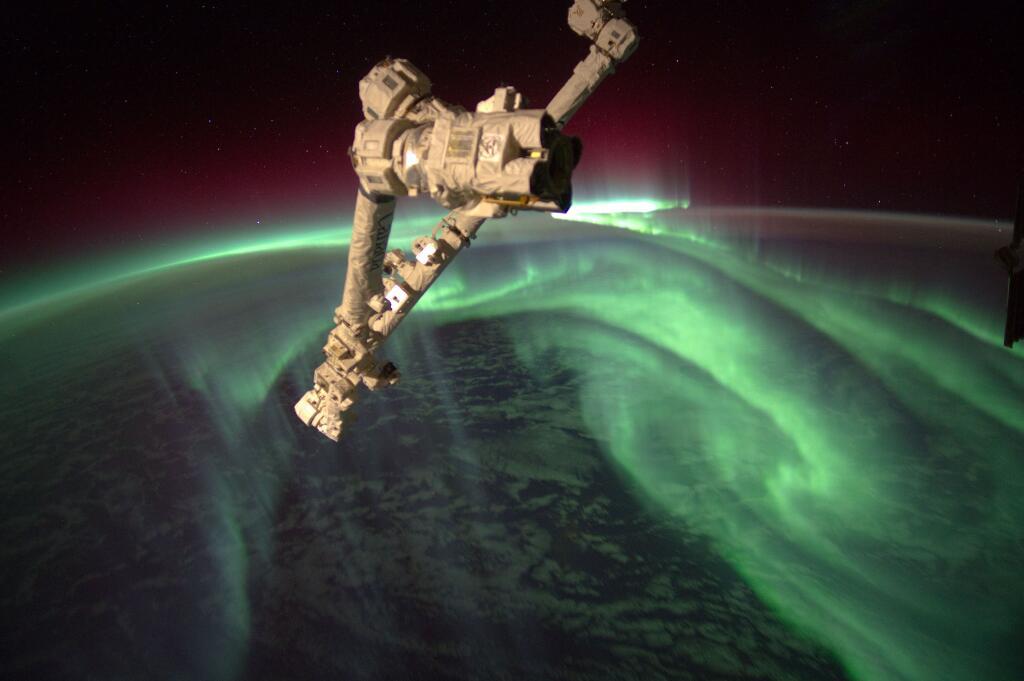
An aurora, as seen from the International Space Station, glows in green and red waves over the polar regions of Earth. These lights are the result of interactions between the solar wind–a stream of hot, rarefied plasma from the sun–and our planet’s magnetic field. A bow shock forms where they meet, about 12,000-15,000 km from Earth. The planet’s magnetic field deflects much of the solar wind, but some plasma gets drawn in along field lines near the poles. When these energetic particles interact with nitrogen and oxygen atoms in the upper atmosphere, it can excite the atoms and generate photon emissions, creating the distinctive glow. Similar auroras have been observed on several other planets and moons in our solar system. (Photo credit: NASA)

Solar Wind
Fluid dynamics appear at all kinds of scales. The animation above shows two comets, Encke and ISON, on their recent approach toward the sun. The darker wisps emanating from the right side of the image are part of the solar wind, a plasma stream continuously emitted by the sun’s upper atmosphere. Although the solar wind is very rarefied by terrestrial standards, its density is sufficient to whip the comets’ tails of gas and dust from side-to-side. Scientists use images like these to learn more about the structure of the solar wind based on its interaction with the comets. For more great images of ISON’s journey around the sun, check out NASA Goddard. (Image credit: K. Battams/NASA/STEREO/CIOC; submitted by John C)

Fluids Round-up – 16 November 2013
Time for another fluids round-up. Here are your links:
- PhysicsBuzz takes a look at the use of plasma actuators to control airflow.
- Over at Deep Sea News, you can learn about parasitic capillary waves.
- NanoWerk reports on self-steering particles in microfluidic devices.
- The 9th drop of the Queensland pitch drop experiment–believed to be the longest continuously running experiment in the world–is expected to fall at any time. Want to be part of the historic moment? Check out their Ninth Watch website.
- Aatish Bhatia examines the concepts behind the Fourier transform, an important mathematical technique used throughout fluid dynamics and physics. (via io9)
- Fluid dynamics and adaptive control might help alleviate traffic jams. (via @AIP_Publishing)
- On the whimsical side, take a look at these beautiful flying model boats built by Luigi Prina. (submitted by jshoer)
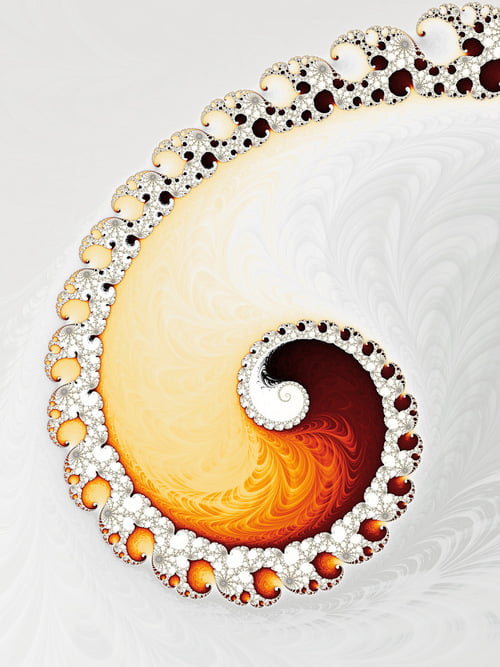
- Finally, our lead image was created with the app Frax, which allows users to make their own fractal-based art. Fluid dynamics has a lot of fractal behaviors. iOS users who want to play with fractals should check it out.
(Image credit: Ath3na)
Convection on the Sun

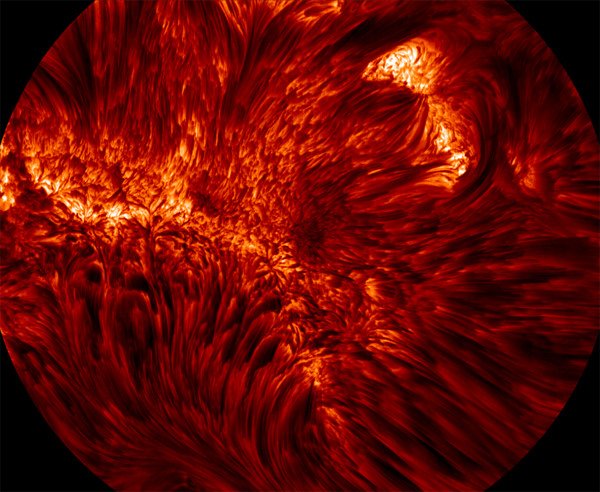
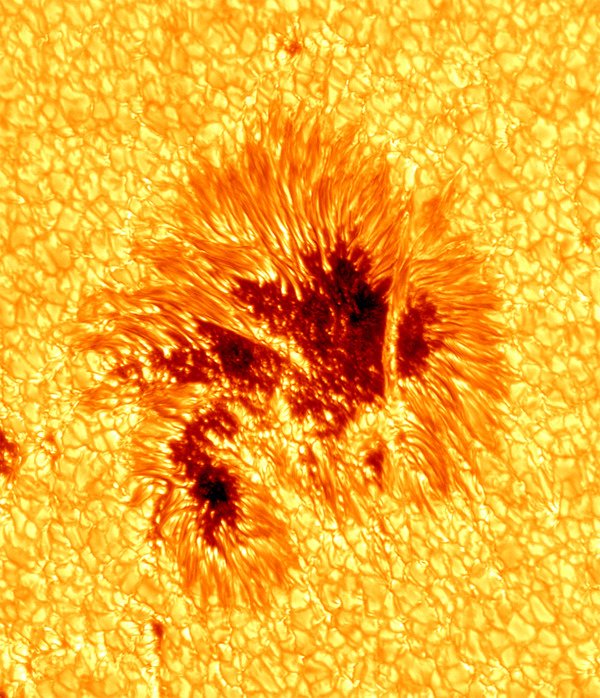
New photographs showing ultra-fine structure in the sun’s chromosphere and photosphere have been released. They offer a fascinating view into the magnetohydrodynamics of the sun, where the fluid behaviors of plasma are constantly modified by the sun’s magnetic field. The left image shows fine-scale magnetic loops rooted in the photosphere, while the right image shows our clearest photo yet of a sunspot. The dark central portion is the umbra, where magnetic field lines are almost vertical; it’s surrounded by the penumbra, where field lines are more inclined. Further out, we see the regular convective cell structure of the sun. (Photo credit: Big Bear Solar Observatory/NJIT; via io9 and cnet)

Turbulence and Magnetic Field Lines
During a solar flare, magnetic field lines on the sun are often visible due to the flow of plasma–charged particles–along the lines. According to theory, these magnetic lines should remain intact, but they are sometimes observed breaking and reconnecting with other lines. An interdisciplinary team of researchers suggests that turbulence may be the missing link. In their magnetohydrodynamic simulation, they found that the presence of chaotic turbulent motions made the magnetic line motion entirely unpredictable, whereas laminar flows behaved according to conventional flux-freezing theory. (Photo credit: NASA SDO; Research credit: G. Eyink et al.; via SpaceRef; submitted by jshoer)

Plasma Jets
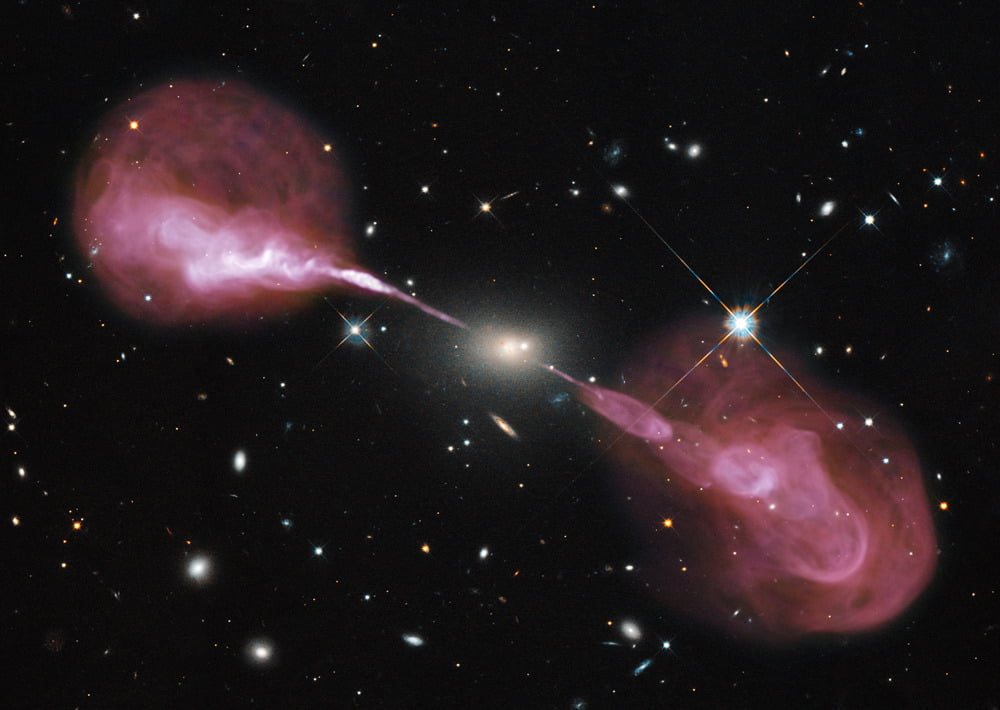
Jets of high-energy plasma and sub-atomic particles explode outward from the Hercules A elliptical galaxy at the center of this photo. The jets are driven to speeds close to that of light due to the gravitation of the supermassive black hole at the center of the elliptical galaxy. Relativistic effects mask the innermost portions of the jets from our view, but, as the jets slow, they become unstable, billowing out into rings and wisps whose turbulent shapes suggest multiple outbursts originating from Hercules A. (Photo credit:NASA, ESA, S. Baum and C. O’Dea (RIT), R. Perley and W. Cotton (NRAO/AUI/NSF), and the Hubble HeritageTeam (STScI/AURA); via Discovery)