Tag: planetary science

  • Gravity Waves on Mars

    Gravity Waves on Mars

    It may look like grainy, black and white static from a 20th-century television, but this animation shows what may be the first view of gravity waves seen from the ground on another planet. The animation was stitched together from photos taken by the Mars Curiosity rover’s navigation camera, and it shows a line of clouds approaching the rover’s position.

    Gravity waves are common on Earth, appearing where disturbances in a fluid propagate like ripples on a pond. In the atmosphere, this can take the form of stripe-like wave clouds downstream of mountains; internal waves under the ocean are another variety of gravity wave. If these are, in fact, Martian gravity waves, they are likely the result of wind moving up and over topography, much like their Terran counterparts. (Image credit: NASA/JPL-Caltech/York University; research credit: J. Kloos and J. Moores, pdf; via Science; h/t Cocktail Party Physics)

  • Ice Bridges

    Ice Bridges

    During winter, Canada’s Arctic Archipelago, home of the Northwest Passage, generally fills with sea ice. These ice bridges form in the long and narrow straits between islands. A new paper models ice bridge formation and break-up, showing that ice bridges can only form when ice floating in the strait is sufficiently thick and compact. To form a bridge, wind must first push the ice together and then frictional forces between individual pieces of ice must be large enough to resist wind or water driving them apart. As temperatures drop, the individual ice chunks can then freeze together into solid sheets until summer returns.

    The existence of a critical thickness and density of the ice field for ice bridge formation has important implications for climate change. As Arctic temperatures warm for longer periods, these waters may no longer generate ice of sufficient thickness and quantity for ice bridges to form. Since ice bridges serve as important oases for marine mammals and sea birds and help isolate Arctic sea ice from warmer waters, their loss will have a profound impact on both Arctic ecology and global climate. (Image credit: NASA Earth Observatory; research credit: B. Rallabandi et al.; via Physics Buzz)

  • Boulder Sorting on Asteroid Itokawa

    Boulder Sorting on Asteroid Itokawa

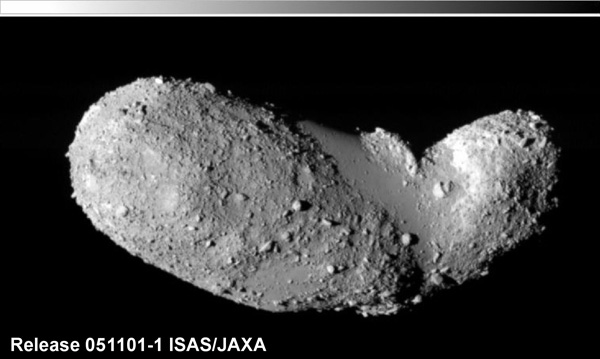
    Itokawa is a small asteroid visited by the Japanese Hayabusa probe in 2005. Photographs of the asteroid revealed a surface covered in large boulders at high elevations and small pebbles in the valleys. The Brazil nut effect is often invoked to explain size separation in particle mixtures, but Itokawa is so small that any shaking sufficient to sort particles would likely exceed the asteroid’s meager escape velocity. Instead, researchers have suggested an alternative size sorting mechanism: ballistic sorting.

    The idea of ballistic sorting is that pebbles that strike boulders will impact and bounce a long way, whereas pebbles that strike other pebbles are likely to rebound only a short way. In both experiments and simulations, the researchers found that this was the case and that mixtures of large and small particles tended to separate just as on the asteroid. The effect is possible on Earth as well, but Itokawa’s small gravitational acceleration makes for more effective size sorting. (Image credit: JAXA; research credit: T. Shinbrot et al.)

  • Titan’s Bubbly Islands

    Titan’s Bubbly Islands

    Titan, Saturn’s largest moon, is a fascinating world with remarkable similarities to our own. It is the only other world we know of with stable bodies of liquid at its surface. Unlike Earth, frigid Titan’s lakes and seas are filled with methane and ethane. Radar data from the Cassini mission has shown oddly changing shorelines on Titan, above, with islands that seem to magically appear and disappear over time.

    Researchers at NASA’s Jet Propulsion Laboratory now think these islands may, in fact, be bubbles. As Titan’s lakes cool, they’re better able to absorb nitrogen gas, but when temperatures warm up, that gas comes out of solution and floats to the surface, much like the bubbles of carbon dioxide in a soda. If this hypothesis holds up, there are some interesting implications for Titan’s atmosphere. Here on Earth, bubbles popping in the ocean are a major source of aerosol particles. It’s possible migrating rafts of bubbles could behave similarly on Titan. (Photo credit: NASA/JPL-Caltech/ASI/Cornell; submitted by jpshoer)

    I’m excited to announce I will be visiting JPL later this month (March 30th), where I have the honor of giving a Women’s History Month talk. If there are any JPLers who are FYFD fans, I hope to see you there. Be sure to RSVP to the ACW luncheon by the March 24th deadline.

  • Jupiter’s Little Red Spot

    Jupiter’s Little Red Spot

    The Juno mission has been revealing angles of Jupiter we’ve never seen before. This photo shows Jupiter’s northern temperate latitudes and NN-LRS-1, a.k.a. the Little Red Spot (lower left), the third largest anticyclone on Jupiter. The Little Red Spot is a storm roughly the size of the Earth and was first observed in 1993. As an anticyclone, it has large-scale rotation around a core of high pressure and rotates in a clockwise direction since it is in the northern hemisphere. Jupiter’s anticyclones seem to be powered by merging with other storms; in 1998, the Little Red Spot merged with three other storms that had existed for decades. (Image credit: NASA/JPL-Caltech/SwRI/MSSS/Gerald Eichstaedt/John Rogers; via Bad Astronomy)

  • Jovian Poles

    Jovian Poles

    NASA’s Juno mission has been revealing a side of Jupiter we’ve never seen before. We all recognize the familiar stripes of the planet’s cloud bands, but its poles are entirely different. Unlike Saturn with its hexagonal polar vortex, Jupiter’s poles are a swirling tapestry of turbulent vortices – full of features that citizen scientists are helping to reveal. All of the images in this post were created by citizen scientists helping to process raw images from Juno, and you can contribute, too! The Juno mission solicits input from the public on where and what should be imaged, in addition to providing raw images individuals can process and repost. Check it out at the JunoCam website and become part of the science! (Image credits: All images – NASA/SwRI/MSSS + R. Tkachenko, Orion76; A. Mai)

  • Jovian Poles

    Jovian Poles

    We’re used to viewing Jupiter from its equator, where bands of light and dark clouds dominate the picture. From its poles, Jupiter looks very different, as these recent images from Juno show. Jupiter’s north pole is shown on the left and its south pole on the right. Both are awash in vortices. There’s another great black-and-white image of the south pole here, where the vortices really stand out. Jupiter’s atmosphere contains both cyclones, which rotate counterclockwise in the northern hemisphere and clockwise in the southern hemisphere, and anticyclones, which behave in the reverse. Unlike in Earth’s atmosphere, anticyclones dominate on Jupiter, especially among storms more than 2000 km across.  (Image credit: NASA/JPL/Juno Mission; via APOD)

    P.S. – Tomorrow night is the Ig Nobel Prize Ceremony, and I’ll be giving one of their 24/7 lectures. If you’d like to tune in and hear me describe fluid dynamics in 24 seconds + 7 words, there will be a webcast here.

  • Where Jupiter’s Heat Comes From

    Where Jupiter’s Heat Comes From

    Exactly what goes on in Jupiter’s atmosphere has confounded scientists for decades. Its upper atmosphere – essentially the only part we can observe – is hundreds of degrees warmer than solar heating can account for. Although it has bright auroras at its poles, that energy is trapped at high altitudes by the same rotational effects that create Jupiter’s stunning bands.

    Observations of Jupiter’s Great Red Spot, a storm that’s lasted for hundreds of years, may provide clues as to where all the extra heat is coming from. Spectral mapping shows that the area over the Spot is over 1000K warmer than the rest of the upper atmosphere. Because of its isolated location, the best explanation for the Great Red Spot’s extra heat comes from below: scientists suspect that the raging storm is generating so much turbulence and such a deafening roar that these gravity and acoustic waves propagate upward and heat the atmosphere above. If so, a similar coupling mechanism to the clouds below may account for the widespread warmth in Jupiter’s upper atmosphere. (Image credit: NASA; research credit: J. O’Donoghue et al.)

  • Arriving at Jupiter

    Arriving at Jupiter

    Today all eyes turn to Jupiter where NASA’s Juno spacecraft will enter orbit around the gas giant. In preparation, Hubble and ground-based telescopes have been observing Jupiter in both the visible (upper right) and infrared (upper left) spectrum. The lower image shows a 1:5 scale model of Juno and a full-size replica of one of its solar panels; note the mannequin in the lower right corner for scale. 

    Juno is entering one of the harshest environments in the solar system with intense magnetic fields that trap lethal amounts of radiation around the planet. The lovely blue auroras Hubble sees around Jupiter’s poles are a never-ending hailstorm of solar wind particles hitting Jupiter’s atmosphere. Juno will be studying the structure of Jupiter’s magnetosphere, gravitational field, and its interior, hopefully helping scientists explain how the planet formed and the role it played in the formation of our solar system. (Image credits: infrared Jupiter – ESO/L. Fletcher; Jovian auroras – Hubble/ESA; Juno model and solar panel – N. Sharp)

  • Boiling on Mars

    Boiling on Mars

    Today’s Mars is cold and dry, with a thin and insubstantial atmosphere. One of the challenges facing planetary scientists is unraveling the processes behind the complex terrain we can observe on the surface. Without flowing water, how do we explain these features? A new experiment suggests that the answer lies in boiling.

    Surface conditions on Mars include atmospheric pressures low enough to be below the triple point of water* – the critical temperature and pressure where water vapor, liquid water, and ice can all exist simultaneously. This means that liquid water is unstable under Martian conditions; any water that seeped up to the surface would immediately begin to boil. That explosive boiling ejects sand particles, as seen in the animation above. The authors suggest that this hybrid process of wet percolation combined with vaporous ejection of sediment may better explain the Martian surface features we observe. (Image credit: M. Masse et al., source: Supplementary Movie 3; via Gizmodo; submitted by Paul vdB)

    * The evidence we’ve seen so far on Mars points to briny water flowing near the surface. Although brines have lower freezing temperatures than pure water, the authors’ argument holds for them, as well. The boiling is simply not as vigorous.