Tag: physics

  • Aligning by Bubble Array

    Aligning by Bubble Array

    Assembling structures from small components is often difficult. Techniques like optical tweezers are limited to very small objects, and magnetic techniques only work with certain materials. Here, researchers use acoustical forces on bubbles to move and align centimeter-sized objects.

    When a single bubble oscillates in an ultrasonic field, its changing size creates pressure variations around it. When an acoustic wave scatters off one bubble and impacts another, it sets up a small attractive force between the bubbles, known as the secondary Bjerknes force. For individual bubble pairs, this force is extremely small and unable to affect much. But using arrays of bubbles — one array on a fixed object and another on a floating object — researchers amplified the attraction and showed that the resulting forces could manipulate and align their components. (Image credit: top – J. Thomas, others – R. Goyal et al.; research credit: R. Goyal et al.; via APS Physics)

  • Featured Video Play Icon

    Perturbations

    At first glance, today’s video appears to have little to do with fluid dynamics since it’s a demonstration of interactions between magnets. But for those who’ve delved into the mathematics of fluid dynamics — especially subjects like perturbation theory — there’s a lot to appreciate here. In the video, we see systems of magnets constructed and then manipulated, often by moving a single magnet and watching how the rest respond. Visually, this demonstrates how disturbances move in complex, interconnected damped systems. The auditory component — definitely turn the sound on for this video — is an extra layer of fluids-related goodness that also shows how reconfiguring a system changes its resonant frequencies. (Image and video credit: Magnetic Tricks and Magnetic Games; via Colossal)

  • Liquid Sculptures

    Liquid Sculptures

    Snapshots of splashes are nothing new, but few have mastered the art of freezing incredible shapes in water the way Markus Reugels has. His splash photography is mind-boggling, especially knowing that he uses Photoshop only for minor corrections like contrast and removing sensor noise. Fortunately, he’s generous in sharing his expertise. Check out lots more incredible photos and plenty of how-to guides (mostly in German) over at his site. (Image credits: M. Reugels)

  • Microscale Kelvin-Helmholtz

    Microscale Kelvin-Helmholtz

    When we think of cavitation in a flow, we often think of it occurring at a relatively large scale — on the propeller of a boat, for example. But cavitation takes place on microscales, too, including around fuel-injection nozzles. In this study, researchers investigated submillimeter-scale cavitation using a flow through a tiny Venturi tube. What they found was something we usually associate with larger scale flows: the Kelvin-Helmholtz instability.

    The Kelvin-Helmholtz instability takes place on this cavitation bubble.

    The wavy shape of a Kelvin-Helmholtz instability forms when two layers of fluid move past one another at different speeds and the interface where they meet becomes unstable. Here, that happens along a cavitation bubble, where the bubble and the flow meet. Interestingly, at these scales, the Kelvin-Helmholtz instability seems to be the primary method of break-up, instead of shock wave interactions.

    For those keeping track, we’ve now seen the Kelvin-Helmholtz instability from the quantum scale up to 160 thousand light-years. It’s hard to achieve a much wider range than that! (Image and research credit: D. Podbevšek et al.; submitted by M. Dular)

  • Florida’s Keys

    Florida’s Keys

    Stretching from the southern tip of Florida, a chain of low-lying islands, known as keys or cays, formed underwater during a warm interglacial period some 125,000 years ago. Originally coral reefs and sand bars, the islands hardened and fossilized when sea levels dropped during an ice age. These natural-color satellite images hint at the keys’ impressive ecosystems. The bright blue streak is a giant coral reef separating the deeper waters of the Atlantic from the shallow waters and sea-grass beds lying between the islands. Formations like these, along with mangrove forests, are part of nature’s way to mitigate the damage and flooding caused by hurricanes. Unfortunately, warmer seas and rising sea levels now threaten the keys. (Image credit: L. Dauphin/USGS; via NASA Earth Observatory)

  • Encapsulating Drops

    Encapsulating Drops

    Sometimes a droplet needs a little protection while it’s traveling to its destination. When that’s the case, we often try to encapsulate it in a layer of material that won’t be affected by whatever environment the drop is traveling through. In this study, researchers aimed to give their drops not one but two layers of protection — in as simple a way as possible.

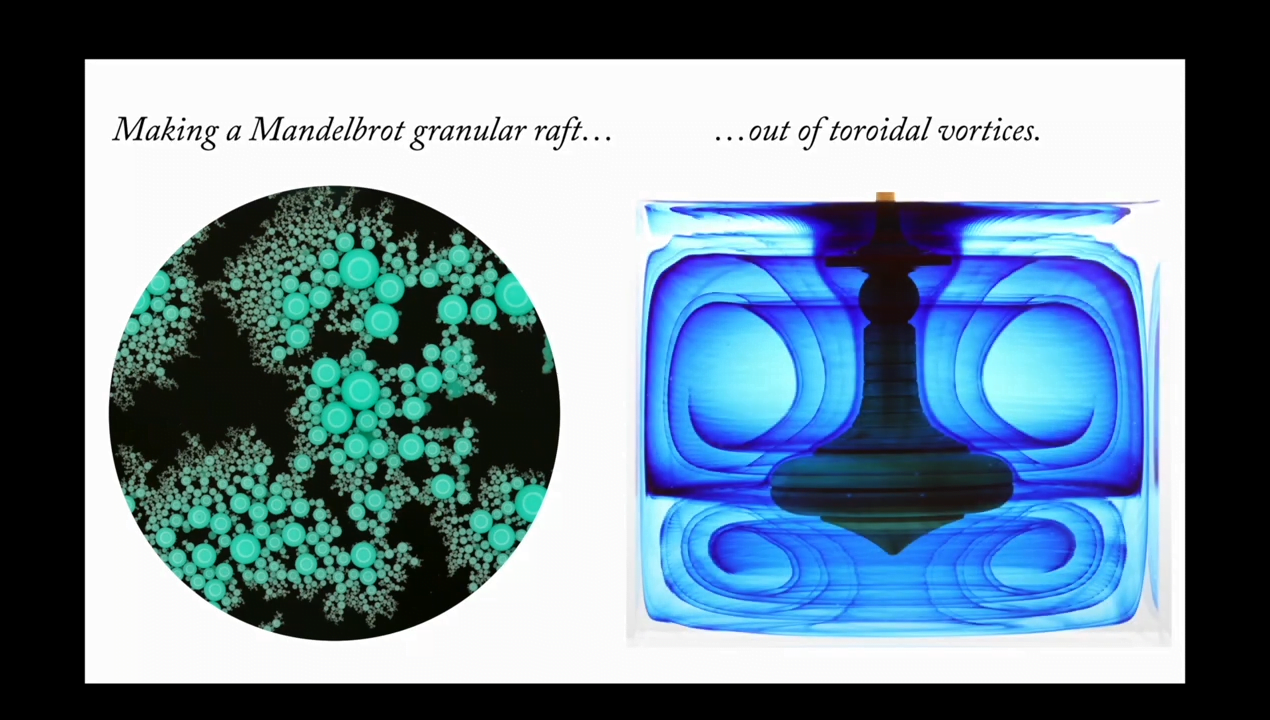
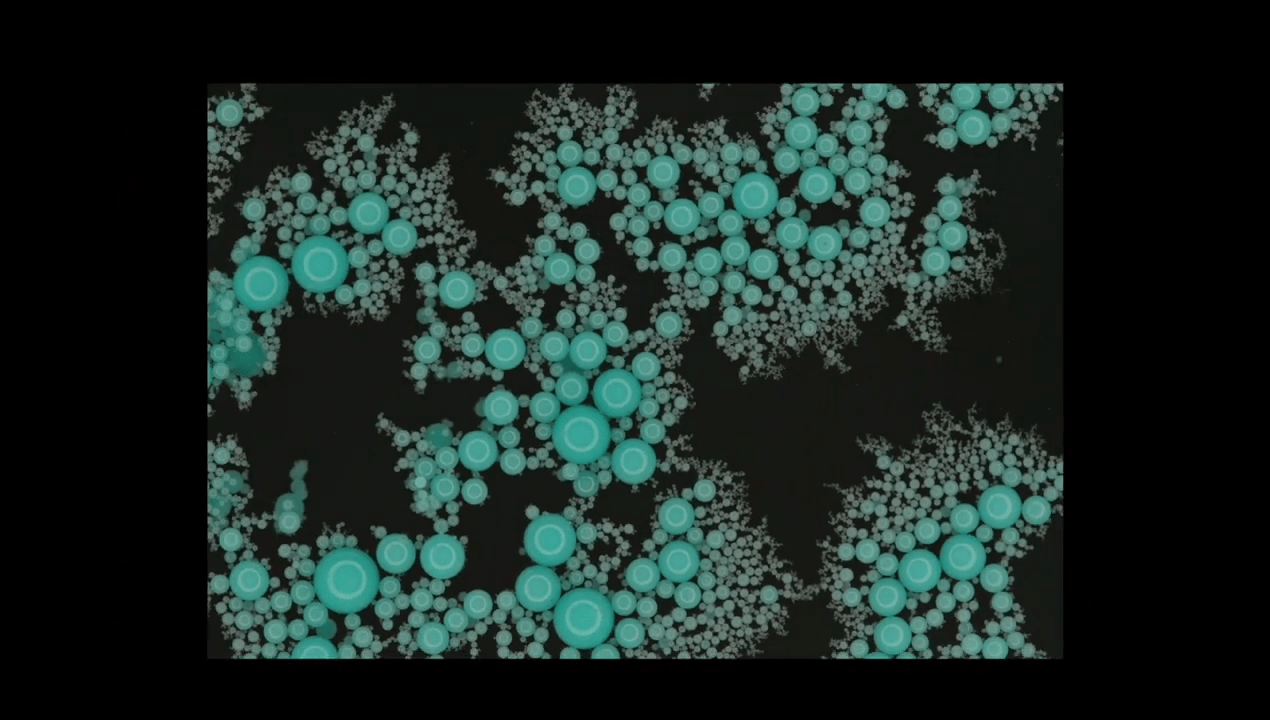
    The team began with three layers of liquid. The lowest layer was water, the middle layer was an oil, and the top layer was a mixture of water and isopropyl alcohol. Next, they added glass particles that were denser than the alcohol, but less dense than the oil. This caused the particles to form a clump — a granular raft — along the interface between the alcohol and the oil (not shown). When the layer of particles became heavy enough, it began to sink into the oil, carrying some of the alcohol with them. This conglomeration formed the initial droplet of alcohol mixture encased in an armor of glass beads.

    As this armored droplet sank, it approached the second interface: the oil-water interface. At this juncture, the team observed three different outcomes. When the glass particles were small or light, the armored drop would come to a rest at the oil-water interface. As the drop deformed, water would pierce the armor, causing the whole drop to rupture (Image 1).

    In the second case, heavier particles caused the armored drop to sink through the oil-water interface, but a low oil viscosity meant that the oil film drained from the bottom of the drop before the drop was fully encapsulated. Once again, this let the water through and ruptured the droplet (Image 2).

    In the final case, armored drops with just the right bead density and oil viscosity would sink through the oil-water interface until the oil pinched off behind the drop. This pinch-off allowed the oil to redistribute around the drop, encapsulating it in layers of both oil and particles, thereby protecting it as it continued its journey (Image 3). (Image credits: top – Girl with red hat, experiment – A. Hooshanginejad et al.; research credit: A. Hooshanginejad et al.)

  • Featured Video Play Icon

    When Reservoirs Run Dry

    With the ongoing megadrought in the U.S. Southwest, more and more reservoirs are reaching historic low water levels. So it’s worth asking: what happens when a reservoir runs dry? And what, exactly, does a reservoir do in the first place? In this Practical Engineering video, Grady tackles both questions and takes a look at the many disciplines — beyond just civil engineering — that go into making a functional reservoir. (Image and video credit: Practical Engineering)

  • Featured Video Play Icon

    “Art of Paint”

    Filmmaker Roman De Giuli is always coming up with spectacular and visually fascinating new ways to manipulate ink and other liquids. In “Art of Paint,” he applies thin layers atop a custom plate that can be tilted in any direction. The results sometimes resemble acrylic paint pours, sometimes Marangoni flows, and sometimes look more like salt fingers or Rayleigh-Taylor instabilities. The extreme variety of forms is quite unique among these sorts of films and is well worth taking the time to view in fullscreen. (Image and video credit: R. De Giuli)

  • Slow to Relax

    Slow to Relax

    Oobleck is a decidedly weird substance. Made from a dense suspension of cornstarch in water, oobleck is known for its mix of liquid-like and solid-like properties, depending on the force that’s applied. In a recent study, researchers took a look at what happens when you really push oobleck to the extreme. When the force applied to oobleck is small or slowly added, the water between cornstarch particles helps keep the particles apart and free of contact. It’s when the force is large that those particles start jamming up against each other and having friction between them, and then the oobleck suddenly acts like a solid. But what happens once that force is removed?

    When the force is gone, we expect the particles to repel and for water to squeeze back into the spaces between them, breaking up the friction and allowing the oobleck to relax back to a liquid-like form. But the team found that sometimes the oobleck doesn’t relax as easily as expected; instead, it seems to retain some memory of its solid-like state, due to persisting friction between particles. (Image credit: T. Cox; research credit: J. Cho et al.)

  • Featured Video Play Icon

    The Tea Leaves Effect

    If you’ve ever stirred a cup of tea with loose leaves in it, you’ve probably noticed that the leaves tend to swirl into the center of the cup in a kind of inverted whirlpool. At first, this behavior can seem counter-intuitive; after all, a spinning centrifuge causes denser components to fly to the outside. In this video, Steve Mould steps through this phenomenon and how the balance of pressures, velocities, densities, and viscosity cause the effect. (Note that Mould uses the term “drag,” but what he’s really referring to is the boundary layer across the bottom of the container. But who wants to explain a boundary layer in a video when they can avoid it?) (Video and image credit: S. Mould)

    When liquid in a cup is stirred, the densest layers move to the center.