Tag: physics

  • Packing Disks

    Packing Disks

    Liquid crystals, bottles of pills, and hoppers of grains can all involve disk-shaped particles. To better understand how disks pack together, researchers studied how disks in a box orient themselves after shaking. They used MRI to observe the disks’ interior packing.

    These reconstructions show the packing found in the experiment. The disks are color-coded by orientation; more horizontal disks are redder and vertical ones are bluer. Initially, the packing has many horizontal disks (left), but after shaking, the disks get more compacted (right). The disks form short stacks that are randomly oriented. This increases the overall density but the random orientations reduce the total alignment.
    These reconstructions show the packing found in the experiment. The disks are color-coded by orientation; horizontal disks are redder and vertical ones are bluer. Initially, the packing has many horizontal disks (left), but after shaking, the disks get more compacted (right). The disks form short stacks that are randomly oriented. This increases the overall density but the random orientations reduce the total alignment of disks.

    The team found that shaking increases the disks’ density, but that increase does not come from disks orienting in the same direction. Instead, the disks form short stacks of similarly-oriented disks. The stacks themselves took on many different orientations, which reduced the system’s overall alignment in orientation. (Image credit: coins – M. Blan, packing – Y. Ding et al.; research credit: Y. Ding et al.; via APS Physics)

  • Star YY Hya

    Star YY Hya

    A team of professional and amateur astronomers discovered and then imaged this previously undiscovered galactic nebula. At the heart of the stellar remnant is a binary star pair. Shock waves of the gas and dust twist and spread in the surrounding space, the remains of an earlier star’s violent eruption. (Image credit: M. Drechsler et al.; via 2023 Astronomy POTY)

  • Vivid Auroras Over Iceland

    Vivid Auroras Over Iceland

    When solar storms in late February sent energetic particles toward Earth, photographer Cari Letelier ventured to the remote northern edge of Iceland to capture the resulting auroras. When fast-moving, high-energy particles from the solar wind meet Earth’s magnetosphere, they’re directed toward the poles. There the particles slam into Earth’s upper atmosphere, exciting atoms that glow in greens, reds, and pinks. Curtains of light dance across the sky as a result. February’s show was particularly stunning, as captured by Letelier at Arctic Henge. (Image credit: C. Letelier; via Colossal)

  • Forests Slow Avalanches

    Forests Slow Avalanches

    In snowy mountainous regions, avalanches are a dangerous and destructive problem. Researchers studying the mechanisms of these flows have a suggestion: plant more trees. A group of researchers found that a “forest” of regularly spaced pillars slowed avalanches by as much as two-thirds. On an empty slope, the avalanche picked up speed as its thickness grew. But with regularly-spaced pillars the slower flow rate became almost completely independent of avalanche thickness.

    The researchers with their avalanche set-up, which releases glass beads through a forest of pillars.
    The researchers with their avalanche set-up, which releases glass beads through a forest of pillars.

    For now, the researchers suggest placing trees every 3 meters on steep, avalanche-prone slopes — a technique that, admittedly, only works for slopes below the treeline. In their next round of experiments, the researchers plan to see how a randomly arranged forest affects an avalanche. (Image credit: top – N. Cool, apparatus – Université Paris-Saclay/FAST; research credit: B. Texier et al.; via Physics World)

  • Capturing the Tides

    Capturing the Tides

    Twice a day the tides rise and fall along coastlines. Increasingly, engineers are trying to harness these regular currents for clean energy. Tidal turbines spin during the fastest flows, turning a rotor that powers an electrical generator. Compared to wind and solar energy, tidal energy is expensive, but it’s also predictable — a feature wind and solar lack.

    Previous investments in clean energy have reduced costs as technologies mature, and proponents expect this will hold true for tidal turbines, as well. The machines face difficult conditions: salt and water are notoriously tough on equipment. Right now that makes large-scale facilities impractical. Instead, most projects are on a smaller scale, often focusing on powering remote rural coastal communities that currently rely on diesel for their electricity. These projects provide immediate benefits to the community while serving as a proving ground for the technology as a whole. For more, see this Physics Today article. (Image credit: Nova Innovation; see also Physics Today)

  • Scooting Droplets

    Scooting Droplets

    As a child, I always loved watching rain on the windows as I rode in the car. Hemispherical droplets got stretched by the wind flowing over them. But they never stretched smoothly; instead they seemed to shiver and shake unevenly. A recent study looks at a similar situation: drops of glycerin forced to slide along a horizontal surface under the force of the wind. Like the drops on my parents’ car, the glycerin gets stretched out into an elongated oval. Surface waves develop atop the drop and move downstream. The drops, the authors observe, move a bit like a crawling caterpillar, pilling up and smoothing out as they move. (Image credit: rain – A. Alves, experiment – A. Chahine et al.; research credit: A. Chahine et al.; via APS Physics)

    This series of images shows an elongated droplet subjected to airflow moving from left to right. Waves form on the drop and move downstream in a fashion similar to a caterpillar crawling.
    This series of images shows an elongated droplet subjected to airflow moving from left to right. Waves form on the drop and move downstream in a fashion similar to a caterpillar crawling.
  • Field of Dunes

    Field of Dunes

    Barchan dunes collide in this astronaut image of Brazil’s southern coastline. Barchan (pronounced “bar-kahn”) dunes are crescent-shaped; their tips point downwind into their direction of travel. When many barchan dunes overlap, they coalesce into a dune field like the one seen here. A dune’s speed depends on many factors, including the wind speed, dune size, and its proximity to other dunes. In experiments, dunes have even chased one another and changed speeds to avoid collision. (Image credit: NASA; via NASA Earth Observatory)

  • Featured Video Play Icon

    “Aquakosmos”

    Colorful chandeliers, passing spirits, sprouting mushrooms, and fountains of falling ink appear in Christopher Dormoy’s “Aquakosmos.” Driven by the slight density difference between ink and water, many of these elaborate shapes result from the Rayleigh-Taylor instability. Anytime you see mushroom-like plumes and chandelier-like splitting vortex rings, there’s probably a Rayleigh-Taylor instability behind it. Check out the full video above, and, if you want to give this kind of flow visualization a try yourself, a glass of water and vial of food coloring is a great place to start. (Video and image credit: C. Dormoy)

  • Stopping a Bottle’s Bounce

    Stopping a Bottle’s Bounce

    A few years ago, the Internet was abuzz with water bottle flips. Experimentalists are still looking at how they can arrest a partially fluid-filled container’s bounce, but now they’re rotating the bottles vertically rather than flipping them end-over-end. Their work shows that faster rotating bottles have little to no bounce after impacting a surface.

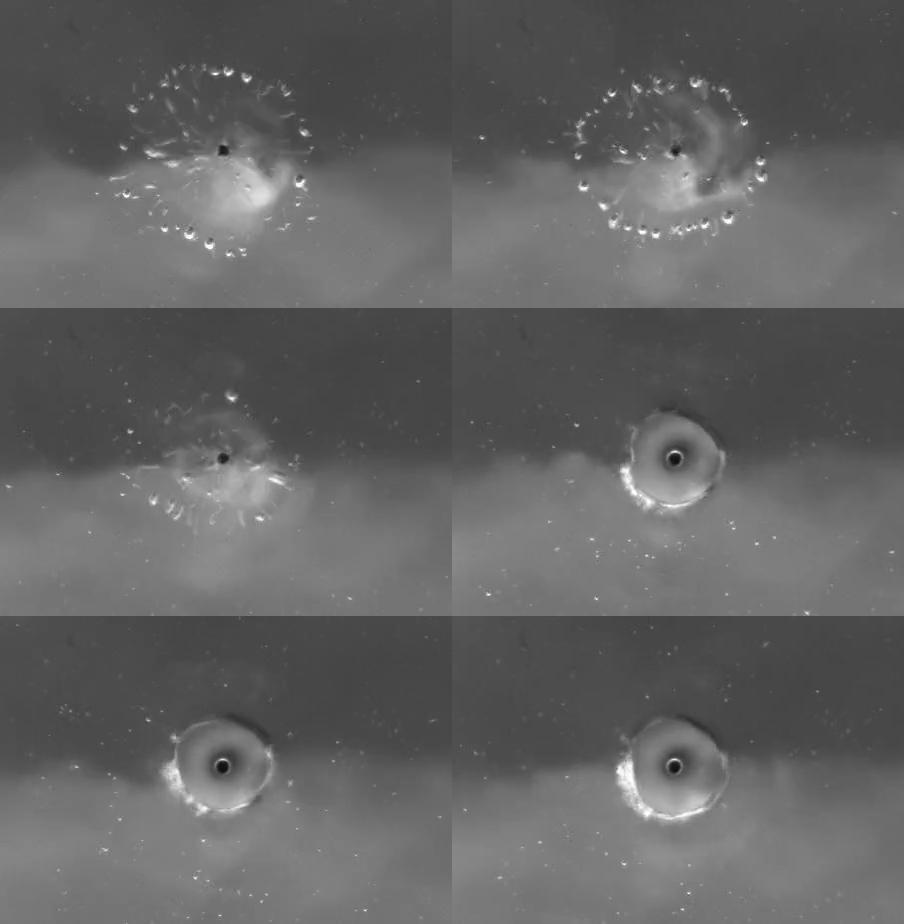
    This image sequence shows how water in a rotating bottle moves during its fall (top row) and after impact (bottom row). Water climbs the walls during the fall, creating a shell of fluid that, after impact, forms a central jet that arrests the bottle's momentum.
    This image sequence shows how water in a rotating bottle moves during its fall (top row) and after impact (bottom row). Water climbs the walls during the fall, creating a shell of fluid that, after impact, forms a central jet that arrests the bottle’s momentum.

    The reason for this is visible in the image sequence above, which shows a falling bottle (top row) and the aftermath of its impact (bottom row). When the bottle rotates and falls, water climbs up the sides of the bottle, forming a shell. On impact, the water collapses, forming a central jet that shoots up the middle of the bottle, expending momentum that would otherwise go into a bounce. It’s a bit like the water is stomping the landing.

    The authors hope their observations will be useful in fluid transport, but they also note that this bit of physics is easily recreated at home with a partially-filled water bottle. (Image and research credit: K. Andrade et al.; via APS Physics)

  • Featured Video Play Icon

    Mitigating Urban Floods

    For densely-populated urban areas, floods are one of the most damaging and expensive natural disasters. We can’t control the amount of rain that falls, so engineers need other ways to mitigate damage. It’s not usually possible to remove people and property from floodplains, so instead civil engineers look below the surface, building flood tunnel networks to alleviate floodwaters. In this Practical Engineering video, Grady demonstrates how these systems work and what some of their challenges are. (Video and image credit: Practical Engineering)