Tag: physics

  • Predicting Droplet Sizes

    Predicting Droplet Sizes

    Squeeze a bottle of cleaning spray, and the nozzle transforms a liquid jet into a spray of droplets. These droplets come in many sizes, and predicting them is difficult because the droplets’ size distribution depends on the details of how their parent liquid broke up. Shown above is a simplified experimental version of this, beginning with a jet of air striking a spherical water droplet on the far left. In less than 3 milliseconds, the droplet has flattened into a pancake shape. In another 4 milliseconds, the pancake has ballooned into a shape called a bag, made up of a thin, curved water sheet surrounded by a thicker rim. A mere 10 milliseconds after the jet and drop first meet, the liquid is now a spray of smaller droplets.

    Researchers have found that the sizes of these final droplets depend on the balance between the airflow and the drop’s surface tension; these two factors determine how the drop breaks up, whether that’s rim first, bag first, or due to a collision between the bag and rim. (Image credit: I. Jackiw et al.; via APS Physics)

  • Reinterpreting Uranus’s Magnetosphere

    Reinterpreting Uranus’s Magnetosphere

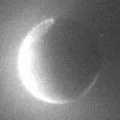
    NASA launched the Voyager 2 probe nearly 50 years ago, and, to date, it’s the only spacecraft to visit icy Uranus. This ice giant is one of our oddest planets — its axis is tilted so that it rotates on its side! — but a new interpretation of Voyager 2’s data suggests it’s not quite as strange as we’ve thought. Initially, Voyager 2’s data on Uranus’s magnetosphere suggested it was a very extreme place. Unlike other planets, it had energetic energy belts but no plasma. Now researchers have explained Voyager 2’s observations differently: they think the spacecraft arrived just after an intense solar wind event compressed Uranus’s magnetosphere, warping it to an extreme state. Their estimates suggest that Uranus would experience this magnetosphere state less than 5% of the time. But since Voyager 2’s data point is, so far, our only look at the planet, we just assumed this extreme was normal. (Image credit: NASA; research credit: J. Jasinski et al.; via Gizmodo)

  • Growing Downstream

    Growing Downstream

    This astronaut photo shows Madagascar’s largest estuary, as of 2024. On the right side, the Betsiboka River flows northwest (right to left, in the image). Less than 100 years ago, most of the estuary was navigable by ships, but now more than half of it is taken up by the river delta. Upstream on the river, extensive logging and expansions to farmland have caused severe soil erosion; the river carries that sediment downstream, dyeing the waters reddish-orange. As the river branches and the flow slows, that sediment falls out of suspension, building up islands and seeding new sand bars further downstream.

    A difference of 40 years. A 2024 astronaut photo of the Betsiboka River delta compared with one from 1984 (inset). Several islands are labeled in both images. Notice how new islands have formed upstream of the ones seen in 1984.
    A difference of 40 years. A 2024 astronaut photo of the Betsiboka River delta compared with one from 1984 (inset). Several islands are labeled in both images. Notice how new islands have formed upstream of the ones seen in 1984.

    In the image above, you can compare the 2024 delta to the way it looked in 1984. Letters A, B, C, and D mark the downstream-most islands from 1984. Today newer islands and sand bars sit even further downstream. (Image credit: NASA; via NASA Earth Observatory)

  • “Surfing on the Other Side”

    “Surfing on the Other Side”

    Surfers come in many forms — humans, robots, birds, and even honeybees. Most of the time, though, we see surfers above the water. In this award-winning photo, on the other hand, the surfing penguin shoots by beneath the water, riding beneath the wave’s crest. Keeping pace with the breaking wave should be no trouble for a penguin. They waddle awkwardly on land, but they have incredible speed in the water. Years ago, a penguin streaked past me in the water like a rocket to my paper airplane. (Image credit: L. Fitze/BPOTY)

  • A Dandelion-Like Supernova Remnant

    A Dandelion-Like Supernova Remnant

    In 1181 CE, astronomers in China and Japan recorded a new, short-lived star in the constellation Cassiopeia. After burning for nearly six months, this historic supernova disappeared from the naked eye. It was only in 2013 that an amateur astronomer identified a nebula in the vicinity of that supernova, and, in the years since, astronomers have collected evidence that identifies the object, known as Pa 30, as the remnants of that 1181 supernova. Now, astronomers have mapped the supernova remnant, revealing an unusual dandelion-like structure (shown in an artist’s conception above and below). Filaments of sulfur project outward from a dusty central region that houses the remains of the original star. Normally, a supernova destroys its original star, but this was a Type Iax supernova, a “failed” explosion that left behind a hot, inflated star that may eventually cool into a white dwarf star.

    Why the supernova remnant has this strange shape remains unclear. Scientists speculate that shock waves may have helped concentrate sulfur into these clumpy filaments. The material’s velocity suggests a ballistic trajectory (meaning, essentially, that it has neither sped up nor slowed down since the original explosion). Winding the trajectory backwards pegs their origin to 1181, helping confirm that Pa 30 is, indeed, the remains of that 1181 supernova. (Image and video credit: W.M. Keck Observatory/A. Makarenko; research credit: R. Fesen et al.; via Gizmodo)

  • Lines of Ice Eddies

    Lines of Ice Eddies

    In February 2024, the North Atlantic’s sea ice reached its furthest extent of the season, limning the coastline with tens of kilometers of ice. These images — both capturing the Labrador coast on the same day — show the swirling patterns marking the wispy edges of ice field. In this region, the ice is likely following an eddy in the ocean below. Eddies like these can form along the edges where warm and cold currents meet. An ice eddy is particularly special, though, as the water must be warm enough to fragment the sea ice, but not so warm that it melts the smaller ice pieces. (Image credit: top – NASA, lower – M. Garrison; via NASA Earth Observatory)

    This satellite image shows sea ice off the Labrador coast, on the same day in February 2024.
    This satellite image shows sea ice off the Labrador coast, on the same day in February 2024.
  • Featured Video Play Icon

    “There is a crack in everything…”

    When millimeter-sized drops of water infused with nanoparticles dry, they leave behind complex and beautiful residues. As water continues evaporating, the residues warp, bend, and crack. In this video, researchers set their science to the music of Leonard Cohen. The results resemble blooming flowers and flying water fowl. If you’d like to learn more about the science behind the art, check out the two open-access papers linked below. (Video and image credit: P. Lilin and I. Bischofberger; submitted by Irmgard B.; see also P. Lilin and I. Bischofberger and P. Lilin et al.)

  • Featured Video Play Icon

    Running Out of Sand?

    Headlines over the past few years have suggested that the world is running out of sand — specifically, that we’re running out of the angular sand grains preferred for concrete. Grady breaks down this idea in this Practical Engineering video, showing that the issue is more complicated than the shape of a sand grain. Yes, angular sand grains make stronger concrete than rounded ones for the same ingredient ratios. But concrete’s water content is also a major factor for strength, and rounded sand grains need less water to form a spreadable, workable concrete. Using less water also makes for stronger concrete.

    And though we may be short on some types of sand in certain places, sand is a manufacturable substance. We have machines and processes capable of breaking rocks into sand. It’s more a matter of choosing between the economics of mining and manufacturing. (Video and image credit: Practical Engineering)

  • “Alive Painting”

    “Alive Painting”

    Artist Akiko Nakayama’s intuitive grasp of fluid dynamics is so good that she manipulates liquids live to musical accompaniment. Her dendritic paintings — made from a combination of acrylic paint and isopropyl alcohol — inspired scientific research papers. There’s no substitute, I’m sure, for seeing her art live, but you can get a taste of her performances in the video below. Then you can head over to Physics World for more on the artist, her inspirations, and her scientific collaborations. (Image credits: H. Akagi and A. Nakayama; video credit: Eternal Art Space; via Physics World)

  • How Magnetic Fields Shape Core Flows

    How Magnetic Fields Shape Core Flows

    The Earth’s inner core is a hot, solid iron-rich alloy surrounded by a cooler, liquid outer core. The convection and rotation in this outer core creates our magnetic fields, but those magnetic fields can, in turn, affect the liquid metal flowing inside the Earth. Most of our models for these planetary flows are simplified — dropping this feedback where the flow-induced magnetic field affects the flow.

    The simplification used, the Taylor-Proudman theorem, assumes that in a rotating flow, the flow won’t cross certain boundaries. (To see this in action, check out this Taylor column video.) The trouble is, our measurements of the Earth’s actual interior flows don’t obey the theorem. Instead, they show flows crossing that imaginary boundary.

    To explore this problem, researchers built a “Little Earth Experiment” that placed a rotating tank (representing the Earth’s inner and outer core) filled with a transparent, magnetically-active fluid inside a giant magnetic. This setup allowed researchers to demonstrate that, in planetary-like flows, the magnetic field can create flow across the Taylor-Proudman boundary. (Image credit: C. Finley et al.; research credit: A. Pothérat et al.; via APS Physics)