Fragments of sea ice tumble and swirl in this satellite image of Greenland’s east coast. In spring, Arctic sea ice journeys down the Fram Strait between Greenland and Svalbard. Along the way, large ice floes break — and melt — into smaller pieces. Large pieces of sea ice are visible closer to the coastline, but the smaller individual floes get, the wispier they appear in the satellite image. In the haziest portions of the image, the ice may be only meters across. In recent years, less and less Arctic sea ice has survived the journey southward, shifting the temperature and salinity of Arctic contributions to global ocean circulation. (Image credit: W. Liang; via NASA Earth Observatory)
Tag: physics

Blocking Bubbles
Many industrial processes, including those producing aluminum and “green” hydrogen, use electrodes to speed up chemical reactions. Unfortunately, bubbles that form on the electrode reduce its efficiency anywhere from 10 to 25 percent by blocking parts of the electrode. The assumption has been that any area shadowed by bubbles is blocked, but a recent study shows that’s not the case. Instead, it’s only the electrode area in direct contact with the bubble that’s blocked.
To show this, researchers looked at a smooth electrode where bubbles formed randomly (left) and a nanotextured one with many spots where bubbles could form (right). In the animation above, bubble shadows are highlighted with circles. There are clearly more bubbles on the nanotextured electrode, but it actually performs better than the smooth electrode because the bubble contact area is smaller. (Image and research credit: J. Lake et al.; via MIT News)
A Comet’s Two Tails
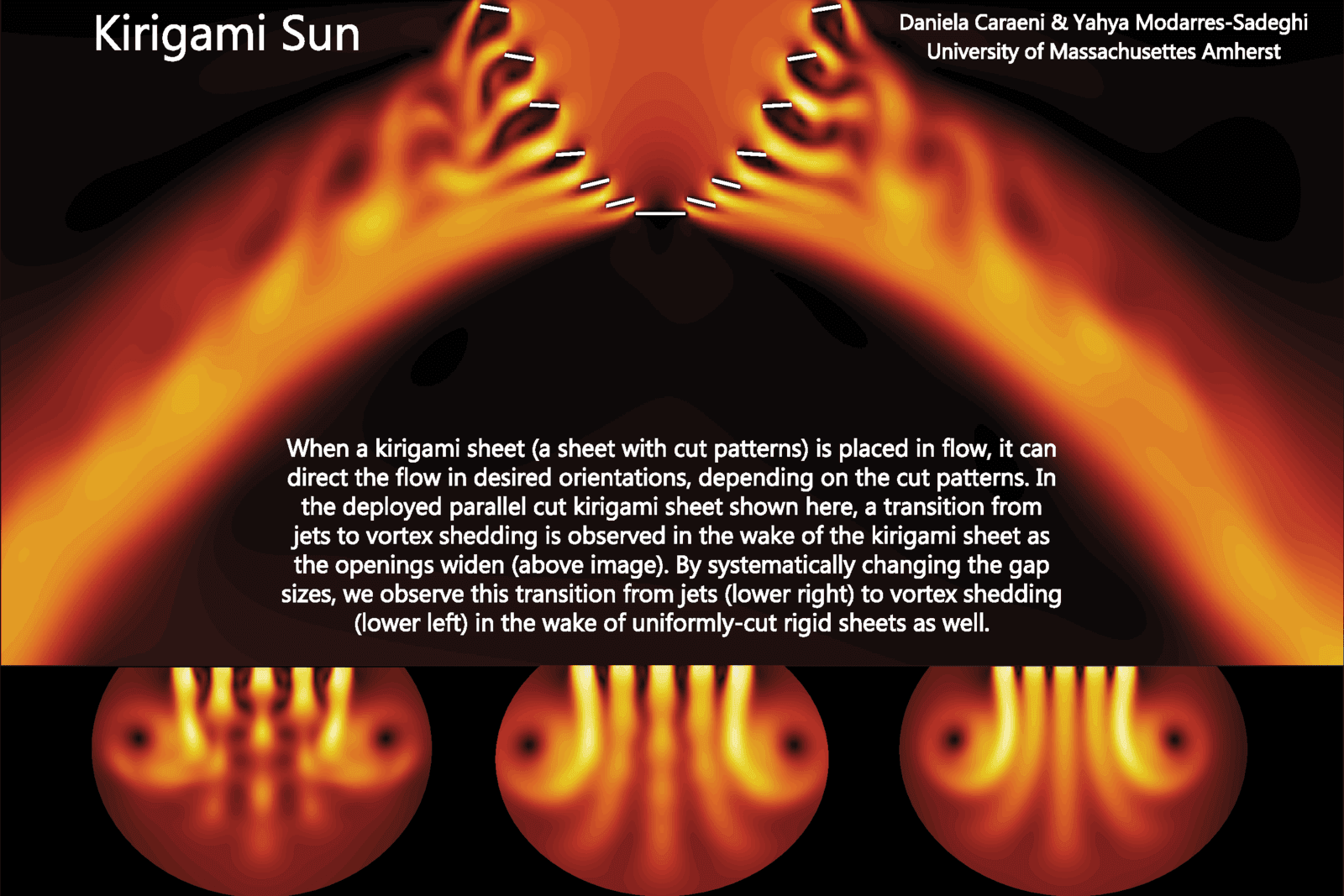
The bright tail of a comet doesn’t actually stream out behind it. Instead, the tail points away from the sun, showing off all the ice, dust, and gas blown off the comet by the solar wind. Because the tail is tied to the sun’s direction and not the comet’s trajectory, comets sometimes have a second tail, called the anti-tail. The anti-tail consists of material that came off the comet previously, so it does mark the comet’s previously traveled path. In this image of Comet Tsuchinshan-ATLAS from October 2024 the dimmer anti-tail points opposite of the brighter tail. That means the comet’s direction of travel is diagonally upward, from right to left. Since that aligns with its bright tail, we can tell that the comet is moving away from the sun in this photo. (Image credit: B. Fulda; via APOD)

Erie Algal Bloom
Blue-green algae bloom in Lake Erie’s summer conditions. Unfortunately for those looking to spend summer on the water, the dominant organism in this bloom produces a toxin that “can cause liver damage, numbness, dizziness, and vomiting.” Bloom season can last from late June into October, depending on the how many nutrients get washed into the lake and when wind mixes the lake water in the fall. A new hyperspectral instrument aboard NASA’s PACE spacecraft will identify bloom species from space, helping scientists track, understand, and predict blooms like these. (Image credit: W. Liang; via NASA Earth Observatory)

Eerie Aurora
This surreal image comes from an aurora on Halloween 2013. Photographer Ole C. Salomonsen captured it in Norway during one of the best auroral displays that year. The shimmering green and purple hues are the glow of oxygen and nitrogen in the upper atmosphere reacting to high-energy particles streaming in from the solar wind. These geomagnetic storms can disrupt GPS satellites, compromise radio communication, and even corrode pipelines, but they also create these stunning nighttime displays. (Image credit: O. Salomonsen; via APOD)

Marangoni Blossoms
When surface tension varies along an interface, fluids move from regions of low surface tension to higher surface tension, a behavior known as the Marangoni effect. Here, a drop of (dyed) water is placed on glycerol. The two fluids are miscible, but water has much a lower viscosity and density yet a higher surface tension. The drop’s interface quickly becomes unstable; viscous fingers form along the edge as the less viscous water pushes into the more viscous glycerol. Eventually, the surface-tension-driven Marangoni flow breaks those fingers off into lip-like daughter drops. The researchers also show how the interplay between viscosity and surface tension affects the size of fingers that form by varying the water/glycerol concentration. (Image and video credit: A. Hooshanginejad et al.)

The Great Red Spot’s Cycle
First spotted by humanity in 1664, Jupiter‘s Great Red Spot is a seemingly endless storm. Strictly speaking, there is debate as to whether observations prior to 1831 were of the same storm, but there’s no denying that the storm has raged unabated since regular observations began in the first half of the nineteenth century. Despite its longevity, the Great Red Spot is not unchanging. Overall, its major axis is shrinking, making the storm more circular over time. The storm also has a 90-day cycle in which its size, shape, and brightness vary, as seen below. Researchers note that the changes are relatively subtle — at least to the eye — but now that they’ve been identified, it may be possible to use amateur astronomers’ data to track these variations more closely. (Image credits: GRS – K. Gill/NASA, snapshots – A. Simon et al.; research credit: A. Simon et al.; via Gizmodo)

Over a 90 day cycle, Jupiter’s Great Red Spot oscillates in size, shape, and other characteristics. 
A Plasma Arc Lights
Plasma lighters — as their name indicates — use plasma in place of burning butane. Plasma — our universe’s most common state of matter — is a gas that’s been stripped of its electrons, ionizing it so that it’s electrically and magnetically active. In these lighters (as well as other plasma generators), a high-voltage current jumps between two nodes to ignite the spark. In effect, it’s a tiny lightning bolt you can hold in your hand. (Though I don’t recommend that you try to literally hold it; plasma burns suck.) (Video and image credit: J. Rosenboom; via Nikon Small World in Motion)

An arc of plasma from a plasma lighter dances. 
“Last Breath of Autumn”
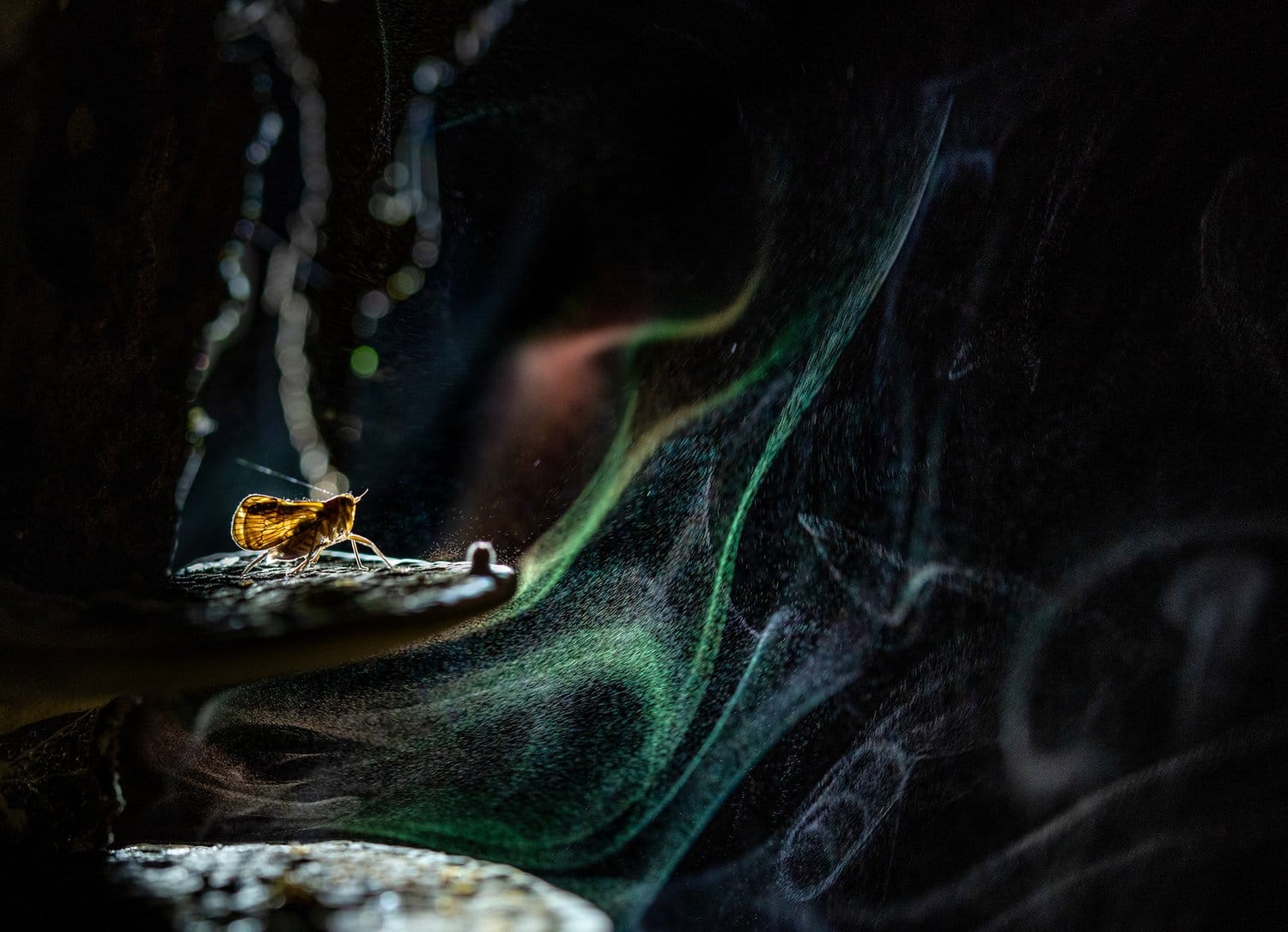
On a rainy autumn day, Agorastos Papatsanis headed to the forest in search of fungi. There he captured this fairytale-like scene with falling rain and drifting spores. Near the forest floor, any breeze is slight, so mushrooms use their own humidity to move air and spread their spores. As water evaporates from the mushroom’s cap, it cools the air nearby, causing it to spread outward. Since that water vapor is lighter than air, it rises, too, carrying the mushroom’s spores along with it. (Image credit: A. Papatsanis; via Wildlife PotY)

Self-Cleaning With Salt Critters
Even freshwater contains trace salts and minerals that cause scaly buildups as they evaporate. Getting rid of the scale usually requires toxic chemicals and/or lots of scrubbing, neither of which are desirable at the industrial level. At the same time, we’re extremely limited in the amount of freshwater that we have available; only about 1% of Earth’s water is liquid and fresh. If we could use salt water in more industrial processes, that would preserve freshwater for drinking and agriculture. But how do we tackle the scaly buildup?

(A) On microtextured surfaces, salt from evaporating drops can work its way into the gaps, destroying the superhydrophobicity of the surface. (B) In contrast, nanotextured surfaces give the salt nowhere to adhere, resulting in “salt critters” that grow upward and detach. Enter “salt critters.” Researchers found that when salt water evaporated from microtextured surfaces designed to shed water, salt would eventually build up in the gaps, breaking the hydrophobic effect and allowing scale to build up. In contrast, a nanotextured surface left nowhere for the salt to adhere. On these surfaces, evaporating salt water built jellyfish-like salt critters that rose from the surface and, eventually, broke off and rolled away, leaving the surface pristine. (Image credit: S. McBride; research credit: S. McBride et al.; via Physics Today)