Tag: physics

  • Rebounding Jets

    Rebounding Jets

    The photo sequence in the upper image shows, left to right, a fluid-filled tube falling under gravity, impacting a rigid surface, and rebounding upward. During free-fall, the fluid wets the sides of the tube, creating a hemispherical meniscus. After impact, the surface curvature reverses dramatically to form an intense jet. If, on the other hand, the tube is treated so that it is hydrophobic, the contact angle between the liquid and the tube will be 90 degrees during free-fall, impact, and rebound, as shown in the lower image sequence. The liquid simply falls and rebounds alongside the tube, without any deformation of the air-liquid interface. (Photo credit: A. Antkowiak et al.)

  • Featured Video Play Icon

    Stingray Wakes

    This numerical simulation shows a swimming stingray and the vorticity generated by its motion. Stingrays are undulatory swimmers, meaning that the wavelength of their motion is much shorter than their body length. Manta rays, in contrast, move their fins through a wavelength longer than their body length, making them oscillatory swimmers. Observe the difference in this video. To swim faster, stingrays increase the frequency of their undulation, not the amplitude. This is quite common among swimmers because increasing the amplitude also increases projected frontal area, which causes additional drag. Increasing the frequency of motion does not affect the projected area, making it the more efficient locomotive choice. (Video credit: G. Weymouth; additional research credit: E. Blevins; submitted by L. Buss)

    Also, FYFD now has a Google+ page for those who prefer to follow along and share that way. – Nicole

  • Ink Diffusion

    Ink Diffusion

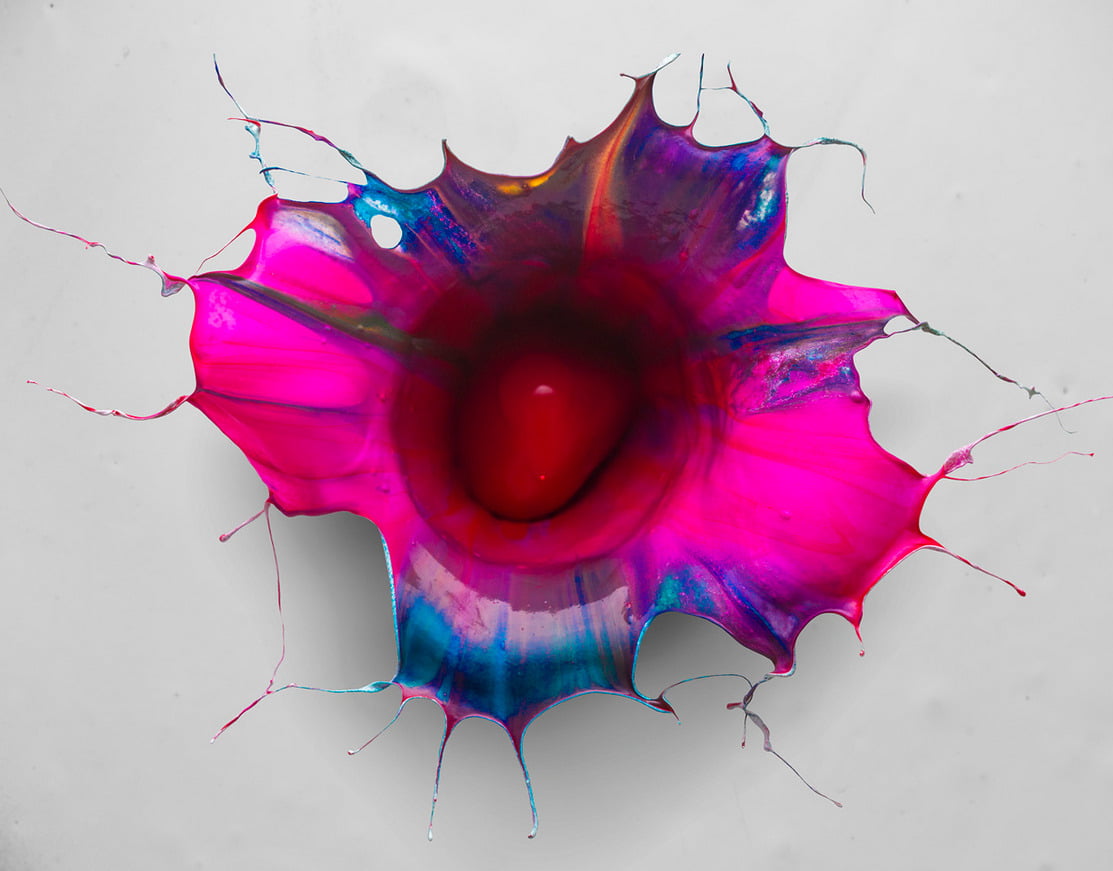
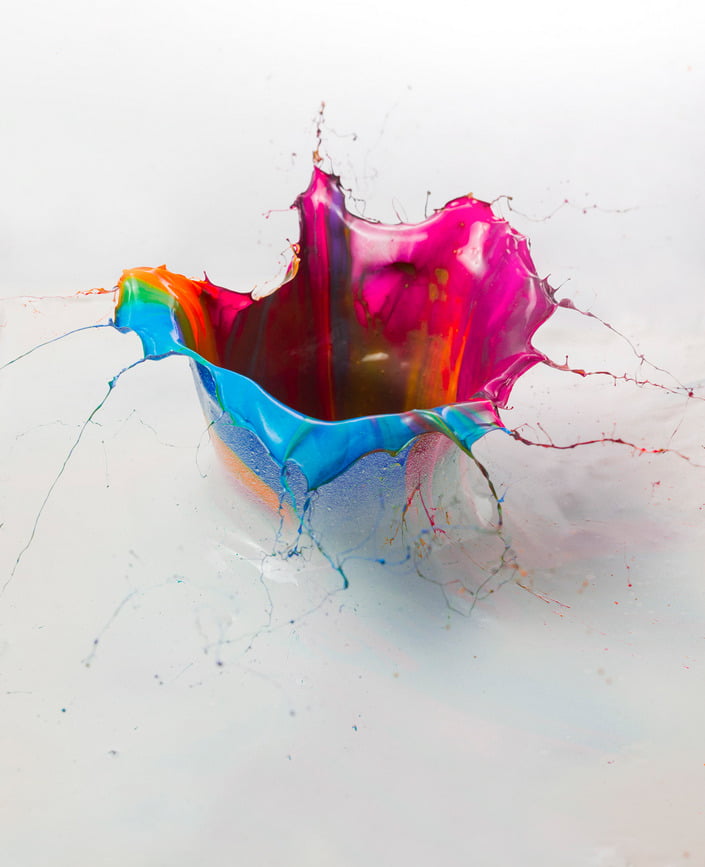
    Alberto Seveso’s gorgeous high-speed photos of ink diffusing in water have a dramatic sense of texture to them. Though still delicate, the whorls of fluid seem almost solid enough to touch. Watch the edges, though, and you can see thin wisps of color and hints of instabilities. Like cream poured into coffee, these ink sculptures are short-lived. Some of his works are available as prints or wallpapers (zip file). (Photo credit: Alberto Seveso)

  • The Real Raindrop

    The Real Raindrop

    What is the shape of a falling raindrop? Surface tension keeps only the smallest drops spherical as they fall; larger drops will tend to flatten. The very largest drops stretch and inflate with air as they fall, as shown in the image above. This shape is known as a bag and consists of a thin shell of water with a thicker rim at the bottom. As the bag grows, its shell thins until it ruptures, just like a soap bubble. The rim left behind destabilizes due to the surface-tension-driven Plateau-Rayleigh instability and eventually breaks up into smaller droplets. This bag instability limits the size of raindrops and breaks large drops into a multitude of smaller ones. The initial size of the drop in the image was 12 mm, falling with a velocity of 7.5 m/s. The interval between each image is 1 ms. (Photo credit: E. Reyssat et al.)

  • Featured Video Play Icon

    10 Years of Weather

    This timelapse video captures the past 10 years’ worth of weather as seen by the GEOS-12 satellite during its service. It’s a mesmerizing look at the large-scale convective flow of Earth’s atmosphere. The prevailing winds for each region are clear from the motion of the clouds, but short-term effects are visible as well. June through November marks the Atlantic hurricane season, and you can see as storm after storm gets generated near western Africa and shoots westward toward North and Central America. You can also see the pattern tracks of these storms in these maps, which show 170 years’ worth of worldwide hurricane tracks.  (Video credit: NOAA; via Scientific American)

  • Featured Video Play Icon

    “Pacific Light”

    This lovely video from Ruslan Khasanov showcases the beautiful interplay of surface tension, diffusion, and immiscibility in common fluids. With soy sauce, oil, ink, soap, and a little gasoline, he creates a mesmerizing world of color and motion. It’s a great reminder of the wonders that populate our daily lives, if we just look closely enough to see them. (Video credit: R. Khasanov; via Wired; submitted by Trevor)

  • Why Honeycomb is Hexagonal

    Why Honeycomb is Hexagonal

    The regular hexagonal structure of honeycomb may owe more to fluid dynamics than the careful engineering of the bees that build it. Observations indicate that honeycomb cells start out circular and become hexagonal as the bees continue building. Both experiments and models show that an array of circular cells can transform into hexagons due to surface tension driving flow at the junctions where the three cell walls meet. But for the wax to flow, it has to be warm–about 45 degrees Celsius compared to the hive’s ambient temperature of 25 degrees. The researchers suggest that the worker bees constructing the comb knead and heat the wax with their bodies until it’s able to flow and form the hexagons. (Photo credit: G. Mackintosh; via Nature and B. L. Karihaloo et al.)

  • Featured Video Play Icon

    Ski Jumping Aerodynamics

    Last summer we featured fluid dynamics in the Summer Olympics and there’s more to come for Sochi. Winter athletes like ski jumper Sarah Hendrickson are hard at work preparing, which can include time in wind tunnels, as shown here. There are two main diagnostics in tests like these: drag measurements and smoke visualization. The board Hendrickson stands on is connected to the tunnel’s force balance, which allows engineers to measure the differences in drag on her as she adjusts equipment and positions. This gives a macroscopic measure of drag reduction, and reduced drag makes the skier faster on the snow and lets her fly longer in the jump. The smoke wand provides a way to visualize local flow conditions to ensure flow remains attached around the athlete, which also reduces drag.  (Video credit: Red Bull/Outside Magazine; submitted by @YvesDubief)

  • Shocking Instabilities

    Shocking Instabilities

    The Richtmyer-Meshkov (RM) instability occurs when the interface between two fluids of different density is impulsively accelerated – usually by the passage of a shock wave. The image above shows a thin layer of gaseous sulfur hexafluoride embedded in air. Each vertical line, from left to right, shows the distortion of the two fluids at subsequent time steps after a Mach 1.2 shock wave passes through the gases. The interface’s initial waviness grows into mushroom-like shapes that mix the two gases together, ultimately leading to turbulence. Scenarios involving the RM instability include supersonic combustion ramjet engines, supernovas, and inertial confinement fusion. The RM instability is closely related to Rayleigh-Taylor instability and shares a similar morphology. (Photo credit: D. Ranjan et al.)

  • Featured Video Play Icon

    Evaporating Drops

    When still drops evaporate from a surface, they do so in several phases, as illustrated in the video above. Initially, the drop forms a spherical cap. At this point the velocity within the droplet is so small that it is difficult to resolve, but particles within the drop move outward toward the contact line. As the drop evaporates, they form a circle of sediment – the familiar coffee ring. As the drop flattens, radial velocity increases, drawing more and more particles to the coffee ring. Eventually the drop pulls away from the ring, leaving surface tension and evaporation to compete in driving the internal flow. During this phase, some parts of the contact line try to re-establish the flow pattern that made the first ring; this leaves behind circular segments broken up by the increasing instabilities in the contact line. In the final stage, surface tension smooths some of the irregularities and drives an inward velocity that leaves behind radial sediment segments. (Video credit: G. Hernandez-Cruz et al.)