Compared to birds, manmade aircraft tend to be quite limited and inelegant. Fixed-wing aircraft, for example, require long, flat areas for take-off and landing, whereas birds of all sizes are adept at maneuvers like perching. This video examines the perching behaviors of large birds and extends the physics to a small unmanned aerial vehicle (UAV). As a bird approaches a perching location, it pitches its body and wings upward. This places the bird in what’s known as deep stall, where air flowing over the upper surface of the wing separates just after the leading edge. This move dramatically increases drag on the bird, slowing it for landing. At the same time, the speed of the pitch maneuver generates a vortex on the wing that helps the bird maintain lift despite the drop in speed. With the help of both forces, the bird can make a graceful, controlled landing in only a short distance. (Video credit: J. Mitchell et. al.)
Tag: physics

Beach Cusps
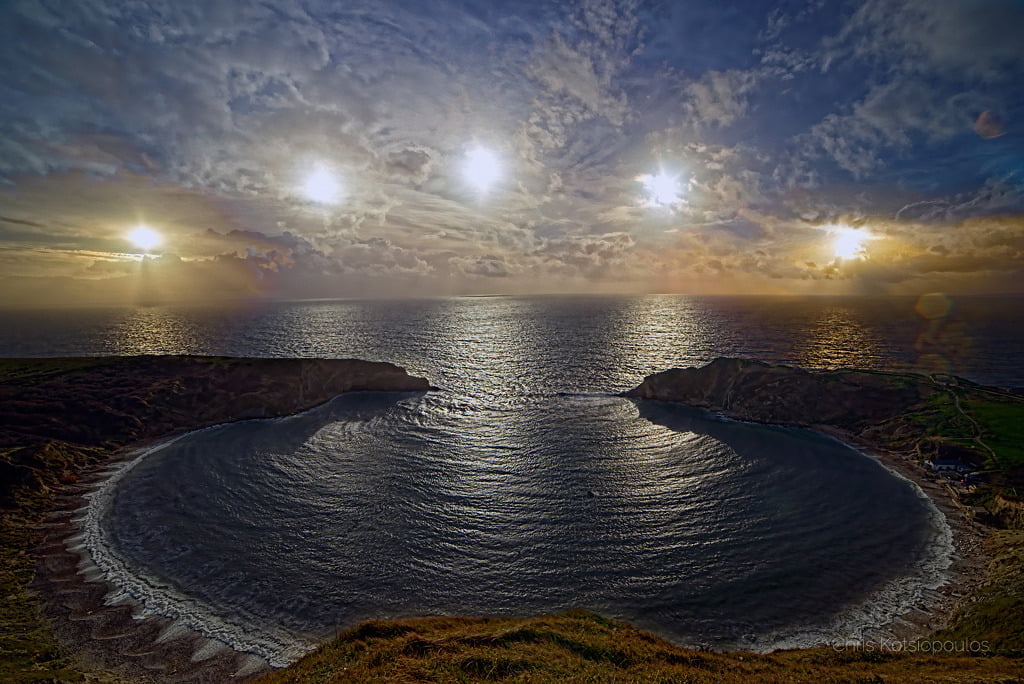
This composite photo shows the arc of the sun over Lulworth Cove in England during the December solstice. The low sun angle reveals a distinctive circular diffraction pattern of waves inside the cove. Along the shoreline, the beach has eroded into a regular, arc-like pattern known as beach cusps. Although there are multiple theories about how cusps form, their pattern is self-sustaining. They consist of a horn of coarse materials that projects into the water and an arc of finer sediments called an embayment. When incoming waves hit the horn, they slow down, depositing heavier coarse sediment on the horn while lighter, fine particles are carried further ashore. (Image credit: C. Kotsiopoulos; via APOD; submitted by jshoer)

The Best of FYFD 2015


2015 was a pretty good year. FYFD turned five, we had a great reader survey response, and Tumblr gave us a Tumblr Lifetime Achievement! Guess that means I’ve got more in common with Wil Wheaton and the New York Public Library than my lifelong obsession with books.
Without further ado, I give you the top 10 FYFD posts of 2015:
1. The secret of the dancing droplets
2. The open siphon and self-pouring liquids
3. Fingers of sea foam
4. The physics of rain drops falling on a puddle
5. Fin-like Kelvin-Helmholtz clouds in the Galapagos
6. A fish swimming in microgravity
7. Hawaiian lava waterspouts
8. Colorado’s Kelvin-Helmholtz clouds
9. Delicious fluid dynamics in the kitchen
10. Inside of a fluidic oscillatorThanks for a great year, readers, and stay tuned. There are exciting developments afoot for 2016!
(Image credits: N. Cira et al., Ewoldt Research Group, L. Meudell, K. Weiner, C.Miller, IRPI LLC, B. Omori, Breckenridge Resort, Buttery Planet, M. Sieber et al.)

Chocolate Fountain
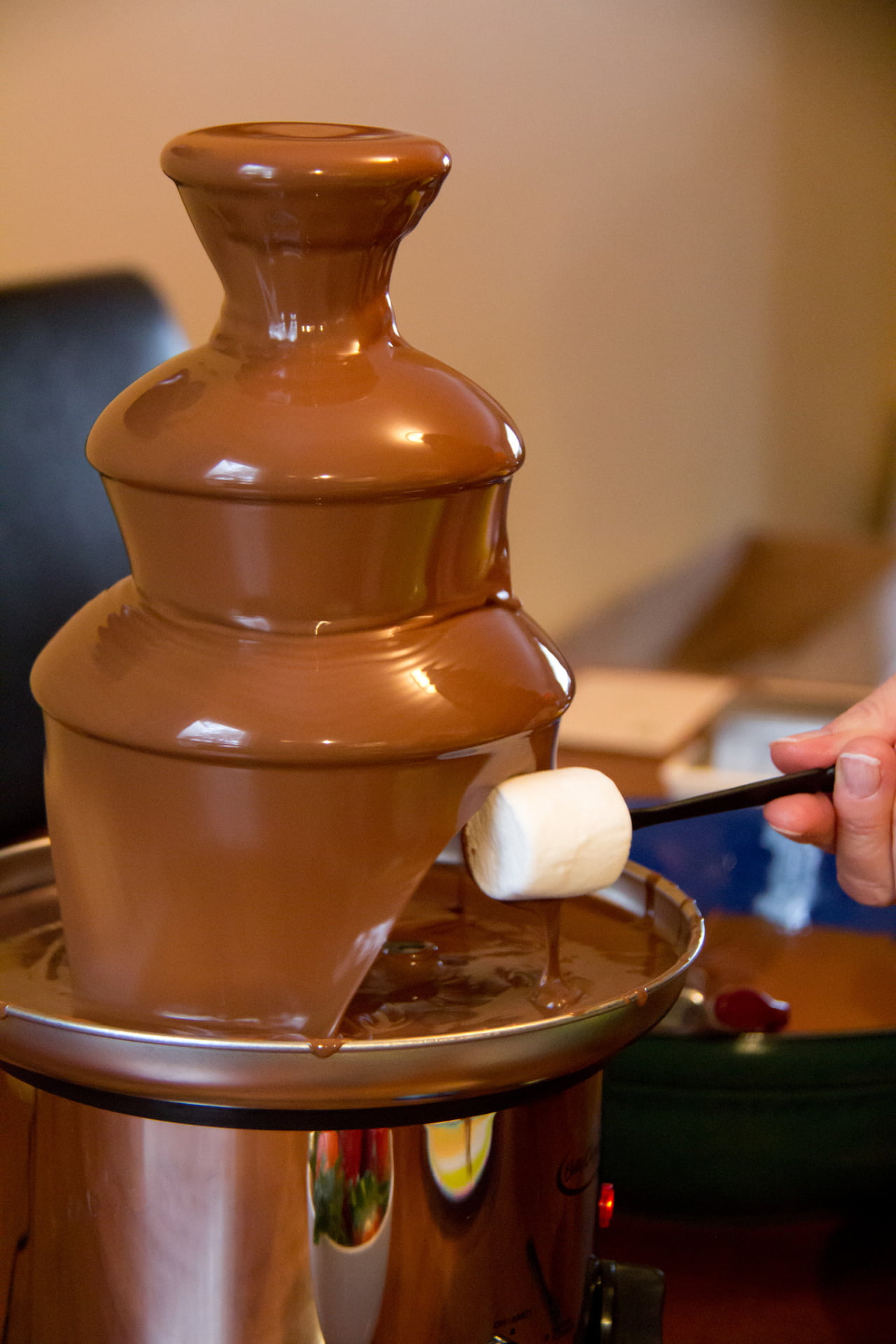
Amidst your holiday celebrations, you may have encountered a chocolate fountain. In a recent paper, applied mathematicians have laid out the physics behind these delicious decorations, and it turns out they are an excellent introduction to many fluids concepts. Molten chocolate is a mildly shear-thinning, non-Newtonian fluid, meaning that it becomes less viscous when deformed. This adds a wrinkle to the mathematics describing the flow, but only a little one. The researchers divide the flow into three regimes: pipe flow driving the chocolate up the inside of the fountain, thin-film flow over the fountain’s domes, and, finally, the curtain of falling chocolate where foodstuffs are dipped. The final regime is the most mathematically challenging and may be the most fascinating. The authors found that the free-falling curtain of liquid pulls inward as it falls due to surface tension. Their paper is quite approachable, and I recommend those of you with mathematical inclinations check it out. (Image credit: P. Gorbould; research credit: A. Townsend and H. Wilson)

Freezing From Below
Watch closely as a droplet freezes on a cold surface, and you’ll observe something surprising. First, a freeze front will appear, traveling upward from the substrate. It curves slightly near the edges, leaving a liquid cap atop the frozen drop. But, as we’ve all discovered, water expands as it freezes. We can watch the drop freezing and see that the water isn’t expanding radially. Instead, the water expands vertically, forming a sharp tip or cusp just as the drop freezes completely. Remarkably, the geometry of the final tip doesn’t depend on the temperature of the substrate or on the wetting contact angle. (Video credit: L. Posada)

Swimming in Microgravity
For years, I have wondered what a fish swimming in microgravity would look like. Finally, my curiosity has been rewarded. Here is a sphere of water in microgravity, complete with a fish. Personally, I am impressed that, despite the fish’s best efforts, the surface tension of the water is strong enough to keep it confined. This may not bode well for microgravity swimming pools at space hotels. (Video credit: IRPI LLC, source)

Falling Ink


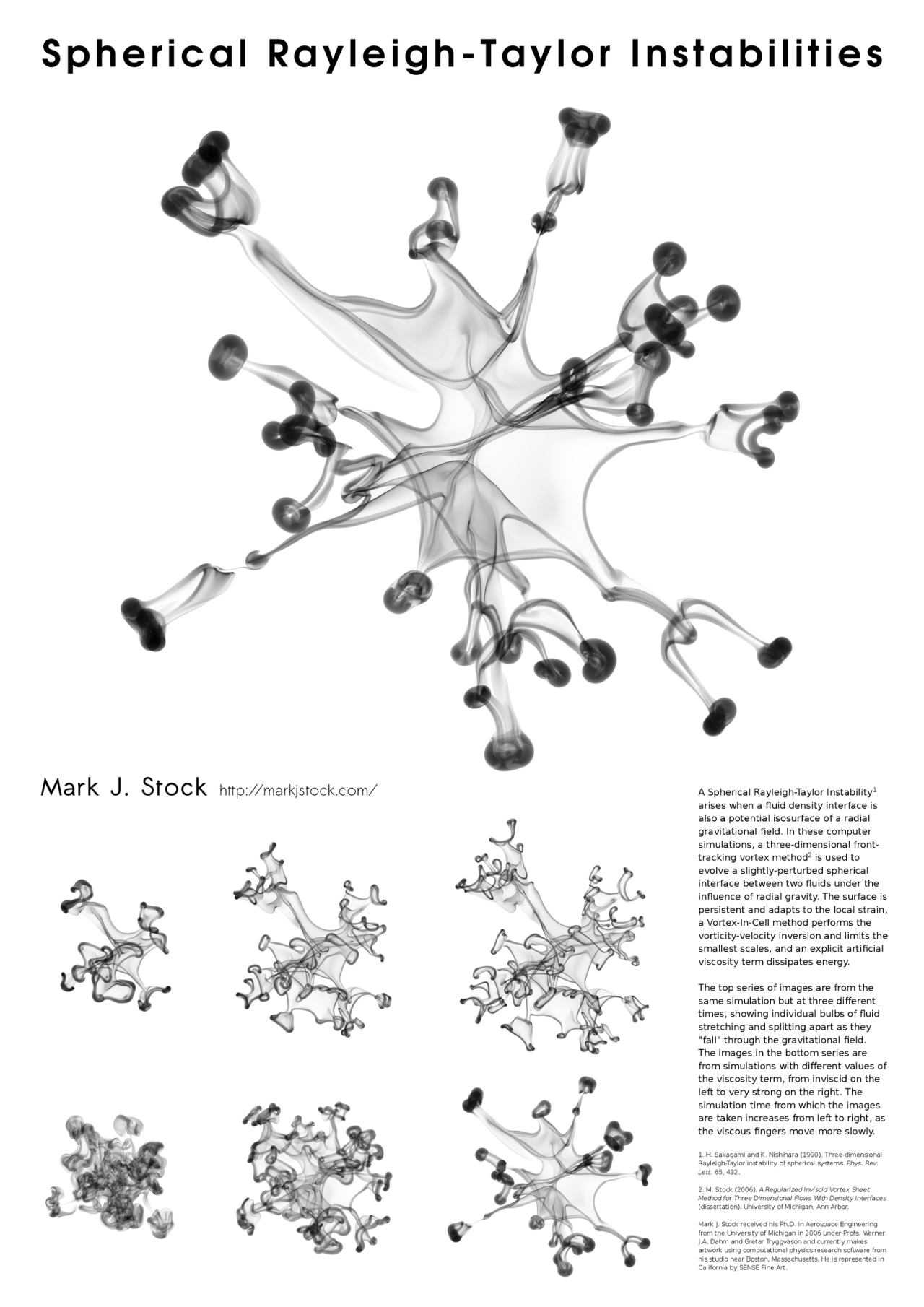
Photographer Linden Gledhill created these nebula-like composites from photos of ink diffusing in water. The work was inspired by Mark Stock’s “Spherical Rayleigh-Taylor Instabilities” series featured here last week. Like Stock’s computational art, the twisted fingers and vortex rings above form due to the denser ink falling through less dense water. The interface between the two fluids distorts under the effects of gravity and the fluids’ relative motion. Such shapes are ephemeral at best; the falling ink will quickly become turbulent and diffuse throughout the water. (Photo credit and submission: L. Gledhill)

Helicopter Tip Vortices
Airplanes and other fixed-wing aircraft produce wingtip vortices as a result of their finite length. Rotor blades, like those on helicopters, produce the effect as well. Both wings and rotors generate lift by trapping low-pressure air on their top surface and high-pressure air below. At their tips, though, the high-pressure air can sneak around the wing or rotor, creating vortices like the ones visualized above. Here smoke from a wire is entrained by the rotors’ inflow and twisted into a tip vortex. The line of vortices drifts downward due to the rotor’s downwash. (Image credit: M. Giuni et al., source)
Inside a Popping Bubble
Popping a soap bubble is more complicated than what the eye can see. In high-speed video, we find that the action is very directional, with the soap bubble film pulling away from the point of rupture. As it does so, waves, like those in a flapping flag, appear along the surface and strings of fluid form along the edge of the film before breaking into droplets. This video takes matters a step further, looking at what happens to air inside a bubble when it pops. Those subtle waves and strings of fluid we see in the high-speed rupture have a distinctive effect on air inside the bubble. As the film pulls away, it leaves behind a rippled, wavy surface rather than a smooth sphere of foggy air. (Video credit: Z. Pan et al.)

Numerical Rayleigh-Taylor
If you’ve ever dripped food coloring or ink into a glass of water, you’ve probably created a cascade of tiny vortex rings similar to the images above. This is the Rayleigh-Taylor instability, in which the heavier ink/food coloring falls under gravity into the less dense water. What’s shown above is a special case–one that no experiment can recreate. It’s a numerical simulation of a spherical Rayleigh-Taylor instability. Imagine a sphere of a dense fluid “falling” outward under the influence of a radial gravitational field. This is one of the interesting aspects of computational fluid dynamics–it can simulate situations that are impossible to create experimentally. That can be both a strength and a weakness, allowing researchers to probe otherwise unavailable physics or fooling the unwary into thinking they have captured something real. (Image credit: M. Stock)