Clean-up of accidents like the 2010 Deepwater Horizon oil spill can be complicated by what goes on beneath the ocean surface. Variations in temperature and salinity in seawater create stratification, stacked layers of water with differing densities. When less dense layers are on top, the fluid is said to be stably stratified. Since oil is less dense than water, one might assume that buoyancy should make an oil plume should rise straight to the ocean surface. But the presence of additives or surfactants in the oil mixture plume can prevent that. With surfactants present, an oil mixture tends to emulsify, breaking into tiny droplets like a well-mixed salad dressing. Even if the density of the emulsion is smaller than the surrounding fluids, such a plume can get trapped at a density boundary, as seen in the photo above. Researchers report a critical escape height, which depending on the plume’s characteristics and stratification boundary, determines whether a plume escapes or becomes trapped. (Image credit: R. Camassa et al.)
Tag: oil spill

Underwater Plumes
During 2010’s Deepwater Horizon oil spill there were reports of underwater plumes of oil escaping collection. This video demonstrates how such a plume can form. There are two clips shown here; in both the tank is filled with salt water of varying salinity, with denser saltwater at the bottom. The first jet is a green alcohol/water mixture and the second is a red gauge oil. Both jets have the same density and flow rate, but they vary in their Reynolds number. The first turbulent jet gets trapped at the interface between the denser and lighter saltwater while the less turbulent red jet passes the interface with no difficulty. The researchers suggest that strong turbulence can create an emulsion, a mixture of two normally immiscible fluids–imagine shaking a container of oil and vinegar really well–which can lead to underwater trapping.
Dr. Seussian Mystery Fluid Could Have Saved Top Kill
Dr. Seussian Mystery Fluid Could Have Saved Top Kill
Wired article about using non-Newtonian fluids to plug leaking oil wells as we featured previously.

Plugging an Oil Leak
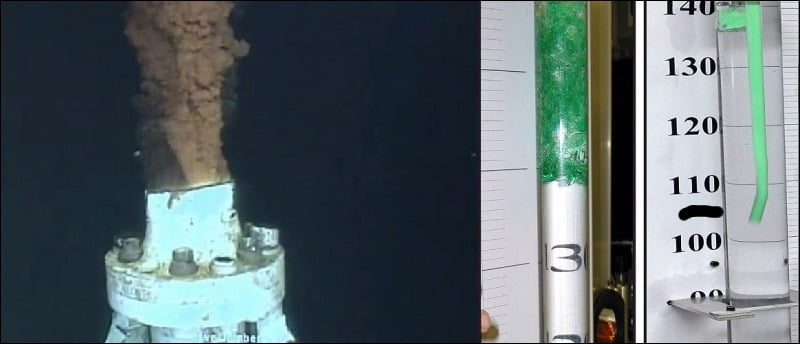
Recent research indicates that adding cornstarch to drilling mud increases the likelihood that a “top-kill” procedure will plug a leaking oil well. Adding cornstarch to water (or mud) turns it into a non-Newtonian fluid with viscoelastic properties that prevent the instabilities that lead to turbulent breakup. On the left, an underwater photo of the Deepwater Horizons leak; in the center, colored water breaks into turbulence when descending into oil; on the right, water with cornstarch maintains its coherence when pumped downward into the oil. # (PDF of research paper)