When a fluid is stratified into layers, it’s possible to have waves generated and transmitted along the interface between layers. Because these waves remain inside the bulk fluid, they are called internal waves. They often occur in the atmosphere or the ocean as fluids with different properties move past changing terrain. The Strait of Gibraltar is an excellent source of internal waves. The tidal exchange of waters between the Mediterranean Sea and Atlantic Ocean takes place through a narrow corridor interrupted by the peak of Camarinal Sill. The internal waves generated by the constriction are large enough that their effect on the surface flow is visible to satellites. The video above visualizations data from a numerical simulation of flow through the Strait, showing the obstacles, flow, and wave structures generated. (Video credit: J.C. Sanchez Garrido et al.)
Tag: ocean

Phytoplankton Bloom
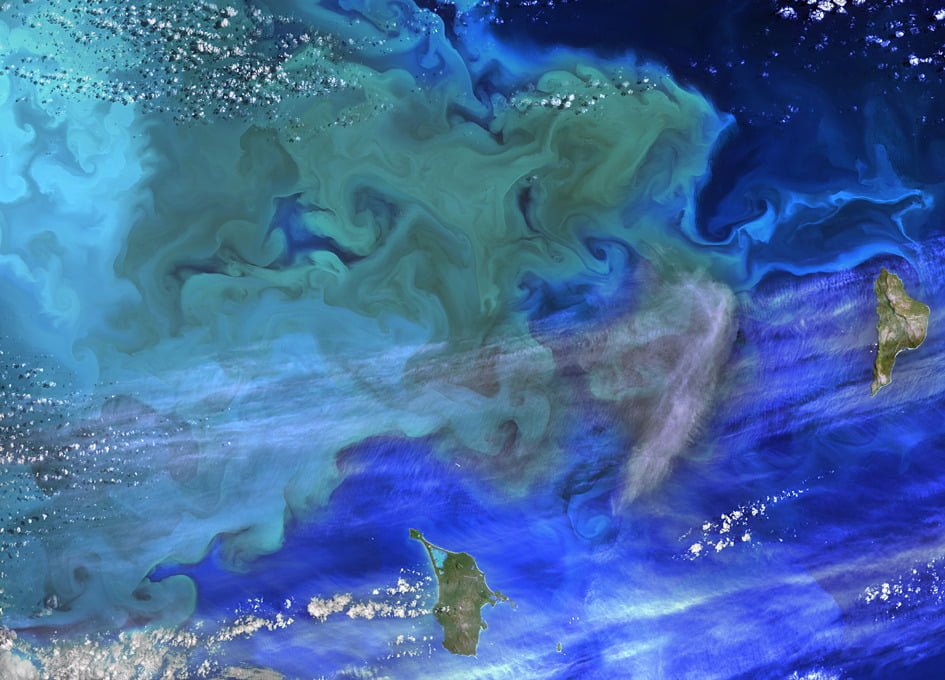
In satellite imagery the blue and green whorls of massive phytoplankton blooms stand out against the ocean backdrop. These microscopic organisms are part of a delicate predator-prey balance and can be very sensitive to nutrient concentrations and other environmental conditions. Their individual size is negligible, but in a bloom phytoplankton are numerous enough that they act as seed particles for the flow. As a result, differing concentrations of phytoplankton reveal the swirling, turbulent mixing of ocean waters. (Image credit: NASA/USGS; via SpaceRef; submitted by jshoer)

Freediving
The freediving del Rosario brothers have created a real treat with this underwater film. There are no computer-generated special effects, just some clever tricks with camera angles, perspective, and buoyancy. The end result is slightly surrealistic and captures some of the fluid beauty of the ocean. And don’t miss the excellent bubble ring vortices. (Video credit: The Ocean Brothers; via Gizmodo; submitted by jshoer)

Reader Question: Wave Vortex
Reader unquietcode asks:
I saw this post recently and it made me wonder what’s going on. If you look in the upper right of the frame as the camera submerges, you can see a little vortex of water whirring about. Even with the awesome power of the wave rolling forward a little tornado of water seems able to stably form. Any idea what causes this phenomenon?
This awesome clip was taken from John John Florence’s “& Again” surf video. What you’re seeing is the vortex motion of a plunging breaking wave. As ocean waves approach the shore, the water depth decreases, which amplifies the wave’s height. When the wave reaches a critical height, it breaks and begins to lose its energy to turbulence. There are multiple kinds of breaking waves, but plungers are the classic surfer’s wave. These waves become steep enough that the top of the wave overturns and plunges into the water ahead of the wave. This generates the vortex-like tube you see in the animation. Such waves can produce complicated three-dimensional vortex structures like those seen in this video by Clark Little. Any initial variation in the main vortex gets stretched as the wave rolls on, and this spins up and strengthens the rib vortices seen wrapped around the primary vortex. (Source video: B. Kueny and J. Florence)

Wave Tank
A new wave tank facility opening at the University of Edinburgh promises new capabilities to simulate ocean wave behavior. The circular 25m diameter wave tank is lined with 168 wave makers and is equipped with 28 submerged flow-drive units. Together, these allow the tank to simultaneously simulate nearly any wave type as well as tidal currents up to 1.6 m/s. The facility is intended for 1/20th scale modeling; projected to full-size, this means that the tank is capable of making waves representative of 28 m high ocean waves and tidal currents in excess of 12 knots. It’s expected to be particularly valuable in the development and testing of wave and tidal motion generators for clean energy. For more, see BBC News and FloWave’s own website. (Image credit: Brightspace/BBC News; submitted by srikard)
How Tsunamis Cross the Ocean
Last week an earthquake in Chile raised concerns over a possible tsunami in the Pacific. This animation shows a simulation of how waves would spread from the quake’s epicenter over the course of about 30 hours. In the open ocean, a tsunami wave can travel as fast as 800 kph (~500 mph), but due to its very long wavelength and small amplitude (< 1 m), such waves are almost unnoticeable to ships. It’s only near coastal areas, when the water shallows, that the wave train slows down and increases in height. Early in the video, the open ocean wave heights are only centimeters; note how, at the end of the video, the wave run-up heights along the coast are much larger, including the nearly 2 meter waves that impacted Chile. The power of the incoming waves in a tsunami are not their only danger, though; the force of the wave getting pulled back out to sea can also be incredibly destructive. (Video credit: NOAA/NWS/Pacific Tsunami Warning Center; via Wired)
Harnessing Ocean Waves
Ocean waves contain substantial amounts of energy, and many projects are underway to harness them as renewable energy sources. Most of these projects use the motion caused by waves to generate electrical energy. In this example, a flexible carpet is attached to hydraulic pumps. As the waves move over the carpet, it oscillates, raising and lowering the piston of the pumps. This adds hydraulic pressure to the discharge lines that run from the wave carpet to the shore. Once on dry land, that hydraulic pressure can be converted to electrical energy. This design addresses one of the major challenges in ocean-wave-energy technologies–namely how to safely transmit power from the wave farm to the shore. (Video credit: University of California Television)
Sand Ripples
Wave motion in a bay or near a beach can cause significant sediment transport. Individual granular particles, like sand, can be lifted by the passage of a single wave, but, over time, complex patterns form as the granular bottom surface shifts due to the waves. This video shows time-lapse footage of the ripples that form and move in submerged sand during many hours of wave motion. A slight imperfection in the surface causes a network of sand ripples to grow and spread. Once formed, those ripples shift and reform depending on changes in the wave conditions. (Video credit: T. Parron et al.)

Beach Cusps
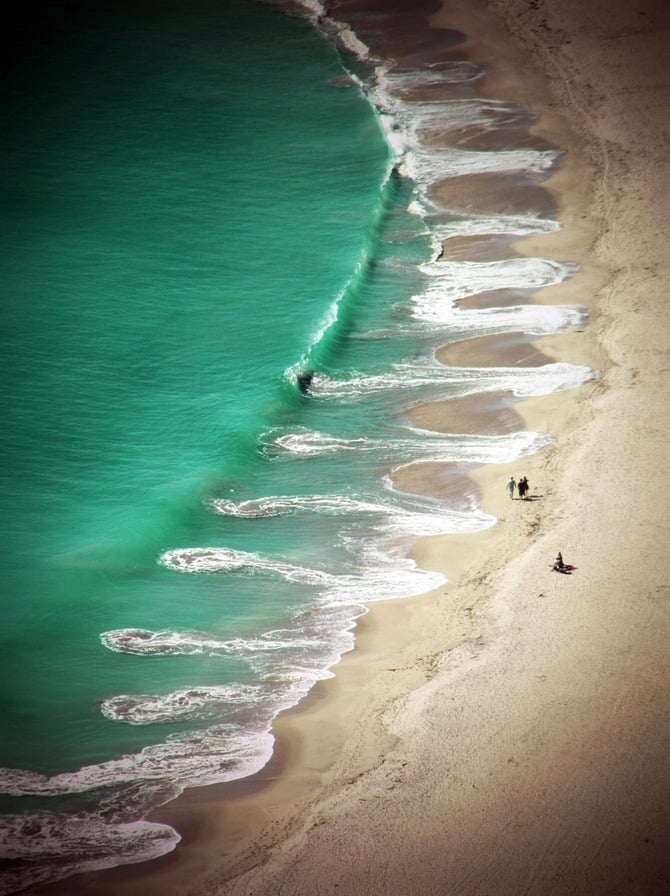
Beach cusps are arc-like patterns of sediment that appear on shorelines around the world. Cusps consist of horns, made up of coarse materials, connected by a curved embayment that contains finer particles. They are regular and periodic in their spacing and usually only a few meters across. A couple of theories exist as to how cusps form, but once they do, they are self-sustaining. When an incoming wave hits a horn, the water splits and diverts. The impact of the wave on the horn slows the water, causing it to deposit heavy, coarse particles on the horns while finer sediment gets carried up to the embayment before the wave flows back outward. (Photo credit: L. Tella; inspired by E. Wiebe)

Reader Question: Oceans Meeting?
Reader favoringfire asks:
Hi! Maybe you can help me: I’ve seen a pic revolving around Tumblr from the Danish city of Skagen showing the Baltic and North sea meeting. Where they meet the ocean is two very distinct hues of blue–what captions say are “two opposing tides with different densities.” Tides? Currents w/different temps often are often diff color from one another. But can “tides” be of different “densities???”
After some searching, I think the photo above is probably the one you’ve seen represented as where the Baltic and North Seas meet. It turns out, however, that it’s not. It’s a photo from an Alaskan cruise taken by Kent Smith. Fluid dynamically, though, it’s still very interesting! What we see here is a sharp gradient between regions with very different densities. One side contains lots of freshwater from rivers fed by melting glaciers, which creates a very different density from the general seawater.
It’s not true, however, that the two won’t mix. This border is not a static phenomenon but one that is ever-changing due to currents and the diffusion of one fluid into another. In a sense, this photo is very much the sea-level version of photos like these which show the massive scale of sediment transport and nutrient mixing that occur in our oceans.
(Photo credit: K. Smith)