Most beach-goers have probably wondered just what makes the waves coming in to shore rear up and break. The secret lies in the depths–or rather the lack thereof–beneath the waves. Far from shore, the wave’s length scale is small compared to the ocean depth, and the ocean’s bottom is effectively infinitely far away to all parts of the wave. But, as the wave rolls toward shore, the depth decreases and the ocean bottom begins to influence the wave. In the trough, the ocean bottom slows the wave. Meanwhile, the crest of the wave carries forward, rising until its height reaches 80% of the water depth, at which point it will tip over and break.(Video credit: BBC)
Tag: ocean

Glinting Off Waves
Sunglint on the ocean surface can sometimes reveal different patterns in wave conditions. In the satellite photo above, we see the Canary Islands with wavering silvery wakes stretching to the southwest. The predominant wind direction over the islands is from the northeast. The rocky islands act as a wind-break, redirecting the flow and shadowing the ocean in their wake from much of it. As a result, fewer waves are stirred up in the islands’ wakes, thereby changing the local surface reflection properties and making this image possible. (Photo credit: NASA Earth Observatory)

Reader Question: Energy from Whirlpools?
shiftymctwizz asks:
So I just read your post about vortices, and now I’m wondering if we could build structures similar to the Corryvreckan and put turbines in them for energy production? Would it be any more efficient than hydroelectric dams? Are you the right person to ask?
I can’t give you numbers off the top of my head, but I suspect that your typical hydroelectric dam will be more reliable if not more efficient. The trouble with things like the Corryvreckan, aside from the randomness of where the vortices pop up, is that they aren’t there every single day the way, say, Niagara Falls is.
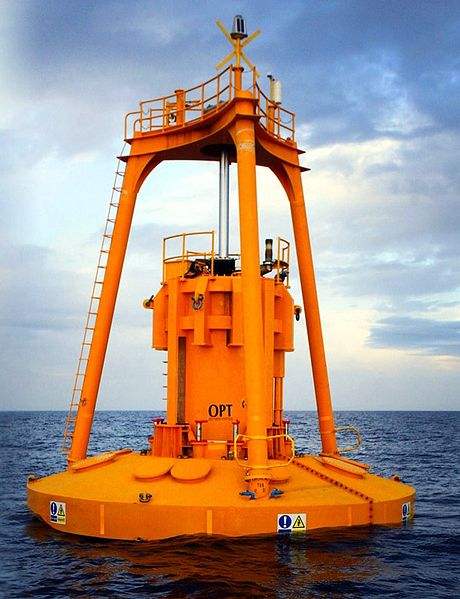
That said, there is on-going work to effectively harness ocean waves for power, with ideas like buoy generators or sea snake generators. As with most concepts one of the difficulties in implementation is determining a safe and efficient manner to transmit the electricity generated from these offshore sites (we’re generally talking miles from shore) to where it’s needed. This problem is often similarly faced by solar and wind energy producers. There are already wave farms in place around the world, though, and it’s a promising field of renewable energy. (Photo credit: Wikimedia)

Real-Life Whirlpools

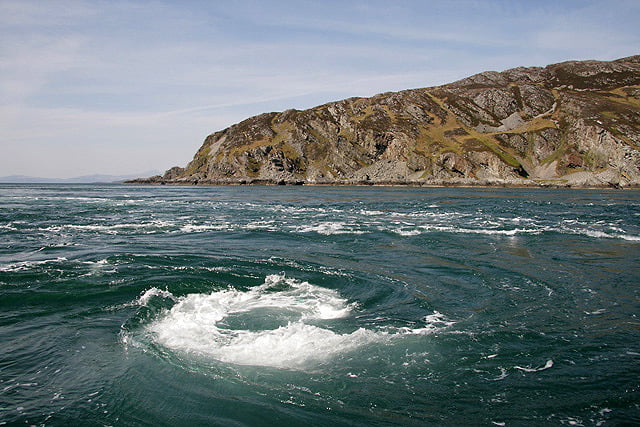
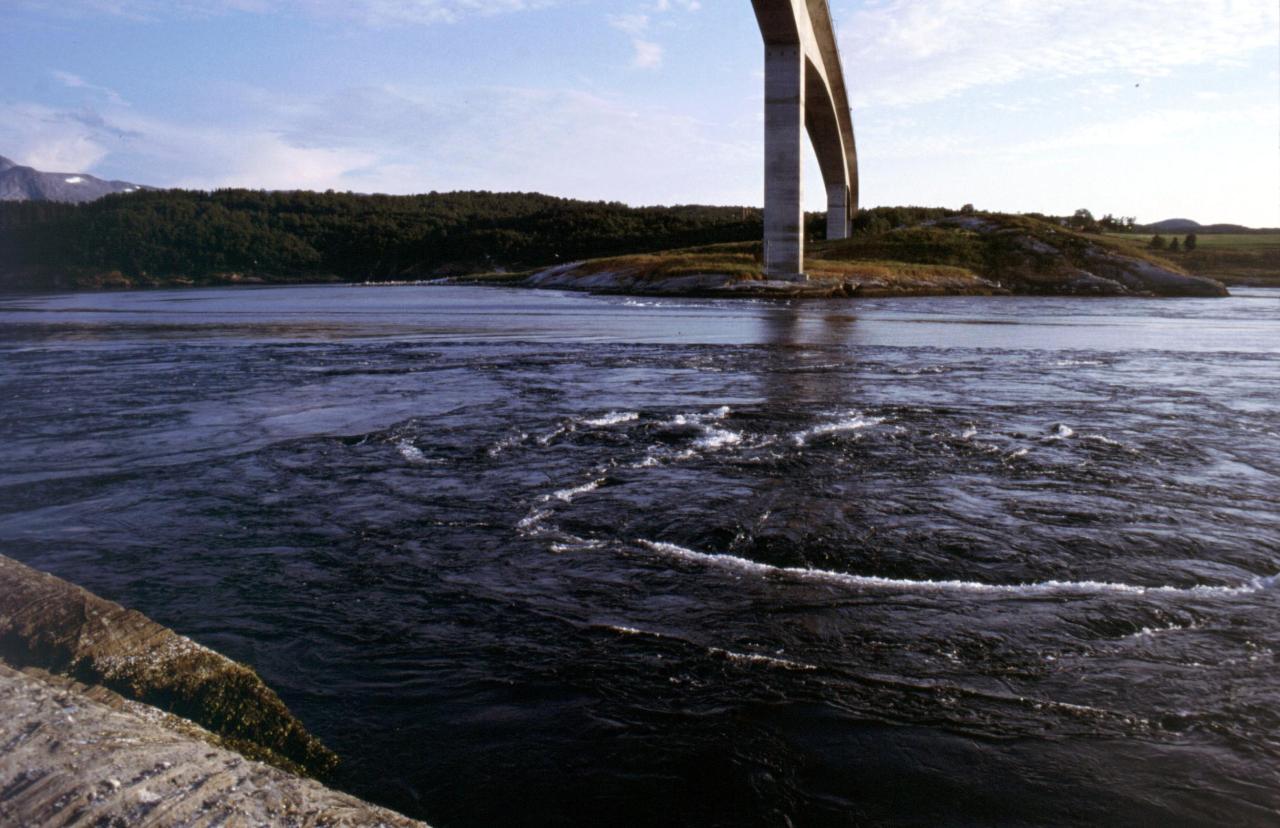
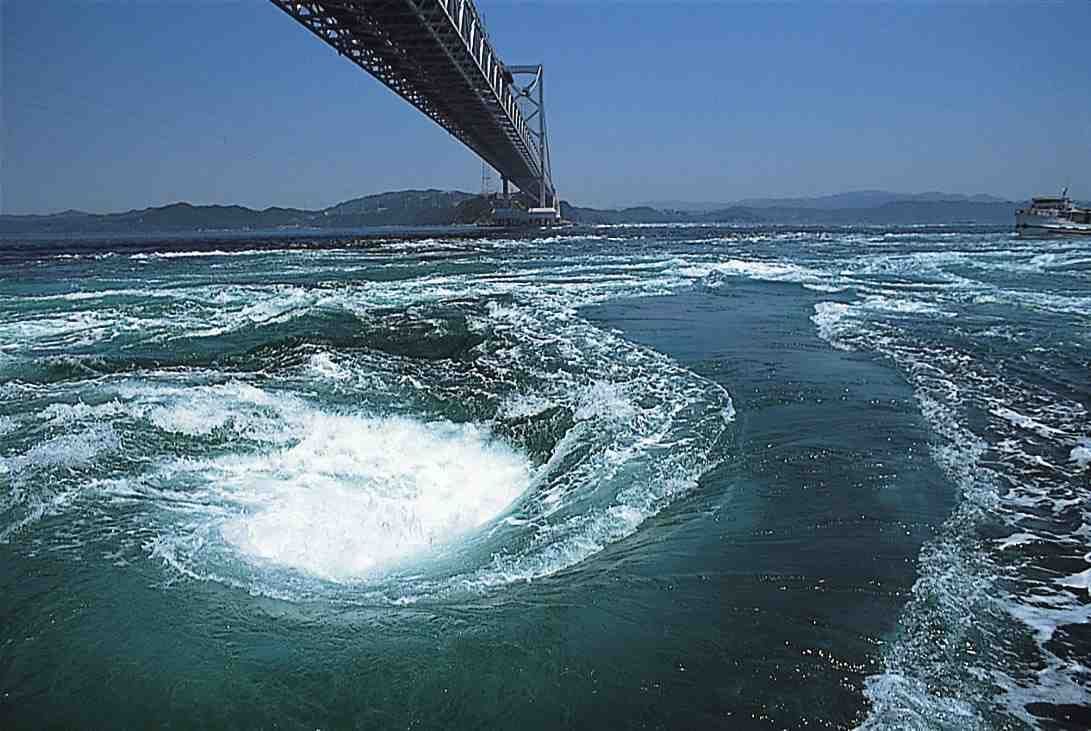
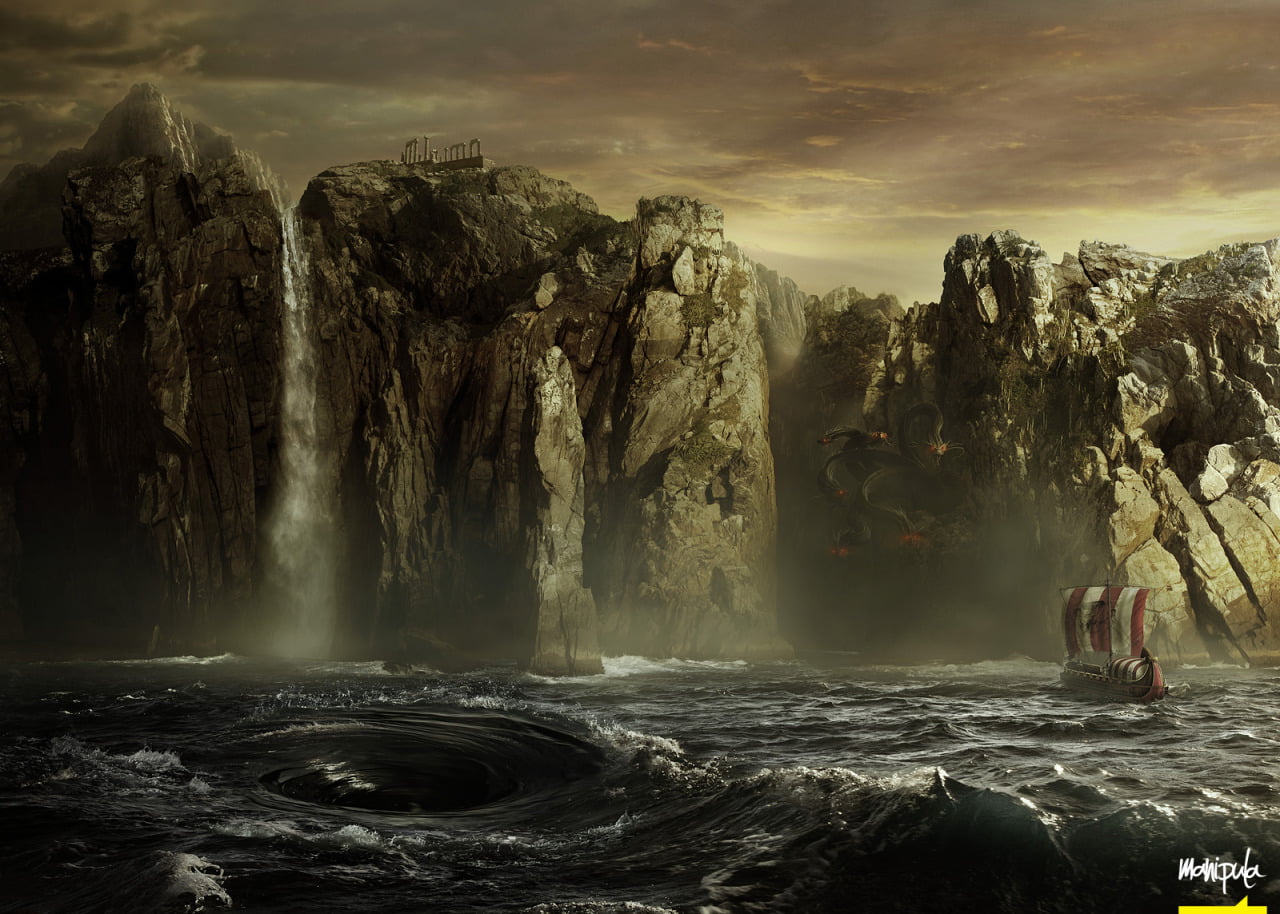
Literature is full of descriptions of monstrous whirlpools like Charybdis, which threatens Homer’s Odysseus. While it’s not unusual to see a small free vortex in bodies of water, most people would chalk boat-swallowing maelstroms up to literary device. But it turns out that, while there may not be permanent Hollywood-style whirlpools, there are several places in the world where the local tides, currents, and topology combine to produce turbulence, dangerously vortical waters, and even standing vortices on a regular basis.
One example is the Corryvreckan, between the islands of Jura and Scarba off Scotland. In this narrow strait, Atlantic currents are funneled down a deep hole and then thrust upward by a pinnacle of rock that rises some 170 m to only 30 m below the surface. The swift waters and unusual topology produce strong turbulence near the surface and whirlpools pop up throughout the strait. Other “permanent” maelstroms, such as those in Norway and Japan, arise from tidal interactions with similar structures rising from the sea floor.
For more, check out this Smithsonian article, Gjevik et al., Moe et al., and the videos linked above! (Photo credits: Manipula, Tokushima Gov’t, Wikimedia, and W. Baxter; requested by @kb8s)

Reader Question: Standing Waves
captainandry asks:
What would happen to a fish or swimmer in a standing wave?
First of all, check out the video that inspired this question, which shows a standing water wave created in a wave tank. Before we tackle the standing wave, it’s helpful to know what motion exists in a typical water wave. For deep water waves, the motion of a particle as the waves pass is circular, with a decreasing radius with increasing depth. Below a certain depth the energy of the surface wave doesn’t penetrate. Here’s an animation, where the red dots represent massless particles and the blue circles show their paths:
In shallower waters, the circular paths get compressed into ellipses. The image below shows pathlines for particles at different depths as a water wave passes. Notice how the paths are circular near the surface, where the depth is much greater than the wavelength, while close to the bottom, the pathlines are elliptical.

So what about motion for a standing water wave? Such a wave has no apparent horizontal motion, as seen in the animation below:

Similar to the way that decreasing the depth compresses the circular particle motion into an ellipsoid, creating a standing wave compresses the horizontal motion of any particle near the surface. What this means is that anything floating near the surface of the standing wave will simply bob up and down. Unless it’s located at one of the nodes (marked by red dots), in which case it won’t move at all! As with the other types of water waves, the amount of displacement will decrease with depth. People and fish, of course, are not massless particles, so their motion will be damped by inertia, but the same principles apply.
(Photo credits: P. Videtich; R. L. Wiegel and J.W. Johnson; Wikipedia)

Mixing the Southern Ocean
Motion in the ocean is driven by many factors, including temperature, salinity, geography, and atmospheric interactions. While global currents dictate much of the large-scale motion, it’s sometimes the smaller scales that impact the climate. This visualization shows numerically simulated data from the Southern Ocean over the course of a year. The eddies that swirl off from the main currents are responsible for much of the mixing that occurs between areas of different temperature, which ultimately impacts large-scale temperature distributions, in this case affecting the flux of heat toward Antarctica. (Video credit: I. Rosso, A. Klocker, A. Hogg, S. Ramsden; submitted by S. Ramsden)

Under the Waves
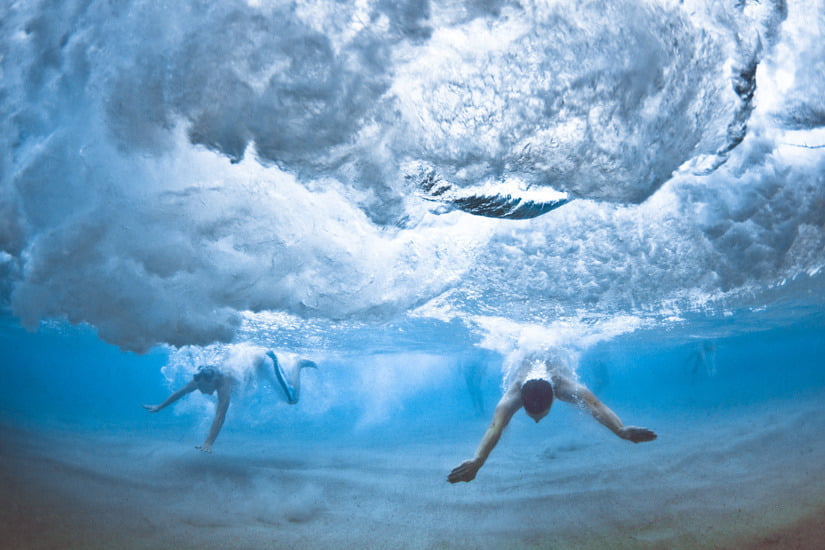


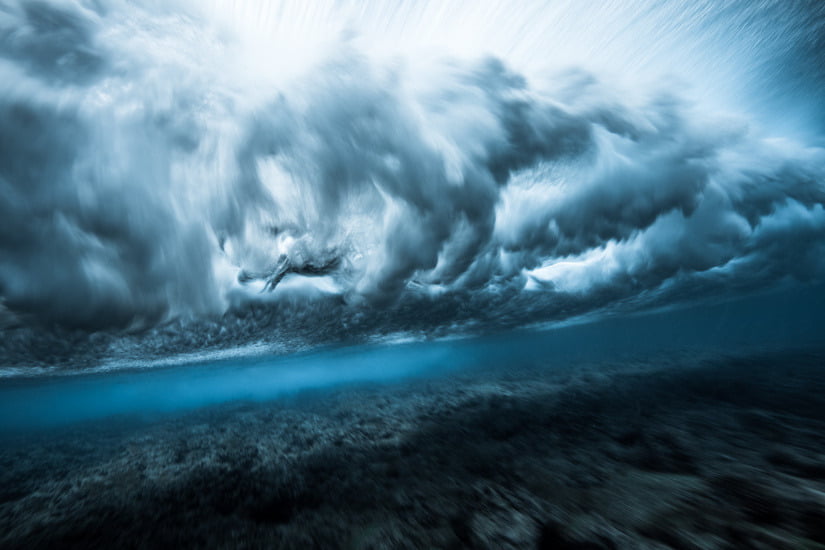
When I was a kid, I liked to dive underwater in the pool and sit at the bottom, looking up at the peculiar dancing sky the water made overhead. Photographer Mark Tipple takes it further, capturing images of the ocean from below the surface as waves roll in. His photos show swimmers and surfers diving to escape a roiling wave that, from below, bears a surreal similarity to the underside of a thundercloud in a summer storm. This is part of the beauty of fluid dynamics. Despite their differences, water and air obey the same physics. (Photo credits: Mark Tipple; via io9)

Phytoplankton and Sediments
Pale sediments are carried out to sea by the rivers of the Mergui Archipelago of Myanmar. Dark blue ocean waters mix with the sediment, creating turbulent swirls in this natural color satellite image. With the sediment comes valuable nutrients for plant life in the ocean, which can prompt the formation of phytoplankton blooms. (Photo credit: Michael Taylor/Landsat/NASA)
Sea Surface Temperatures
This video shows sea surface temperature results and their seasonal variation from a numerical simulation modeling circulation in the atmosphere and oceans. Modeling such enormous problems requires the development of reasonable models of the turbulent physics, clever algorithms to quickly progress the solutions, relatively low-fidelity (a single grid node may cover tens of kilometers), and enormous computing power. (Video credit: NOAA; via Gizmodo)
How the Sun Drives the Earth
This video describes how the sun’s energy drives wind and ocean currents on earth. As solar winds stream forth from the sun, our magnetosphere deflects the brunt of the impact (creating auroras at the poles) while the atmosphere, land masses, and oceans absorb thermal energy from the sun’s light. Because of our cycles of day and night and the differences in how land, water, and ice absorb heat, temperature differentials around the earth drive a massive heat engine, causing the circulation of water and wind all around our world. Numerical simulations like the ones underlying this video are vital for the prediction of climate and weather, as well as for developing models and techniques that can be applied to other problems in science and engineering. (Video credit: NASA; via Gizmodo)