Tag: multiphase

  • Mushy Layers

    Mushy Layers

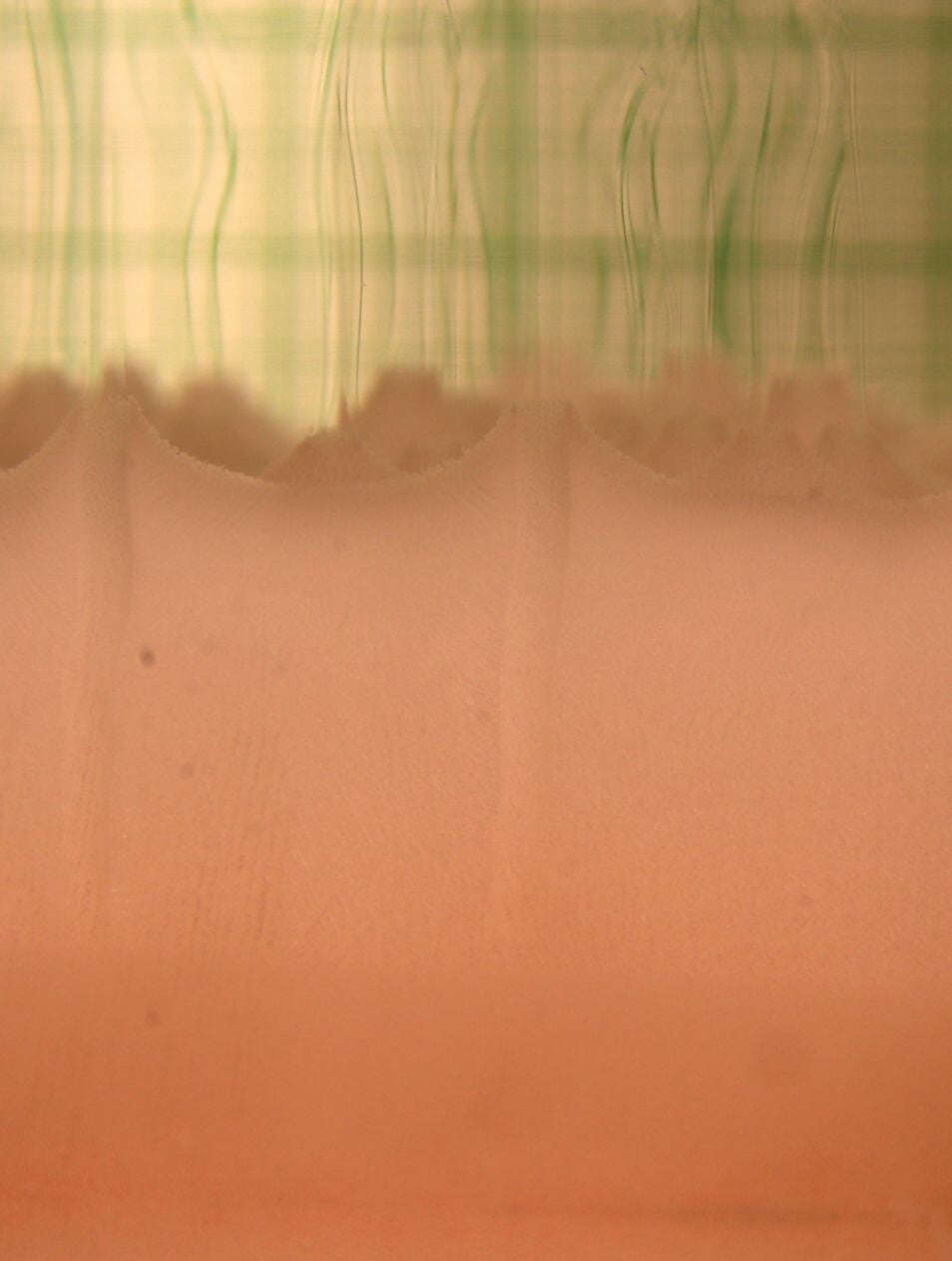
    In many geophysical and metallurgical processes, there is a stage with a porous layer of liquid-infused solid known as a mushy layer. Such layers form in sea ice, in cooling metals, and even in the depths of our mantle. Within the mushy layer, temperature, density, and concentration can vary dramatically from one location to another.

    The image above shows a mushy layer made from a mixture of water and ammonium chloride. Above the mushy layer, green plumes drift upward, carrying lighter fluid. Look closely within the mushy layer and you’ll see narrow channels feeding up to the surface. These are known as chimneys. In sea ice, chimneys like these carry salty brine out of the ice and into the seawater, increasing its salinity. See this Physics Today article for more details on the dynamics of mushy layers. (Image credit: J. Kyselica; via Physics Today)

  • Ice Labyrinths

    Ice Labyrinths

    Pattern formation is extremely common in nature, from the dendritic growth of trees and snowflakes to the stripes of a tiger. A new paper describes how a thin layer of ice in a liquid can form labyrinthine patterns when illuminated with near-infrared light. Both the liquid and ice are maintained at a constant temperature below the melting point, but the ice absorbs the near-infrared light more effectively than the water. This means that parts of the ice that are far from the liquid warm and melt faster, creating holes that can then allow a pocket of liquid to seep in and reduce the absorption rate. The ice crystals themselves thin and expand across the surface at the expense of more holes, which eventually create larger channels that pock the ice. (Image and research credit: S. Preis et al.; via Nature; submitted by Kam-Yung Soh)

  • Featured Video Play Icon

    Recreating Pyroclastic Flow

    One of the deadliest features of some volcanic eruptions is the pyroclastic flow, a current of hot gas and volcanic ash capable of moving hundreds of kilometers an hour and covering tens of kilometers. Since volcanic particles have a high static friction, it’s been something of a mystery how the flows can move so quickly. Using large-scale experiments (top), researchers are now digging into the details of these fast-moving flows.

    What they found is that the two-phase flow results in a pressure gradient that tends to force gases downward. This creates a gas layer with very little friction near the bottom of the pyroclastic flow (bottom), essentially lubricating the entire flow with air. This helps explain why pyroclastic flows are so fast and long-lived despite their inherent friction and the roughness of the terrain over which they flow. (Image and research credit: G. Lube et al.; video credit: Nature; submitted by Kam-Yung Soh)

  • Snowmelt

    Snowmelt

    Much of the rain that falls on Earth began as snow high in the atmosphere. As it falls through warmer layers of air, the snowflakes melt and form water droplets. The details of this melting process have been difficult to capture experimentally, but a new computational model may provide insight. The basic process has a couple stages. As snow begins to melt, surface tension draws the water into concave areas nearby. When those regions fill up, the water flows out and merges with neighboring liquid, forming water droplets around a melting ice core.

    Although this same sequence was observed for many types of snow, scientists also observed some important differences between rimed and unrimed snowflakes. Rime forms when supercooled water droplets freeze onto the surface of a snowflake. Lightly rimed snow still looks light and fluffy, like the animation above, but heavily rimed snow forms denser and more spherical chunks. Because there are lots of porous gaps in heavily rimed snow, water tends to gather there during initial melting. Rimed snow was also more likely to form one large water droplet rather than breaking into multiple droplets like snow with less rime. For more, check out NASA’s video and the Bad Astronomy write-up. (Image credit: NASA, source; research credit: J. Leinonen and A. von Lerber; via Bad Astronomy; submitted by Kam Yung-Soh)

  • Absorbing Bubbles

    Absorbing Bubbles

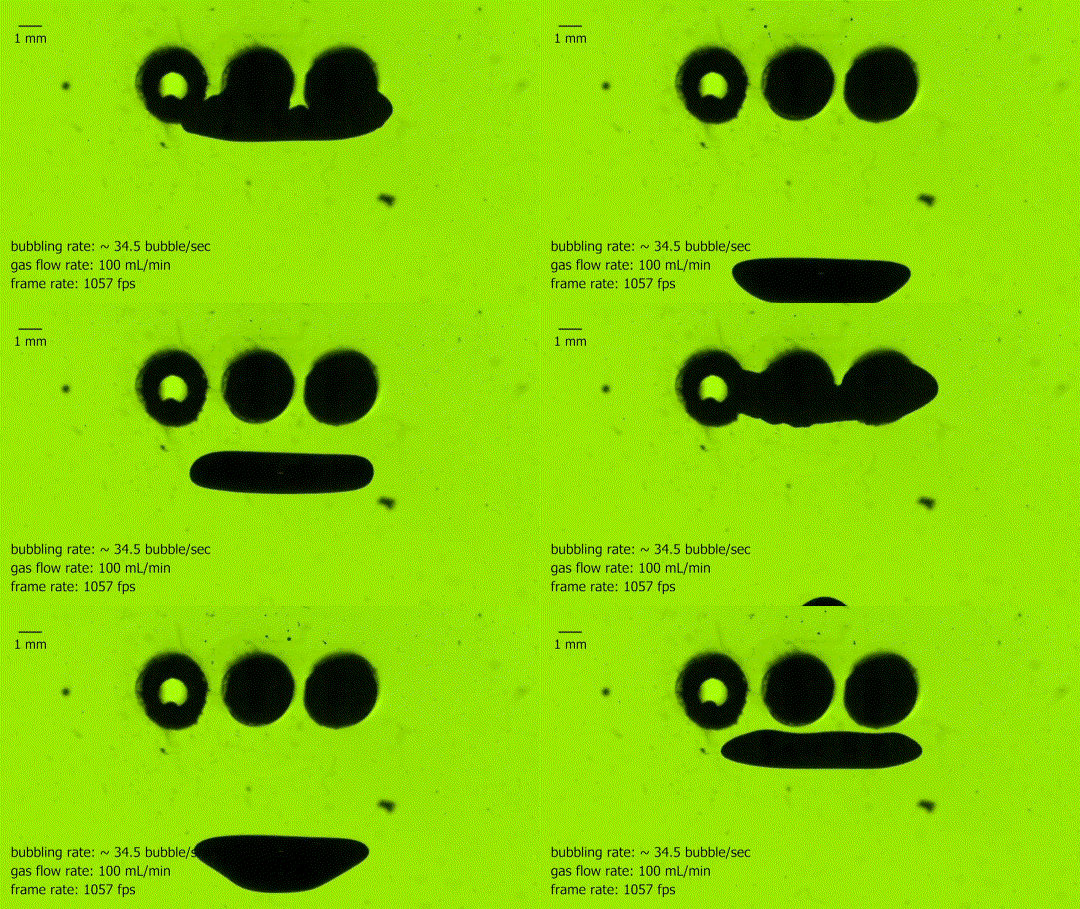
    This is a bubble absorber. It’s formed from an array of three springs, seen end-on in the upper center, each of which is coated to make it superhydrophobic. The hollow interior of the springs is filled with air and ventilated to the atmosphere. As bubbles rise through the water, they contact the springs and readily coalesce with the interior gas. In the blink of an eye, the large bubble is almost completely absorbed into the thin air film that clings to the springs. Superhydrophobic arrays like these may be useful in power and life support systems that need to separate liquid and gas phases under low-gravity conditions. (Image credit: N. Pour and D. Thiessen, source)

  • Watching Flow Inside Rock

    Watching Flow Inside Rock

    Flow through porous substances has been a major interest in fluid dynamics for the last hundred years because rocks are porous. For most of that period, we’ve used Darcy’s law to calculate how a fluid flows through pores in a rock. (Incidentally, it can also be used for determining the perfect length of time for dunking a cookie in milk.) Often, however, there is more than one fluid in a pore – for example, both a liquid and a gas could be trapped there. In that case, researchers made a few assumptions that allowed them to extend Darcy’s law for these multiphase situations. For a long time, that was the best anyone could do because it was impossible to observe what’s actually happening in the pores inside an actual rock.

    Recently, however, scientists have begun observing these multiphase flows inside sandstone pores using x-ray imaging. They’re only able to take an image every 45 seconds or so, but even that is frequent enough to show that the flow is surprisingly unsteady. An example image is shown above. The colored areas show pores filled with nitrogen inside the rock. Brine is also being injected into the rock but not being shown. The colors indicate how connected the nitrogen-filled pores are to other pores nearby. Red areas are highly connected; blue have moderate connections; and green areas are smaller and have fewer connections. The network connections inside the rock change relatively rapidly, even with steady-state injection conditions. That varying connectivity implies that some of the injection energy is going into shifting interfaces around rather than actually moving the fluids through the pores. More work will be needed to unravel what’s really happening inside the porous network, but the results have far-reaching implications for understanding groundwater filtration, fossil fuel extraction, and, in the future, the possibility of carbon sequestration. (Image credit: C. Reynolds et al., source; submitted by Simon D.)

  • Featured Video Play Icon

    Living Fluid Dynamics

    This short film for the 2016 Gallery of Fluid Motion features Montana State University students experiencing fluid dynamics in the classroom and in their daily lives. As in her previous film (which we deconstructed), Shanon Reckinger aims to illustrate some of our everyday interactions with fluids. This time identifying individual phenomena is left as an exercise for the viewer, but there are hints hidden in the classroom scenes. How many can you catch? I’ve labeled some of the ones I noticed in the tags. (Video credit: S. Reckinger et al.)

  • Daily Fluids, Part 3

    Daily Fluids, Part 3

    A lot of the fluid dynamics in our daily lives centers around the preparation and consumption of food. (And in its digestion afterward, but that’s another story!) Here are a few examples of fluid dynamics you might not have realized you’re an expert on:

    Low Reynolds Number Flows
    This is a fancy way of discussing the motion of syrup, honey, and other thick and viscous fluids we interact with in our lives. These flows are typically slow moving and exhibit some neat properties like coiling or being possible to unstir.

    Immiscible Fluids
    Oil and water don’t mix, a fact anyone familiar with salad dressings or marinades is well aware of. The way around this is to shake them up! This disperses droplets of the oil within the water (or vinegar or whatever) to create an emulsion. While not truly mixed, it does make for more pleasant eating.

    Multiphase Flows
    Multiphase flows are ones containing both liquid and gaseous states. Boiling is an example we often see in our daily lives, though carbonated beverages, water sprayers, and sneezes are other common ones.

    Leidenfrost Effect
    The Leidenfrost effect occurs when liquid is introduced to a surface that is much, much hotter than its boiling point. Part of the liquid instantly vaporizes, leaving droplets to skitter around on a thin vapor layer. This is most often seen around the stove and in skillets. (And, yes, it does qualify as a multiphase flow!)

    Tune in all week for more examples of fluid dynamics in daily life. (Image credit: S. Reckinger et al., source)

    P.S. – I’m at VidCon (@vidconblr) this year! If you are, too, come say hi and get an FYFD sticker 😀

  • Featured Video Play Icon

    Watching a Sneeze

    What does a sneeze look like? You might imagine it as a violent burst of air and a cloud of tiny droplets. But this high-speed video shows, that’s only part of the story. The liquid leaving a sneezer’s mouth and nose is a mixture of saliva and mucus, and in the few hundred milliseconds it takes to expel this air/mucosaliva mixture, there’s not enough time for the liquid to break into droplets. Instead, liquid leaves the mouth as a fluid sheet that breaks into long ligaments.

    Because mucosaliva is viscoelastic and non-Newtonian, it does not break down into droplets as quickly as water. Instead, when stretched, the proteins inside the fluid tend to pull back, causing large droplets to form with skinny strands between them – the beads-on-a-string instability. The end result when the ligaments do finally break is more large droplets than one would expect from a fluid like water. Understanding this break-up process and the final distribution of droplet sizes is vital for better understanding the spread of diseases and pathogens.  (Video credit: Bourouiba Research Group; research paper: B. Scharfman et al., PDF)