Tag: mathematics

  • Finding New Shapes in Foam

    Finding New Shapes in Foam

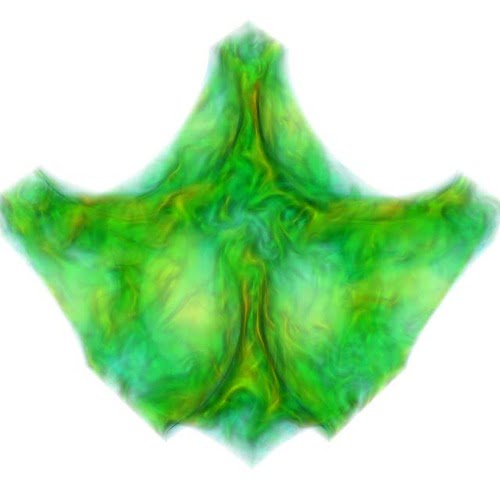
    In the summer of 2018, a group of researchers announced they’d discovered a new geometrical shape, the scutoid. They found the scutoid, a sort of twisted prism, in the shape of epithelial cells packed between curved surfaces. Having heard of this new geometry, a different group of physicists wondered if they could find scutoids elsewhere, specifically, in the cells of a foam. As shown in the picture above, they did.

    To visualize a scutoid, first image a prism. Take two polygons with an equal number of sides and connect them. But if you imagine packing such prisms between two curved surfaces, you’ll quickly see that it won’t work. They just don’t fit together. Instead, one face may adopt, say, six sides, while the other takes on five. To join those two end faces, one of the sides will have to have a Y-shaped junction and a triangular face. This is a scutoid.

    You can see two such shapes in the image above. In the left bubble, the far side forms a pentagon, while the near face is a hexagon. On the right, the bubble has six faces in the background and eight in the foreground. And between them, you can just see the triangular face that connects the two scutoids.

    It’s not only exciting to find scutoids in a new, non-biological medium; it suggests a physical mechanism behind their formation. Foams are a well-known example of energy minimization. The fact that scutoids are found in a curved foam suggests that the shape itself is connected to energy minimization, something that could help us understand how biological scutoids grow and form. (Image and research credit: A. Mughal et al.; via Physics World; submitted by Kam-Yung Soh)

  • Featured Video Play Icon

    An Introduction to Turbulence

    With some help from Physics Girl and her friends, Grant Sanderson at 3Blue1Brown has a nice video introduction to turbulence, complete with neat homemade laser-sheet illuminations of turbulent flows. Grant explains some of the basics of what turbulence is (and isn’t) and gives viewers a look at the equations that govern flow – as befits a mathematics channel! 

    There’s also an introduction to Kolmogorov’s theorem, which, to date, has been one of the most successful theoretical approaches to understanding turbulence. It describes how energy is passed from large eddies in the flow to smaller ones, and it’s been tested extensively in the nearly 80 years since its first appearance. Just how well the theory holds, and what situations it breaks down in, are still topics of active research and debate. (Video and image credit: G. Sanderson/3Blue1Brown; submitted by Maria-Isabel C.)

  • Chocolate Fountain

    Chocolate Fountain

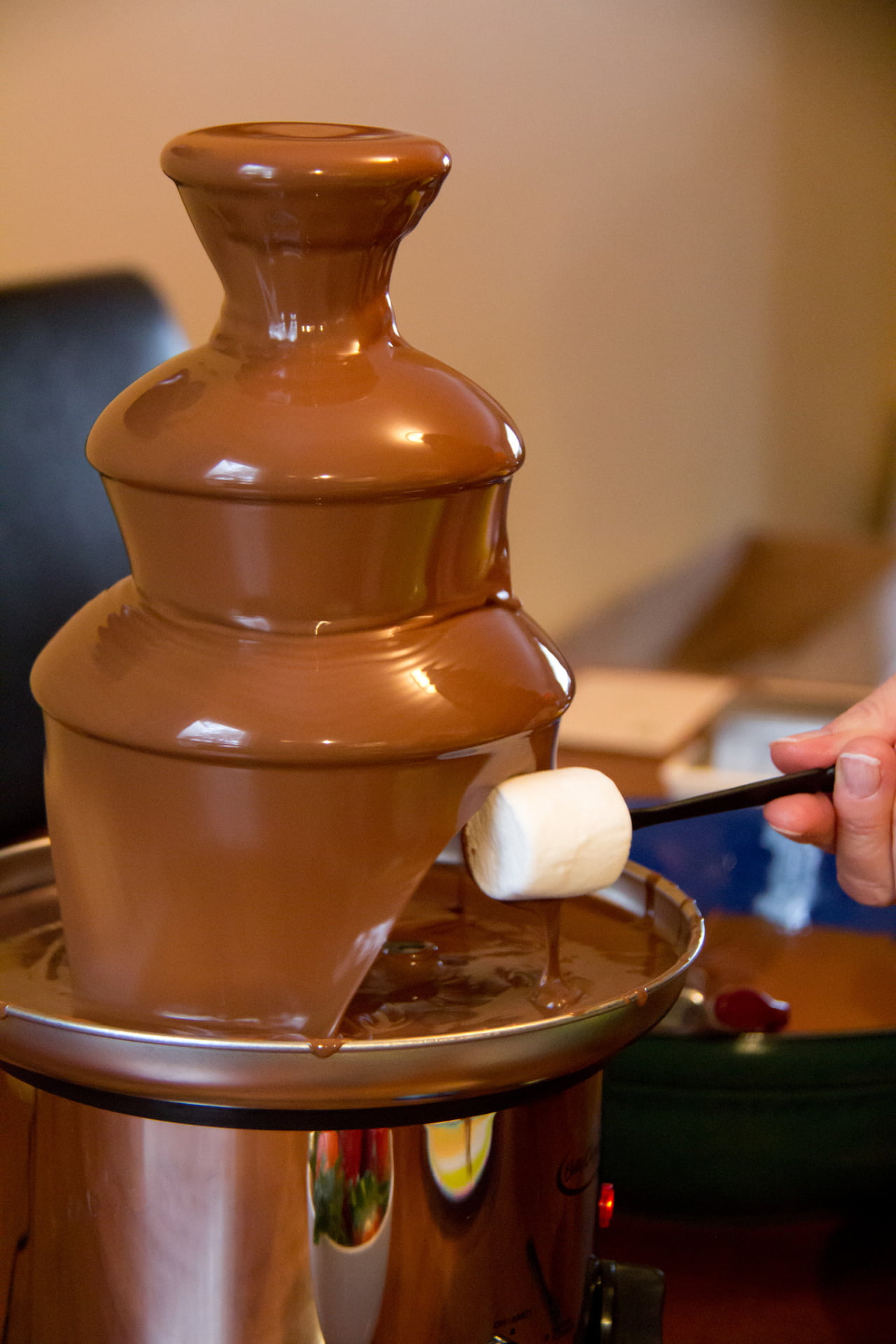
    Amidst your holiday celebrations, you may have encountered a chocolate fountain. In a recent paper, applied mathematicians have laid out the physics behind these delicious decorations, and it turns out they are an excellent introduction to many fluids concepts. Molten chocolate is a mildly shear-thinning, non-Newtonian fluid, meaning that it becomes less viscous when deformed. This adds a wrinkle to the mathematics describing the flow, but only a little one. The researchers divide the flow into three regimes: pipe flow driving the chocolate up the inside of the fountain, thin-film flow over the fountain’s domes, and, finally, the curtain of falling chocolate where foodstuffs are dipped. The final regime is the most mathematically challenging and may be the most fascinating. The authors found that the free-falling curtain of liquid pulls inward as it falls due to surface tension. Their paper is quite approachable, and I recommend those of you with mathematical inclinations check it out.  (Image credit: P. Gorbould; research credit: A. Townsend and H. Wilson)

  • Reader Question: Fractals and Turbulence

    Reader Question: Fractals and Turbulence

    Reader 3d-time asks:

    Hi, there is a guy, at my college, who is doing a master’s degree thesis in turbulence. He says he uses fractals and computational methods. Can you explain how fractals can be used in fluid dynamics?

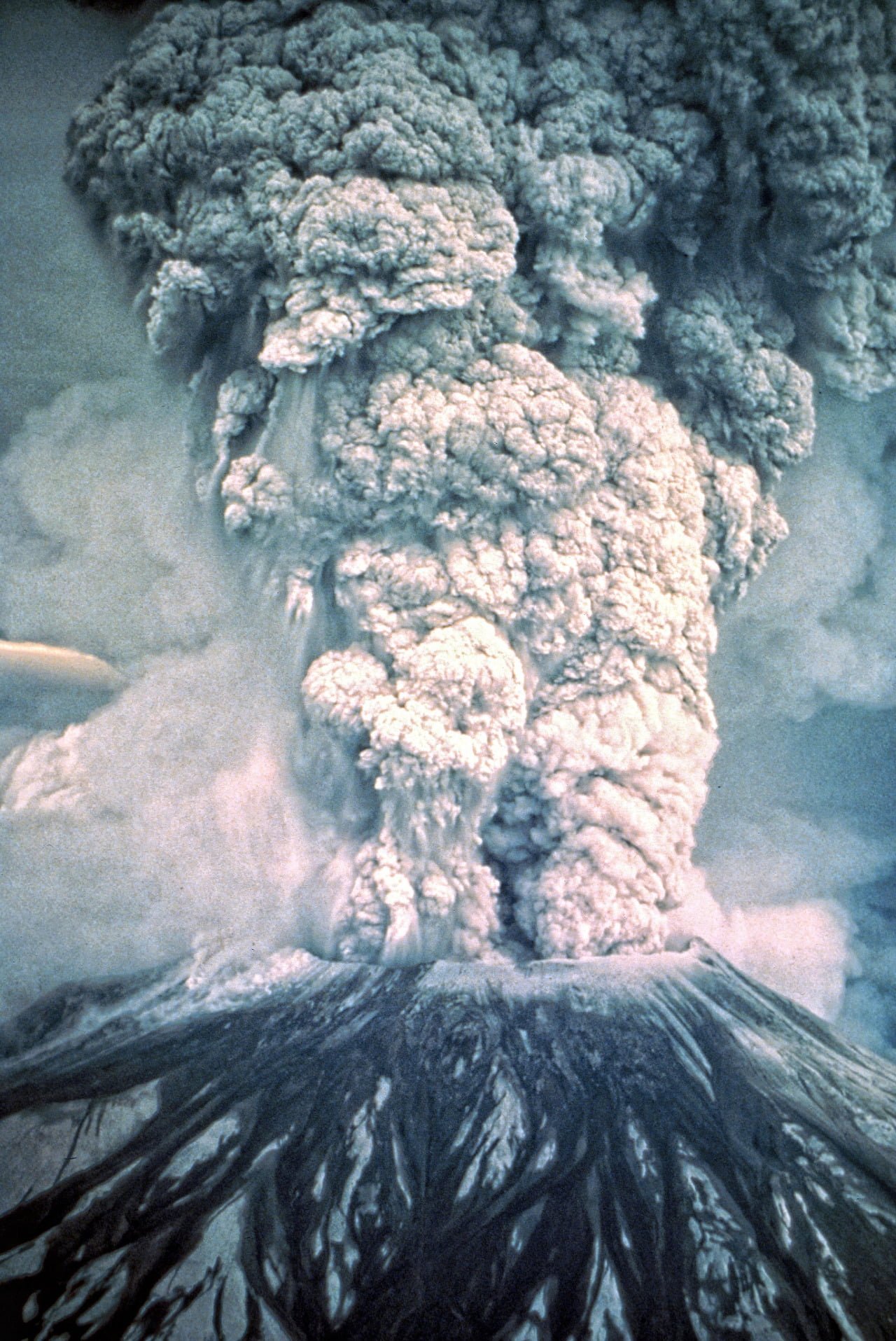
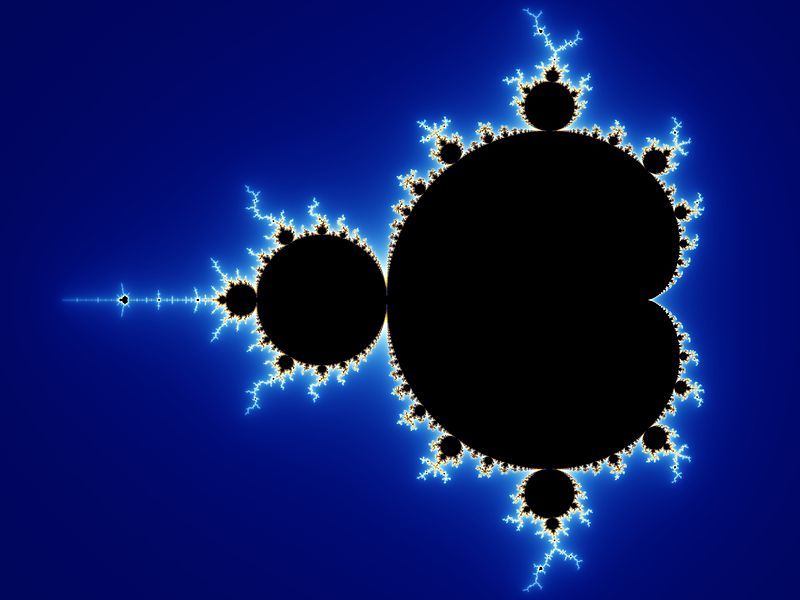
    That’s a good question! Fractals are a relatively recent mathematical development, and they have several features that make them an attractive tool, especially in the field of turbulence. Firstly, fractals, especially the Mandelbrot set shown above, demonstrate that great complexity can be generated out of simple rules or equations. Secondly, fractals have a feature known as self-similarity, meaning that they appear essentially the same regardless of scale. If you zoom in on the Mandelbrot set, you keep finding copy after copy of the same pattern. Nature, of course, doesn’t have this perfect infinite self-similarity; at some point things break down into atoms if you keep zooming in. But it is possible to have self-similarity across a large range of scales. This is where turbulence comes in. Take a look at the turbulent plume of the volcanic eruption in the photo above. Physically, it contains scales ranging from hundreds of meters to millimeters, and these scales are connected to one another by their motion and the energy being passed from one scale to another. There have been theories suggested to describe the relationship between these scales, but no one has yet found a theory truly capable of explaining turbulence as we observe it. Both the self-similarity and the complex nature of fractals suggest they could be useful tools in finally unraveling turbulence. In fact, Mandelbrot himself wrote several papers connecting the two concepts. Perhaps your friend will help find the next hints!  (Image credit: U.S. Geological Survey, Wikimedia)

  • Featured Video Play Icon

    River Paths

    As a follow-up to this recent post about river meander, check out this video from Numberphile about some of the mathematics behind the path of rivers. A river’s course is typically much longer than the direct distance between its origin and outlet; the ratio of these two distances is the river’s sinuosity. The fluid dynamics of a river’s bend tend to create stronger bends, but, once a bend reaches an extreme point, it will often be cut off, thereby straightening the river’s path. A model of unconstrained rivers suggests that, on average, the sinuosity of rivers should be about pi. As noted in the video, it would be very interesting to see how this theory holds up next to real rivers. But, given the way humans have fixed the course of rivers to prevent flooding, their current sinuosity is probably far from natural or unconstrained. (Video credit: Numberphile; research credit: H. Stølum; submitted by haxpaxmax)

  • Solution to a Millennium Prize Problem?

    Solution to a Millennium Prize Problem?

    Reports emerged this weekend that Kazakh mathematician Mukhtarbay Otelbaev has published a proposed solution to the Navier-Stokes existence and smoothness problem, one of the seven Millennium Prize problems offered by the Clay Mathematics Institute. Today I want to explain some of the background of this problem, what is known about Otelbaev’s proposed solution, and what a solution would mean for fluid dynamics.

    The Navier Stokes Equation

    The Navier-Stokes equation is one of the governing equations of fluid dynamics and is an expression of conservation of momentum in a fluid. With the exception of a few very specific and simplified cases, there is no known general solution to equation. Instead, the equation, or a simplified model, is solved numerically using supercomputers as part of direct numerical simulation (DNS) or other forms of computational fluid dynamics (CFD). These methods allow scientists and engineers to solve the equations of fluid motion for practical problems from flow through a pipe to flow around a re-entering spacecraft.

    Existence and Smoothness

    Although the Navier-Stokes equation has been known for more than 150 years and can be solved numerically for many situations, some basic mathematical aspects of the equation have not yet been proven. For example, no one has proven that a general solution always exists in three-dimensions and that the energy of such a solution is bounded at all points. Colloquially, this is known as the Navier-Stokes existence and smoothness problem. The Clay Mathematics Institute has a very specific problem statement (PDF) asking for a proof (or counter-proof) of the existence and smoothness of the Navier-Stokes equation for an incompressible fluid in three-dimensions. Otelbaev contends that he has provided such a proof.

    Otelbaev’s Proposed Solution

    Mukhtarbay Otelbaev is an experienced mathematician with numerous papers addressing related mathematical problems. His latest paper, entitled “Existence of a strong solution to the Navier-Stokes equation,” is freely available online (PDF, in Russian, with an English abstract at the end). There is an ongoing project to translate the paper into English, and mathematicians are already evaluating the validity of this proposed solution. From what I can gather of the paper, it specifically address the Millennium Prize problem and presents Otelbaev’s proposed solution for the existence and smoothness of an incompressible fluid in three dimensions with periodic boundary conditions.

    What It Means

    As with any announcement of a major technical breakthrough, skepticism is warranted while experts evaluate the proposal. If the mathematical community upholds the validity of Otelbaev’s proof, he may be offered the Millennium Prize and other honors. More importantly, his solution could lead to a better understanding of the nature of the equation and the flows it describes. It is not, in itself, a general solution to the Navier-Stokes equation, but it may be a stepping stone in the path toward one. In the meantime, scientists and engineers will continue to rely on a combination of theory, experiment, and computation to progress our understanding of fluid dynamics.

    For More

    The story of Otelbaev’s proof and the community’s evaluation of its validity is on-going. You can follow @fyfluiddynamics and the #NavierStokes hashtag on Twitter for updates and commentary. I’d like to specially thank Catriona Stokes, Praveen C, David Sarma, and Glenn Carlson for their helpful links and observations as this story develops.

  • Fluids Round-up – 16 November 2013

    Fluids Round-up – 16 November 2013

    Time for another fluids round-up. Here are your links:

    (Image credit: Ath3na)
  • Fluids Round-up – 2 November 2013

    Fluids Round-up – 2 November 2013

    Fluids round-up time! Here are your latest links:

    While not strictly fluid dynamical, I want to take a moment to talk about education. I receive a lot of stunned reactions and self-deprecation when people learn I study aerospace engineering. Many people say, “Oh, I could never do that!” or “You must be some kind of genius.” I’m not. It’s true that studying engineering and fluid dynamics involves a lot of math and some it is complex (no pun intended). There’s a lot of unfounded fear about science and math in our society, when really they are just skills that any of us can improve with practice and effort. So, for those out there who have ever thought, “I can’t do that, there’s too much math,” please watch this young woman address mathphobia. She sums up just about everything I’ve always wanted to tell you.
    (Photo credit: Argonne National Laboratory)
  • Incense in Transition

    Incense in Transition

    A buoyant plume of smoke rises from a stick of incense. At first the plume is smooth and laminar, but even in quiescent air, tiny perturbations can sneak into the flow, causing the periodic vortical whorls seen near the top of the photo. Were the frame even taller, we would see this transitional flow become completely chaotic and turbulent. Despite having known the governing equations for such flow for over 150 years, it remains almost impossible to predict the point where flow will transition for any practical problem, largely because the equations are so sensitive to initial conditions. In fact, some of the fundamental mathematical properties of those equations remain unproven. (Photo credit: M. Rosic)

  • Turning Sound Into Imagery

    Turning Sound Into Imagery

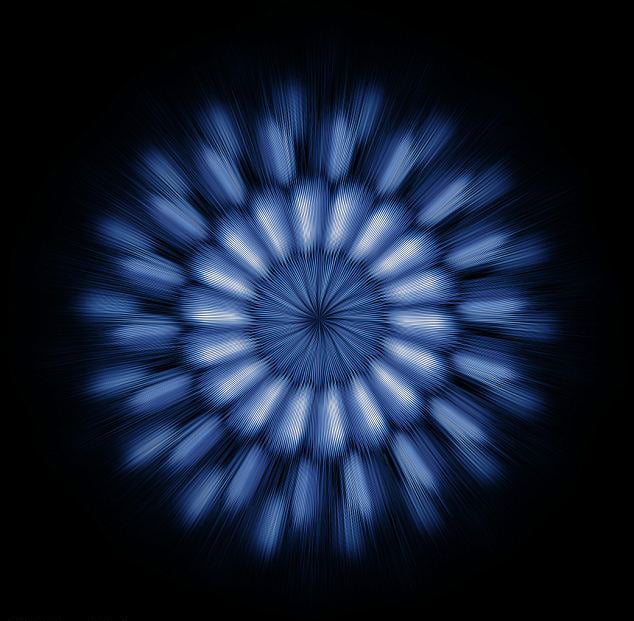
    The acoustic signatures of many animals contain features we humans cannot appreciate, given the limited range of frequencies we can hear. In fluid dynamics and many other fields, scientists and engineers have to find ways to analyze and decompose time-series data–like acoustic pressure signals–into useful quantities. Mark Fischer uses one tool for such analysis, a wavelet transform, to turn the calls of whales, birds, and insects into the colorful snapshots seen here. Wavelet transforms are somewhat similar to Fourier transforms but represent a signal with a series of wavelets rather than sinusoids. They’re also widely used for data compression. (Image credits: M. Fischer/Aguasonic Acoustics; via DailyMail)