Tag: laser

  • Lasers and Soap Films

    Lasers and Soap Films

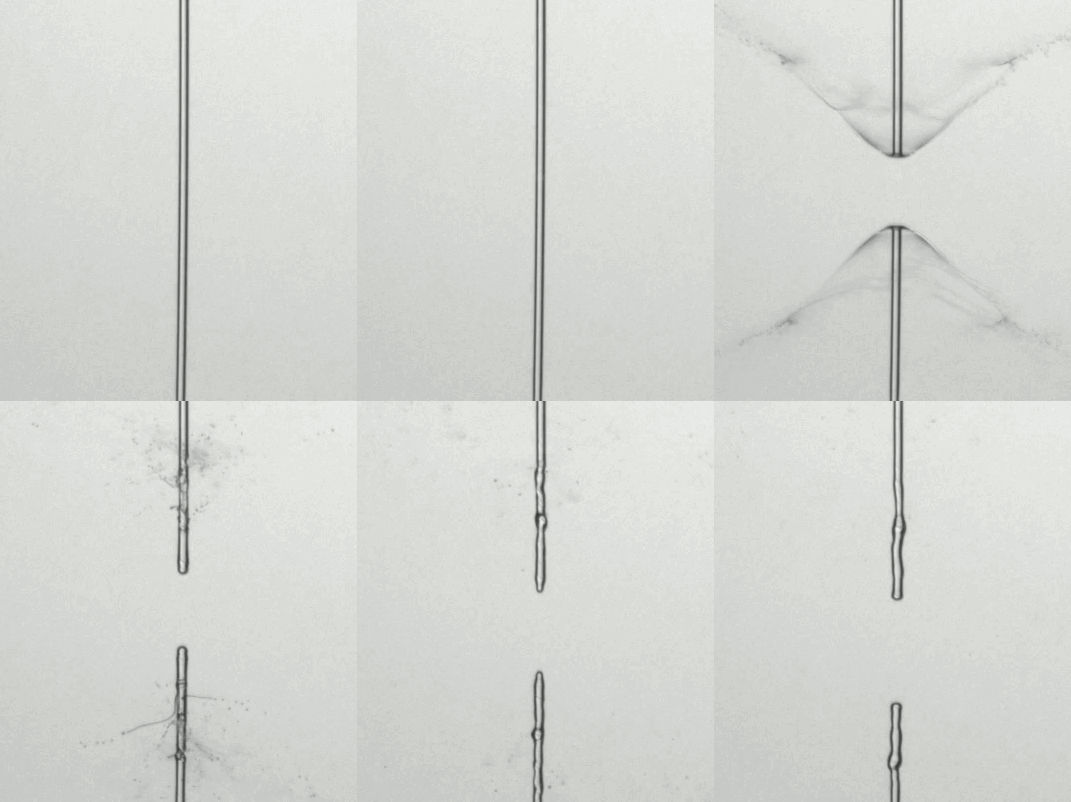
    Soap films are a great system for visualizing fluid flows. Researchers use them to look at flags, fish schooling and drafting, and even wind turbines. In this work, researchers explore the soap film’s reaction to lasers. When surfactant concentrations in the soap film are low, laser pulses create shock waves (above) in the film that resemble those seen in aerodynamics. The laser raises the temperature at its point of impact, lowering the local surface tension. That temperature difference triggers a Marangoni flow that draws the heated fluid outward. The low surfactant concentration gives the soap film relatively high elasticity, and that allows the shock waves to form.

    In contrast, a soap film with a high concentration of surfactants has relatively little elasticity. In these films (below), the laser creates a mark that stays visible on the flowing soap film. This “engraving” technique could be used to visualize flow in the soap film without using tracer particles. (Image and research credit: Y. Zhao and H. Xu)

    When surfactant concentrations are high, a laser pulse "engraves" spots onto a flowing soap film. Shown in terms of interference (left) and Schlieren (right) imaging.
    When surfactant concentrations are high, a laser pulse “engraves” spots onto a flowing soap film. Shown in terms of interference (left) and Schlieren (right) imaging.
  • Lasing Bubbles

    Lasing Bubbles

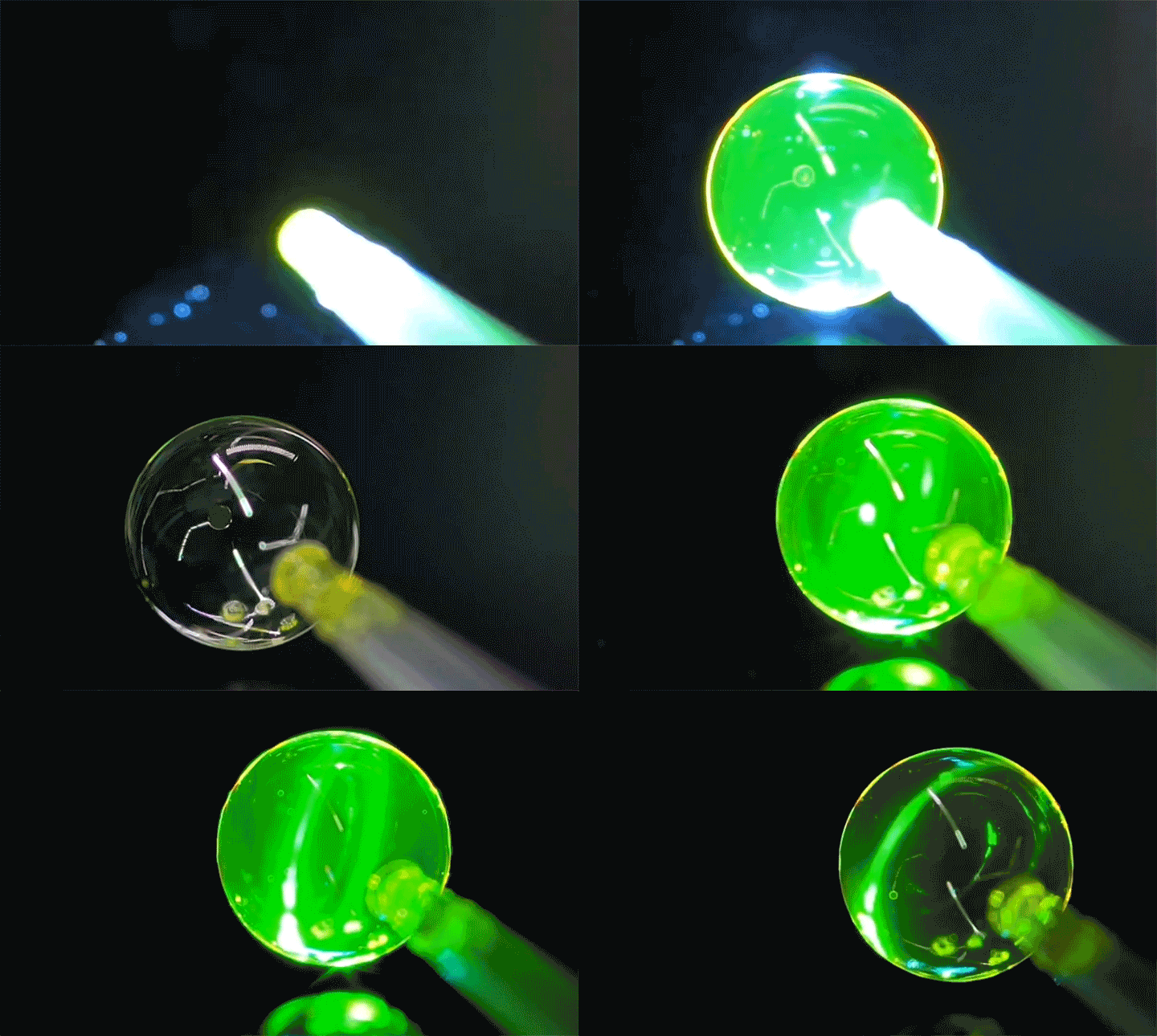
    The thin shells of bubbles interact with light in fascinating ways; that is, of course, the source of their brilliant colors. In this recent study, researchers discovered that bubbles can serve as tunable lasers. A laser has three major components: an energy source, an optical resonator, and a gain medium that amplifies light in the resonator. For bubble lasers, an external pump laser provides energy and the bubble’s thin shell acts as a resonator. Fluorescent dye in the bubble serves as the gain medium.

    Once formed, the bubble lasers are incredibly sensitive to electric fields and pressure changes, making them excellent sensors. For added stability, the team is using smectic liquid crystal bubbles, which, unlike soap bubbles, don’t evaporate easily. (Video, image, and research credit: Z. Korenjak and M. Humar; via APS Physics)

  • Laser-Induced Jet Break-Up

    Laser-Induced Jet Break-Up

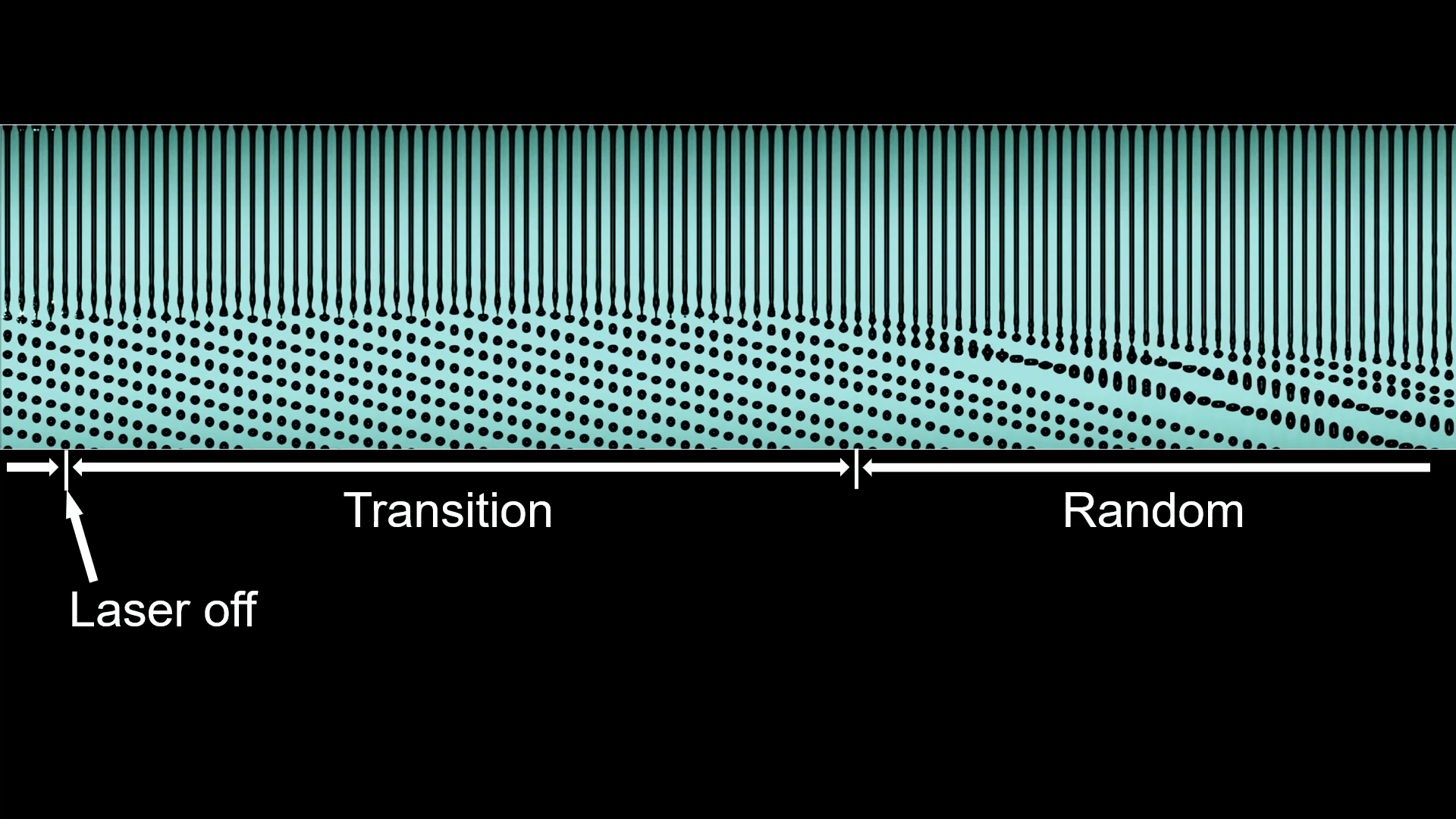
    A falling stream of water will naturally break up into droplets via the Plateau-Rayleigh instability. Those droplets are random, unless something like vibration of the nozzle sets their size. In this study, though, researchers found that shining a laser beam on the stream can trigger an orderly break-up with droplets that are consistent in size and spacing.

    The optofluidic phenomenon depends on a few different effects. The changing curvature of the liquid stream reflects the laser light, some of which undergoes total internal reflection and travels up the jet as if it were a fiber optic cable. Look closely in the right side of the second image, and you’ll see a periodic flicker of green light at the mouth of the nozzle. Those flashes of green reveal that the liquid jet is guiding the light upstream in bursts, each of which exerts an optical pressure that triggers the Plateau-Rayleigh instability.

    When the laser first turns on, there’s a transition period before the orderly break-up begins, and, likewise, turning the laser off triggers a transition from orderly to random (top image). (Image and research credit: H. Liu et al.; via APS Physics; submitted by Kam-Yung Soh)

  • The Best of FYFD 2020

    The Best of FYFD 2020

    2020 was certainly a strange year, and I confess that I mostly want to congratulate all of us for making it through and then look forward to a better, happier, healthier 2021. But for tradition and posterity’s sake, here were your top FYFD posts of 2020:

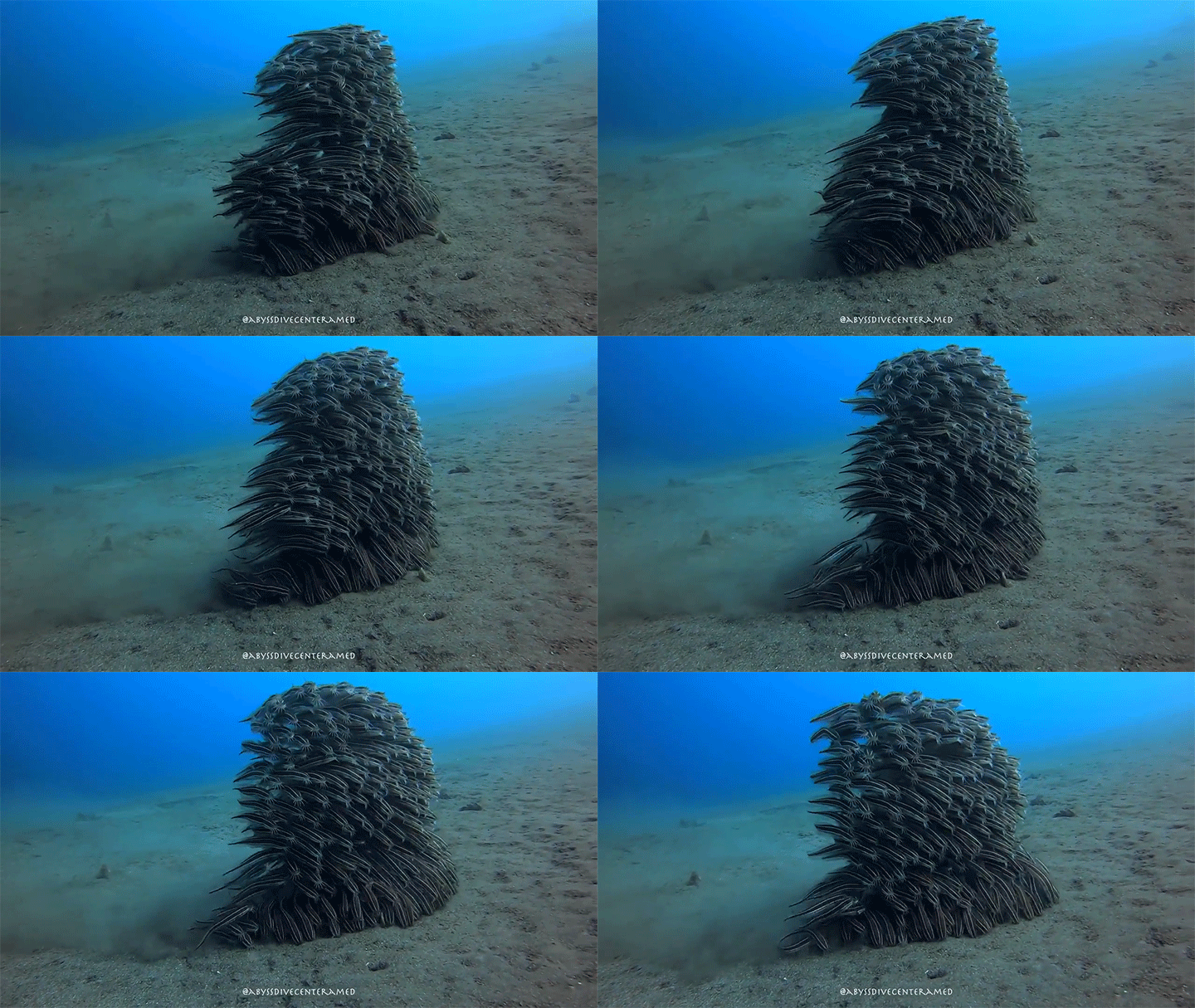
    1. Juvenile catfish collectively convect for protection
    2. Gliding birds get extra lift from their tails
    3. How well do masks work?
    4. Droplets dig into hot powder
    5. Updating undergraduate heat transfer
    6. Branching light in soap bubbles
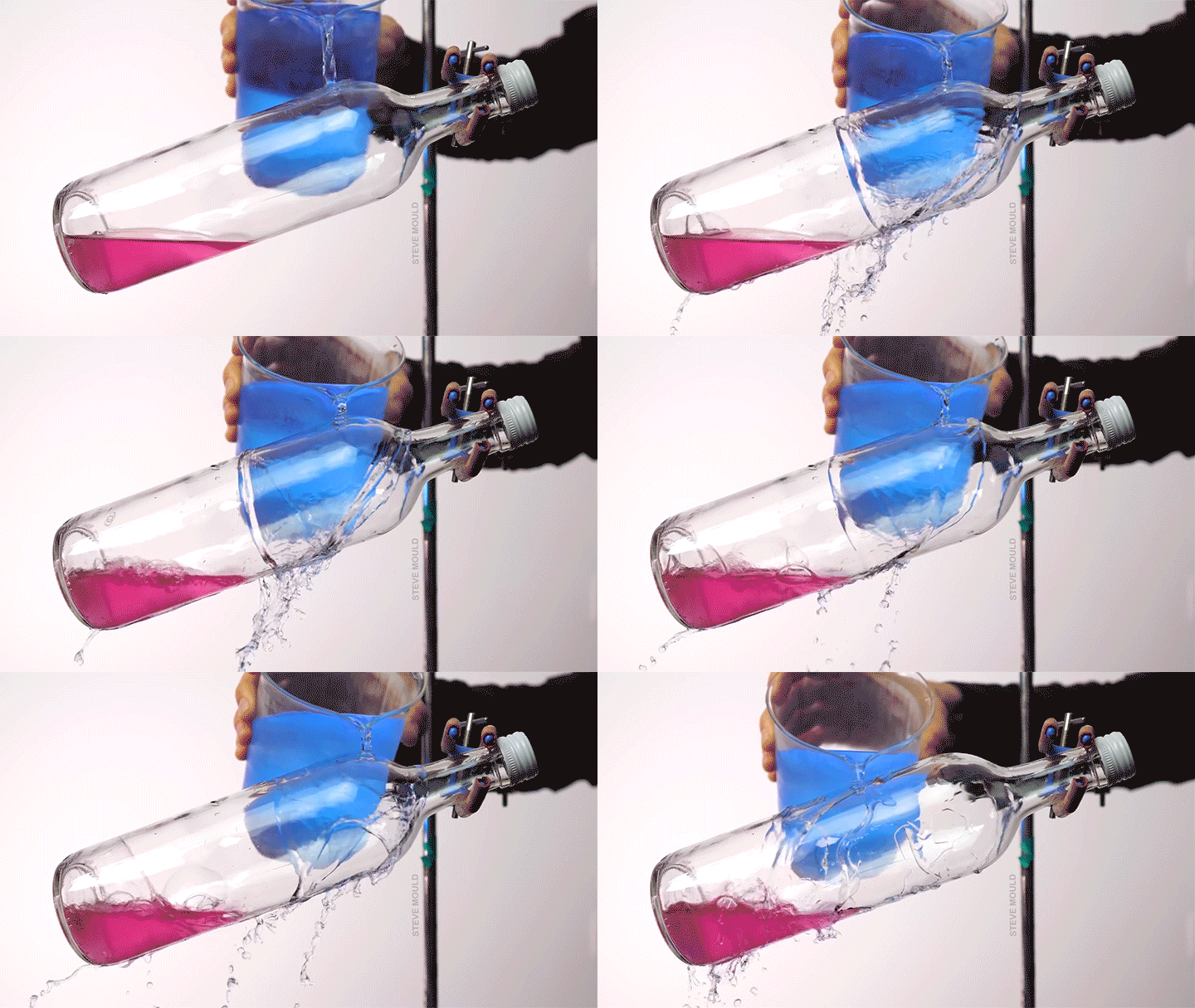
    7. Boiling water using ice water
    8. Concentric patterns on freezing and thawing ice
    9. Bouncing off superhydrophobic defects
    10. To beat surface tension, tadpoles blow bubbles

    There’s a good mix of topics here! A little bit of biophysics, some research, some phenomena, and some good, old-fashioned fluid dynamics.

    If you enjoy FYFD, please remember that it’s primarily reader-supported. You can help support the site by becoming a patronmaking a one-time donationbuying some merch, or simply by sharing on social media. Happy New Year!

    (Image credits: catfish – Abyss Dive Center, owl – J. Usherwood et al., masks – It’s Okay to Be Smart, droplet – C. Kalelkar and H. Sai, boundary layer – J. Lienhard, bubble – A. Patsyk et al., boiling – S. Mould, ice – D. Spitzer, defects – The Lutetium Project, tadpoles – K. Schwenk and J. Phillips)

  • Jets from Lasers

    Jets from Lasers

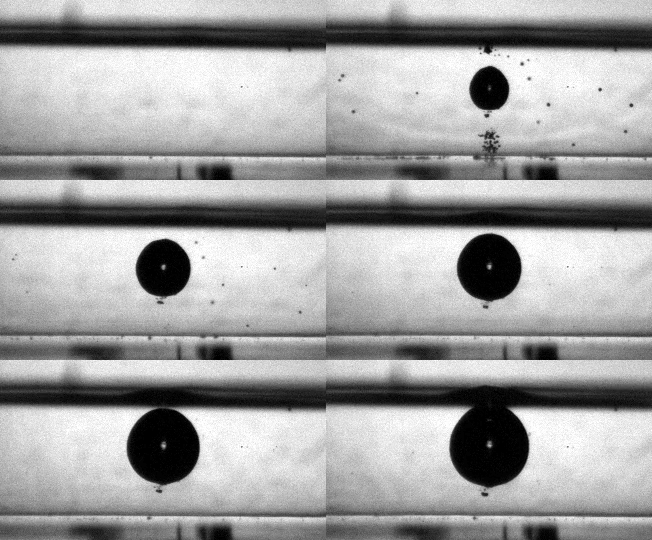
    Laser-induced forward transfer (LIFT) is an industrial printing technique where a laser pulse aimed at a thin layer of ink creates a tiny jet that deposits the ink on a surface. In practice, the technique is plagued with reproducibility issues, in part because it’s difficult to produce only a single cavitation bubble when aiming a laser at the liquid layer. This is what we see above. 

    The laser pulse creates its initial bubble just above the middle of the liquid layer. Shock waves expand from that first bubble and quickly reflect off the liquid surface (top) and wall (bottom). When reflected, the shock waves become rarefaction waves, which reduce the pressure rather than increasing it. This helps trigger the clouds of tiny bubbles we see above and below the main bubble. 

    The effect is worst along the path of the laser pulse because that part of the liquid has been weakened by pre-heating, but impurities and dissolved gases in the liquid layer are also prone to bubble formation, as seen far from the bubble. The trouble with all these unintended bubbles is that they can easily rise to the surface, burst, and cause additional jets of ink that splatter where users don’t intend. (Image and research credit: M. Jalaal et al.; submitted by Maziyar J.)

  • Laser Goggles for Parrotlets

    Laser Goggles for Parrotlets

    Many experimental techniques in fluid dynamics use lasers. One such technique, particle image velocimetry (PIV), introduces tiny particles into the flow and uses a laser to illuminate the particles. By taking pictures in rapid succession and comparing them, researchers can measure the velocity in different parts of the flow. This technique is incredibly powerful but it’s rarely used to study topics like animal flight, except using mechanical substitutes for live animals.

    Part of the reason researchers don’t typically use live animals in this type of experiment is that these very powerful lasers can blind people or animals that aren’t properly protected. So to protect their test subject, Stanford researchers designed and built a special pair of laser safety goggles for their parrotlet. This let the bird fly safely despite the lasers and enabled the researchers to measure flow around realistic bird flight conditions. (Image credit: Stanford News, source, and E. Gutierrez; research credit: E. Gutierrez et al.; submitted by Simon H. via Wired)

  • When Lasers Strike

    When Lasers Strike

    Lasers are a great way to deliver a lot of energy very quickly. In this animation, you see a jet of water get struck by a pulse from a powerful X-ray laser. The energy from that laser pulse gets absorbed by the water in a matter of picoseconds – that’s trillionths of a second. All that energy in so little time makes the water vaporize explosively. It’s this vapor explosion that breaks the jet in two. As the vapor expands outward, it forces water from the jet into a thin film that forms a cone. The conical film bends back on itself until it strikes the jet and coalesces. For more, check out this video of a similar experiment that looked at laser impacts on droplets. (Image credit: C. Stan et al., from Supplementary Movie 5; via Gizmodo)

  • Featured Video Play Icon

    Shooting Droplets with Lasers

    Last week we saw what happens when a solid projectile hits a water droplet; today’s video shows the impact of a laser pulse on a droplet. Several things happen here, but at very different speeds. When the laser impacts, it vaporizes part of the droplet within nanoseconds. A shock wave spreads from the point of impact and a cloud of mist sprays out. This also generates pressure on the impact face of the droplet, but it takes milliseconds–millions of nanoseconds–for the droplet to start moving and deforming. The subsequent explosion of the drop depends both on the laser energy and focus, which determine the size of the impulse imparted to the droplet. The motivation for the work is extreme ultraviolet lithography–a technique used for manufacturing next-generation semiconductor integrated circuits–which uses lasers to vaporize microscopic droplets during the manufacturing process. (Video credit: A. Klein et al.)

  • Featured Video Play Icon

    Laser-Induced Fluorescence

    As demonstrated in the video above, lasers can be used to excite molecules into a higher energy state, which will decay via the emission of photons, causing the medium to glow. This laser-induced fluorescence is utilized in several techniques for measurements in fluid dynamics, including planar laser-induced fluorescence (PLIF) and molecular tagging velocimetry (MTV). In these techniques a flow is usually seeded with a fluorescing material–nitric oxide is popular for super- and hypersonic flows–and then lasers are used to excite a slice of the flow field. The resulting fluorescence can be used for both qualitative and quantitative flow measurements. Here are a couple of examples, one in low-Reynolds number flow and one in combustion. (Video credit: L. Martin et al./UC Berkeley)

  • Featured Video Play Icon

    Particle Image Velocimetry

    One common experimental technique for measuring velocity in a flow is particle image velocimetry (PIV), shown above. Special particles are introduced–seeded–into the flow. Typically, these particles are small, neutrally buoyant, and have a refractive index significantly different from the background flow. One or more lasers are used to illuminate a section of the flow–a plane for 2D measurements or a cube for 3D. Rather than operating continuously, the laser is pulsed, producing very short exposure times of the order of hundreds of nanoseconds. A camera (or more than one camera for 3D measurements) captures a pair of images separated by this short exposure. The time between frames is so small that the particles will not have moved much between frames. Researchers can then correlate the two frames and derive velocity data from the motion of the particles.