In Syracuse, NY, artists and scientists work together to study volcanic flows by melting crushed basalt in a special furnace before releasing the lava into the parking lot. This particular flow is very prone to boiling behavior, likely because of the cold air and ground temperatures (less than 0 C). The outer layers of rock cool quickly, leaving bubble-shaped chambers which hotter lava can fill before melting out. (via It’s Okay To Be Smart; submitted by @jpshoer)
Tag: laminar flow

Reversing a Flow
The reversibility of laminar mixing often comes as a surprise to observers accustomed to the experience of being unable to separate two fluids after they’ve been combined. As you can see above, however, inserting dye into a highly viscous liquid and then mixing it by turning the inner of two concentric cylinders can be undone simply by turning the cylinder backwards. This works because of the highly viscous nature of Stokes flow: the Reynolds number is much less than 1, meaning that viscosity’s effects dominate. In this situation, fluid motion is caused only by molecular diffusion and by momentum diffusion. The former is random but slow, and the latter is exactly reversible. Reversing the rotation of the fluid undoes the momentum diffusion and any distortion remaining is due to molecular diffusion of the dye.
Smoke Flow Viz
Smoke visualization, illuminated by a laser sheet, shows a 2D slice from an axisymmetric jet as it breaks down to turbulence. The flow is laminar upon exiting the nozzle, but the high velocity at the edge of the jet and low velocity of the surrounding air causes shear that leads to the Kelvin-Helmholtz instability. This instability leads to the formation of small vortices that grow as they are advected downstream until they are large enough to interrupt the jet and it breaks down into fully turbulent flow. (Video credit: B. O. Anderson and J. H. Jensen)

Faces from Laminar Mixing

Transition to Turbulence
Smoke introduced into the boundary layer of a cone rotating in a stream highlights the transition from laminar to turbulent flow. On the left side of the picture, the boundary layer is uniform and steady, i.e. laminar, until environmental disturbances cause the formation of spiral vortices. These vortices remain stable until further growing disturbances cause them to develop a lacy structure, which soon breaks down into fully turbulent flow. Understanding the underlying physics of these disturbances and their growth is part of the field of stability and transition in fluid mechanics. (Photo credit: R. Kobayashi, Y. Kohama, and M. Kurosawa; taken from Van Dyke’s An Album of Fluid Motion)
Laminar and Turbulent Flows from a Faucet
Here laminar and turbulent flows, basic concepts in fluid mechanics, are demonstrated in the kitchen sink! While laminar flow is often desirable for decreasing drag due to friction, most practical flows are turbulent. The hissing the video author associates with the onset of turbulence is not a coincidence either. The chaotic motion of turbulent flows can produce aerodynamic noise like the roar produced by airplane propellers or the hum of electrical lines in the wind.
Toroidal Vortex
When instabilities exist in laminar flow, they do not always lead immediately to turbulence. In this video, a viscous fluid fills the space between two concentric cylinders. As the inner cylinder rotates, a linear velocity profile (as viewed from above) forms; this is known as Taylor-Couette flow. If any tiny perturbations are added to that linear profile–say there is a nick in the surface of one of the cylinders–the flow will develop an instability. In this type of flow, an exchange of stabilities will occur. Rather than transitioning to turbulence, the fluid develops a stable secondary flow–the toroidal vortex highlighted by the dye in the video. If the rotation rate is increased further other instabilities will develop.
Un-Mixing a Fluid Demo
Not only is this demonstration one of my favorites, it’s a reader favorite, too. Even though I posted it nearly a year ago, I’ve had it resubmitted over and over. Here’s what I originally wrote:
Laminar flow (as opposed to turbulence) has the interesting property of reversibility. In this video, physicists demonstrate how flow between concentric cylinders can be reversed such that the initial fluid state is obtained (to within the limits of molecular diffusion, of course!)
For more examples, see the first half of this video.
The results of those videos might be surprising, but they highlight the difference between laminar flow and turbulence. In laminar flow, the motion of the dye is caused by molecular diffusion and momentum diffusion, the latter of which is exactly reversible. In turbulence, much of the fluid motion is tied up in momentum convection, which is irreversible. This is why you can “unstir” the glycerin but not the milk in your coffee.

Osborne Reynolds and Transition

How and when flow through a pipe becomes turbulent has been a conundrum for fluid mechanicians since the days of Osbourne Reynolds (~1870s):
Typically, the laminar-to-turbulence transition is studied mathematically by linearizing the Navier-Stokes equations, the governing equations of fluid dynamics, then perturbing the system. These perturbations will gradually disappear in laminar flow, but if the flow is turbulent, they’ll grow and produce chaotic motion. The transition, then, is the critical point between these two.
However, for pipe flows, this linearized approach shows that the perturbations decay for all Reynolds numbers, even though this doesn’t happen in actual experiments. In the real world, as the Reynolds number increases, small, turbulent puffs begin to split and interact, and their lifetimes increase. Eventually, these puffs carry enough turbulence to transition the flow entirely. # (submitted by David T)

River Jumps

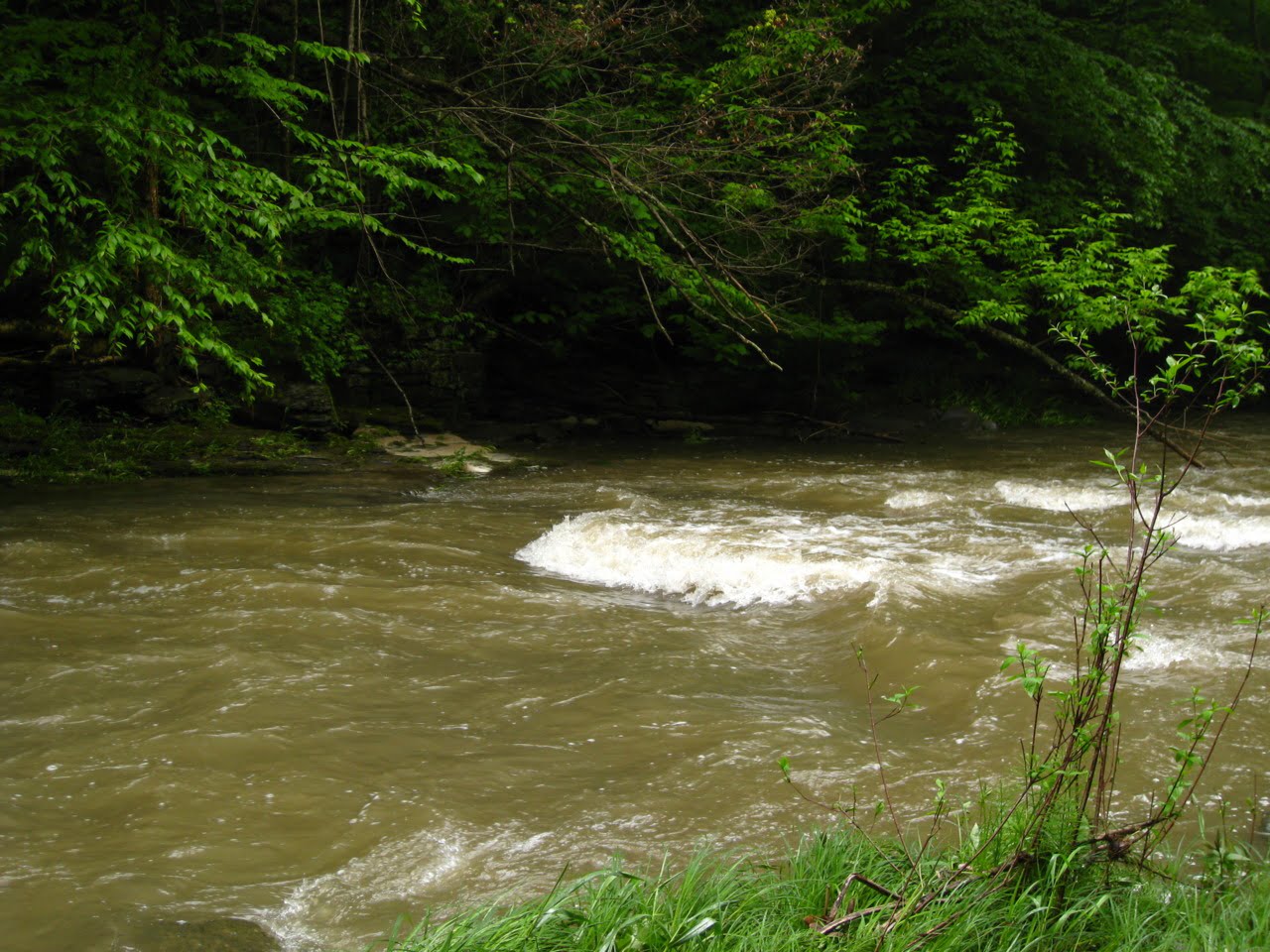
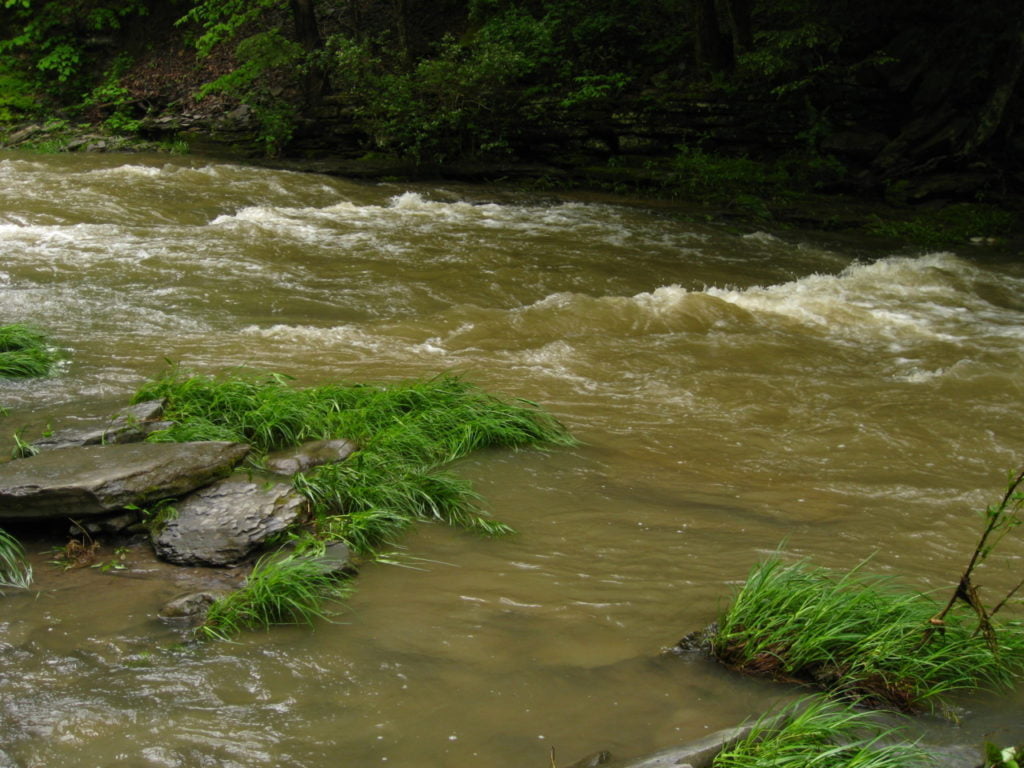
Hydraulic jumps occur when a high velocity liquid runs into an area of low velocity liquid. The faster moving liquid decelerates rapidly and increases in height, effectively trading kinetic energy for potential energy. The phenomenon is frequently observed in open channel flow, like in spillways or along rivers, as in the photos above. In nature, the hydraulic jump will often be laminar upstream and turbulent downstream. #