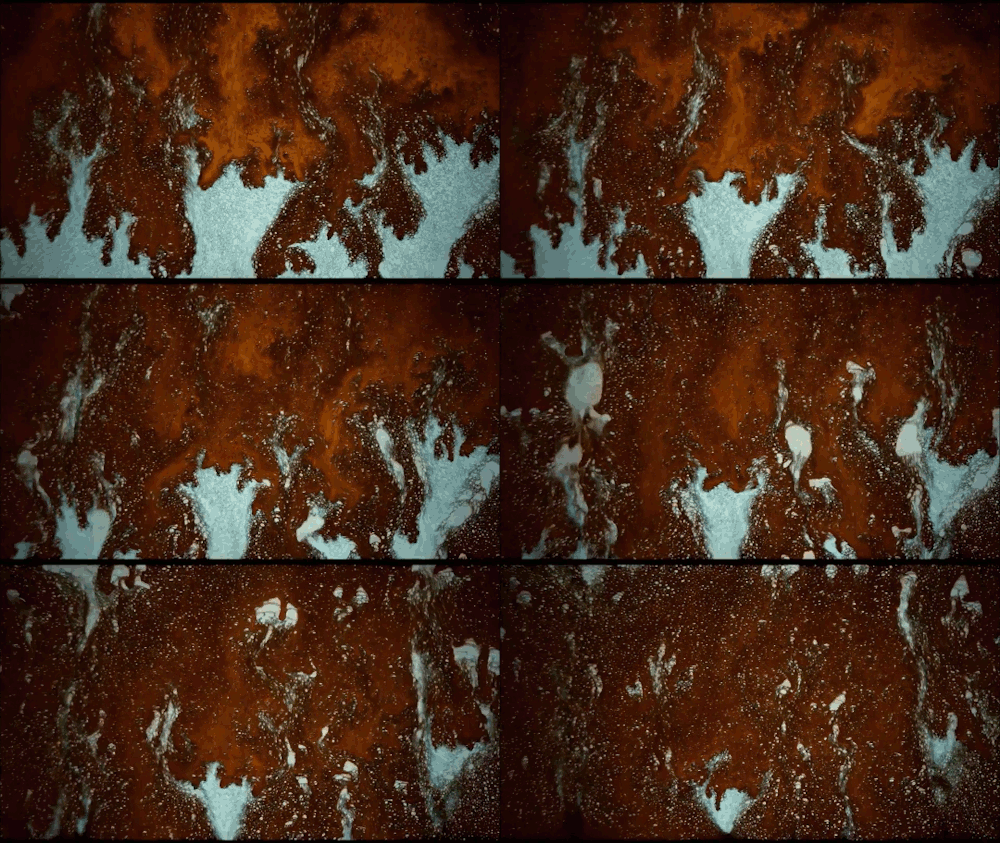
Imagine taking two panes of glass and setting them in a frame with a small gap between them. Then partially fill the gap with a mixture of dye, glycerol, water, and soap. After turning the frame over several times, the half of the frame will be filled with foamy bubbles. When you flip it again, the dyed glycerol-water will sink and penetrate the bubble layer, creating complex and beautiful patterns as it mixes. Some of the bubbles may get squeezed together until they coalesce into larger bubbles that shoot upward thanks to their increased buoyancy. Other smaller bubbles will wend their way upward as neighboring fluid shifts. If you examine the tracks left by individual bubbles, you can find patterns reminiscent of Impressionist paintings, as seen at the end of this Gallery of Fluid Motion video. (Image credit: A. Al Brahim et al., source)
Tag: foam

Putting Out Fires
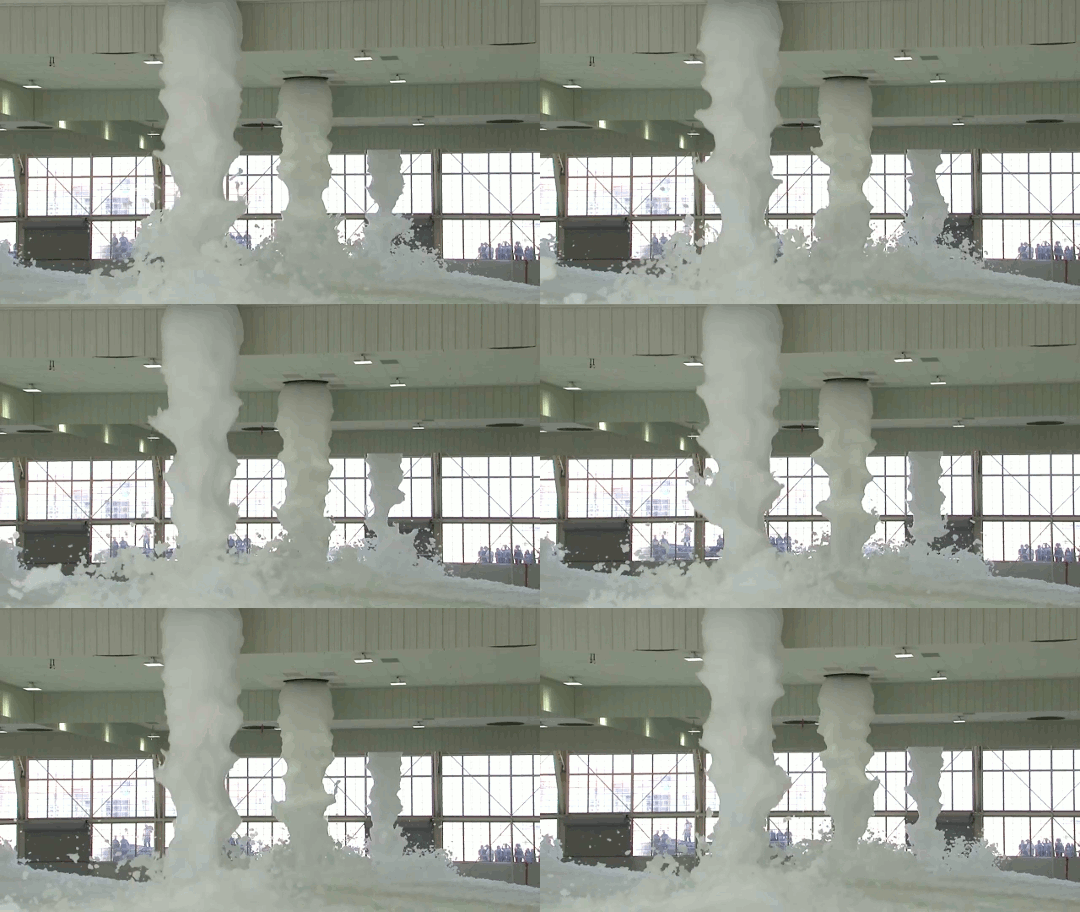
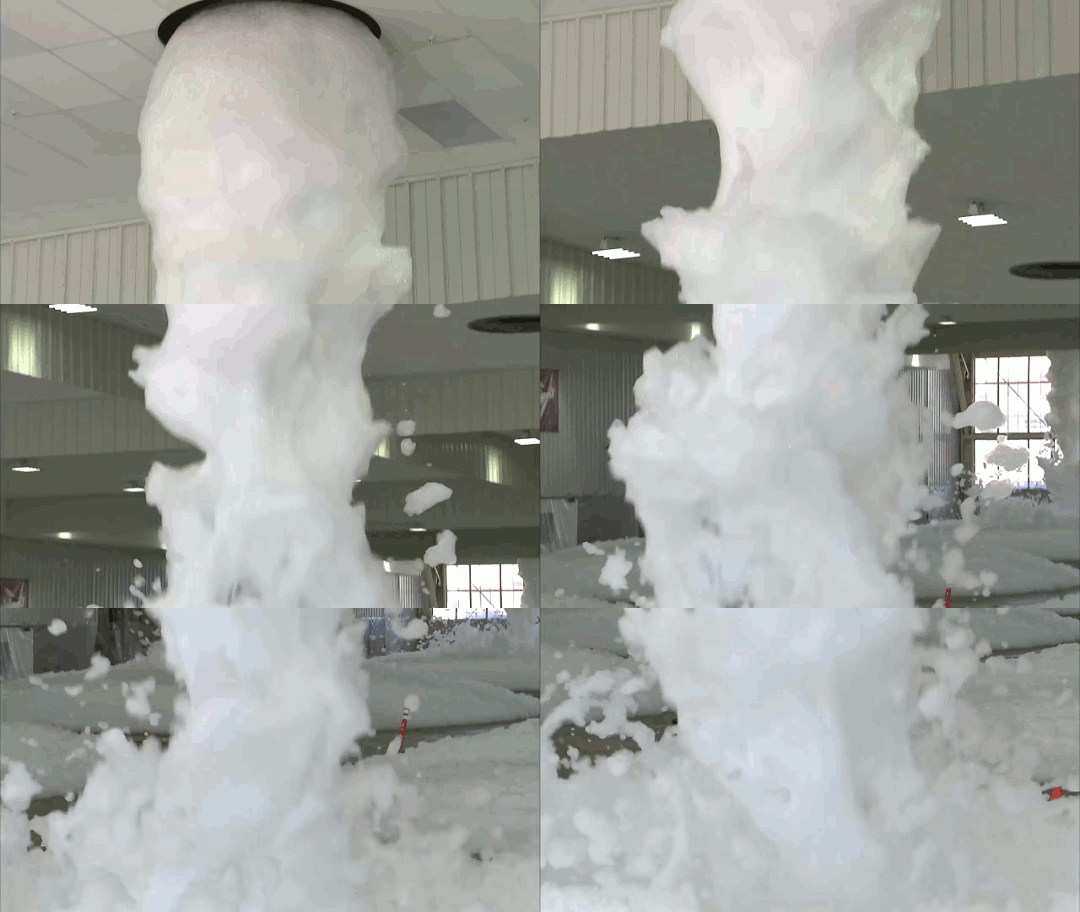
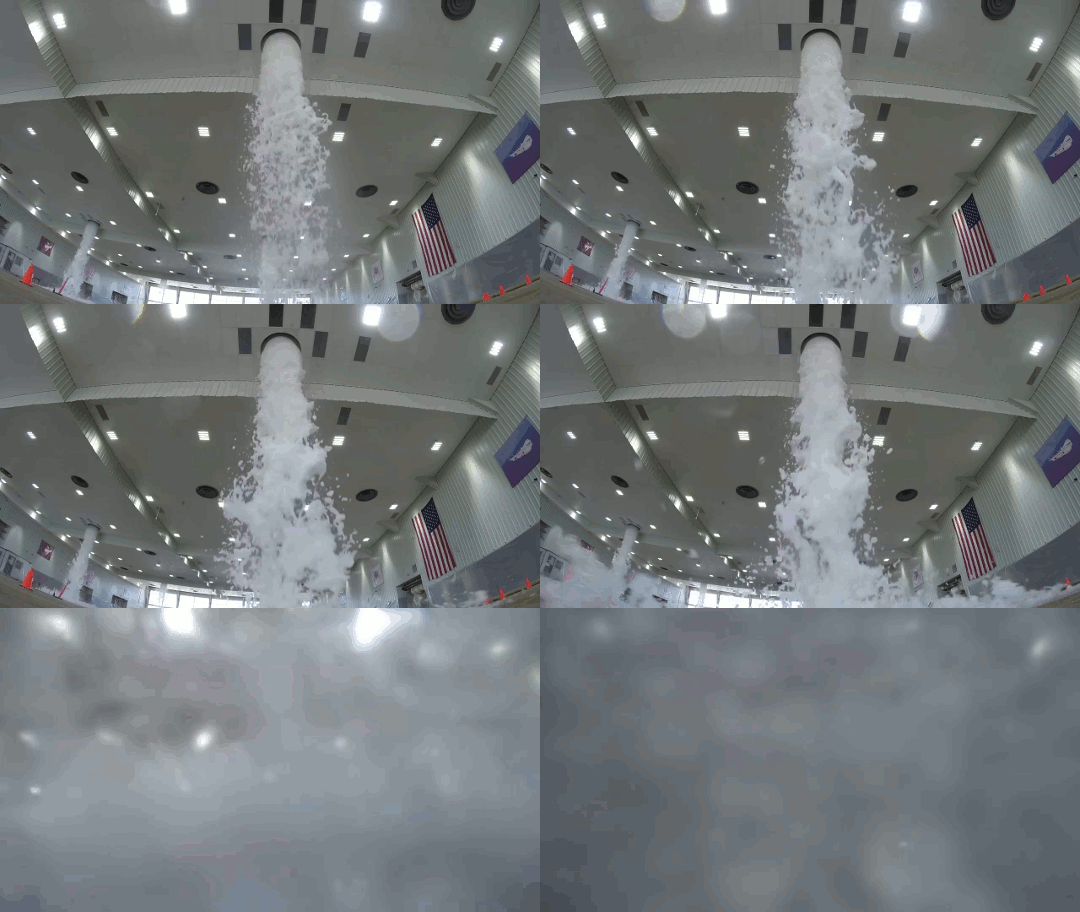
Fires in large, open spaces like aircraft hangers can be difficult to fight with conventional methods, so many industrial spaces use foam-based fire suppression systems. These animations show such a system being tested at NASA Armstrong Research Center. When jet fuel ignites, foam and water are pumped in from above, quickly generating a spreading foam that floats on the liquid fuel and separates it from the flames. Since the foam-covered liquid fuel cannot evaporate to generate flammable vapors, this puts out the fire.
The shape of the falling foam is pretty fascinating, too. Notice the increasing waviness along the foam jet as it falls. Like water from your faucet, the foam jet is starting to break up as disturbances in its shape grow larger and larger. For the most part, though, the flow rate is high enough that the jet reaches the floor before it completely breaks up. (Image credit: NASA Armstrong, source)

Carbonation in Space
Astronauts don’t typically drink soda or other carbonated beverages while in space. The reason is probably apparent if you watch this new video of an effervescent tablet in water on the space station (or, you could watch the older classic one from Don Pettit). Unlike on Earth, where the carbon dioxide bubbles are buoyant and rise to the surface, the bubbles in a fluid in microgravity are randomly distributed. Those few bubbles that happen to be located along the edge of the water sphere will sometimes burst, creating the halo of tiny droplets you see in the video. In the case of sodas, though, the bubbles’ behavior creates a foamy mess, and, after ingestion, the bubbles are stuck travelling through the astronaut’s digestive system instead of getting burped out. Sounds rather unpleasant to me. (Video credit: NASA; submitted by entropy-perturbation and buckitdrop)
——————
LAST CALL: Help us do some science! I’ve teamed up with researcher Paige Brown Jarreau to create a survey of FYFD readers. By participating, you’ll be helping me improve FYFD and contributing to novel academic research on the readers of science blogs. It should only take 10-15 minutes to complete. You can find the survey here.

Sea Foam
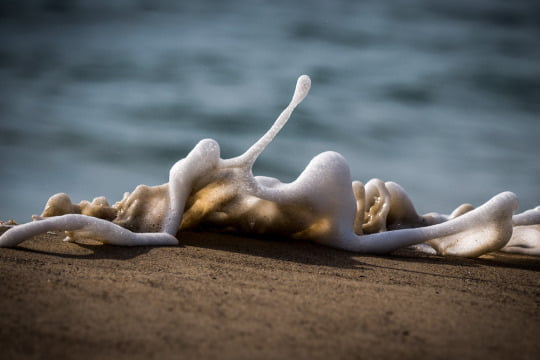
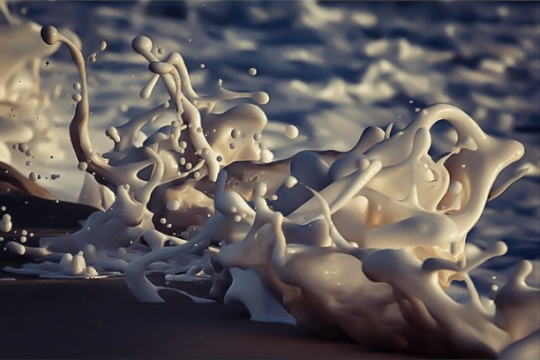
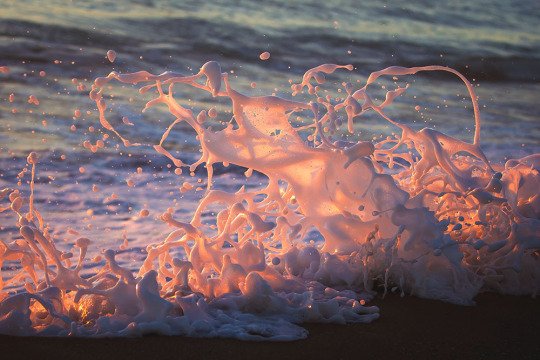
Photographer Lloyd Meudell captures surrealistic images of breaking sea foam.
Interestingly, the sea foam is essentially a three-phase fluid made up of air, water, and sand. Yet despite the surrealism of its forms, the foam bears strong resemblance to other flows. The shapes the foam forms are reminiscent of vibrated non-Newtonian fluids like paint or oobleck. Momentum deforms the foam into sheets and ligaments smoothed and held together by surface tension until droplets snap free. You can find more of Meudell’s work at his site. (Image credits: L. Meudell; via freakingmindblowing; submitted by molecular-freedom)

Oily Foams
It is common in many industries to use oil as a defoamer to break up existing foams or prevent foams from forming. But with the right surfactants–additives that change the foam’s surface tension–it’s possible to make aqueous foams that are actually stabilized by the presence of oil. This video explores some of the ways that oil can interact with these kinds of foam, beginning with capillary action, which draws the oil up into the junctions between foam films. For more, see Piroird and Lorenceau. (Video credit and submission: K. Piroird)

Overflowing Foam
Hitting a glass bottle full of a non-carbonated drink can shatter the bottle due to cavitation, but doing the same with a carbonated beverage can make the bottle overflow with foam. The video above breaks down the physics of this bar prank. It all begins with nucleation and the tiny bubbles of carbon dioxide that form in the liquid. Striking the top of the bottle generates a compression wave that travels through the liquid, shrinking bubbles as it passes. When it hits the bottom of the bottle, it gets reflected as an expansion wave that expands the bubbles. This reflection happens several times between the free surface of the liquid and the bottom of the bottle. The rapid collapse-and-expansion of the bubbles makes them implode into a cloud of tinier bubbles that expands until the local supply of carbon dioxide is used up. At this point, the buoyancy of the bubbles carries them upward in plumes, creating more bubbles with the dissolved carbon dioxide nearby. And, all of a sudden, you’ve got foam everywhere. Like all of this week’s videos, this video is an entry in the 2013 Gallery of Fluid Motion. (Video credit: J. Rodriguez-Rodriguez et al.)

Foam Array
Soap foams represent an interplay of gravitational, capillary, interfacial, and viscous forces, none of which is easily isolated in a laboratory experiment. This makes it difficult to sort out the various effects governing the foam since individual variables cannot be controlled independently. The image above is of a special foam, one in which the liquid phase has been replaced with a ferrofluid. This adds an additional parameter–external magnetic fields–to the problem, but, unlike the others, this is an independent variable. By manipulating the external magnetic field, researchers can control the foam’s drainage rate and even the structure it takes on. (Photo credit: E. Janiaud)

Guinness Physics
Take a look at the physics of a pint of Guinness, including the formation of foam, the circulation of bubbles, and the importance of nitrogen and surfactants. The Physics of Fluids paper the host refers to is available here. (And, yes, I will admit to debating the physics occurring in my pint glass while in a pub.) # (via Martin)