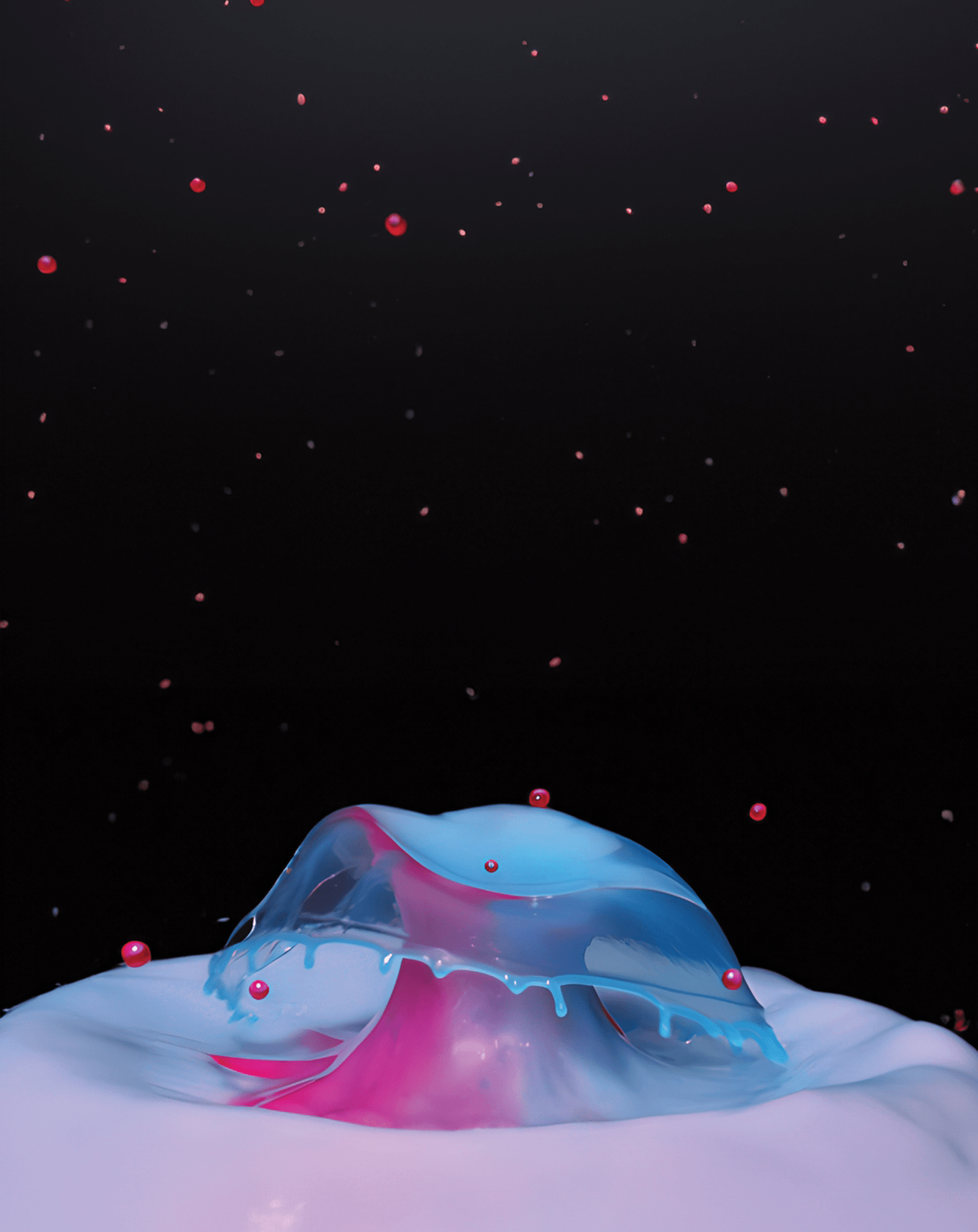
Since Harold Edgerton’s experiments with stroboscopic photographs in the 1930s, we’ve been fascinated by the shape of splashes. These days students and artists can take advantage of programmable external flashes to capture this split-second moment of impact. Here, a pink-dyed drop of ethanol strikes a jet rising from a pool of glycerin, milk, and food coloring. The resulting splash is umbrella-like, with a thickened rim that shows tiny ligaments of fluid — an early sign of the instability that will ultimately detach droplets from the splash. This image was taken by students in a course that connects art and fluid mechanics. (Image credit: L. Sharpe et al.; via Physics Today)
Tag: fluid dynamics

How Water Droplets Charge Up
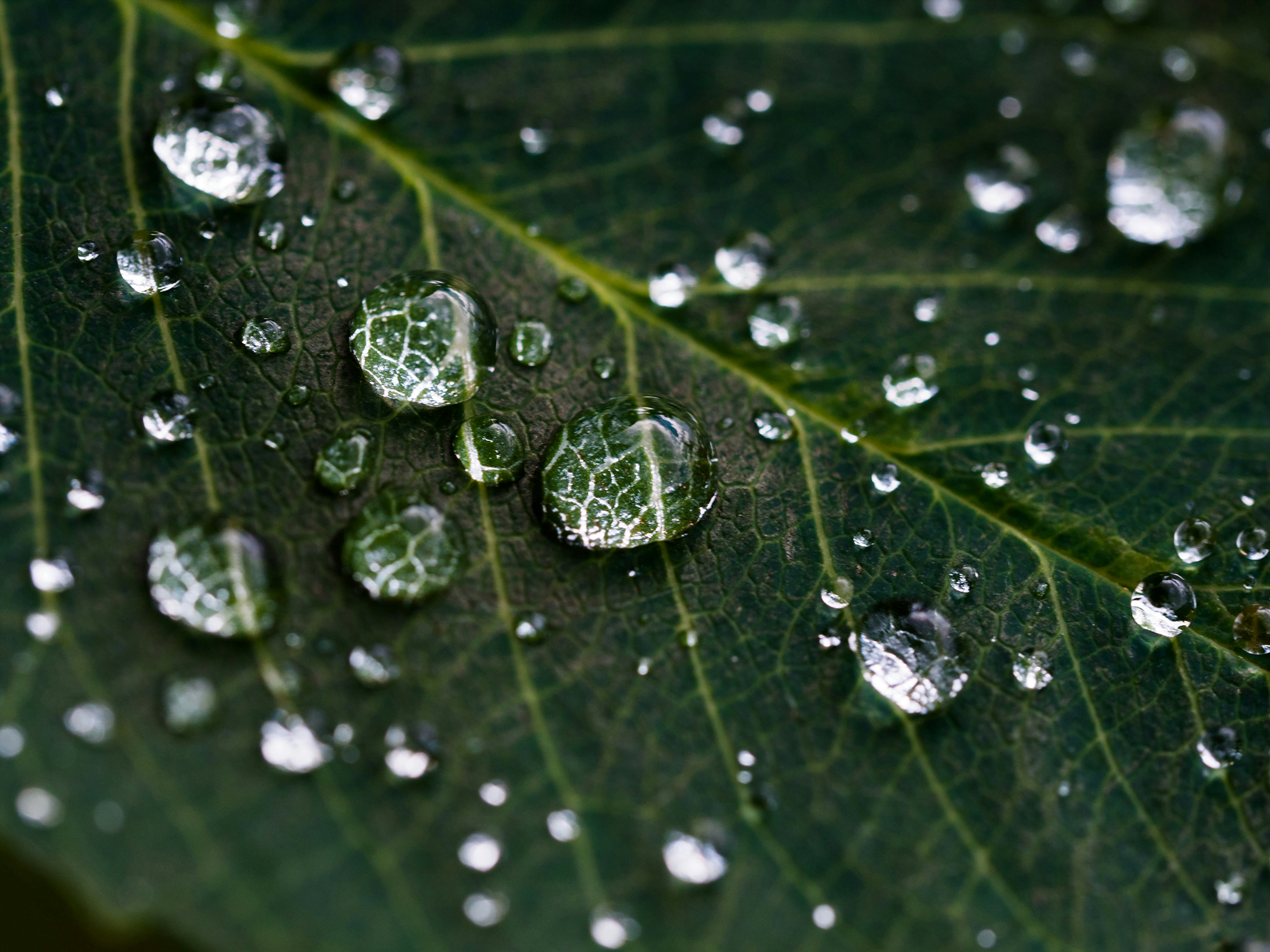
Rubbing a balloon on your hair can build a significant electrical charge. Water droplets have the same issue when they slide across a hydrophobic, electrically-insulated surface. A new study models why these charges build up and tests the model both experimentally and through simulation. They focused their theory on three effects that determine how much charge builds up. The first is a two-way chemical reaction that continuously creates charge at the interface, with positive charge building in the drop. Secondly, the drop’s contact angle with the surface sets how many protons can build up at the contact line, thereby affecting the electrical field they generate. And, finally, fluid motion at the rear of the drop deflects protons upward, shifting the electrical field. In particular, their model predicts that the higher contact angles of hydrophobic surfaces should increase charge build-up and faster sliding velocities should slow charge build-up, both of which agree with experiments.
The model should help researchers understand various charging scenarios, like those found on self-cleaning surfaces, in inkjet printing, and in semiconductor manufacturing. In the last scenario, rinsing semiconductor wafers in ultrapure water can build up charges in the kilovolt range, which is enough to damage the product. (Image credit: D. Carlson; research credit: A. Ratschow et al.; via APS Physics)

Mardi Gras Pass
The mighty Mississippi River has long been bound by humanity’s efforts. To keep the river in place and control its flooding, engineers have built levees, canals, and other structures. But those efforts have come with costs. Where the wild Mississippi used to deposit sediment and build new land, the bound river sends its sediment out to sea, contributing to wetland erosion. But sometimes the river still exerts its own control.
In 2012, around the time of Mardi Gras, the river broke through its eastern bank (near an existing canal) and created a new channel to the Gulf of Mexico. Known as Mardi Gras Pass, this distributary waterway now contributes fresh sediment, nutrients, and water to the Louisiana wetlands. Despite its small size, observations indicate that the Mardi Gras Pass is, indeed, helping to build new land in the area. (Image credit: J. Stevens; via NASA Earth Observatory)

How to Run on Water
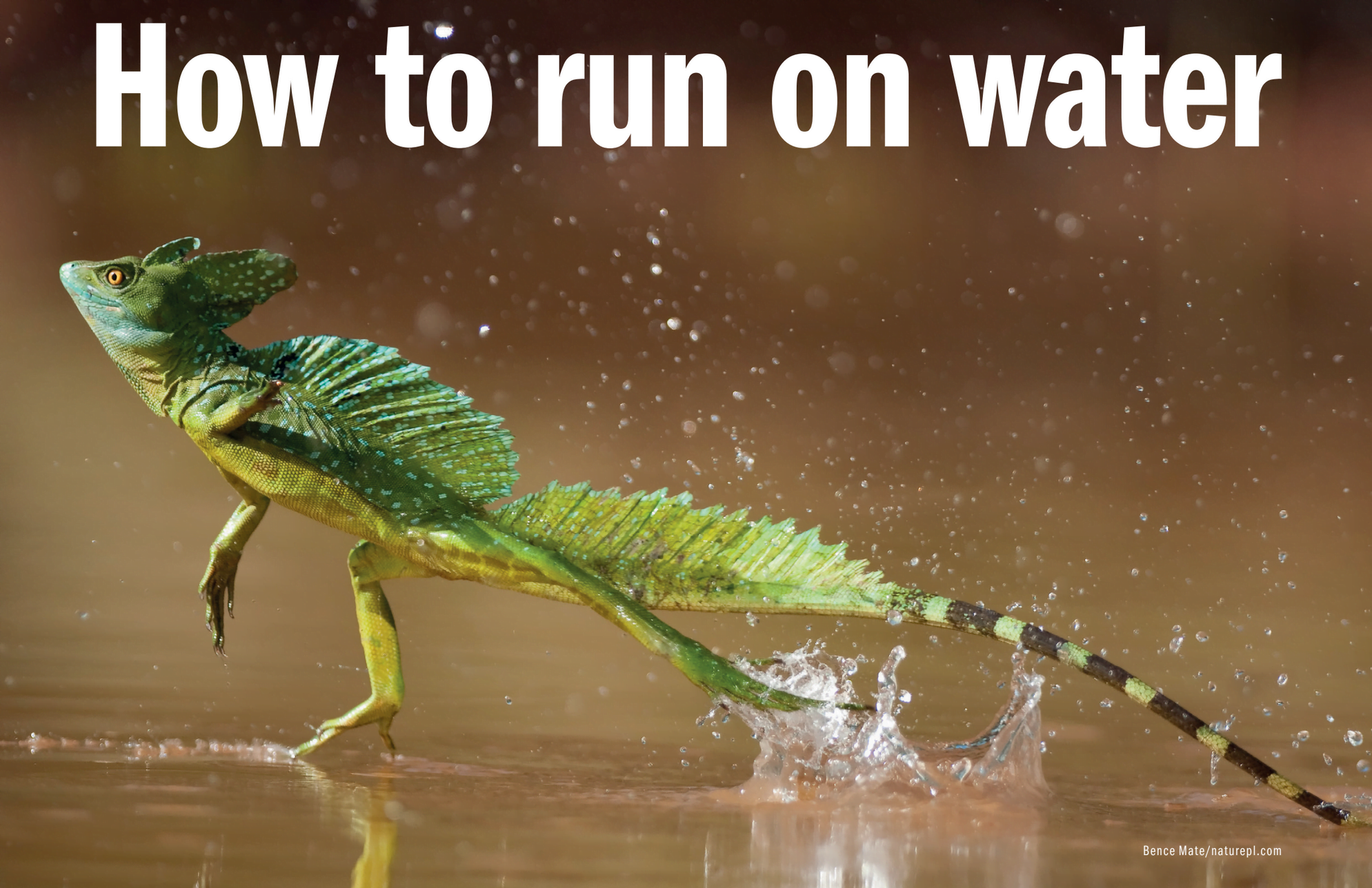
Ahead of the Olympics, I’ve written a feature article for Physics World that explores how basilisk lizards and grebes run on water and what it would take for a human runner to do the same. Check it out! (Image credit: B. Mate; see Physics World)

A Shallow Origin for the Sun’s Magnetic Field
The Sun‘s complex magnetic field drives its 11-year solar activity cycle in ways we have yet to understand. During active periods, more sunspots appear, along with roiling flows within the Sun that scientists track through helioseismology. Longstanding theories posit that the Sun’s magnetic field has a deep origin, about 210,000 kilometers below the surface. But new measurements have prompted an alternate theory: that the Sun’s magnetic field originates in its outer 5-10% due to a magnetorotational instability.
Magnetorotational instabilities are usually associated with the accretion disks around black holes and other massive objects. When an electrically-conductive fluid — like the Sun’s plasma — is rotating, even a small deviation in its path can get magnified by a magnetic field. In accretion disks, these little disruptions grow until the disk becomes turbulent.
By applying this idea to the sun, researchers found they were better able to match measurements of the plasma flows beneath the Sun’s surface. With measurements from future heliophysics missions, they believe they can work out the mechanisms driving sunspot formation, which would help us better predict solar storms that can damage electronics here on Earth. (Image credit: NASA/SDO/AIA/LMSAL; research credit: G. Vasil et al.; via Physics World)

Wasps in Flight


Personally, I’ve had some bad encounters with wasps, but Dr. Adrian Smith of Ant Lab feels the insects receive short shrift. In this video, he shows many species in the order — most of which are venomless and stingless. In high-speed video, their flight is mesmerizing. Wasps have separate fore- and hindwings, but during flight, they move them like a single wing. Velcro-like hooks on the edges of the wings hold the two together.
From a mechanics perspective, I find this fascinating. Aerodynamically, I’d expect much greater benefits from one large wing over two small ones, but outside of flight, separate wings are more easily tucked away. It’s so neat that wasps have a way to enjoy the benefits of both, enabled by a simple but secure line of hooks. (Video and image credit: Ant Lab/A. Smith)
“Emitter”


For this latest experimental film, artist Roman De Giuli provides a glimpse of the unique fluid art machine he’s built over the last 3.5 years. With 10 channels driven by peristasltic tube pumps and stepper motors, his “printer” drips up to 10 colors on a paint-covered, tilted canvas to create these beautiful images. As he says in his description of the invention, the set-up produces paint layering that’s almost impossible to create by hand. Fluid dynamically speaking, we’re seeing gravity currents like a lava flow or avalanche that are mixing together viscously. There’s also some added effects from density differences between different layered paint colors. Artistically, this machine offers an infinite palette of visual opportunities; financially, though, De Giuli admits its an absolute beast at consuming paint! (Image and video credit: R. De Giuli)

Viscous Fireworks
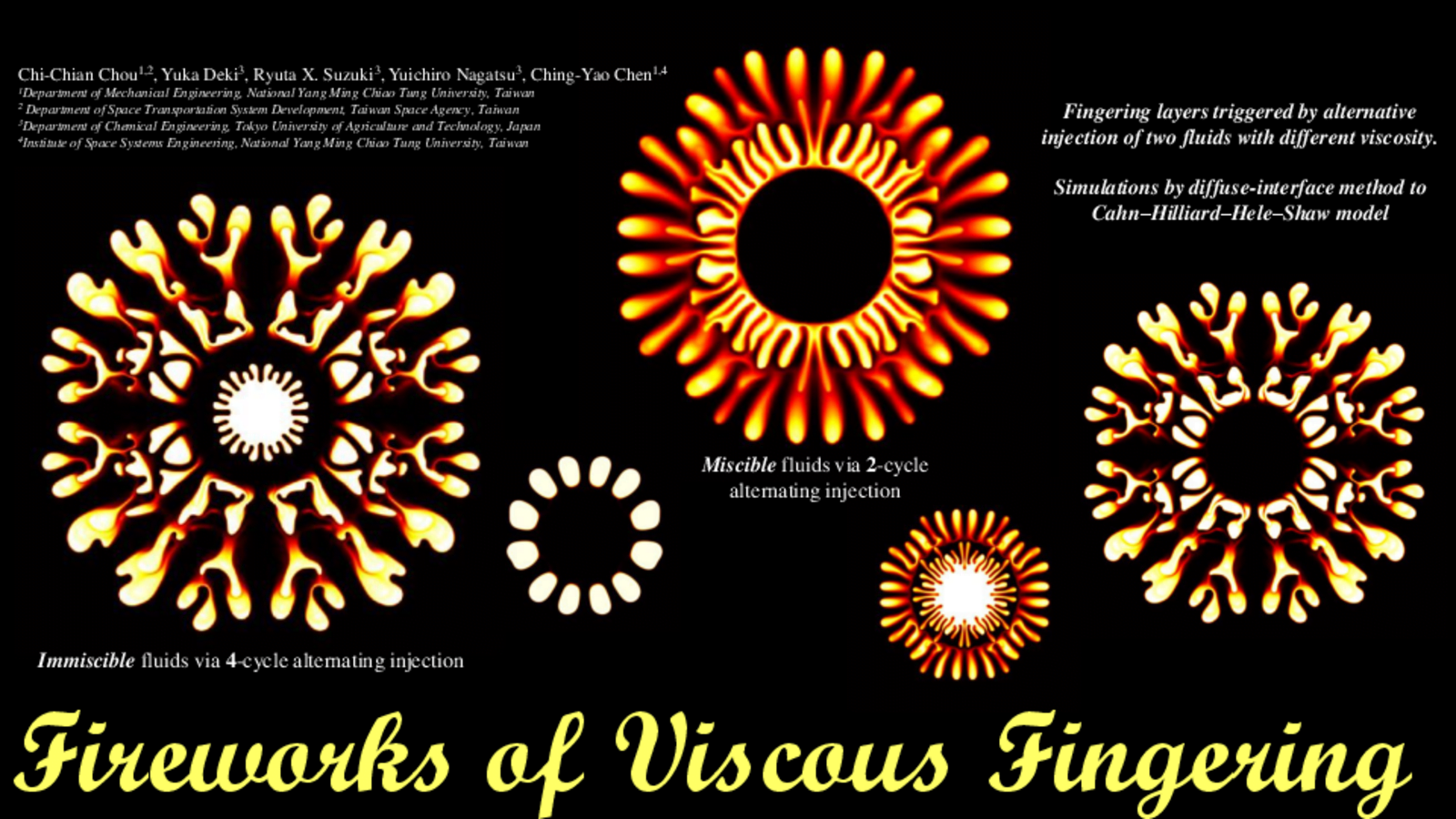
Inject a less viscous fluid into a gap filled with a more viscous fluid, and you’ll get finger-like patterns spreading radially. Here, researchers put a twist on this viscous fingering by taking turns injecting different liquids. Each injection cycle disrupts what came before, layering fingering patterns on fingering patterns. The results resemble fireworks. Happy 4th of July! (Image credit: C. Chou et al.)
Fish Ladders Keep Species Swimming


Dams often use fish ladders to help migratory species make their way upstream without interruption. In this video, Grady from Practical Engineering discusses some of the considerations that go into this special infrastructure and what kinds of designs work for different species. The first challenge for any dam is attracting fish to the ladder, which is often done by regulating the water flow at the entrance to create the velocity and turbulence that fish look for when going upstream.
Once fish are in the ladder, they travel up a series of jumps that break the dam’s elevation into manageable steps. Different dams use various baffle designs to create jumps suited to their local species and the way they like to swim. Calmer spots in each section give fish a spot to rest before they carry on. In well-designed systems, the vast majority (97%!) of fish that enter a ladder make it through to the other side. (Video and image credit: Practical Engineering)
Fediverse Reactions
-

Sensing Sound Like Spiderwebs
Most microphones — like our ears — work by sensing the tiny pressure changes caused by a sound wave‘s passing. But for microphones built this way, the smaller they get, the more sensitive they are to thermal noise. That’s one reason that the tiny microphones in a laptop or webcam just don’t sound as good as larger mics.
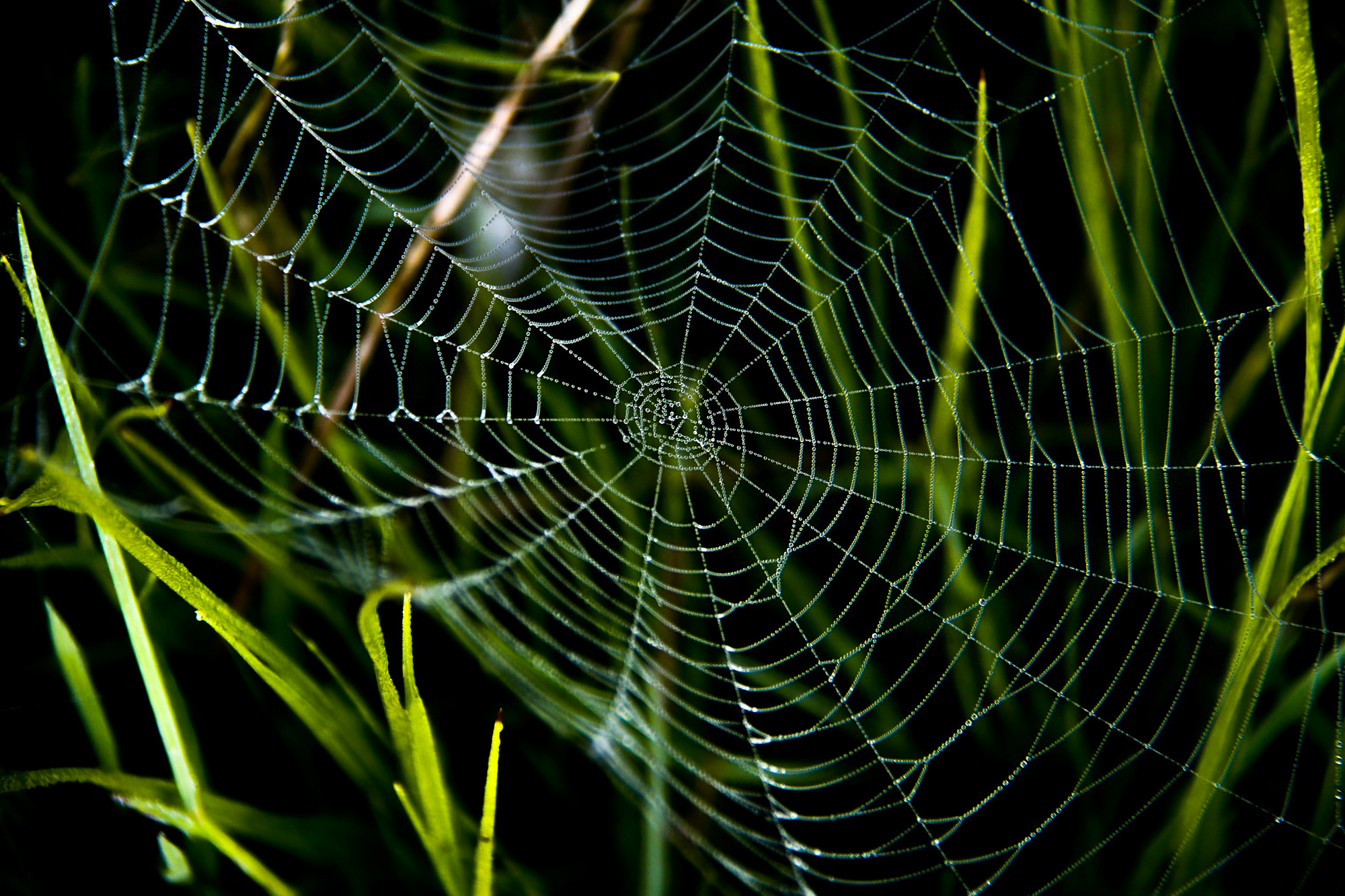
Researchers turned to nature to look for alternative ways to measure sound and zeroed in on the mechanism spiders use. Spiders “listen” to their web’s vibrations; the tiny strands of silk quiver as air flow from a sound moves past. Instead of being pressure-based, this mechanism uses viscous drag to register a sound.
The team fabricated an array of microbeams to test the concept of a viscosity-based microphone and found that tiny beams sensed sounds just as well as larger ones. That means these microphones can get smaller without sacrificing performance. For now, they’re not as sensitive as conventional microphones, but that’s not surprising, given that engineers have been improving pressure-based microphones for 150 years. It’s a promising start for a new technology, though. (Image credit: N. Fewings; research credit: J. Lai et al.; via APS Physics)