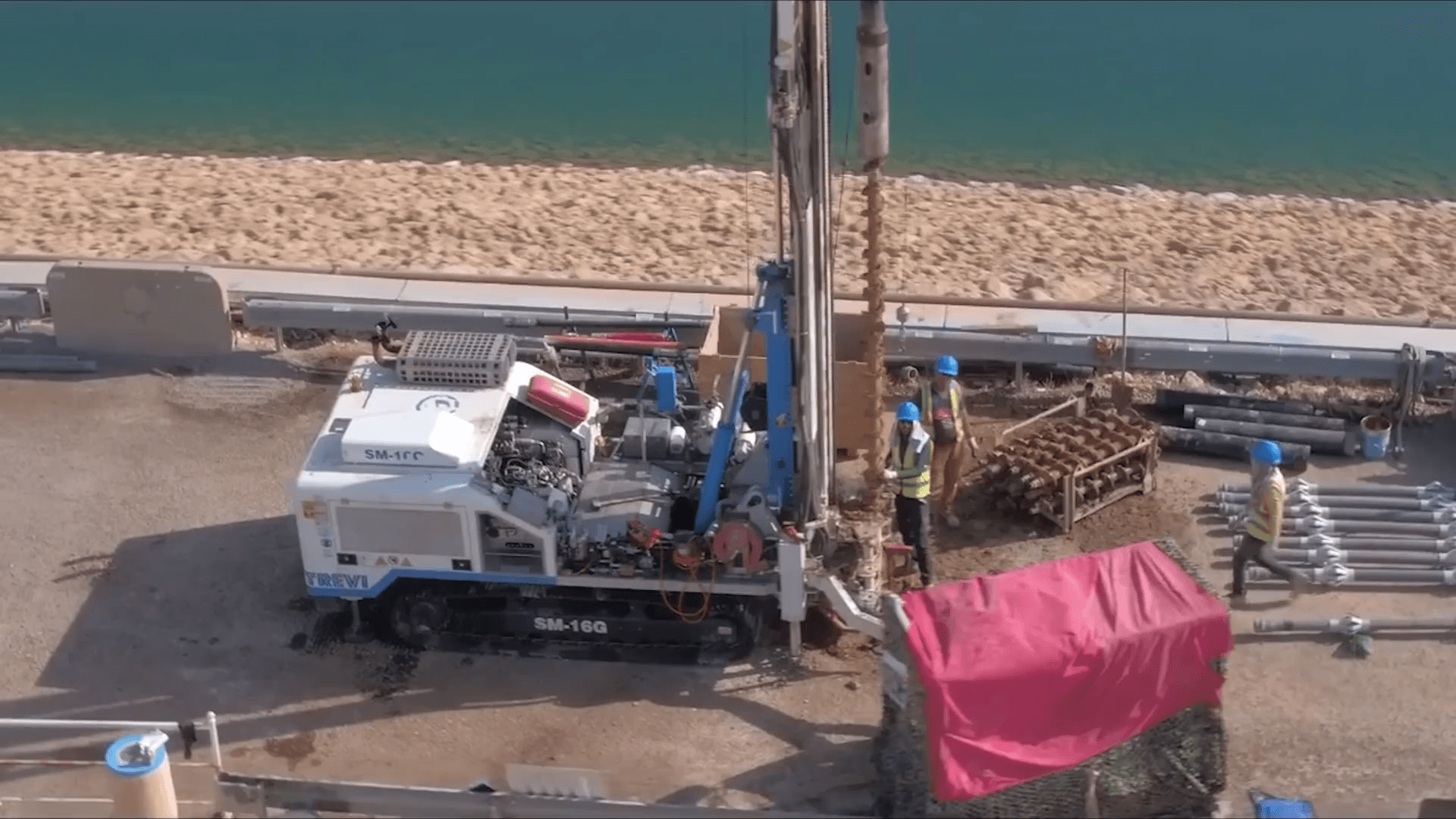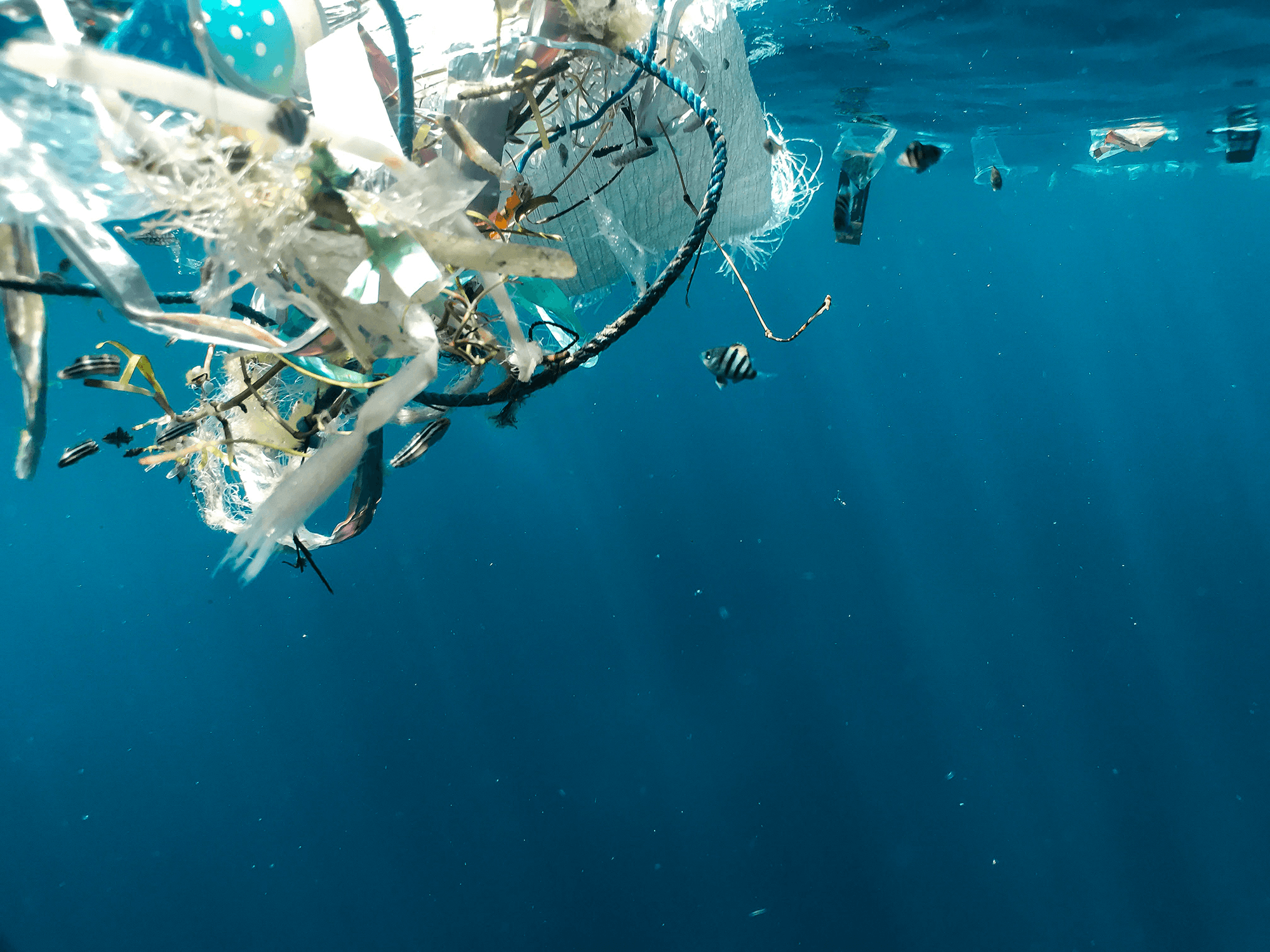
To help reduce greenhouse emissions, businesses are exploring systems that reduce a container ship’s drag by releasing bubbles beneath them. But how do bubbles reduce drag? To find out, researchers simulated a bubbly flow that mimics the underside of a moving ship. By playing with the balance between inertial forces, buoyancy, and surface tension, they were able to sweep through conditions that the bubbles could experience.
The best performance comes when bubbles stick together and coat the entire underside of the surface. In that case, they measured a nearly 40% reduction in the drag. But other conditions were not so fortuitous; in fact, with poorly chosen conditions, adding bubbles could actually increase the drag. (Video and image credit: S. Di Georgio et al.)
In this latest project, the Beauty of Science team explores colorful crystallization as chemicals precipitate out of evaporating solutions. The variety of shapes and colors is incredible. To see many more of these crystalline “gardens,” check out the video below and the project’s webpage. (Video and image credit: W. Zhu/Beauty of Science; via Colossal)
Over the last 15 years or so, researchers have been exploring pilot-wave theory–originally proposed by De Broglie in the 1920s as a way to understand quantum mechanics–using hydrodynamic quantum analogs. In these experiments, researchers vibrate pools of silicone oil, which allows oil drops to bounce–and in some conditions, walk–indefinitely on the pool. By mixing in obstacles that mimic classic quantum mechanical experiments, they reproduce effects like the double-slit experiment in a macroscopic system.
In this video and the accompanying papers, a team recreates the Kapitsa-Dirac effect where a standing electromagnetic wave diffracts electrons. Here, the standing wave is instead a Faraday wave in the surface of the pool. Yet the droplets, too, diffract in a manner resembling the quantum version. (Video credit: B. Primkulov et al.; research credit: B. Primkulov et al. 1, 2)
When we first learn about states of matter, we’re taught about three: solid, liquid, and gas. In a solid, atoms are held close to one another–typically, but not always, in an orderly lattice structure. In liquids and gases, atoms are free to slip, slide, bounce, and move. So what really separates a liquid from a gas?
That’s the question at the heart of this video by Steve Mould, in which he explores a weird fourth phase of matter: supercritical fluids. This phase has the diffusive properties of a gas and the solvent properties of a liquid–without really being either one.(Video and image credit: S. Mould)
On the outskirts of our solar system, two enigmatic giants loom: Uranus and Neptune. In terms of mass and size, both resemble many of the exoplanets discovered in recent years. Within our own solar system, these planets are known as “icy giants,” but a new study suggests that moniker may be wrong.
Pinning down the interior composition of a planet is tough on limited measurements. In the case of these outer planets, our main data is gravitational, recorded from visiting spacecraft. That information cannot tell us directly what the composition of a planet is, but it gives constraints for what materials could produce such a gravitational field.
In their simulation, researchers began with random interior configurations for Uranus and Neptune, then had the model iterate through configurations to simultaneously match the gravitational measurements while satisfying the thermodynamic and physical constraints of a stable planet. By repeating the process several times, the researchers created a catalog of potential interiors for Uranus and Neptune. And while some were water-rich–consistent with the “icy giant” title–others were remarkably rocky.
The team suggests that we may need to retire that moniker and consider the possibility that these worlds are more like our own than we thought. To find out which is true, we will need more spacecraft to visit our frigid neighbors, to provide new gravitational measurements and other observations. (Image credit: NASA/ESA/A. Simon/M. Wong/A. Hsu; research credit: R. Morf and L. Helled; via Physics World)
A ring of hydrogen bubbles rises, rotating clockwise, in this video of electrolysis. But there are no fan blades to cause this swirl, so why do the bubbles rotate? The answer is a Lorentz force induced by the electromagnetic set-up of the experiment. Watch to see how researchers manipulate the Lorentz force to affect the flow. (Video and image credit: Y. Cho et al.)
For tiny invertebrates like this one, water is a very different substance than we’re used to. At this scale, surface tension is a force as powerful–or more so–than gravity. Droplets remain spherical, caught on long, spike-like hairs. Even the surface of a pond is different, forming a trampoline creatures can skim but that requires special techniques to escape. (Image credit: N. Baumgartner/CUPOTY; via Colossal)
Schlieren techniques are one of my favorite forms of flow visualization. They cleverly make the invisible visible through an optical set-up that’s sensitive to changes in density. They’re great–as seen in the examples here–for seeing local buoyant flows like the plumes that rise from a candle, or for making gases like carbon dioxide visible. They’re also excellent for visualizing shock waves.
In this video, physicist David Jackson explains how one particular flavor of schlieren–one using a spherical mirror–works. There are lots of other possible schlieren set-ups, too, though each one has its quirks. (Video and image credit: All Things Physics; submitted by David J.)
Before the rise of railroads, canals provided critical commercial shipping infrastructure for many locations worldwide. But connecting canals at different elevations required locks–sometimes a whole series of them–as in the case of Scotland’s Union Canal and the Forth and Clyde Canal. In the canals’ heyday, navigating the 11 locks between them took the better part of a day–one of many reasons that canals fell out of use over time.
When Scotland decided to reconnect the canals in the 1990s, they picked a very different solution for this elevation challenge: the Falkirk Wheel. Grady walks us through the clever engineering of this impressive piece of infrastructure in this Practical Engineering video. (Video and image credit: Practical Engineering)
Cepheid variable stars pulsate in brightness over regular periods. That’s one reason astronomers use them as a standard candle to judge distances–even for stars well outside our galaxy. In this image, researchers display a simulation of convection inside a Cepheid eight times more massive than our sun. The colors represent vorticity, with zero vorticity in white.(Image credit: M. Stuck and J. Pratt)