Tag: flocking

  • Strata of Starlings

    Strata of Starlings

    Starlings come together in groups of up to thousands of birds for the protection of numbers. These flocks form spellbinding, undulating masses known as murmurations, where the movement of individual starlings sends waves spreading from neighbor to neighbor through the group. One bird’s effort to dodge a hawk triggers a giant, spreading ripple in the flock.

    To capture the flowing nature of the murmuration, photographer and scientist Kathryn Cooper layers multiple images of the starlings atop one another. The birds themselves become pathlines marking the murmuration’s motion. The final images are surprisingly varied in form. Some flocks resemble a downpour of rain; others the dangling branches of a tree. (Image credit: K. Cooper; via Colossal)

    Fediverse Reactions
  • Herding Sheep

    Herding Sheep

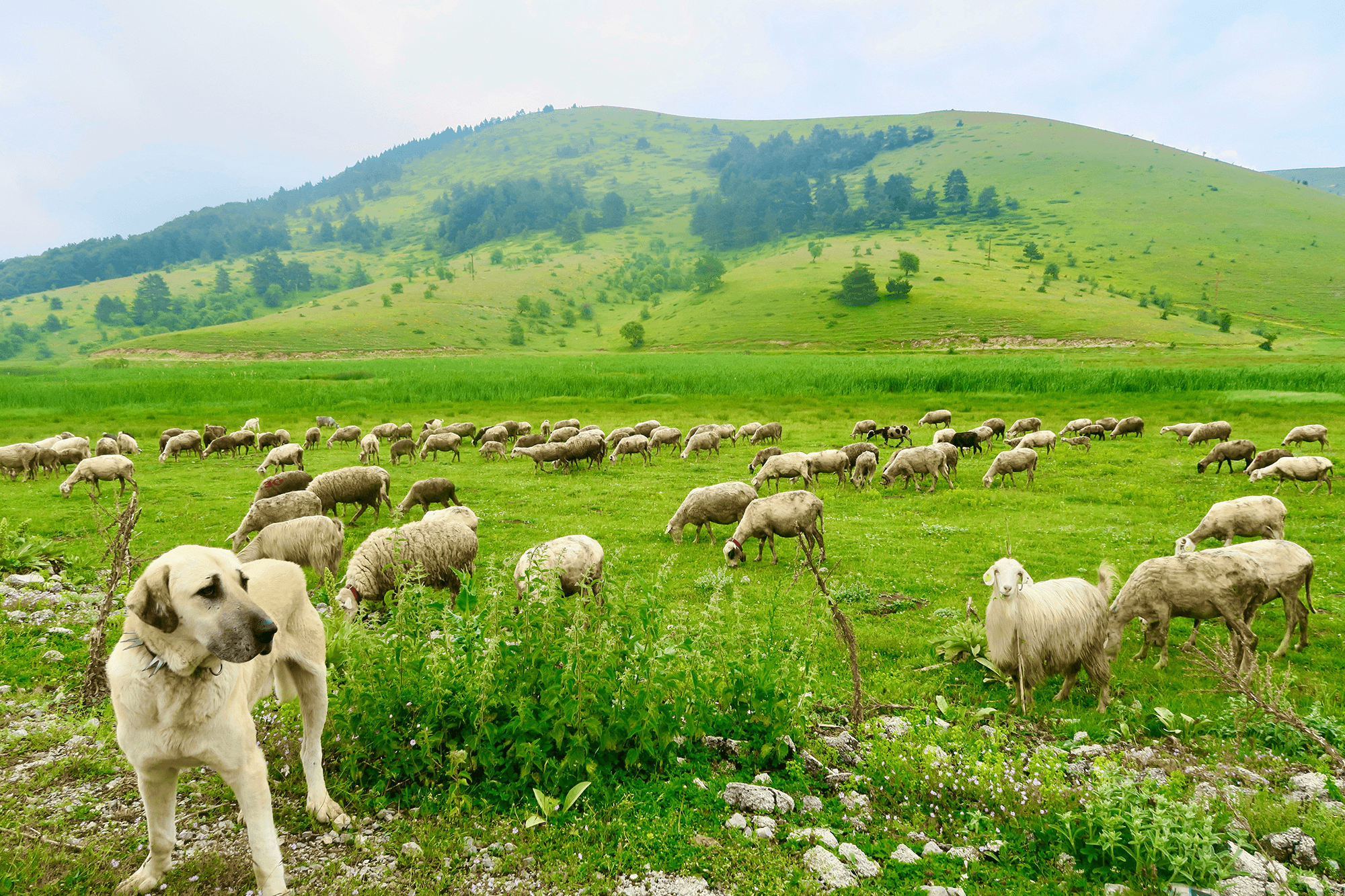
    Flocks of birds, schools of fish, and herds of sheep all resemble fluids at times, and physicists have been trying to recreate their collective motion for decades. Many of these models simplify the animals into particles that follow simple rules based on the direction and speed of their neighbors. Over time, the models have grown more complex; for example, some might differentiate a “sheepdog” particle from “sheep” particles. And some models even tweak the “sheep” to account for the personality traits that real sheep show, like how skittish they behave toward a sheepdog. Physics World has a neat overview of several studies in this vein. (Image credit: E. Osmanoglu; via Physics World)

  • Featured Video Play Icon

    “The Art of Flying”

    Like schools of fish, starlings gather in massive undulating crowds. Known as murmurations, these gatherings are a type of collective motion. Scientists often try to mimic these groups through simulations and lab experiments where individuals in a swarm obey simple rules that depend only on observing their neighbors. It requires very little, it turns out, to form swarms that move in this beautiful manner! (Video and image credit: J. van IJken; via Colossal)

  • Featured Video Play Icon

    Recreating Flocks

    Birds, fish, and other creatures form amazing, undulating swarms of individuals. How these collectives comes together and move continues to fascinate scientists. Here, researchers look at simple particles with two “instructions,” if you will. One causes the particle to self-navigate toward a target; the other causes short-range repulsion if the particle gets too close to another one. With only these two simple guidelines, a flock of these particles forms complex, ever-changing flows! (Image and video credit: M. Casiulis and D. Levine)

  • Featured Video Play Icon

    Starlings Over Rome

    Each winter millions of starlings migrate to Rome, where they form enormous murmurations in the sky above. The ephemeral and amorphous displays are driven by each bird responding to its neighbor’s motions. But the slight delay in individual responses gives the flock as a whole a wave-like, fluid appearance. Behaviors like this help protect the starlings from predators while they search out places to roost.

    As neat as the displays are, though, they come with some real downsides, as the latter part of this video reveals. I don’t know about you, but I wouldn’t want to park my car outside in that storm! (Video credit: BBC Earth)

  • Featured Video Play Icon

    Sheep as a Fluid

    Not all fluids are, well, fluid. Traffic, flocks of birds, ants, and even sheep can behave like fluids. This video shows an aerial perspective on sheep being herded, and despite the four-legged nature of these particles, they have a lot of fluid-like characteristics. You can watch ripples and waves travel through the herd and see how disturbances propagate. The herd is actually a brilliant example of compressible flow; notice how the sheep slow down and bunch up as they near the gate then speed up and spread out once they pass the constriction. This is exactly how supersonic fluids behave! (Video credit: T. Whittaker; submitted by Simon H and John B)

    If you’re in the DC area, I’ll be speaking at the Annals of Improbable Research Show at the AAAS meeting Saturday evening. Our session is open to the public, but it’s likely to be crowded, so you may want to arrive early!

  • Featured Video Play Icon

    Ants as a Fluid

    The collective behavior of ants can mirror the flow of a viscous fluid. It would be interesting to see if any such parallels carry over to the flocking of birds or schooling of fish. The latter two behaviors are thought to increase aero- and hydrodynamic efficiency for the group. #