In this video, Sixty Symbols tackles the physics of wave clouds. When air flows over an obstacle like a mountain, the air can begin to oscillate downstream, forming what is known as a lee wave. As the air bobs up and down, it will cool or warm according to its altitude. At cooler conditions, if the air is moist, it can condense into a cloud at the peak of its oscillation. If you observe this behavior over time, you get what appear to be regularly-spaced stripes of clouds. This is actually a pretty common phenomenon to see, depending on where you live. It’s an example of internal waves in the atmosphere. (Video credit: Sixty Symbols)
Do you enjoy FYFD and want to help support it? Then please considering becoming a patron!
What happens when you pour molten aluminum on dry ice? As the Backyard Scientist shows, you get what looks like slippery, sliding, boiling metal. In fact, what you see may remind you of the Leidenfrost effect, where a liquid can slide around over an extremely hot surface on a thin film of its own vapor. Despite the opposite temperature extremes–this is a very cold surface rather than a very hot one–a very similar thing is happening here. The molten aluminum is so much hotter than the dry ice that it causes the dry ice to sublimate, releasing gaseous carbon dioxide that the aluminum slides around on. For the same reason, the aluminum appears to boil in the bottom animation. What we’re really seeing is carbon dioxide gas rising and escaping the aluminum so violently that it carries some of the metal with it. Be sure to check out the full video for more awesome physics! (Image credit: The Backyard Scientist, source; via Gizmodo)
Do you enjoy FYFD and want to help support it? Then please consider becoming a patron!
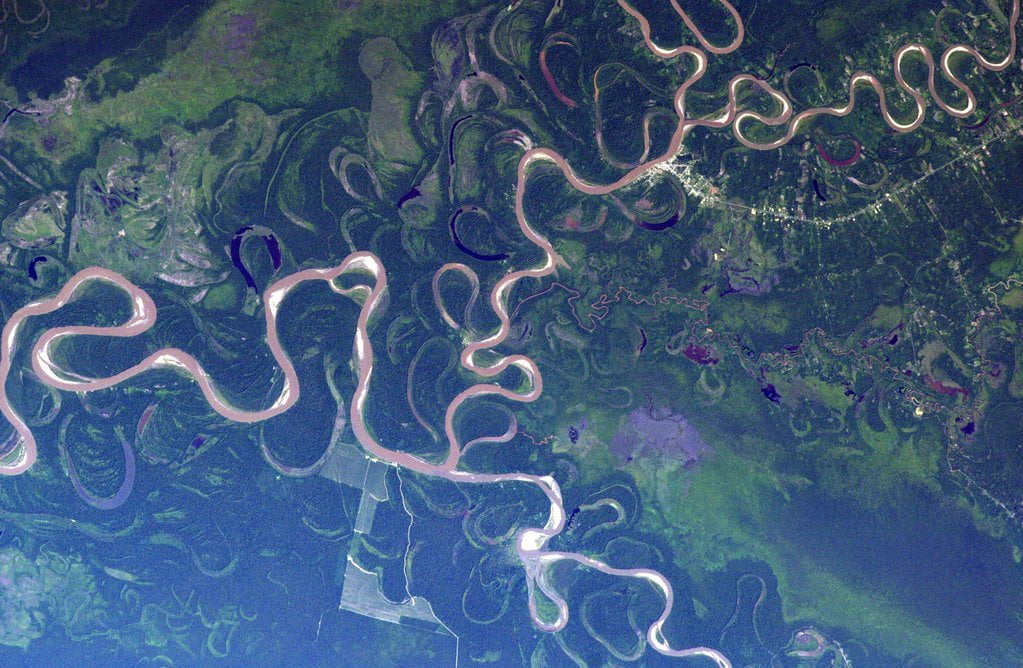
This photo of the Amazon River taken by Astronaut Tim Kopra reveals the many meandering changes of the river’s course. Left untouched by human intervention, rivers tend to get more curvy, or sinuous, over time, simply due to fluid dynamics. Imagine a single bend in a river. Due to conservation of angular momentum, water flows faster around the inside curve of the bend than the outside – just like an ice skater spins faster with her arms pulled in. From Bernoulli’s principle, we know there is an accompanying pressure gradient caused by this velocity difference – with higher pressure near the outer bank and lower pressure on the inner one. This pressure gradient is what guides the water around the bend, keeping the bulk of the fluid moving downstream rather than bending toward either bank.
At the bottom of the river, though, viscosity slows the water down due to the influence of the ground. This slower water, still subject to the same pressure gradient as the rest of the river, cannot maintain its course going downstream. Instead, it gets pushed from the outer bank toward the inner bank in what’s known as a secondary flow. This secondary flow carries sediment away from the outer bank and deposits it on the inner bank, which, over time, makes the river bend more and more pronounced. (Image credit: T. Kopra/NASA; submitted by jshoer)
Do you enjoy FYFD and want to help support it? Then please consider becoming a patron!
Turbidity currents are a gravity-driven, sediment-laden flow, like a landslide or avalanche that occurs underwater. They are extremely turbulent flows with a well-defined leading edge, called a head. Turbidity currents are often triggered by earthquakes, which shake loose sediments previously deposited in underwater mountains and canyons. Once suspended, these sediments make the fluid denser than surrounding water, causing the turbidity current to flow downhill until its energy is expended and its sediment settles to form a turbidite deposit. By sampling cores from the seafloor, scientists studying turbidites can determine when and where magnitude 8+ earthquakes have occurred over the past 12,000+ years! (Video credit: A. Teijen et al.; submitted by Simon H.)
Do you enjoy FYFD and want to help support it? Then please consider becoming a patron!
tl;dr version: FYFD is launching a Patreon campaign. If you enjoy FYFD and want to help support its continued growth, please become a patron today!
And the longer version: At the start of the year, I hinted that there were big things ahead for FYFD. Today’s announcement is part of that. In the past five years, FYFD has grown beyond my wildest dreams. I’m so excited, grateful, and happy to share my love for science with all of you. As FYFD’s audience has grown, so have my plans and dreams for expanding the site and what it does. I want to bring you more: videos that take you behind-the-scenes to see the scientific process firsthand, interviews that let you meet the people behind the work, and articles that explore new and exciting fluid phenomena.
All of the research, filming, writing, and editing necessary to bring those dreams to life takes time and money. I can provide the first: from now on, I’ll be dedicating my full-time attention to FYFD. But I need your help and support to make this possible. That’s why I’m launching a campaign on Patreon. If you enjoy FYFD and want to help it continue and grow, please consider becoming a patron. Your monthly support will enable me to dedicate my full energy to FYFD and will provide funding for materials, equipment, and travel so that I can bring the science back to you.
There are also some pretty cool rewards available to patrons! All patrons will have access to a patrons-only activity feed where I post behind-the-scenes content and extras like video outtakes. It’s also a place where I’ll look for feedback on new ideas. Think of it as an extra dose of FYFD. Other rewards include getting your name added to the FYFD supporter page, getting a handwritten postcard from me, and access to a monthly webcast where I’ll chat with guest scientists and patrons. (I’m really excited about that last one!)
Whether you become a patron or not, I want to thank you for your support. None of those would be possible without you and your enthusiasm. As always, the best thing you can do to support FYFD is to tell others how much you like it.Thank you!
If you have any questions, I’ll be online all day. You can reach me via Tumblr, Twitter, or email.
Here the U.S. Army Corps of Engineers release 13,000 cubic feet per second (~370 cubic meters per second) of water at a dam in Oklahoma. That’s the equivalent of nine-and-a-half shipping containers a second! Releasing that much water at once has created an enormous hydraulic jump, seen on the right side of the animation. Hydraulic jumps are kind of like the shock wave of open channel flow. On the left side of the image, water is moving smoothly and swiftly down the sluiceway. At the center, the incoming water encounters the large, slow-moving mass of water already in the lake. There’s no way for the incoming water to sustain its kinetic energy while discharging into the lake. Instead a hydraulic jump forms, converting the incoming flow’s kinetic energy into potential energy, as seen in the sudden height increase. Some of the energy is also converted to turbulence and dissipated as heat. (Image credit: U.S. Army Corps of Engineers/AP, source; via Gizmodo)
Paint getting flung from a spinning drill bit can create some incredible art. Here the Slow Mo Guys recreate the effect in high-speed video. What we’re seeing is tug of war between centrifugal force, which tries to fling the paint outward, and internal forces in the paint, which struggle to hold the the fluid together. Primarily, it’s surface tension keeping the fluid together, but, depending on what sort of non-Newtonian fluid the paint may be, there could be other internal forces helping keep the paint intact. In this case, centrifugal force is clearly winning out, though the paint stretches pretty far before it thins enough to break. It would be interesting to see how the balance plays out with the drill bit spinning at a lower RPM. (Image credit: Slow Mo Guys, source)
New year, new (or renewed) experiments. This is the fluids round-up, where I collect cool fluids-related links, articles, etc. that deserve a look. Without further ado:
Above is a new music video from the Julia Set Collection, featuring all non-CGI, fluids-based visuals. I spy soap films, vibrating liquids, and lots of cool effects with reflection and refraction. We featured some of their previous work, too.
Nature has an interesting article on active matter, an intersection of physics and biology exploring how matter self-organizes, whether at the level of cells or the flocking of birds. (submitted by 1307phaezr)
Ever wonder what the human face looks like in 457 mph winds? Wonder no more.
When it’s really cold outside–to the tune of -40 degrees (Fahrenheit or Celsius)–physics can get a little crazy. In this photo, boiling-hot water from a thermos turns into an instant snowstorm when tossed. How is this possible? It turns out there are a combination of factors that affect this. Firstly, the rate of heat transfer between two objects depends on the magnitude of the temperature difference between them. The bigger the difference in temperature, the faster the hot object cools. Of course, as the hot object cools down, the temperature difference between it and its surroundings is smaller and the rate of heat transfer decreases.
The second important factor here is that the water is being tossed. When you throw water, it breaks into droplets, and droplets have a large surface area compared to their volume. As it turns out, the rate of heat transfer also depends on surface area. By breaking the hot water into smaller droplets, you increase the surface area exposed to the cold air, allowing the hot water to freeze faster. (Image credit: M. Davies et al.; via Gizmodo)
Also: Since there are a few events scheduled around the country over the next couple months, I’ve added an events page where you can find details for those appearances. And as always, if you’re interested in scheduling a talk or event, feel free to contact me directly.
What do shark scales, underwater robots, blood flow, and art have in common? They’re all a part of the latest FYFD video! Check out my behind-the-scenes look at the latest American Physical Society Division of Fluid Dynamics meeting. Meet the researchers and find out about the science everyone was talking about! (Image/video credit: N. Sharp)