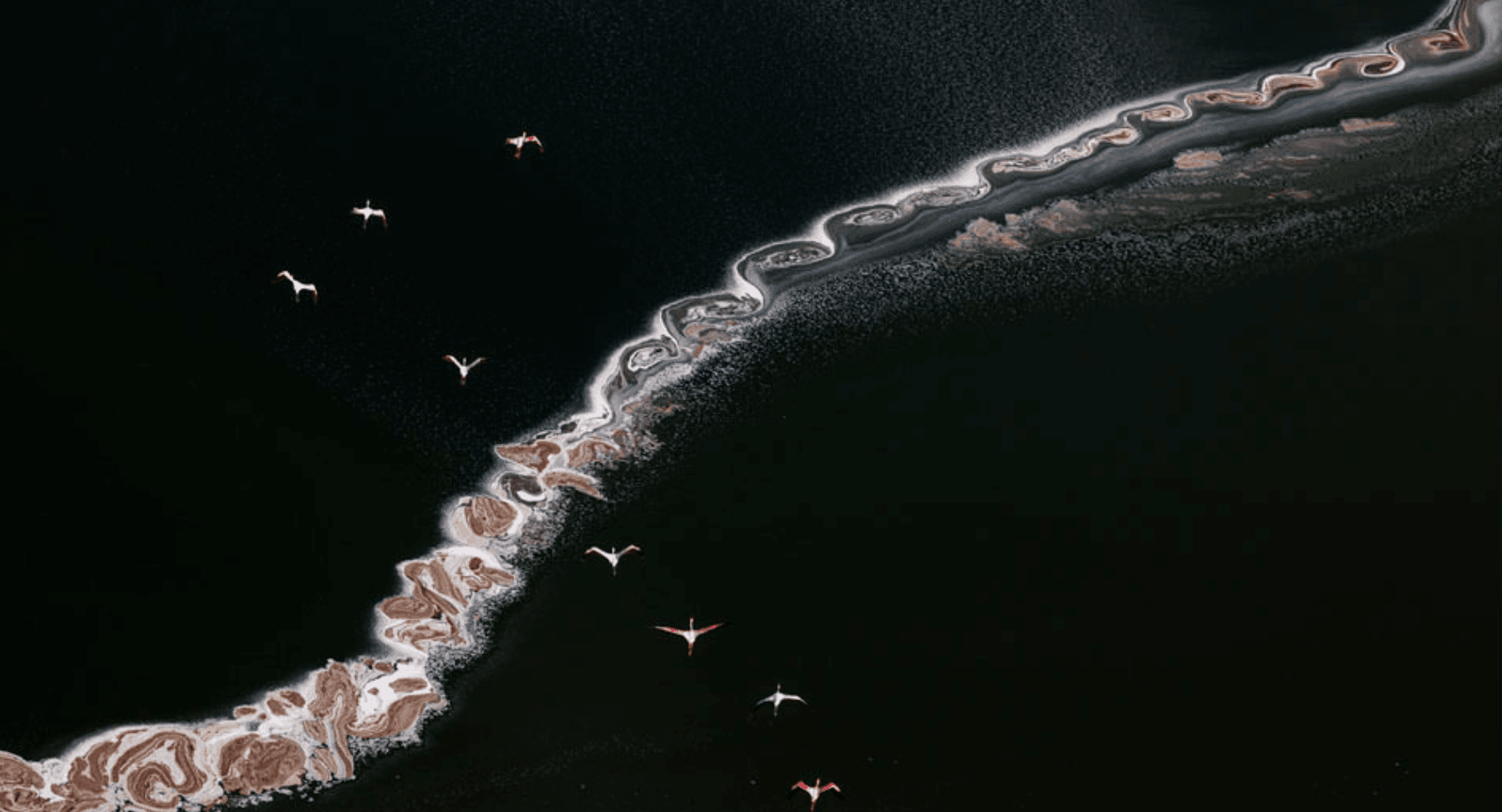
Flamingos soar over swirls of salt and algae in a lake in Kenya’s Rift Valley. Shaped by winds, currents, physics, and chemistry these eddies reflect the motion of the water, evaporation patterns, and more. Without more information, it’s hard to say exactly what shapes the pattern, but it does appear reminiscent of a Kelvin-Helmholtz instability in places. (Image credit: B. Hayden/IAPOTY; via Colossal)
Tag: flow visualization

Glacier Timelines

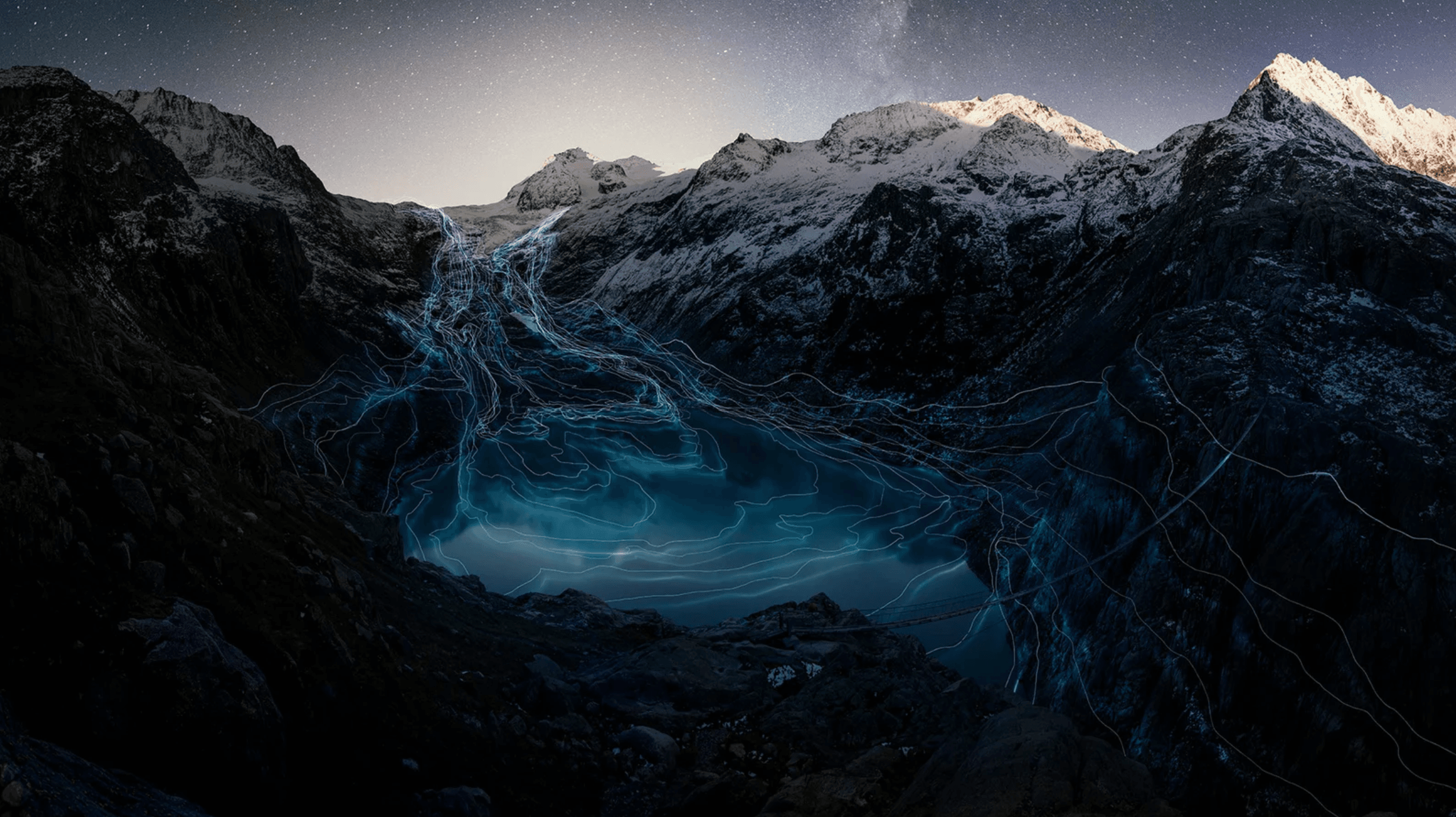
Over the past 150 years, Switzerland’s glaciers have retreated up the alpine slopes, eaten away by warming temperatures induced by industrialization. But such changes can be difficult for people to visualize, so artist Fabian Oefner set out to make these changes more comprehensible. These photographs — showing the Rhone and Trift glaciers — are the result. Oefner took the glacial extent records dating back into the 1800s and programmed them into a drone. Lit by LED, the drone flew each year’s profile over the mountainside, with Oefner capturing the path through long-exposure photography. When all the paths are combined, viewers can see the glacier’s history written on its very slopes. The effect is, fittingly, ghost-like. We see a glimpse of the glacier as it was, laid over its current remains. (Image credit: F. Oefner; video credit: Google Arts and Culture)
Fediverse Reactions
-

A Variety of Vortices
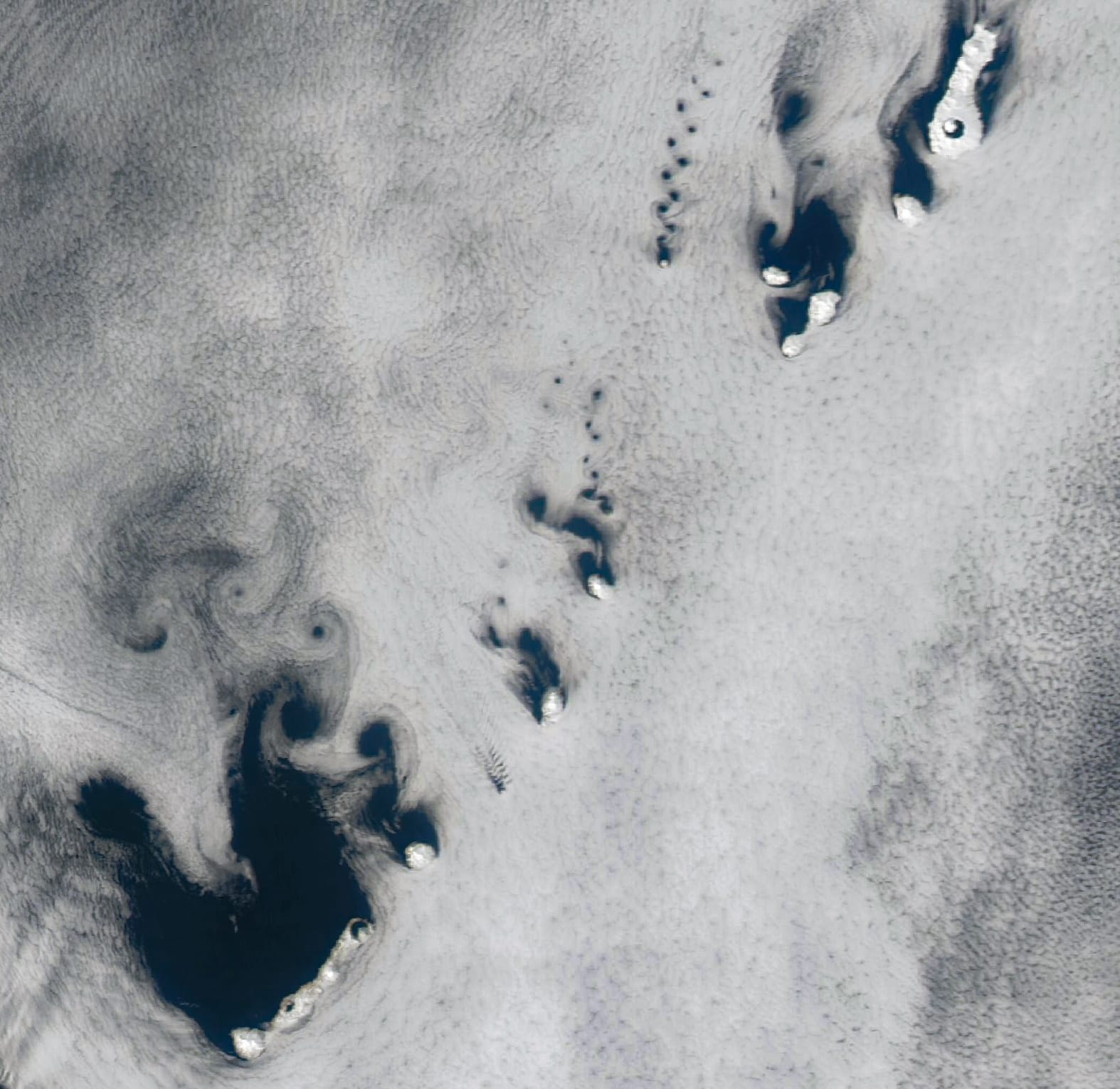
Winds parted around the Kuril Islands and left behind a string of vortices in this satellite image from April 2025. This pattern of alternating vortices is known as a von Karman vortex street. The varying directions of the vortex streets show that winds across the islands ranged from southeasterly to southerly. Notice also that the size of the island dictates the size of the vortices. Larger islands create larger vortices, and smaller islands have smaller and more frequent vortices. (Image credit: M. Garrison; via NASA Earth Observatory)
Fediverse Reactions
-

“Creation”


Videographer Vadim Sherbakov’s short film “Creation” is full of glittery vistas created under a macro lens. Shifting, particle-seeded flows shimmer in bright colors. Glistening deltas shift and form, and Marangoni flows generate feathers and tree-like dendritic arms. Macro flows never cease to fascinate. (Video and image credit: V. Sherbakov; via Colossal)
Inside Cuttlefish Suction


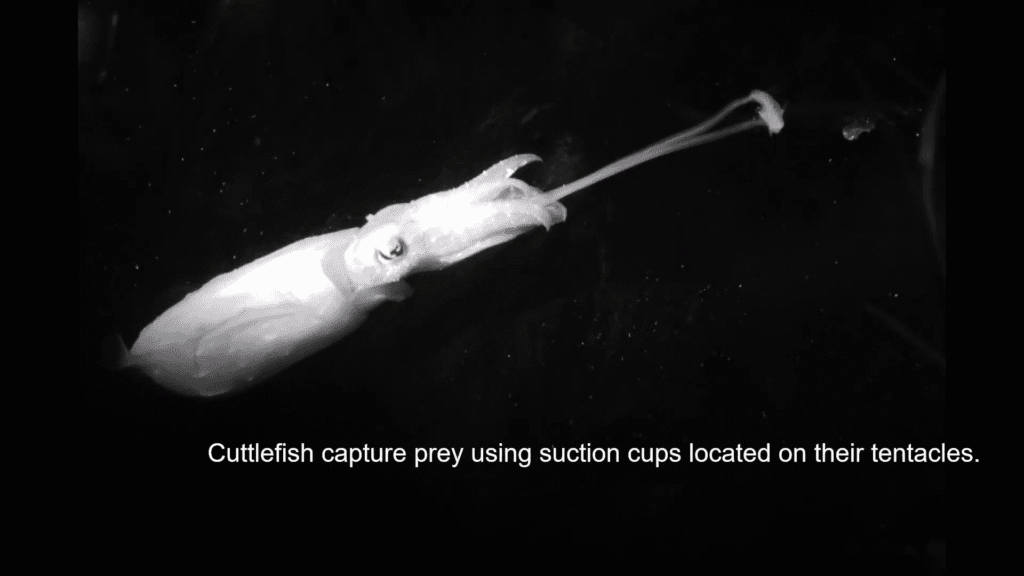
Cuttlefish, like many cephalopods, catch prey with their tentacles. Suction cups along the tentacle help them hold on. In this video, researchers share preliminary studies of what goes on inside these suction cups as they’re detached. The low pressures inside the suction cup cause water to vaporize, temporarily. As seen for both the cuttlefish and a bio-inspired suction cup, small bubbles form inside the attached cup, coalesce into larger bubbles, and then get destroyed in the catastrophic leak that occurs once part of the suction cup detaches. (Video and image credit: B. Zhang et al.)
Fediverse Reactions
-

Glimpses of Coronal Rain
Despite its incredible heat, our sun‘s corona is so faint compared to the rest of the star that we can rarely make it out except during a total solar eclipse. But a new adaptive optic technique has given us coronal images with unprecedented detail.

These images come from the 1.6-meter Goode Solar Telescope at Big Bear Solar Observatory, and they required some 2,200 adjustments to the instrument’s mirror every second to counter atmospheric distortions that would otherwise blur the images. With the new technique, the team was able to sharpen their resolution from 1,000 kilometers all the way down to 63 kilometers, revealing heretofore unseen details of plasma from solar prominences dancing in the sun’s magnetic field and cooling plasma falling as coronal rain.
The team hope to upgrade the 4-meter Daniel K. Inouye Solar Telescope with the technology next, which will enable even finer imagery. (Image credit: Schmidt et al./NJIT/NSO/AURA/NSF; research credit: D. Schmidt et al.; via Gizmodo)
Fediverse Reactions
-

Bow Shock Instability
There are few flows more violent than planetary re-entry. Crossing a shock wave is always violent; it forces a sudden jump in density, temperature, and pressure. But at re-entry speeds this shock wave is so strong the density can jump by a factor of 13 or more, and the temperature increase is high enough that it literally rips air molecules apart into plasma.
Here, researchers show a numerical simulation of flow around a space capsule moving at Mach 28. The transition through the capsule’s bow shock is so violent that within a few milliseconds, all of the flow behind the shock wave is turbulent. Because turbulence is so good at mixing, this carries hot plasma closer to the capsule’s surface, causing the high temperatures visible in reds and yellows in the image. Also shown — in shades of gray — is the vorticity magnitude of flow around the capsule. (Image credit: A. Álvarez and A. Lozano-Duran)
Fediverse Reactions
-

South Island Sediments
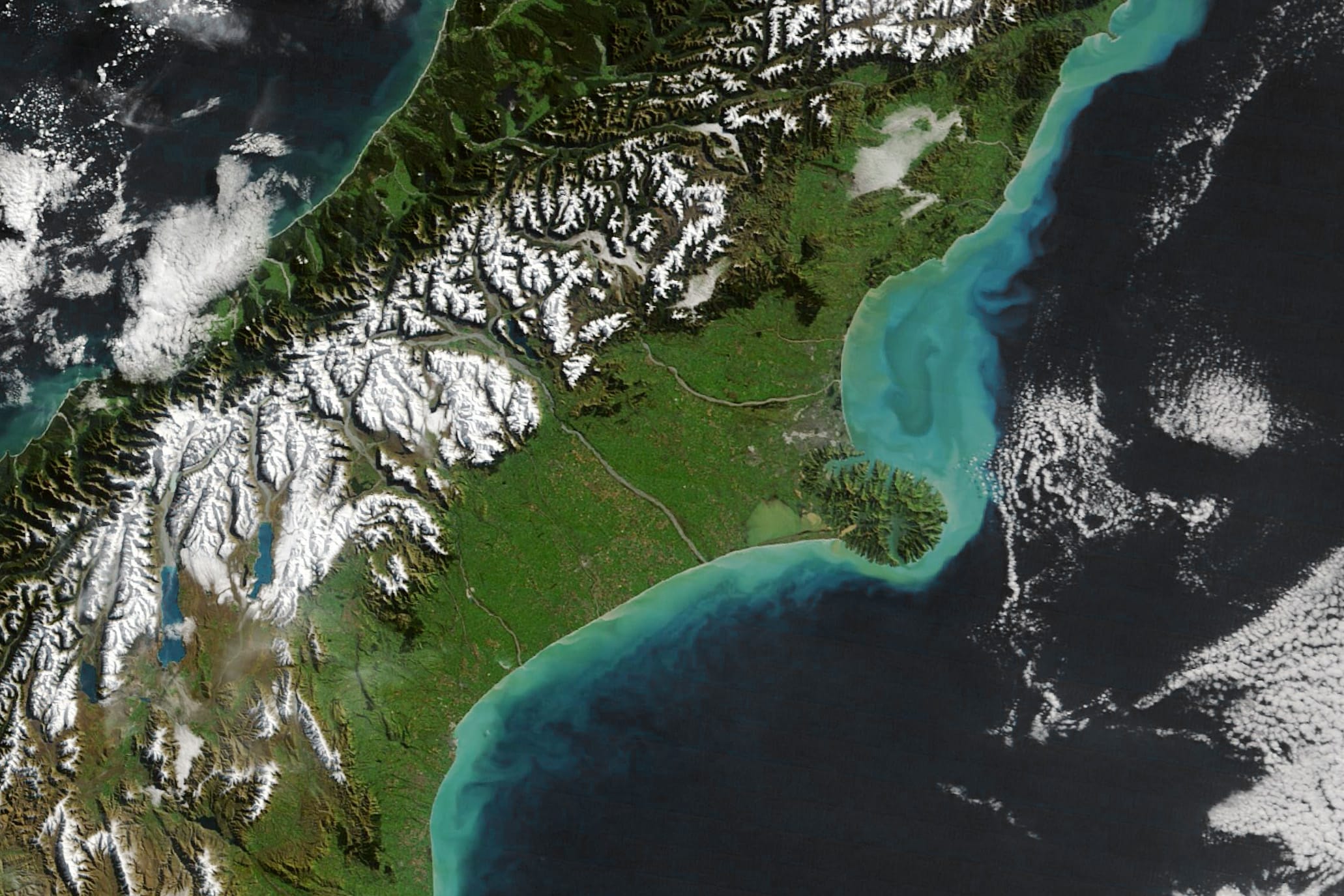
In April and May late autumn storms ripped through Aotearoa New Zealand. This image shows the central portion of South Island, where coastal waters are unusually bright thanks to suspended sediment. We typically think of storm run-off as water, but these flows can carry lots of sediment as well. Here, the large amount of sediment is likely a combination of increased run-off from rivers and coastal sediment stirred up by faster river flows. (Image credit: W. Liang; via NASA Earth Observatory)
Fediverse Reactions
-
“Now I See – The Collection Vol. 2”


In the next video of his current collection, Roman De Giuli takes us flying over liquid landscapes that look like our Earth in miniature. Many of them have the feeling of river deltas or glaciers. Sharp-eyed viewers will notice bubbles and flotsam in some of these streams. If you follow them, you can see how the flows vary — wiggling around islands, speeding up through constrictions and slowing down when the stream widens. It is, as always, a beautiful form of flow visualization. (Video and image credit: R. De Giuli)
Fediverse Reactions
-

Stunning Interstellar Turbulence
The space between stars, known as the interstellar medium, may be sparse, but it is far from empty. Gas, dust, and plasma in this region forms compressible magnetized turbulence, with some pockets moving supersonically and others moving slower than sound. The flows here influence how stars form, how cosmic rays spread, and where metals and other planetary building blocks wind up. To better understand the physics of this region, researchers built a numerical simulation with over 1,000 billion grid points, creating an unprecedentedly detailed picture of this turbulence.
The images above are two-dimensional slices from the full 3D simulation. The upper image shows the current density while the lower one shows mass density. On the right side of the images, magnetic field lines are superimposed in white. The results are gorgeous. Can you imagine a fly-through video? (Image and research credit: J. Beattie et al.; via Gizmodo)
Fediverse Reactions
-











































![[empty]](https://files.mastodon.social/accounts/avatars/106/887/462/825/018/571/original/52e5d4364f73668f.jpg)