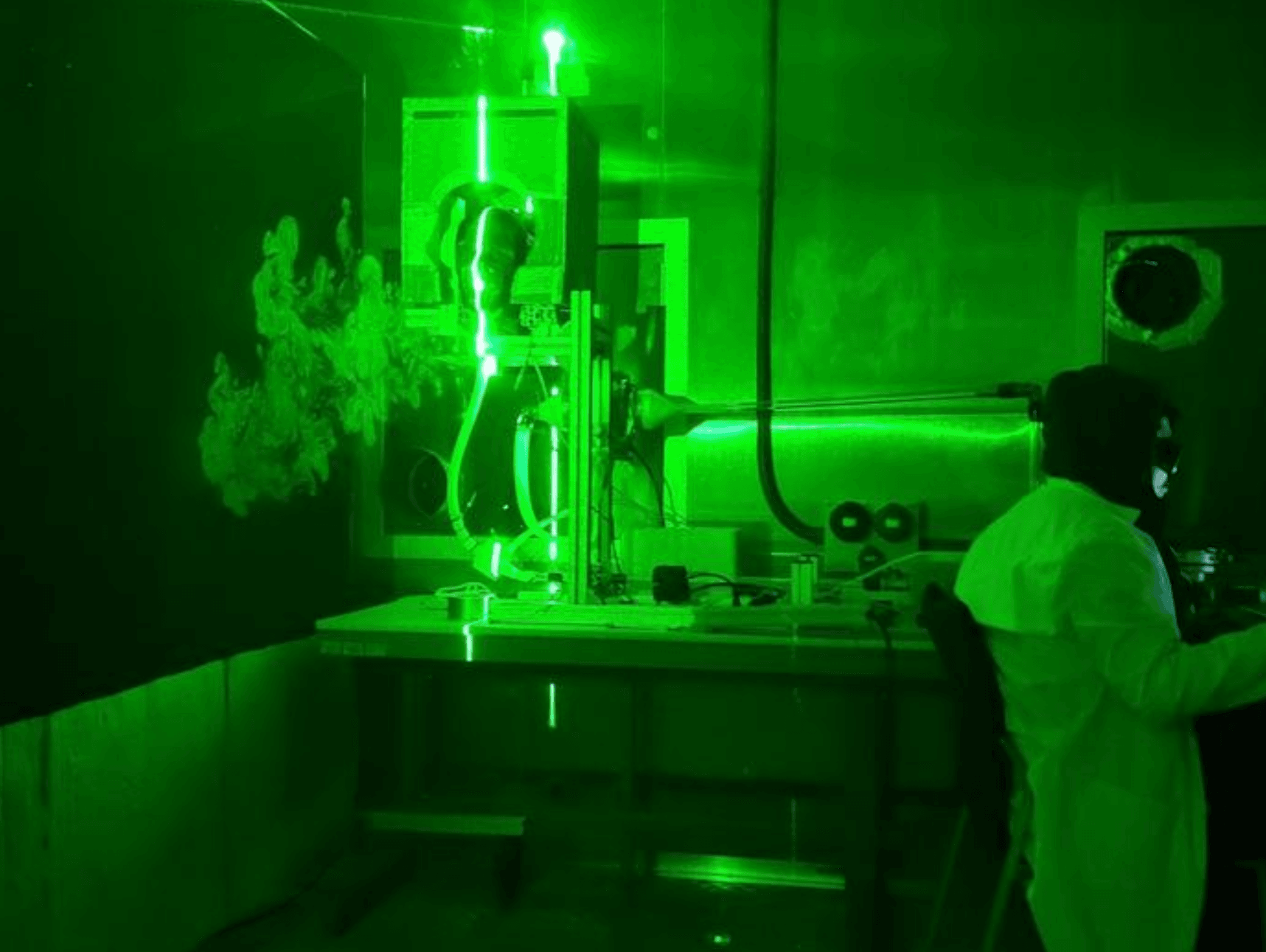
Kirigami is a paper art that combines folding and cutting to create elaborate shapes. Here, researchers use cuts in thin sheets of plastic and explore how the sheets transform in a flow. Depending on the configuration of cuts, the sheets can stretch dramatically in the flow, creating complex, dynamic, and beautiful wakes. I feel like there must be some applications out there that would benefit from kirigami-induced mixing. (Video and image credit: A. Carleton and Y. Modarres-Sadeghi)
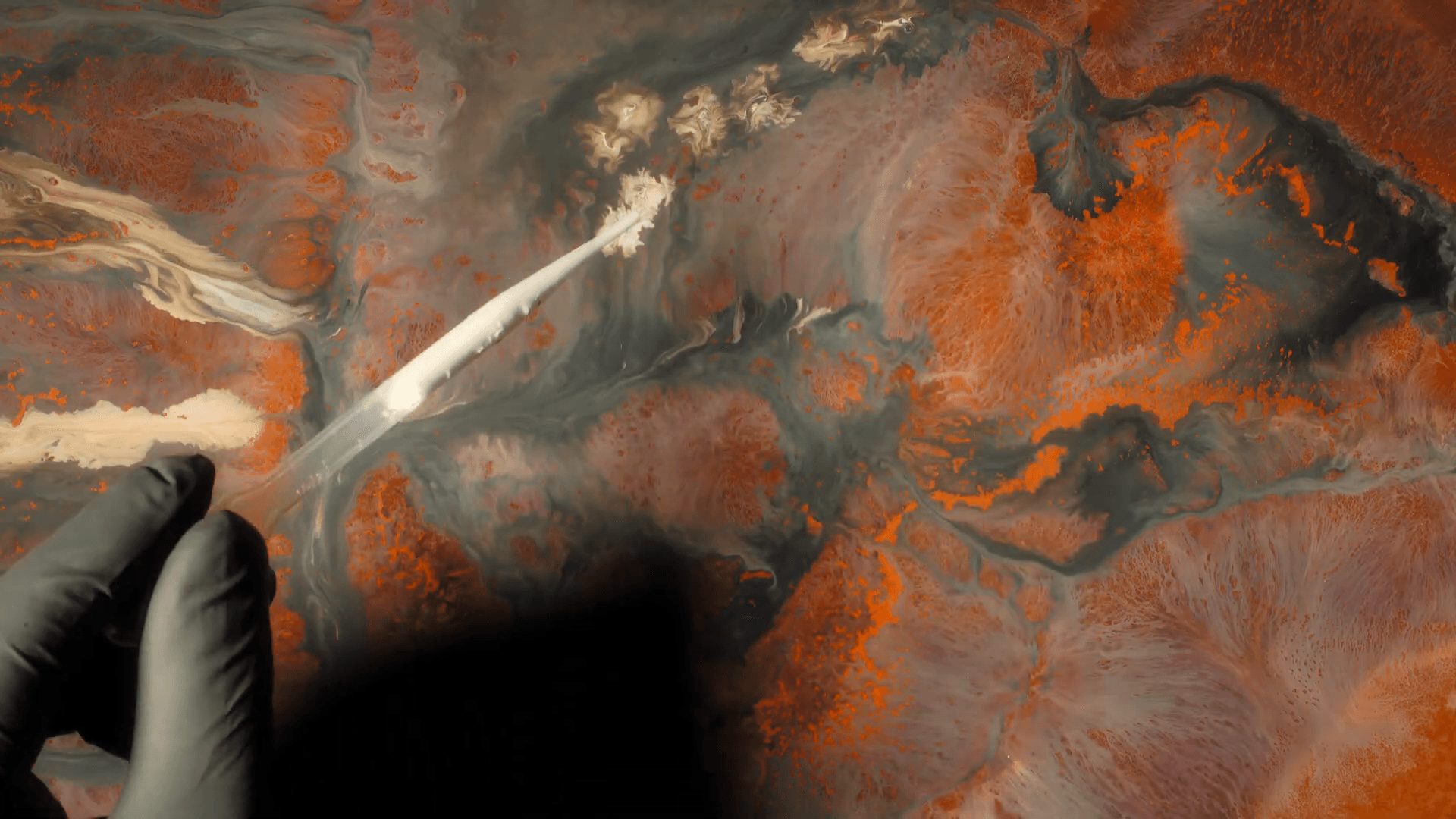
Artist Roman De Giuli excels at creating what appear to be vast landscapes carved by moving water. In reality, these pieces are small-scale flows, created on paper. Now, De Giuli takes us behind the scenes to see how he creates these masterpieces — layering, washing, burning, and repeating to build up the paperscape that eventually hosts the flows we see recorded. The work is meticulous and slow, and the results are incredible. De Giuli’s videos never fail to transport me to a calmer, more pristine version of our world. I can’t wait to see the new series! (Video and image credit: R. De Giuli)
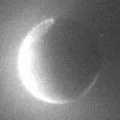
In an ongoing tradition, let’s take another look at some Star Wars-inspired aerodynamics. This year it’s the TIE fighter’s turn. Here, researchers simulate the spacecraft trying to escape Yavin 4’s atmosphere at Mach 1.15. The research poster’s blue contours show pressure contours, with darker colors connoting higher pressures. The bright low pressure region immediately behind the craft suggests a difficult, high-drag ascent and a turbulent, subsonic wake despite the craft’s supersonic velocity. (Image credit: A. Martinez-Sanchez et al.)
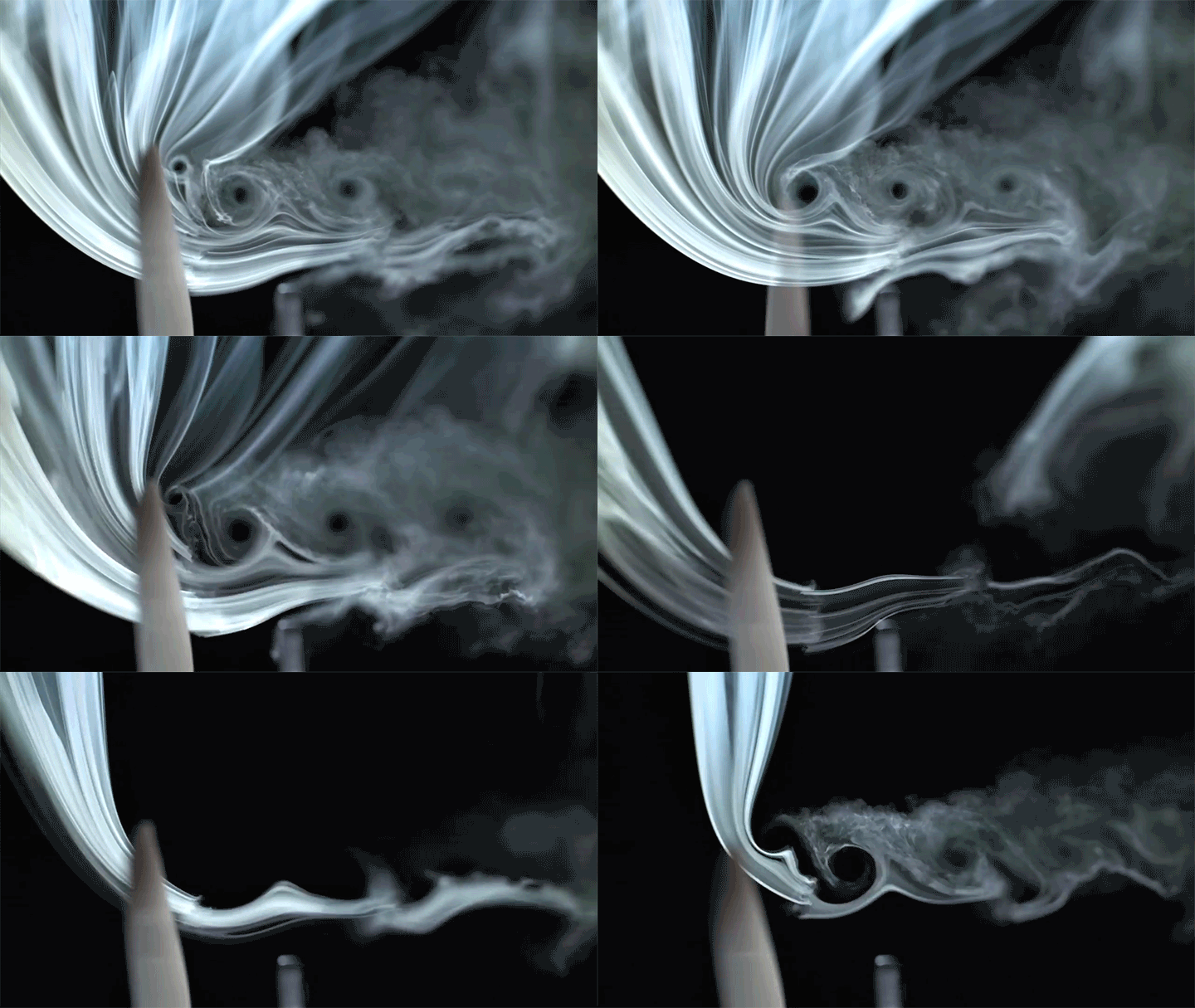
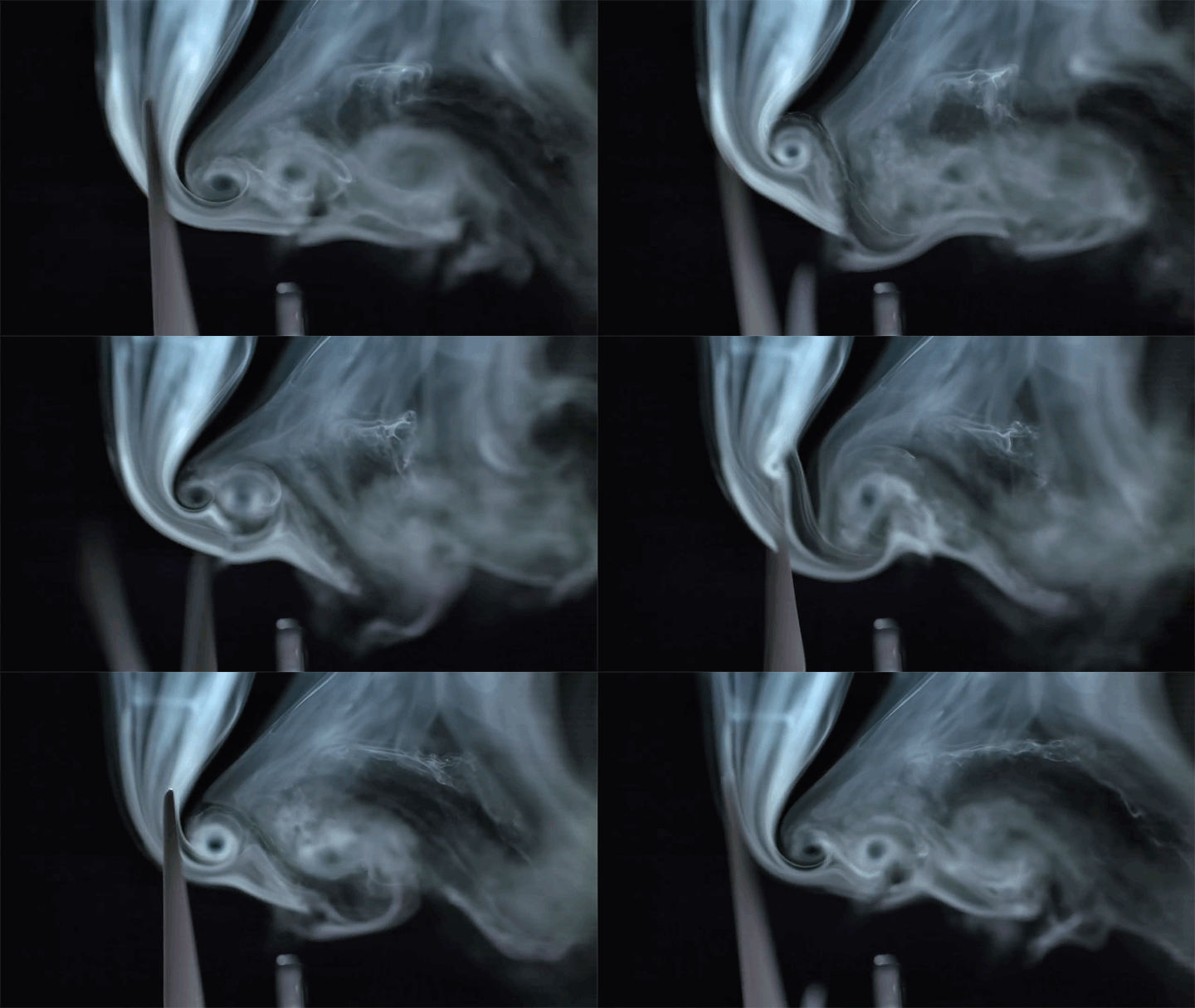
A drone’s noisiness is one of its major downfalls. Standard drones are obnoxiously loud and disruptive for both humans and animals, one reason that they’re not allowed in many places. This flow visualization, courtesy of the Slow Mo Guys, helps show why. The image above shows a standard off-the-shelf drone rotor. As each blade passes through the smoke, it sheds a wingtip vortex. (Note that these vortices are constantly coming off the blade, but we only see them where they intersect with the smoke.) As the blades go by, a constant stream of regularly-spaced vortices marches downstream of the rotor. This regular spacing creates the dominant acoustic frequency that we hear from the drone.
Animation of wingtip vortices coming off a drone rotor with blades of different lengths. This causes interactions between the vortices, which helps disrupt the drone’s noise.
To counter that, the company Wing uses a rotor with blades of different lengths (bottom image). This staggers the location of the shed vortices and causes some later vortices to spin up with their downstream neighbor. These interactions break up that regular spacing that generates the drone’s dominant acoustic frequency. Overall, that makes the drone sound quieter, likely without a large impact to the amount of lift it creates. (Image credit: The Slow Mo Guys)
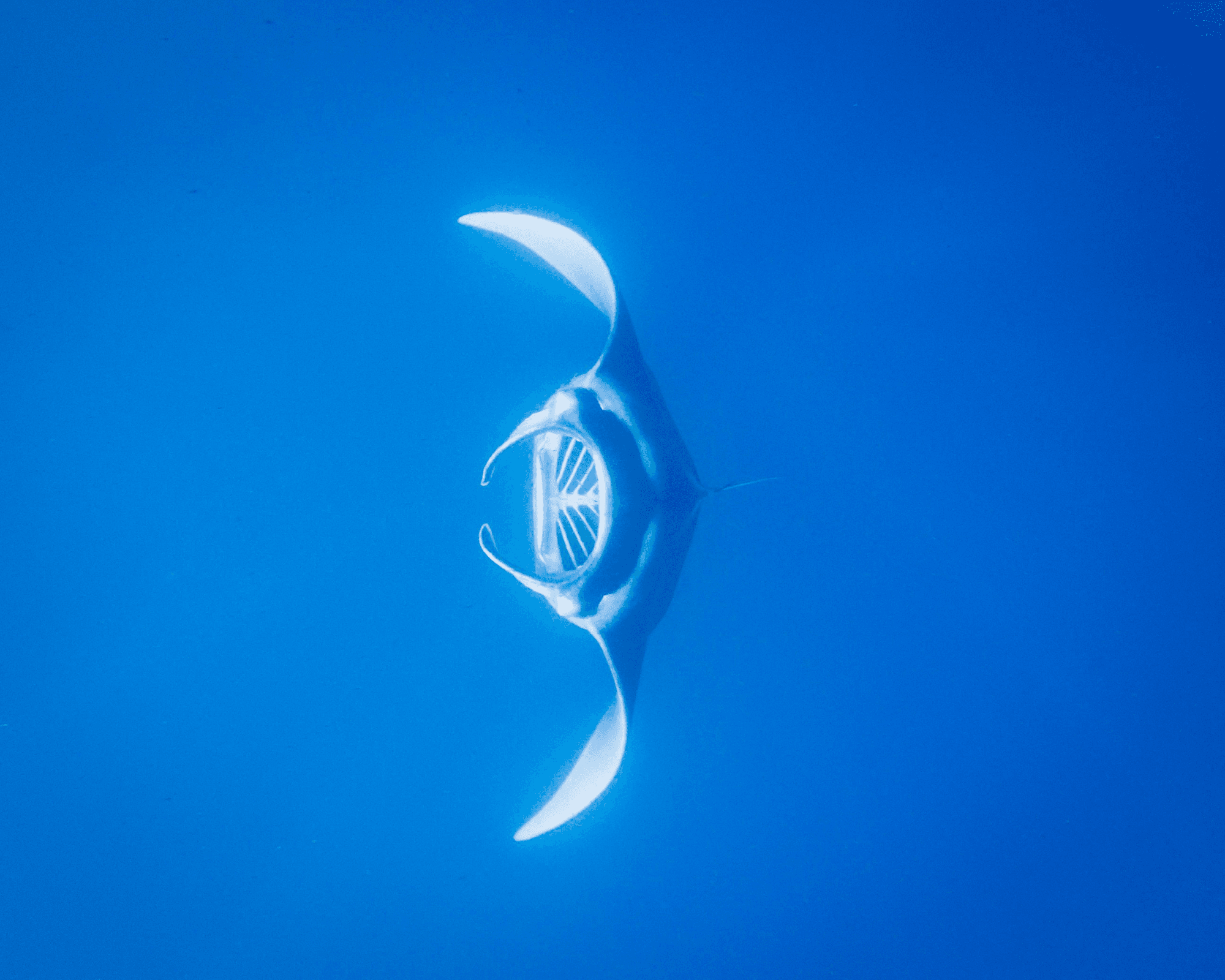
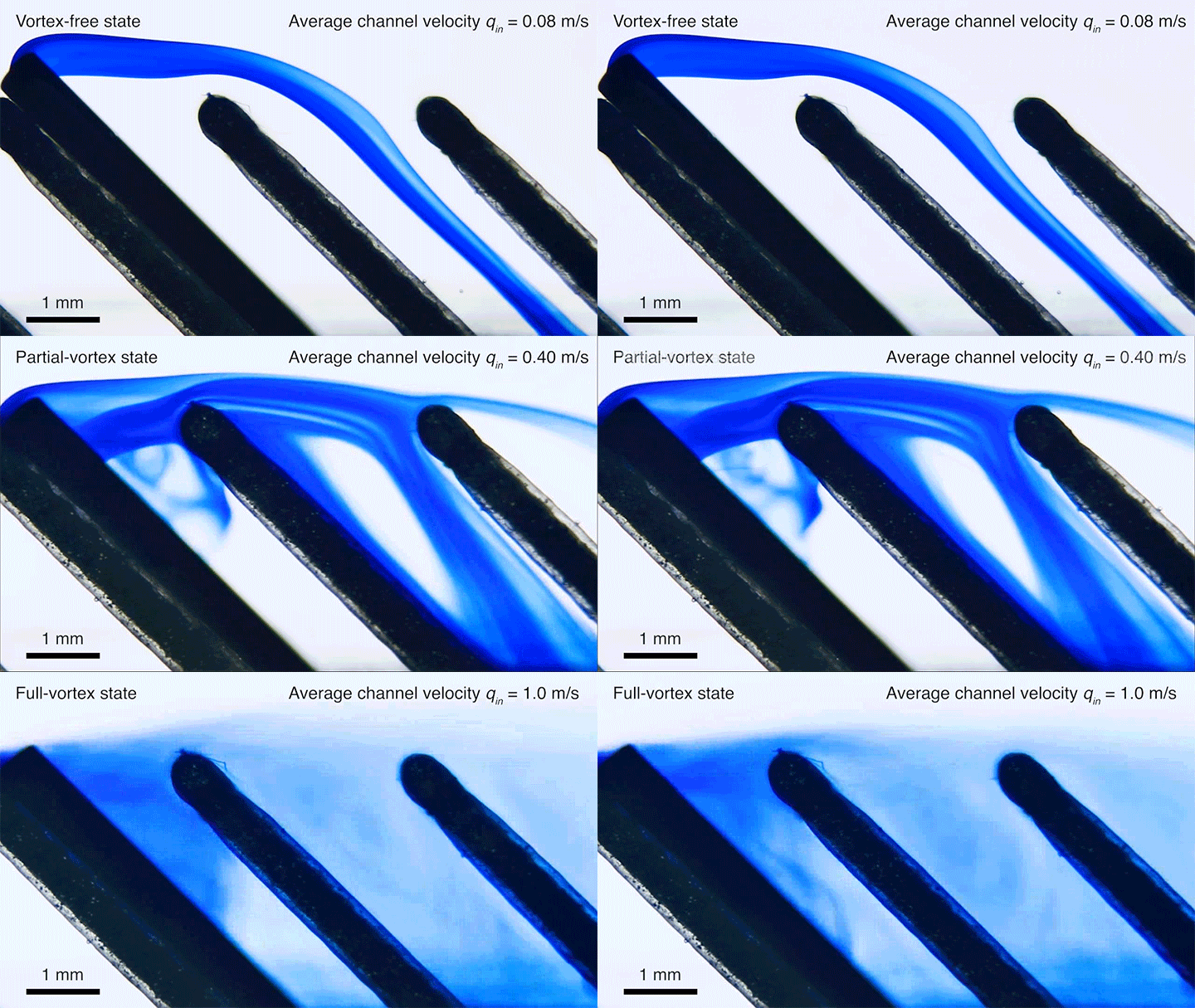
As manta rays swim, they’re constantly doing two important — but not necessarily compatible — things: getting oxygen to breathe and collecting plankton to eat. That requires some expert filtering to send food particles toward their stomach and oxygen-rich water to their gills. Manta rays do this with a built-in filter that resembles an industrial crossflow filter. Researchers built a filter inspired by a manta ray’s geometry, and found that it has three different flow states, based on the flow speed. At low speeds, flow moves freely down the filter’s channels; in a manta, this would carry both water and particles toward the gills. At medium speeds, vortices start to form at the entrance to the filter channels. This sends large particles downstream (toward a manta’s digestive system) while water passes down the channels. At even greater speeds, each channel entrance develops a vortex. That allows water to pass down the filter channels but keeps particles out. (Image credit: manta – N. Weldingh, filter – X. Mao et al.; research credit: X. Mao et al.; via Ars Technica)
Depending on the flow speed, a manta-inspired filter can allow both water and particles in or filter particles out of the water.
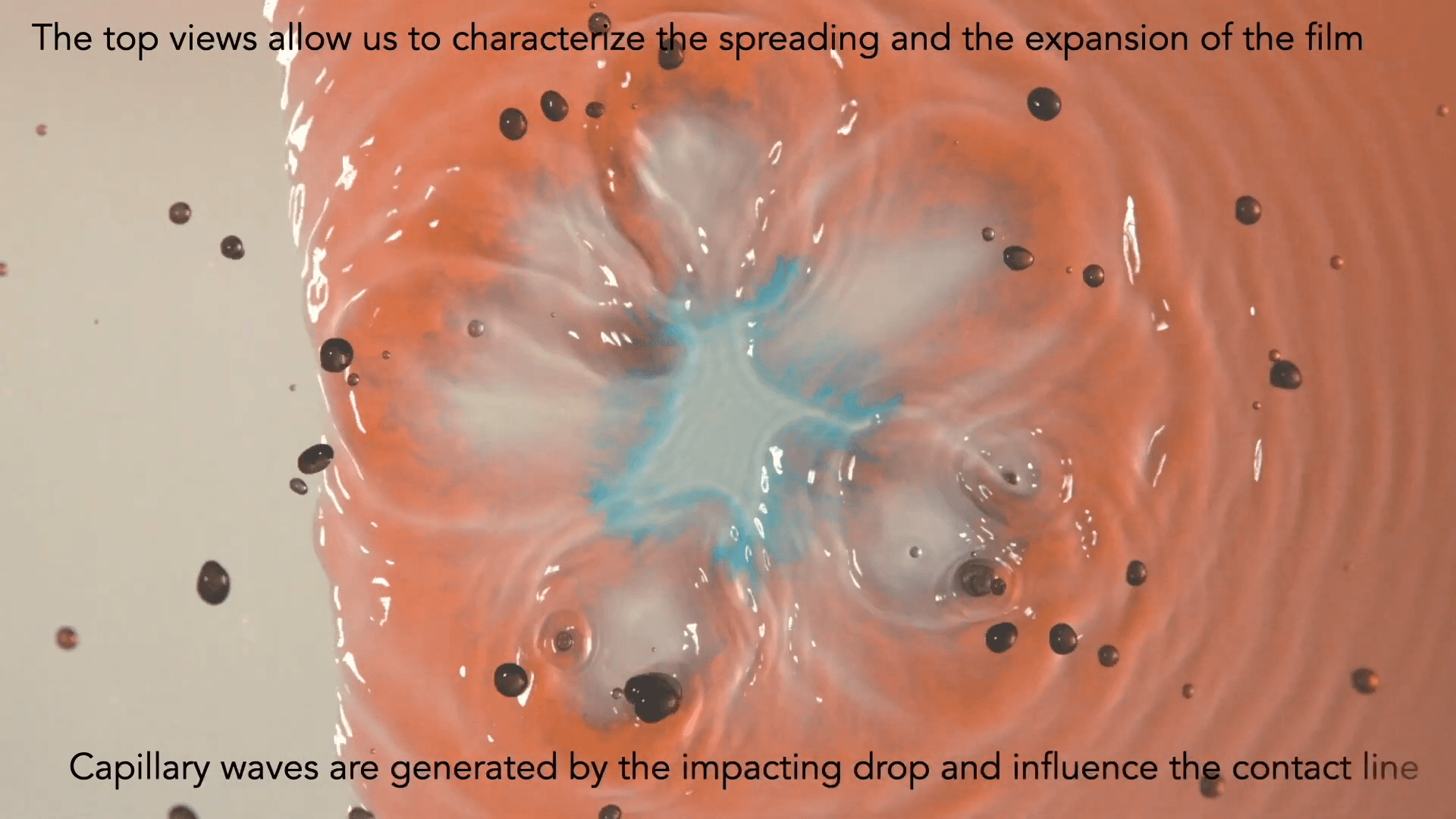
Drops impacting a dry hydrophilic surface flatten into a film. Drops that impact a wet film throw up a crown-shaped splash. But what happens when a drop hits the edge of a wet surface? That’s the situation explored in this video, where blue-dyed drops interact with a red-dyed film. From every angle, the impact is complex — sending up partial crown splashes, generating capillary waves that shift the contact line, and chaotically mixing the drop and film’s liquids. (Video and image credit: A. Sauret et al.)
Any time a fluid under gravity has areas of differing density, it convects. We’re used to thinking of this in terms of temperature — “hot air rises” — but temperature isn’t the only source of convection. Differences in concentration — like salinity in water — cause convection, too. This video shows a special, more complex case: what happens when there are two sources of density gradient, each of which diffuses at a different rate.
The classic example of this occurs in the ocean, where colder fresher water meets warmer, saltier water (and vice versa). Cold water tends to sink. So does saltier water. But since temperature and salinity move at different speeds, their competing convection takes on a shape that resembles dancing, finger-like plumes as seen here. (Video and image credit: M. Mohaghar et al.)
What happens to liquid crystals in a flow? In this video, researchers look at liquid crystals flowing through the narrow gap of a microfluidic device. Initially, all the crystals are oriented the same way, as if they are logs rolling down a river. But as the flow rate increases, narrow lines appear in the flow, followed by disordered regions, and, eventually, a new configuration: vertical bands streaking the left-to-right flow. The colors, in this case, indicate the orientation of the liquid crystals. As the researchers show, the crystals collectively twist to form the spontaneous bands. (Video and image credit: D. Jia and I. Bischofberger)
Sneezing and coughing can spread pathogens both through large droplets and through tiny, airborne aerosols. Understanding how the nasal cavity shapes the aerosol cloud a sneeze produces is critical to understanding and predicting how viruses could spread. Toward that end, researchers built a “sneeze simulator” based on the upper respiratory system’s geometry. With their simulator, the team mimicked violent exhalations both with the nostrils open and closed — to see how that changed the shape of the aerosol cloud produced.
The researchers found that closed nostrils produced a cloud that moved away along a 18 degree downward tilt, whereas an open-nostril cloud followed a 30-degree downward slope. That means having the nostrils open reduces the horizontal spread of a cloud while increasing its vertical spread. Depending on the background flow that will affect which parts of a cloud get spread to people nearby. (Image and research credit: N. Catalán et al.; via Physics World)
Supersonic commercial travel was briefly possible in the twentieth century when the Concorde flew. But the window-rattling sonic boom of that aircraft made governments restrict supersonic travel over land. Now a new generation of aviation companies are revisiting the concept of supersonic commercial travel with technologies that help dampen the irritating effects of a plane’s shock waves.
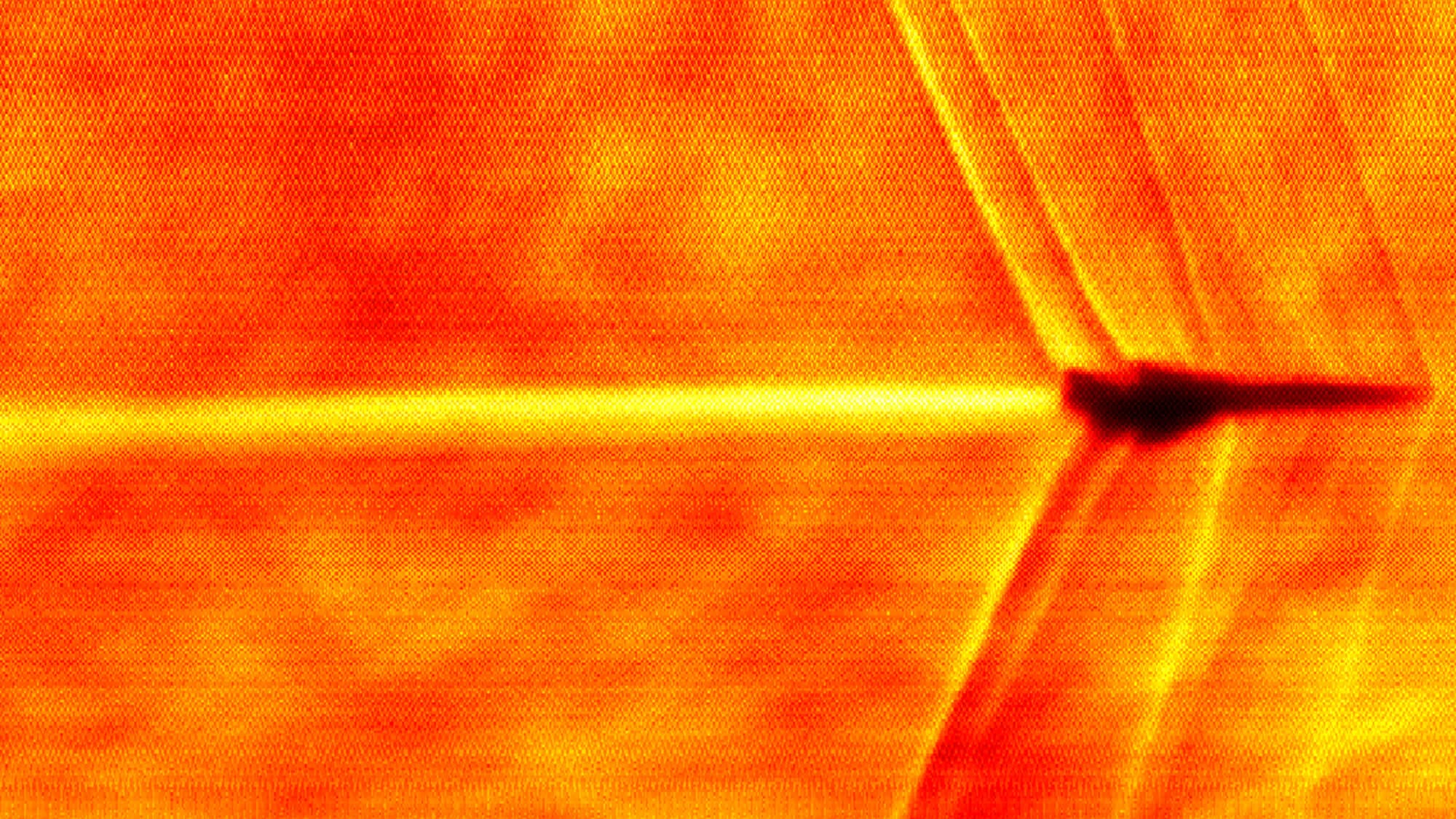
One such company, Boom Supersonic, partnered with NASA to capture the above schlieren image of their experimental XB-1 aircraft in flight. The diagonal lines spreading from the nose, wings, and tail of the aircraft mark shock waves. It’s those shock waves’ interactions with people and buildings on the ground that causes problems. But the XB-1 is testing out scalable methods for producing weaker shock waves that dissipate before reaching people down below, thus reducing the biggest source of complaints about supersonic flight over land. (Image credit: Boom Supersonic/NASA; via Quartz)