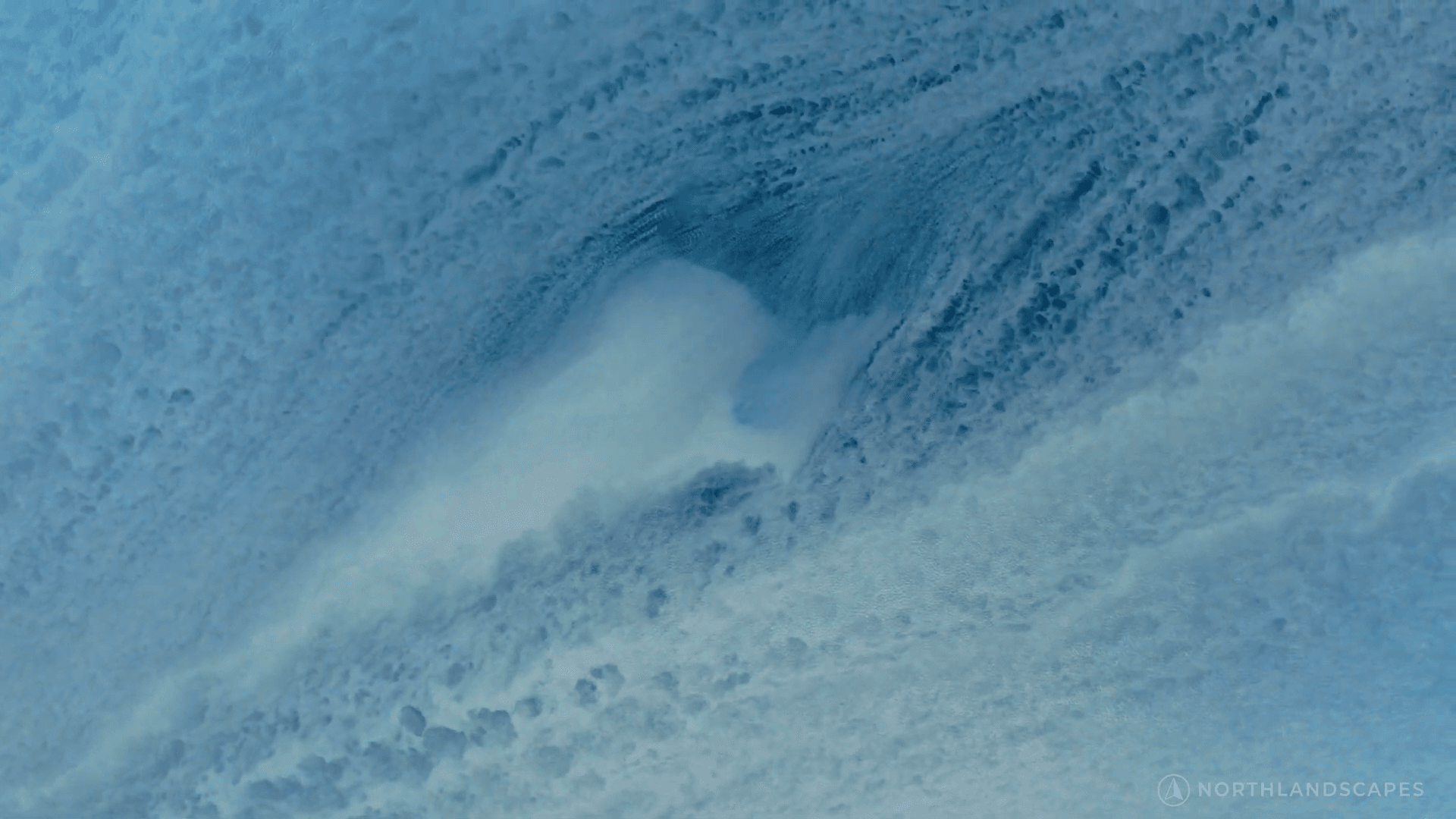
During the winter months, those of us living in the mid-latitudes sometimes experience atmospheric rivers. Formed from the interaction of cold winter storms with warm, moist tropical air, atmospheric rivers can deliver intense rainfall across long distances. In this video, the UCLA SpinLab team shows how you can recreate the effect with a relatively simple and affordable DIYnamics apparatus. (Video and image credit: UCLA SpinLab)
Tag: flow visualization

“Broken Water, Like Broken Glass”
How can you break water? By accelerating it so quickly that the pressure drop forms cavitation bubbles. Here, a steel piston rests against a transparent plate, all underwater. When a hammer strike accelerates the piston away at around 1000g, the severe pressure drop tears the water into bubbles (bottom, left). As the bubbles expand, the nearby piston squishes them into pancakes (bottom, center). As they continue growing, the bubbles press into one another, squeezing thin ridges of water between them. The result (center) resembles broken glass. (Image credit: J. da Silva et al.)


Instabilities in a Particle Flow
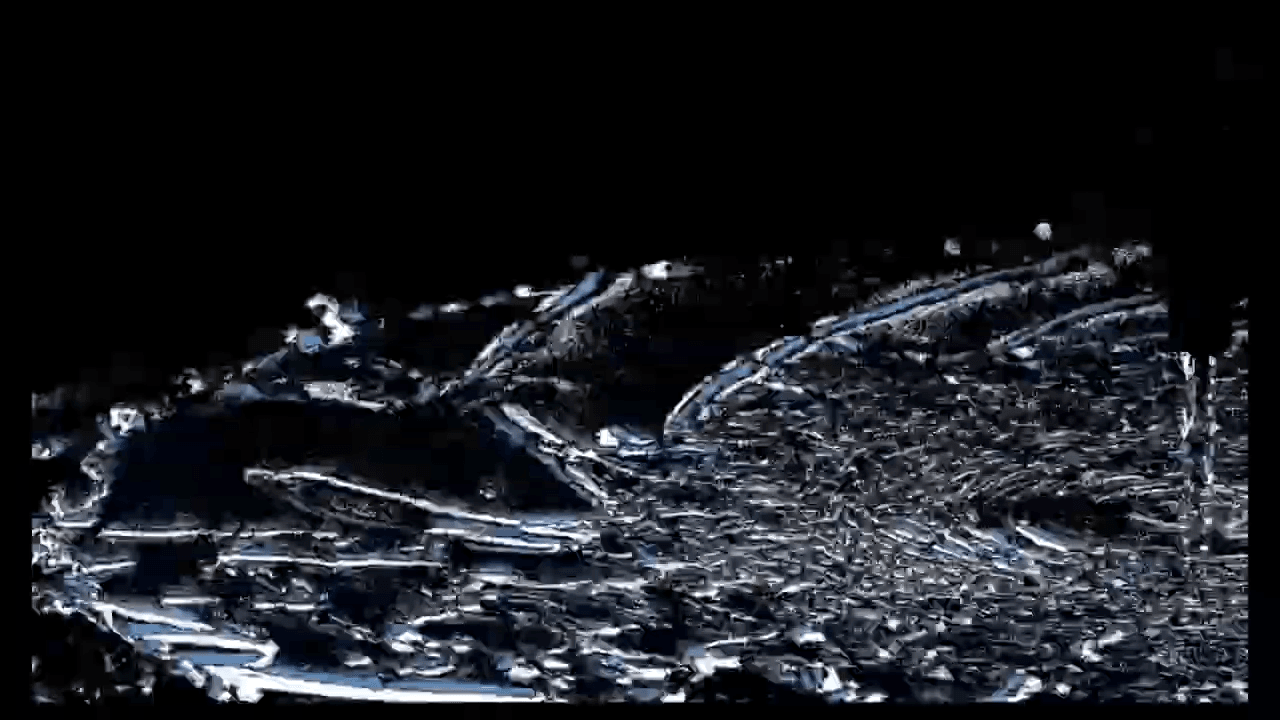
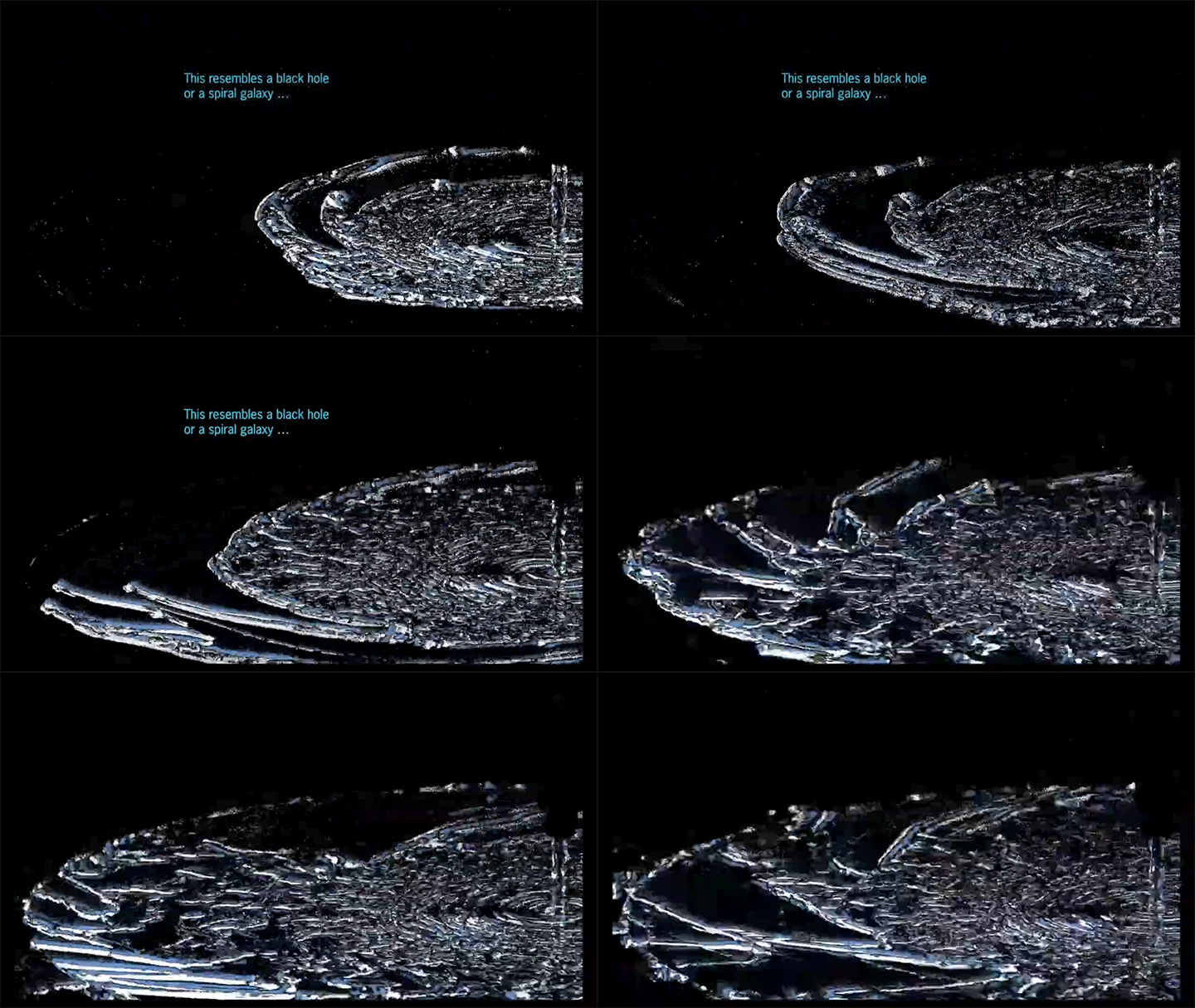
Even though particles are not (strictly speaking) a fluid, they often behave like one. Here, researchers investigate what happens when two layers of particles–with different size and density–slide down an incline together. The video is tilted so that the flow instead appears from left to right.
When the larger, denser particles sit atop a layer of smaller, lighter particles, shear between the two layers causes a Kelvin-Helmholtz instability that runs in the direction of the flow. This creates a wavy interface that lets some small particles work upward while large particles shift downward.
At the same time, a slice across the flow shows that plumes of small particles are pushing up toward the surface, driven by a Rayleigh-Taylor instability. The researchers also look at what happens when the particles are fluidized by injecting a gas able to lift the particles. (Video and image credit: M. Ibrahim et al.; via GFM)

A Supernova in Motion
In 1604, astronomers first caught sight of Kepler’s Supernova Remnant, a massive explosion some 17,000 light-years away. Twenty-five years of observations from the Chandra X-ray Observatory went into making this timelapse, which shows the supernova remnant‘s material pushing into the surrounding gas and dust.

In its fastest regions, the supernova remnant is moving around 2% of the speed of light–some 22 million kilometers per hour. Slower parts of the remnant are moving at just 0.5% of light-speed. (Image credit: NASA/CXC/SAO/Pan-STARRS; via Gizmodo)


Jupiter in a Lab
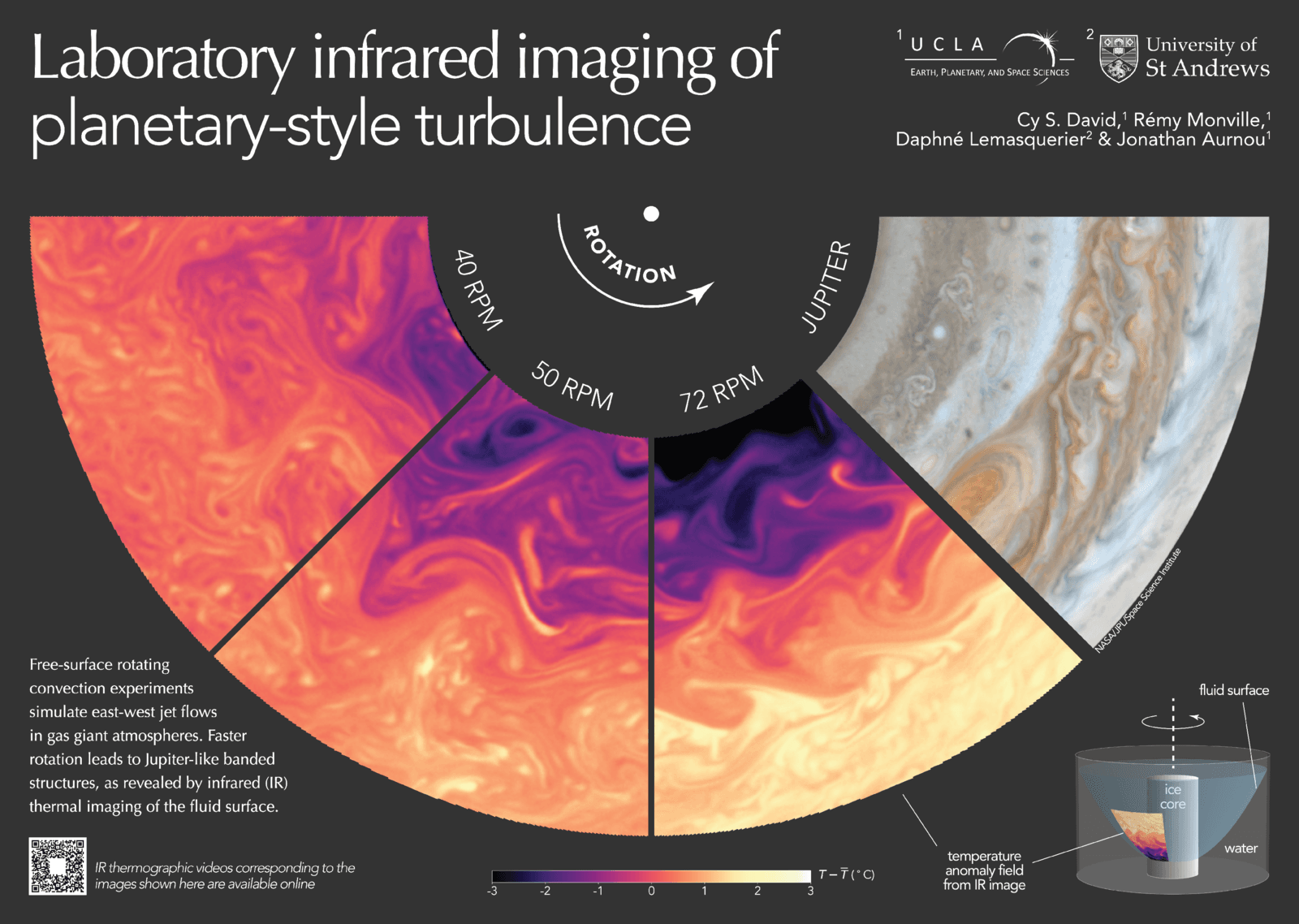
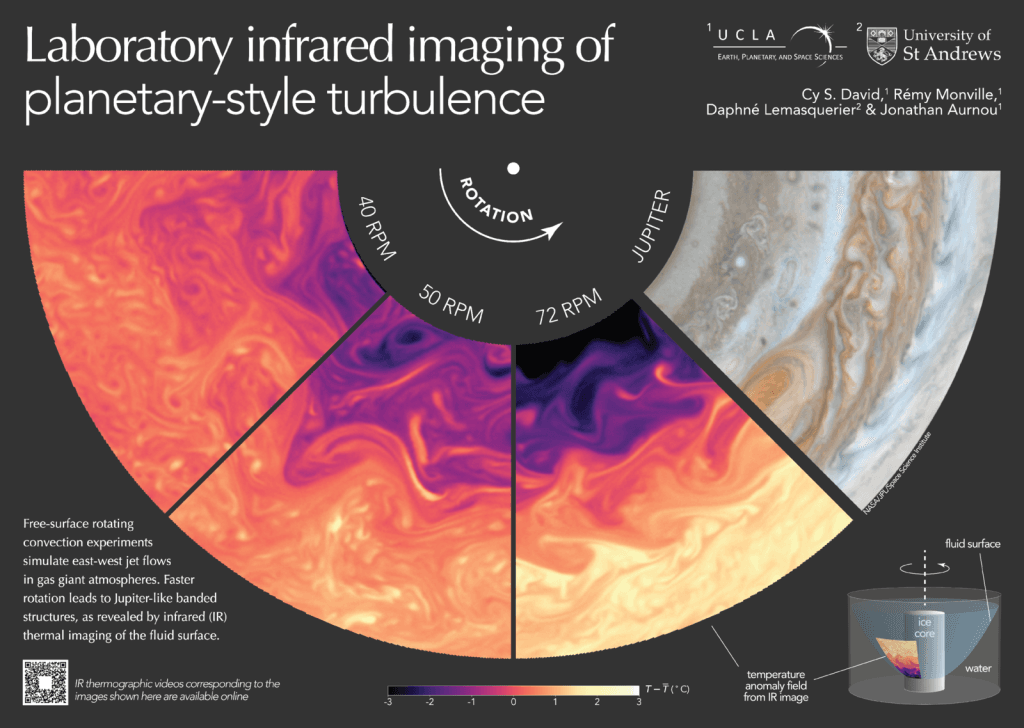
The vivid bands of a gas giant like Jupiter come from the planet’s combination of rotation and convection. It’s possible to create the same effect in a lab by rapidly spinning a tank of water around a central ice core. That’s the physical set-up behind this research poster–note the illustration in the lower right corner. The central snapshots show how temperature gradients on the water surface change the faster the tank rotates. At higher rotational speeds, the parabolic water surface gets ever steeper and Jupiter-like temperature bands form. (Image credit: C. David et al.)


Flow Through Granular Beds
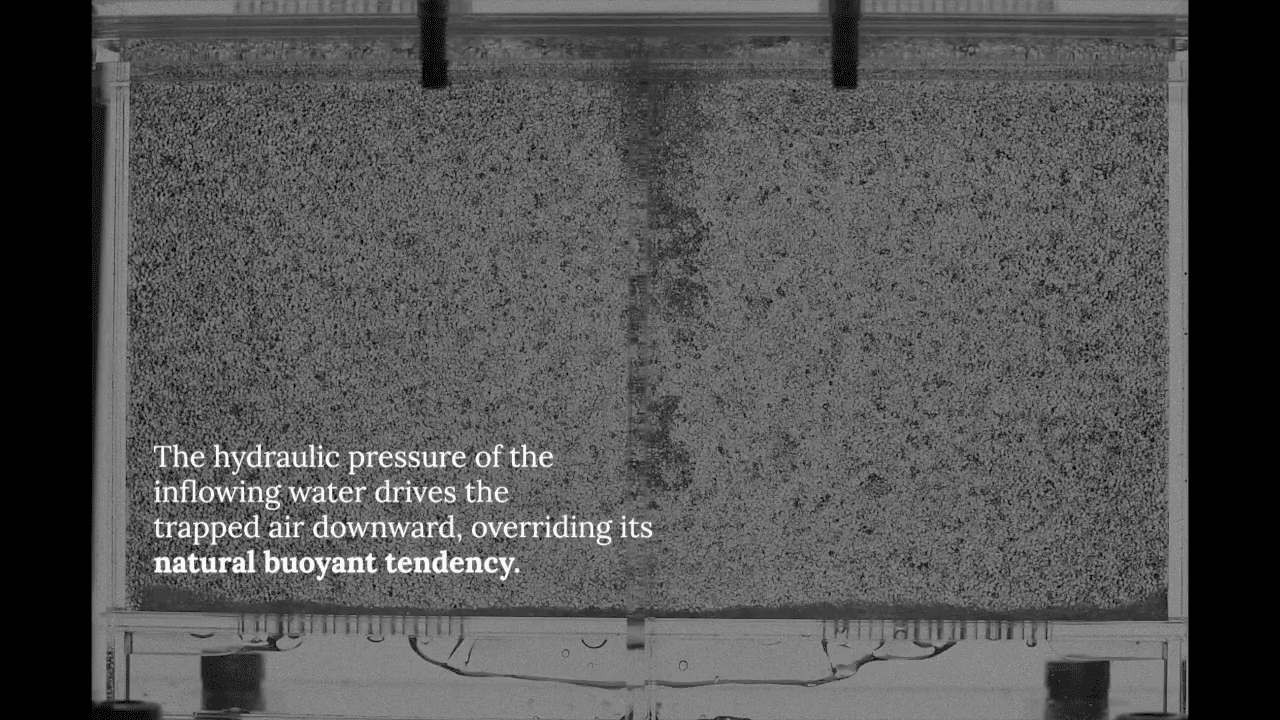
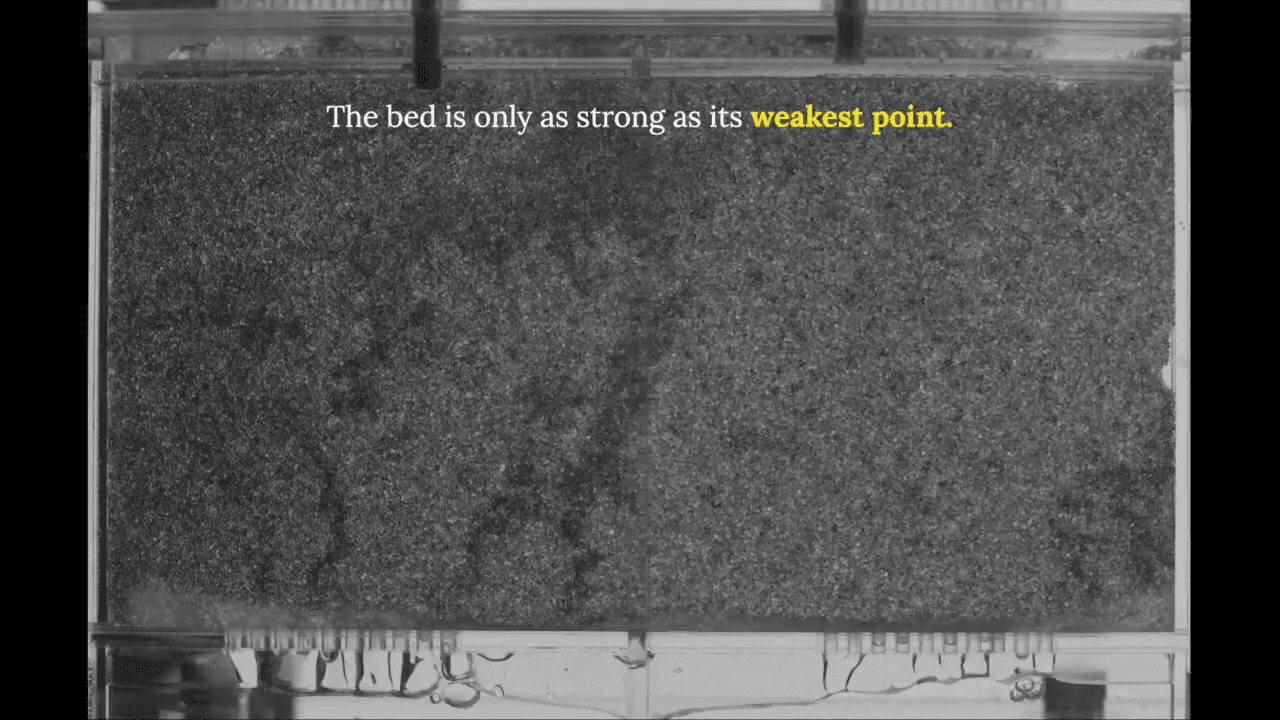
We often rely on water draining through beds of grains, whether it’s the soil foundation beneath a building or the sand-and-gravel-filter used in water treatment. But how does water move through these tortuous porous passages? That’s what we see in this video, which places grains in a jig resembling an ant farm and lets us watch as water–and air–drain through the grains. The result is more complicated than you might imagine, with dry pockets, weak spots, and developing sinkholes. (Video and image credit: J. Choi et al.)

Inside a Bubble’s Burst
When bubbles burst at an interface, both their exterior and interior get spread into the air. Here, researchers watch as a fog-filled bubble rises through silicone oil and settles as the surface. Instabilities ripple down the bubble’s cap as it thins, and, once the bubble bursts, the fog from within is pushed upward, curling into a vortex as it goes. (Video and image credit: R. Shabtay and I. Jacobi; via GFM)

ExaWind Simulation
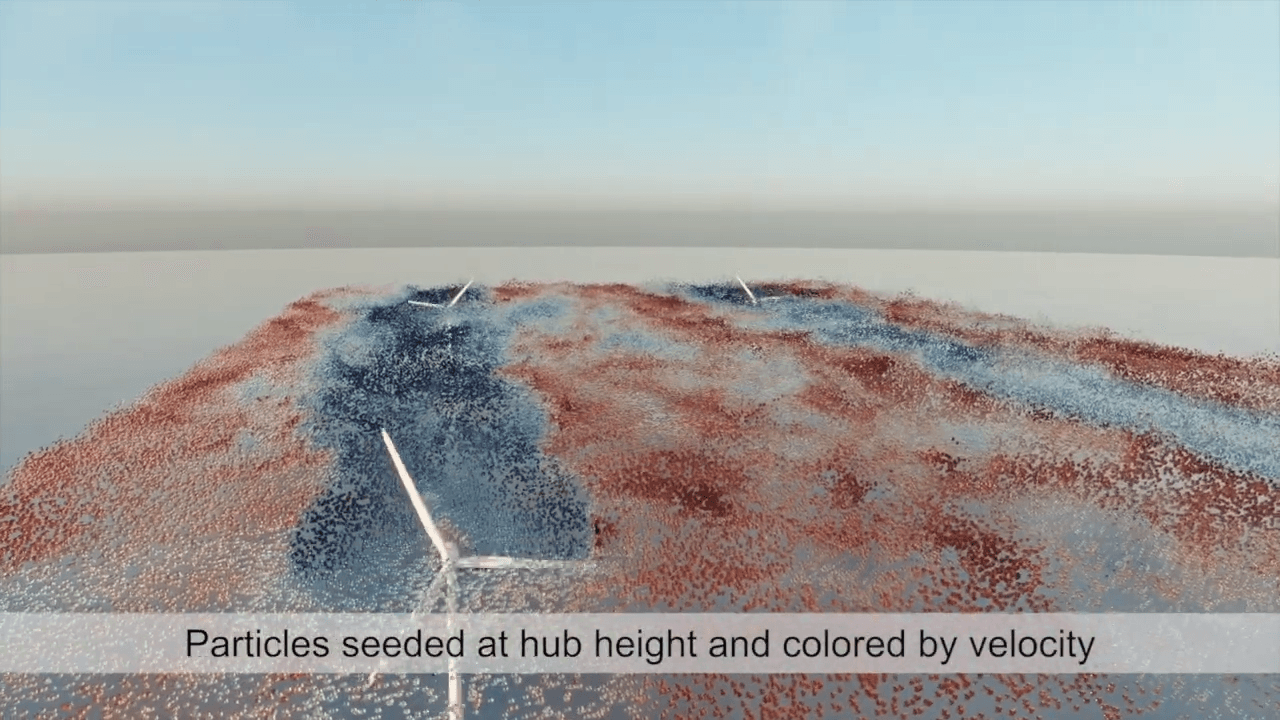
Large-scale computational fluid dynamics simulations face many challenges. Among them is the need to capture both large physical scales–like those of Earth’s atmospheric boundary layer–and small scales–like those of tiny eddies moving around a wind-turbine blade. Capturing all of these scales for a problem like four wind turbines in a wind farm requires using the full computing power of every processor in a large supercomputer. That’s the level of power behind the simulation visualized in this video. The results, however, are stunning. (Video and image credit: M. da Frahan et al.)

“Glacial River Blues”
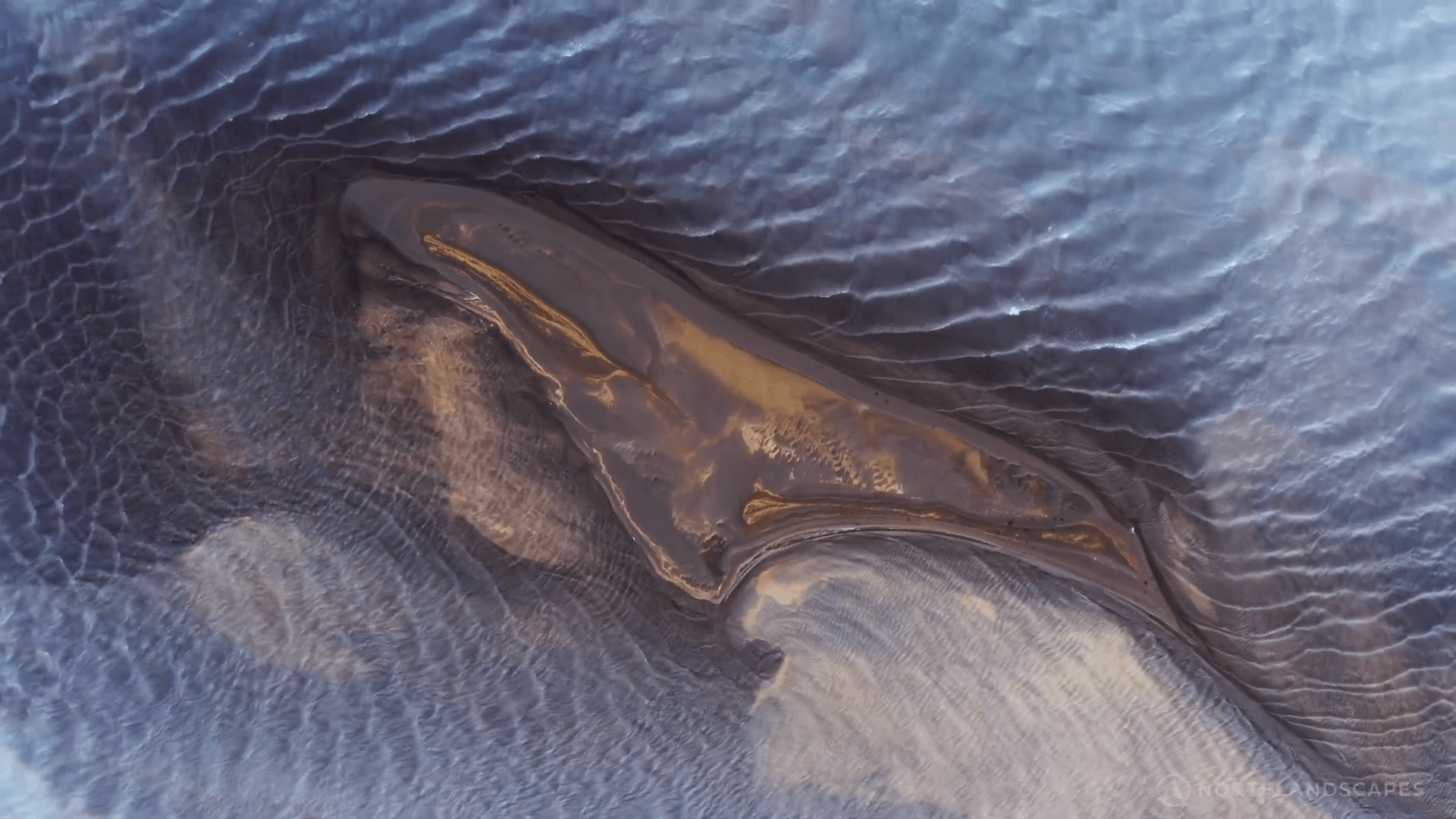
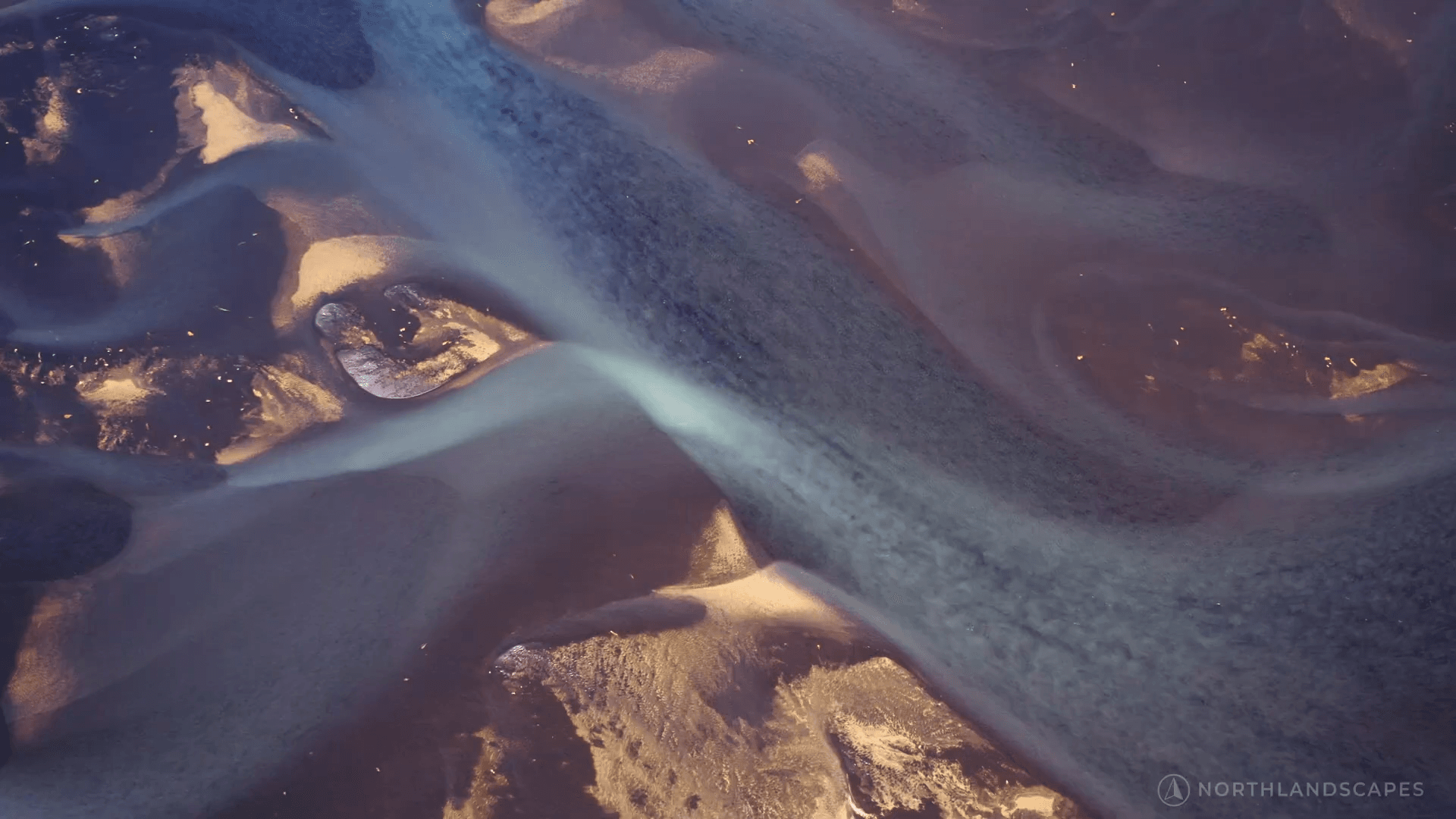
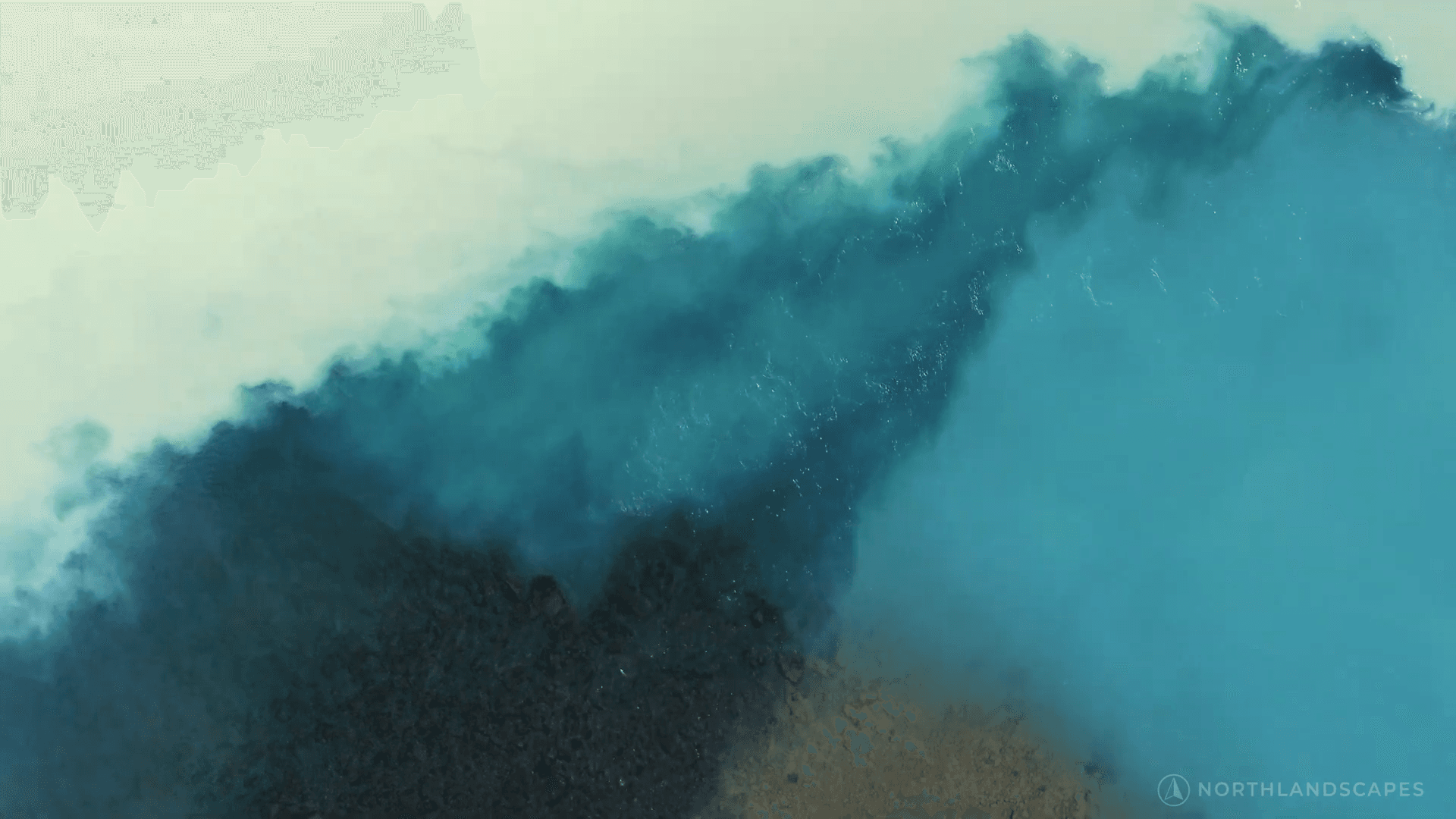
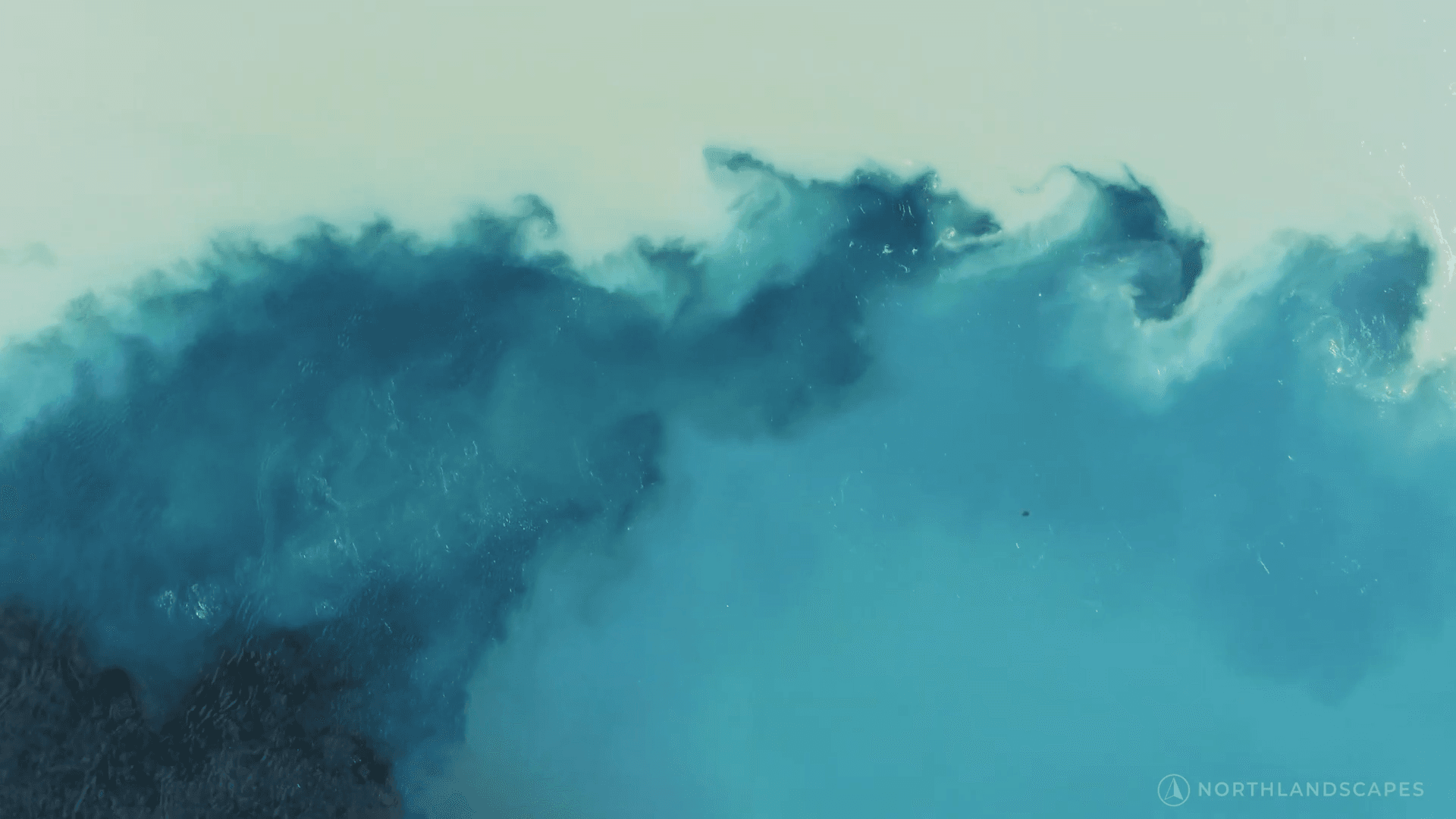
Glacier-fed rivers are often rich in colorful sediments. Here, photographer Jan Erik Waider shows us Iceland’s glacial rivers flowing primarily in shades of blue. While the wave action and diffraction in these videos is great, the real star is the turbulent mixing where turbid and clearer waters meet. Watch those boundaries, and you’ll see shear from flows moving at different speeds which feeds the ragged, Kelvin-Helmholtz-unstable edge between colors. (Video and image credit: J. Waider; via Laughing Squid)

Event-Based Recording
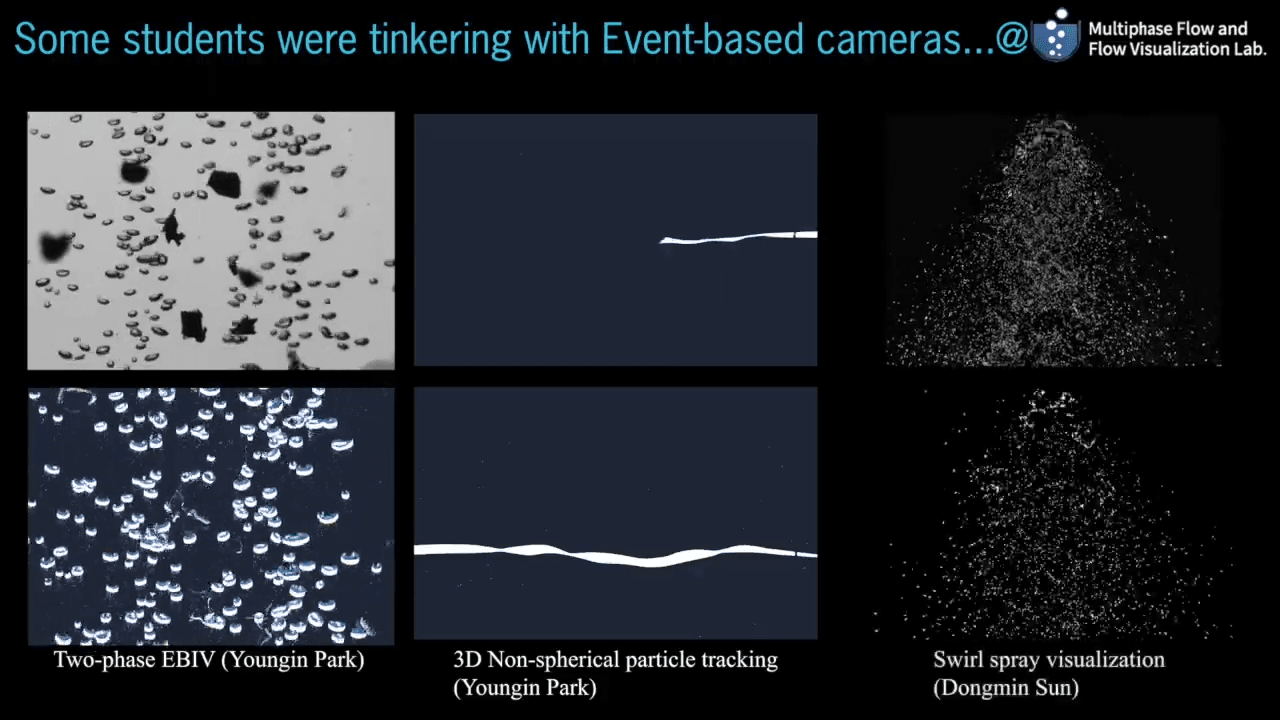
High-speed cameras are an amazing tool in fluid dynamics, but they come with a whole host of challenges. The camera and lighting have to be positioned to deal with reflections, the data sets are enormous, and post-processing all that data takes a long time.

Here, researchers experiment instead with studying a flow using an event-based camera, which records information only when and where the brightness changes. The images and videos look strange to our eyes, but, as the authors show, they work nicely for identifying flow features and extracting valuable data. (Video and image credit: D. Sun et al.)


![Composite image of bed layers for 4 different particle density ratios. Text reads, "The wave amplitude and growth rate increase with particle density ratio but only if [the density of large particles is greater than the smaller particle density]." Composite image of bed layers for 4 different particle density ratios. Text reads, "The wave amplitude and growth rate increase with particle density ratio but only if [the density of large particles is greater than the smaller particle density]."](https://fyfluiddynamics.com/wp-content/uploads/KHbed3-1024x576.png)