Tag: flow visualization

  • Featured Video Play Icon

    To Clog or Not to Clog?

    The clear plastic disks use to study clogging appear rather plain — at least until you look at them through polarizers. Then the disks light up with a web of lines that reveal the unseen forces between the particles. In this video, researchers use this trick to explore how spontaneous clogs occur. If particles jam together into an arch, that bridge can be strong enough to hold the weight of all the particles above it, bringing the flow to a halt. Some arches aren’t strong enough to hold for long; they can break in moments. Other more stable arches persist. By watching the flow through polarizers and carefully tracking the ebb and flow of the forces between particles, researchers can predict which clogs will have staying power. (Video credit: B. McMillan et al.)

  • Featured Video Play Icon

    “Vorticity 5”

    Photographer and stormchaser extraordinaire Mike Olbinski is back with the fifth volume in his “Vorticity” series. Shot over the 2022 and 2023 tornado seasons in the U.S. Central Plains, this edition has virtually everything: supercells, microbursts, lightning, tornadoes, and haboobs. There’s towering convection and churning, swirling turbulence. It’s a spectacular look at the power and grandeur of our atmosphere. (Video and image credit: M. Olbinski)

  • Painting in Sediment

    Painting in Sediment

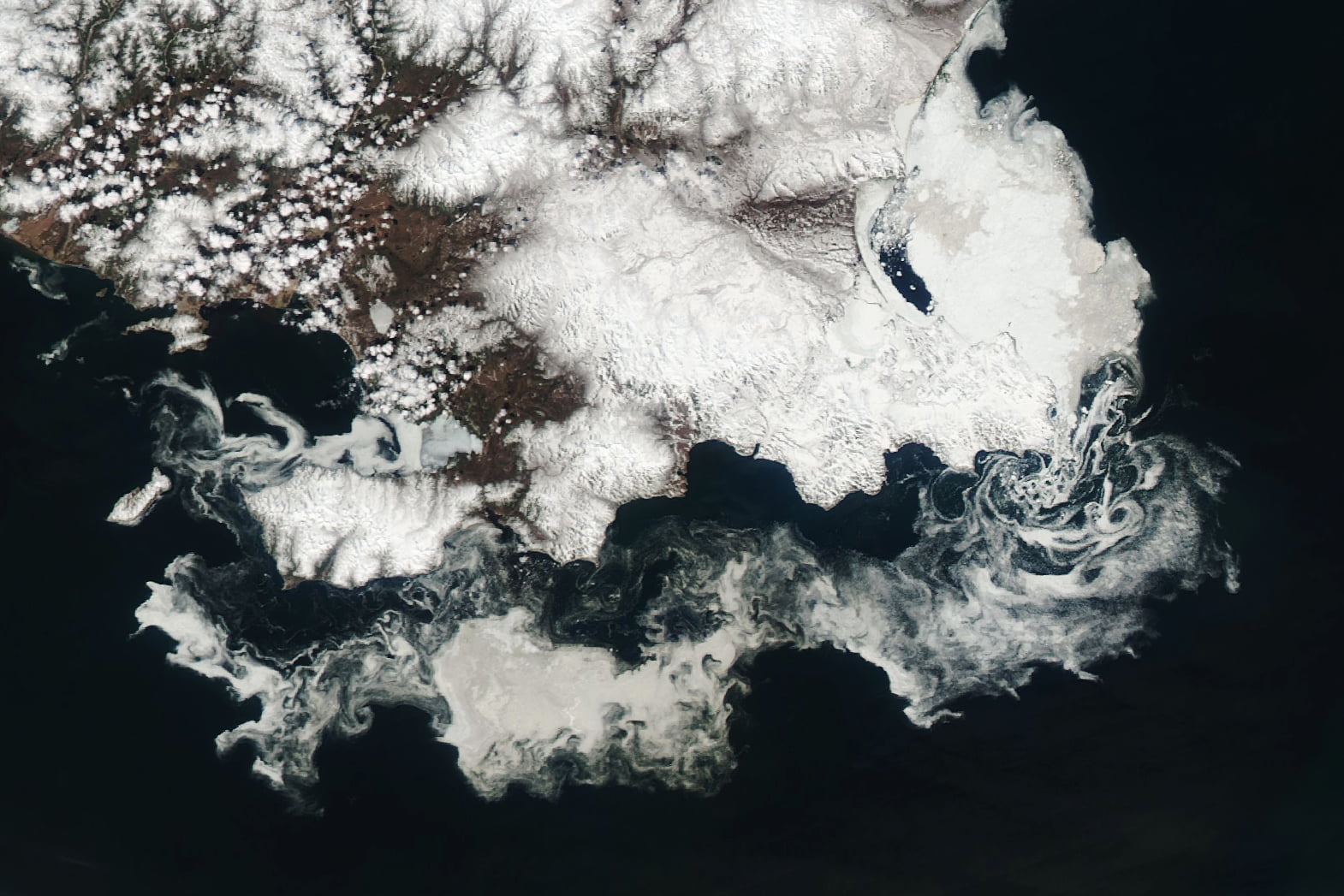
    Pale plumes of sediment flow off these islands in the Gulf of Mannar between India and Sri Lanka. As waves erode the land, currents and tides carry the sediment outward, shaping it into swirls and eddies. I rarely tire of satellite images like these because there are always subtle new details of flow to notice. The photos are much like paintings, with layer after layer to decipher the closer you look. (Image credit: A. Nussbaum; via NASA Earth Observatory)

  • Featured Video Play Icon

    The Destructive Power of a Blank

    Removing the slug does not make a bullet harmless, as the Slow Mo Guys demonstrate in this video. They’re shooting blanks — casings that still contain propellant but no projectile. There’s still more than enough force to obliterate an egg, lunch meat, and water balloons. You really don’t want one of these fired near you.

    It looks as though the burning propellant is generally the first thing to puncture in each of these. Then the gas from the explosion blows the rest of the object away. The most interesting segment, to me, was the final (pink) water balloon, where the blast wave and its aftermath are visible in a schlieren-like effect that passes over the balloon before its destruction. The sun must have been at just the right position relative to their set-up. (Video and image credit: The Slow Mo Guys)

  • Atlantic Blooms

    Atlantic Blooms

    In April 2023, swirls of green and turquoise burst into vivid color in the Atlantic. Much of the color comes from a phytoplankton bloom. Although phytoplankton are individually microscopic, they form eddies a hundred kilometers across that are visible from space. In detailed images like the one above (available here in full resolution) these swirls have amazing turbulent details. Some of the brightest sections almost look like a field of sea ice! (Image credit: L. Dauphin; via NASA Earth Observatory)

    This wider view shows the bloom's location off of the northeastern U.S.
  • Puddle Depth Matters for Stalagmites

    Puddle Depth Matters for Stalagmites

    In a cave, mineral-rich water drips from the ceiling, spreading ions used to build stalagmites. A recent study considers how the depth of a pool affects the droplet’s splash and how material from the droplet spreads. The authors found several scenarios that vary widely depending on pool depth.

    A droplet falling into a shallow pool creates a splash that quickly breaks up into droplets. This flings the red droplet material in many directions.
    A droplet falling into a shallow pool creates a splash that quickly breaks up into droplets. This flings the red droplet material in many directions.

    A drop falling into a shallow pool had a splash that quickly broke up into droplets (above). By dyeing the pool green and the droplet red, they could track where the droplet’s material wound up. The spray of small droplets carried fluid far, but the main point of impact had a strong concentration of the drop’s fluid.

    With a deeper pool, the drop's impact creates a thick crown splash that collapses in on itself. The drop's fluid is quickly mixed into the pool.
    With a deeper pool, the drop’s impact creates a thick crown splash that collapses in on itself. The drop’s fluid is quickly mixed into the pool.

    In contrast, a deeper pool sent up a thick-walled splash crown that collapsed in on itself. This droplet’s material saw lots of mixing with the pool, but only near the point of impact. From their work, the authors concluded that models of stalagmite growth should incorporate pool depth in order to capture how minerals actually concentrate and move. (Image credit: cave – H. Roberson, others – J. Parmentier et al.; research credit: J. Parmentier et al.; via APS Physics; submitted by Kam-Yung Soh)

  • Featured Video Play Icon

    Sniffing in Stereo

    Snakes’ forked tongues have long inspired fear, but, in reality, they are part of a highly-effective sensory system. When snakes flick out their tongues, they waggle them up and down about 15 times a second. That motion draws air inward toward the tongue (Image 2), allowing scent molecules to stick to the saliva on either side of the tongue. Once those molecules are gathered, the snake pulls its tongue back into its mouth, where it settles into two grooves (Image 3). Each one has its own path to the snake’s olfactory organs, giving the snake independent spots to evaluate the left and right forks. That means the snake knows which side has a stronger scent and is better able to track its prey. (Video and image credit: Deep Look)

  • Swirls Over the Canaries

    Swirls Over the Canaries

    Rocky, isolated islands disturb the atmosphere, sending air swirling off one side of the island and then the other. The effects are not always visible to the naked eye, but, as they do here, they can show up in satellite imagery as whirling von Karman vortex streets. The eddies of this image are due to the Canary Islands, and if you follow the line of swirls backward, you’ll find their originating islands. Note that the cloudy swirls don’t appear immediately behind the islands. That’s because there wasn’t enough moisture in the air for clouds to condense yet; the same swirls that you see in the downstream clouds exist in the clear air closer to the islands. (Image credit: A. Nussbaum; via NASA Earth Observatory)

  • Liquid Lens Rupture

    Liquid Lens Rupture

    A blob of sunflower oil floating on soapy water forms a disk known as a liquid lens. But add some dyed ethanol and things take a turn. The lens rapidly expands and distorts as the ethanol and soapy water meet. These surface flows are driven by the imbalance of surface tension between the different liquids. The liquid lens deforms and abruptly ruptures, releasing dye and ethanol before rebounding into a stable lens again. Adding more ethanol to the lens will repeat the cycle. (Image credit: C. Kalelkar and P. Dey; research credit: D. Maity et al.)

  • A Sea of Pollen

    A Sea of Pollen

    Fellow allergy sufferers, beware! This false-color satellite image of the Baltic Sea shows massive slicks made up of pine pollen. I don’t know about you, but the mere thought of enough pollen that it’s visible from space makes me want to double — triple?! — my antihistamines. The swirling patterns in the pollen come from wind-driven currents and waves moving the pollen on the surface of the water.

    It took some sleuthing for scientists to identify these slicks as pollen rather than bacteria or plankton. But by combining experimental results, ground-based observations, and satellite image processing, scientists discovered that the pine pollen has a particular spectral signature. Using that, the team could trawl through older satellite imagery and locate pine pollen in previous seasons. They identified pine pollen slicks in 14 of the last 20 springs. The size of the slicks is growing over time, too, consistent with other observations of longer pollinating seasons. (Image credit: L. Dauphin; via NASA Earth Observatory)