Tag: flow visualization

  • Featured Video Play Icon

    Blood Flow in a Fin

    This award-winning video shows blood flowing through the tail fin of a small fish. Cells flow outward in a central vessel, then split to either side for the return journey. In this microscopic video, the speed of individual cells seems quite fast, even though the vessels themselves are only wide enough for the blood cells to move in single file. Flow at the microscale can be counterintuitive like that. (Video and image credit: F. Weston for the 2023 Nikon Small World in Motion Competition; via Colossal)

  • “Shaken, Not Stirred”

    “Shaken, Not Stirred”

    James Bond notoriously orders his martinis “shaken, not stirred,” a request bartenders fulfill by shaking the cocktail over ice in a separate shaker. But what if you shake the martini glass itself? That’s the question that inspired this lovely mixology.

    By shaking the martini glass gently back and forth (along the directions shown by the arrows in each image), the team created different mixing patterns within the glass. With a little food dye and pearl dust, they visualized the flows they found. By changing the viscosity of the cocktail and the speed of the swish, they made everything from a four-leaf clover to a cadre of ghosts. It seems that martini glasses hold a flow for every occasion! (Image and research credit: X. Song et al.; submitted by Zhao P.)

    GFM poster, describing the experiments used to create these picturesque martinis.
    GFM poster, describing the experiments used to create these picturesque martinis.
  • Eroding the Sphinx

    Eroding the Sphinx

    One theory suggests that the Great Sphinx of Giza formed — in part — naturally as a result of erosion, and ancient Egyptians added features to the bedrock formation. To test the plausibility of the theory, researchers made a miniature sphinx, consisting of a clay mound with a single, harder inclusion to represent the Sphinx’s head, and placed their construction in a water tunnel. As the water eroded away the clay, the head appeared, and flow around this harder-to-erode region formed some of the body and paws of the reclining Sphinx.

    The experiment suggests that it is plausible for part of the Sphinx to have formed naturally, as a result of erosion. But plausibility is not proof, and given the lack of a contemporary inscription explaining the statue’s origin, the goals and methods of the people who built it around 2500 B.C.E. will remain a matter of archaeological debate. (Image credit: S. Boury et al.)
  • “Chaosmosis”

    “Chaosmosis”

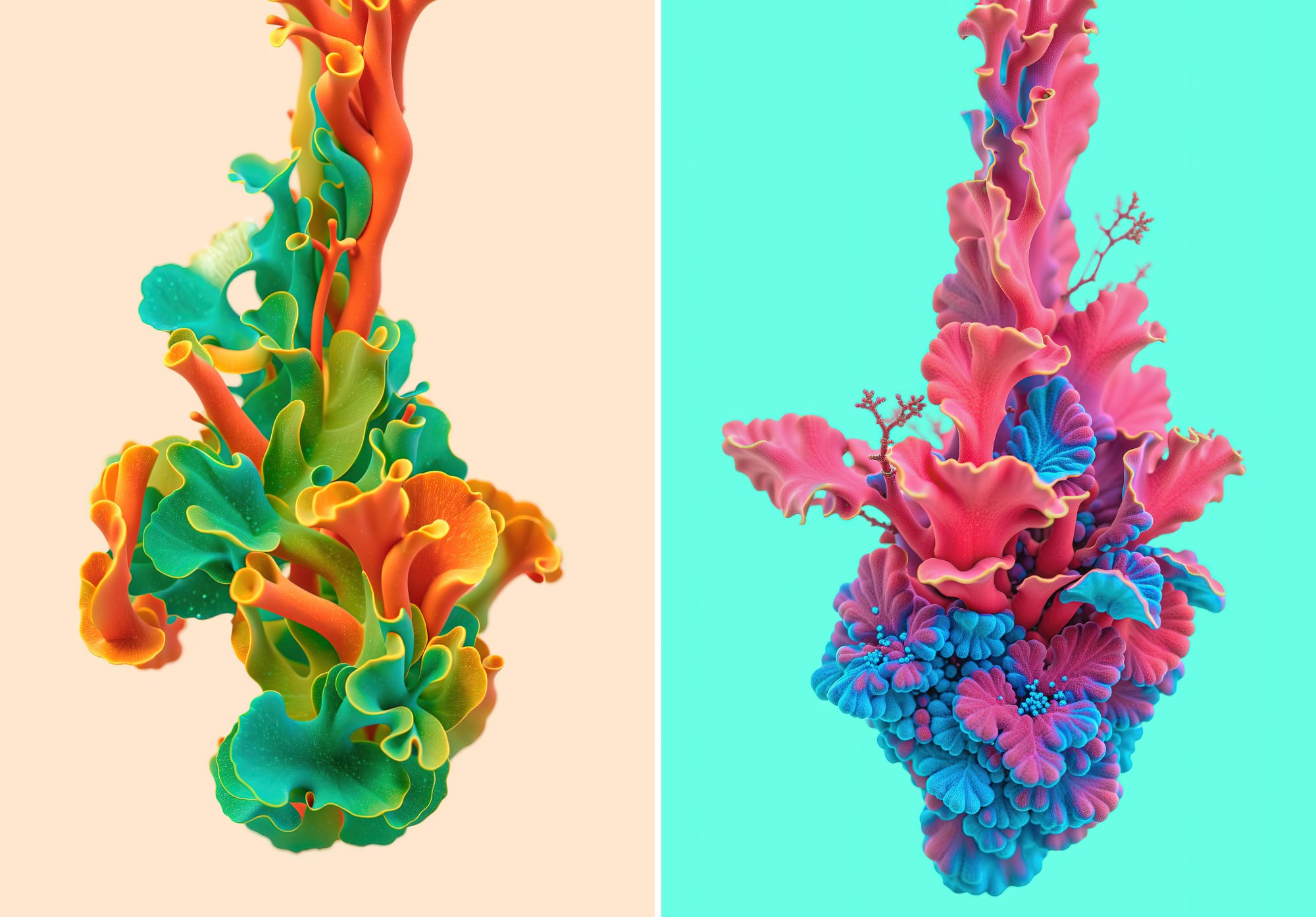
    After many years of featuring work from the Gallery of Fluid Motion, I’m excited to announce a new public exhibition of art drawn from the competition: “Chaosmosis: Assigning Rhythm to the Turbulent.” Works in the exhibit come from both scientists and artists; each piece makes visible the fluid motions that surround us.

    The exhibit is located at the National Academy of Sciences in Washington, DC through February 23, 2024. Entry is free, but only available between 9 a.m. and 5 p.m. on weekdays. For more, check out the exhibit’s webpage and press release (pdf) and the Instagram accounts for CPNAS and the exhibit.

    I’m looking forward to seeing the exhibit when I’m at the APS DFD meeting next month, but if you can’t make it to DC before the exhibit ends, don’t worry! This is just the first stop for the new traveling GFM exhibit. (Image credits: various, see individual images’ titles)

  • Spreading Spores

    Spreading Spores

    Mushrooms are the fruiting bodies of much bigger, largely underground fungi. Being fruit, mushrooms have the job of spreading spores so that the fungus can reproduce. Some mushrooms rely on the wind; others create their own wind. Still others use vortex rings to carry their spores higher. Who knew such fascinating and beautiful physics lies along the forest floor? (Image credit: top – A. Papatsanis, bottom – I. Potyó; via Wildlife POTY)

    Photo by Imre Potyó.
  • Black Hole Signature

    Black Hole Signature

    240 million years ago, pressure waves emanated from a black hole inside the Perseus Galaxy Cluster. Much later, NASA’s Chandra X-Ray Observatory intercepted those waves. Scientists raised the frequency of the signal until it fell within the range of human hearing. And then photographer John White played that sound through a petri dish of water sitting on a speaker. The result is above: a watery glimpse of a long ago black hole’s signature. Within these Faraday waves is the echo of a stellar phenomenon that took place when the very first dinosaurs walked our planet. (Image credit: J. White; via the 2023 Astronomy POTY)

  • Butterfly Scales

    Butterfly Scales

    Catch a butterfly, and you’ll notice a dust-like residue left behind on your fingers. These are tiny scales from the butterfly’s wing. Under a microscope, those scales overlap like shingles all over the wing. Their downstream edges tilt upward, leaving narrow gaps between one scale and the next. Experiments show that, although butterflies can fly without their scales, these tiny features make a big difference in their efficiency.

    At the microscale, a butterfly's scales overlap like roof shingles but are tilted upward, leaving cavities in the downstream direction.
    At the microscale, a butterfly’s scales overlap like roof shingles but are tilted upward, leaving cavities in the downstream direction.

    When air flows over the scales, tiny vortices form in the gaps between. These laminar vortices act like roller bearings, helping the flow overhead move along with less friction and, thus, less drag. Compared to a smooth surface, the scales reduce skin friction on the wing by 26-45%. (Image credit: butterfly – E. Minuskin, scales – N. Slegers et al., experiment – S. Gautam; research credit: N. Slegers et al. and S. Gautam; via Physics Today)

    This lab-scale experiment shows how air moves over butterfly scales. As flow moves from left to right, small persistent vortices form in the gaps between scales. These act like roller bearings that reduce the skin friction from air moving past.
    This lab-scale experiment shows how air moves over butterfly scales. As flow moves from left to right, small persistent vortices form in the gaps between scales. These act like roller bearings that reduce the skin friction from air moving past.
  • Featured Video Play Icon

    Hitting Molten Steel

    Watching droplets burst is often fascinating, but it’s rare that we get to watch droplets of molten metal. In this Slow Mo Guys video, though, they’re shattering globs of molten steel and filming the results in slow motion. It’s the kind of starburst that breaks compression algorithms but remains beautiful regardless. (Video and image credit: The Slow Mo Guys)

  • Featured Video Play Icon

    “Emerald and Stone”

    “Emerald and Stone” is filmmaker Thomas Blanchard’s tribute to the music of Brian Eno. The short film is made, as Blanchard puts it, with “inks and painting,” but I suspect there’s some oil in there, too, to coat the droplets we see. Much of the movement is likely driven by surface tension variations in the background fluid. I love the effect this has on the droplets. If you watch closely, some of them appear to rotate like a miniature planet; others have counter-rotating sections within the drop. The difference, I suspect, is one of scale: I think the smaller drops rotate altogether while larger ones develop more complex internal flows. (Video and image credit: T. Blanchard)

  • Modeling Wildfires With Water

    Modeling Wildfires With Water

    Turbulence over a burning forest can carry embers that spread the wildfire. To understand how wildfire plumes interact with the natural turbulence found above the forest canopy, researchers modeled the situation in a water flume. Dowel rods acted as a forest, with turbulence developing naturally from the water flowing past. For a wildfire, the researchers used a plume of warmer water, which buoyancy lofted into the turbulence over their model forest.

    The experiment used to model wildfire flows. Dowel rods represent the forest and a plume of warm water (right side; distorting the background) represents the wildfire. The dark device in the foreground is a probe used to measure turbulence.
    The experiment used to model wildfire flows. Dowel rods represent the forest and a plume of warm water (right side; distorting the background) represents the wildfire. The dark device in the foreground is a probe used to measure turbulence.

    The flow over the forest canopy naturally forms side-by-side rolls of air rotating around a horizontal axis. As the buoyant plume rises, it can be torn apart by these rollers, as well as carried downstream. Varying the turbulence, they found, did not affect the average trajectory of the plume. But the more intense the turbulence, the greater the vertical fluctuations in the plume. Those large variations, they concluded, could lift more embers into stronger winds that distribute them further and spread a fire faster. (Image credit: wildfire – M. Brooks, experiment – H. Chung and J. Koseff; research credit: H. Chung and J. Koseff; via APS Physics)