Tag: flow visualization

  • Featured Video Play Icon

    A Working Wirtz Pump

    In the mid-eighteenth century, pewterer Andreas Wirtz invented a spiral pump. Even today, his design is useful for small-scale, low-power pumping, as seen in this Steve Mould video. The design relies on a series of air and water plugs to build up pressure that’s then used to lift the fluids higher. In the video, Mould visits a stream-powered, home version of a Wirtz pump that regularly delivers water over eight meters in elevation. See it in action in the full video! (Video and image credit: S. Mould)
  • Swirling Sea Ice

    Swirling Sea Ice

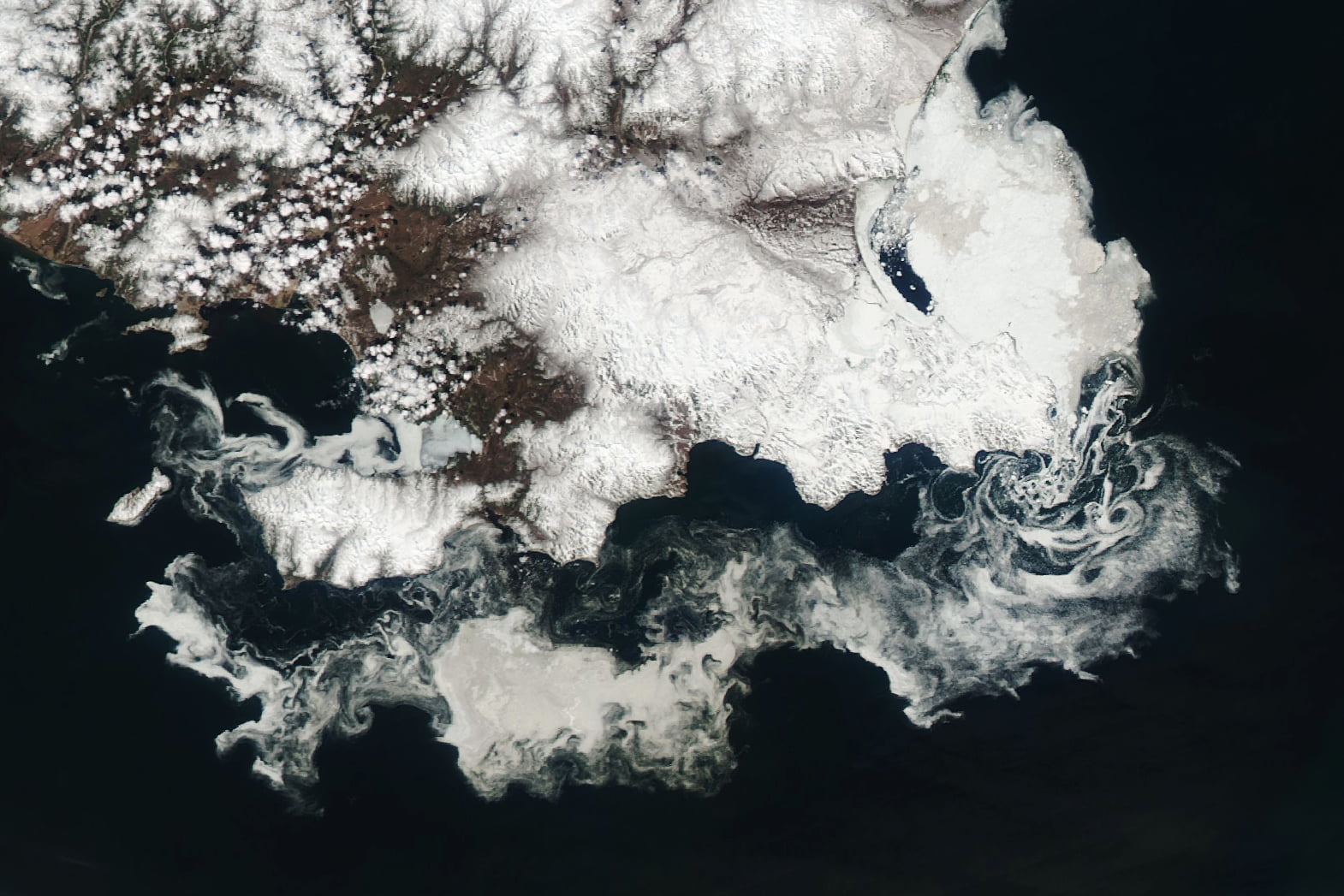
    The Sea of Okhotsk is the northern hemisphere’s southernmost sea that seasonally freezes. Caught between the Siberian coast and the Kamchatka Peninsula, cold air from Siberia helps freeze water kept at lower salinity due to freshwater run-off. This image, taken in May 2023, shows free-floating sea ice forming spirals driven by wind and waves. Small islands off the eastern coast (right side in image) are likely responsible for the swirling eddies seen there. Like phytoplankton blooms and sediment swirls in warmer seasons, the sea ice acts as a tracer to reveal flow. (Image credit: W. Liang; via NASA Earth Observatory)

  • Ghosts of Rivers Past

    Ghosts of Rivers Past

    Artist Dan Coe uses lidar data to create portraits of rivers and their past meanders. Used aerially, lidar produces high-resolution elevation data that provides a glimpse of features that are currently hidden beneath vegetation. With rivers, this means unearthing some of their previous paths. Secondary flows in a river bend erode the bed so that the bend gets more and more strongly curved. Eventually, the river can double back on itself and cut off the long curve. Repeat that process over millennia and you wind up with the complex paths in Coe’s images. (Image credit: D. Coe; via Colossal)

  • Featured Video Play Icon

    Filling Space

    While not directly fluid dynamical, this video from Steve Mould uses water to illustrate mathematical concepts like fractals and space-filling curves. Water, it turns out, does a great job of drawing our eyes to the way these one-dimensional curves fill up two- and three-dimensional space. Check out the full video for a mathematical dive into the concepts. (Video and image credit: S. Mould)

  • Featured Video Play Icon

    Blood Flow in a Fin

    This award-winning video shows blood flowing through the tail fin of a small fish. Cells flow outward in a central vessel, then split to either side for the return journey. In this microscopic video, the speed of individual cells seems quite fast, even though the vessels themselves are only wide enough for the blood cells to move in single file. Flow at the microscale can be counterintuitive like that. (Video and image credit: F. Weston for the 2023 Nikon Small World in Motion Competition; via Colossal)

  • “Shaken, Not Stirred”

    “Shaken, Not Stirred”

    James Bond notoriously orders his martinis “shaken, not stirred,” a request bartenders fulfill by shaking the cocktail over ice in a separate shaker. But what if you shake the martini glass itself? That’s the question that inspired this lovely mixology.

    By shaking the martini glass gently back and forth (along the directions shown by the arrows in each image), the team created different mixing patterns within the glass. With a little food dye and pearl dust, they visualized the flows they found. By changing the viscosity of the cocktail and the speed of the swish, they made everything from a four-leaf clover to a cadre of ghosts. It seems that martini glasses hold a flow for every occasion! (Image and research credit: X. Song et al.; submitted by Zhao P.)

    GFM poster, describing the experiments used to create these picturesque martinis.
    GFM poster, describing the experiments used to create these picturesque martinis.
  • Eroding the Sphinx

    Eroding the Sphinx

    One theory suggests that the Great Sphinx of Giza formed — in part — naturally as a result of erosion, and ancient Egyptians added features to the bedrock formation. To test the plausibility of the theory, researchers made a miniature sphinx, consisting of a clay mound with a single, harder inclusion to represent the Sphinx’s head, and placed their construction in a water tunnel. As the water eroded away the clay, the head appeared, and flow around this harder-to-erode region formed some of the body and paws of the reclining Sphinx.

    The experiment suggests that it is plausible for part of the Sphinx to have formed naturally, as a result of erosion. But plausibility is not proof, and given the lack of a contemporary inscription explaining the statue’s origin, the goals and methods of the people who built it around 2500 B.C.E. will remain a matter of archaeological debate. (Image credit: S. Boury et al.)

  • “Chaosmosis”

    “Chaosmosis”

    After many years of featuring work from the Gallery of Fluid Motion, I’m excited to announce a new public exhibition of art drawn from the competition: “Chaosmosis: Assigning Rhythm to the Turbulent.” Works in the exhibit come from both scientists and artists; each piece makes visible the fluid motions that surround us.

    The exhibit is located at the National Academy of Sciences in Washington, DC through February 23, 2024. Entry is free, but only available between 9 a.m. and 5 p.m. on weekdays. For more, check out the exhibit’s webpage and press release (pdf) and the Instagram accounts for CPNAS and the exhibit.

    I’m looking forward to seeing the exhibit when I’m at the APS DFD meeting next month, but if you can’t make it to DC before the exhibit ends, don’t worry! This is just the first stop for the new traveling GFM exhibit. (Image credits: various, see individual images’ titles)

  • Spreading Spores

    Spreading Spores

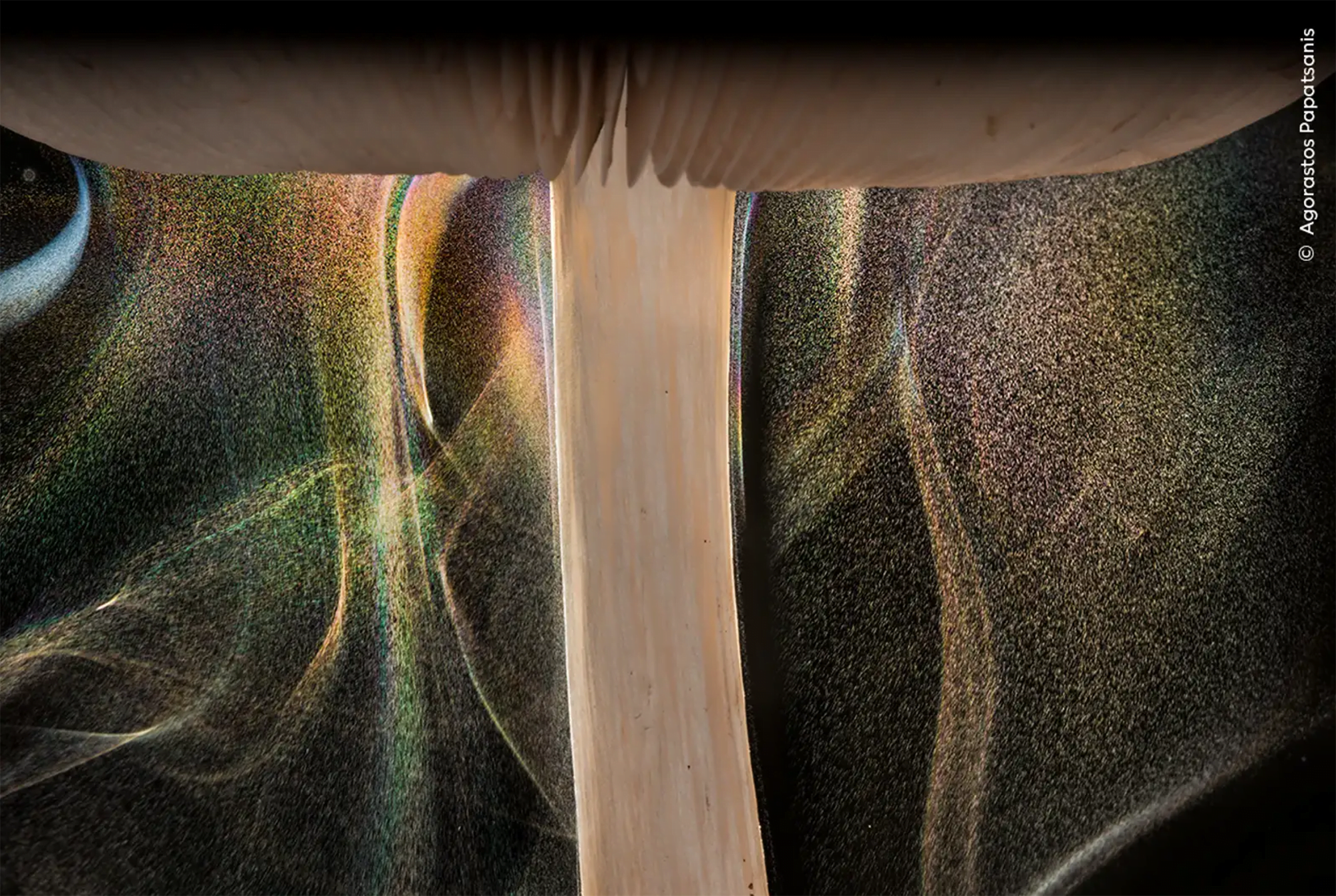
    Mushrooms are the fruiting bodies of much bigger, largely underground fungi. Being fruit, mushrooms have the job of spreading spores so that the fungus can reproduce. Some mushrooms rely on the wind; others create their own wind. Still others use vortex rings to carry their spores higher. Who knew such fascinating and beautiful physics lies along the forest floor? (Image credit: top – A. Papatsanis, bottom – I. Potyó; via Wildlife POTY)

    Photo by Imre Potyó.
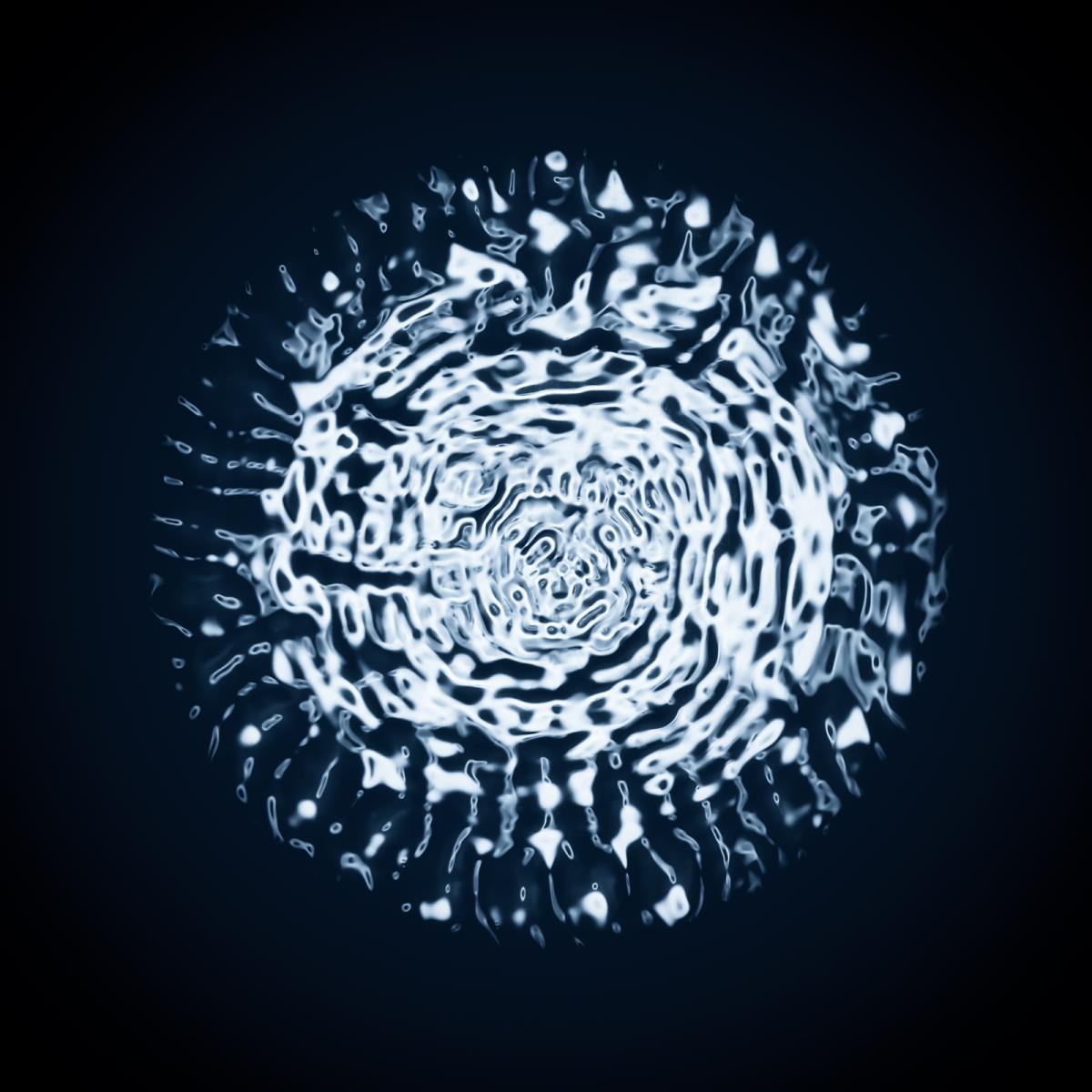
  • Black Hole Signature

    Black Hole Signature

    240 million years ago, pressure waves emanated from a black hole inside the Perseus Galaxy Cluster. Much later, NASA’s Chandra X-Ray Observatory intercepted those waves. Scientists raised the frequency of the signal until it fell within the range of human hearing. And then photographer John White played that sound through a petri dish of water sitting on a speaker. The result is above: a watery glimpse of a long ago black hole’s signature. Within these Faraday waves is the echo of a stellar phenomenon that took place when the very first dinosaurs walked our planet. (Image credit: J. White; via the 2023 Astronomy POTY)