In fluid dynamics, we’re often concerned with flow moving past a solid surface — air past an airplane wing, water past fish scales, oil between moving parts — and those surfaces are rarely perfectly smooth. Rough surfaces affect the flow near them, sometimes in unexpected ways. Here, researchers show a rough surface’s effect on the eddies of the atmospheric boundary layer. Put differently, this poster shows how buildings, trees, and other features influence the lowest layer of the atmosphere. From the tiny gaps between buildings to the eddies towering many times higher, the turbulence reflects roughness’s effects. (Image credit: J. Kostelecky and C. Ansorge)
Tag: flow visualization

Tracking Break-Up


In fluid dynamics, researchers are often challenged with complicated, messy flows. With so much going on at once, it’s hard to work out a way to keep track of it all. Here, researchers are looking at the break-up of two colliding liquid jets. This setup is often used to break rocket fuel into droplets prior to combustion. This video shows off a new data analysis tool that lets researchers break the flow into different parts, track them in time, and extract data about the changes that happen along the way. (Video and image credit: E. Pruitt et al.)

Feynman’s Sprinkler Solved
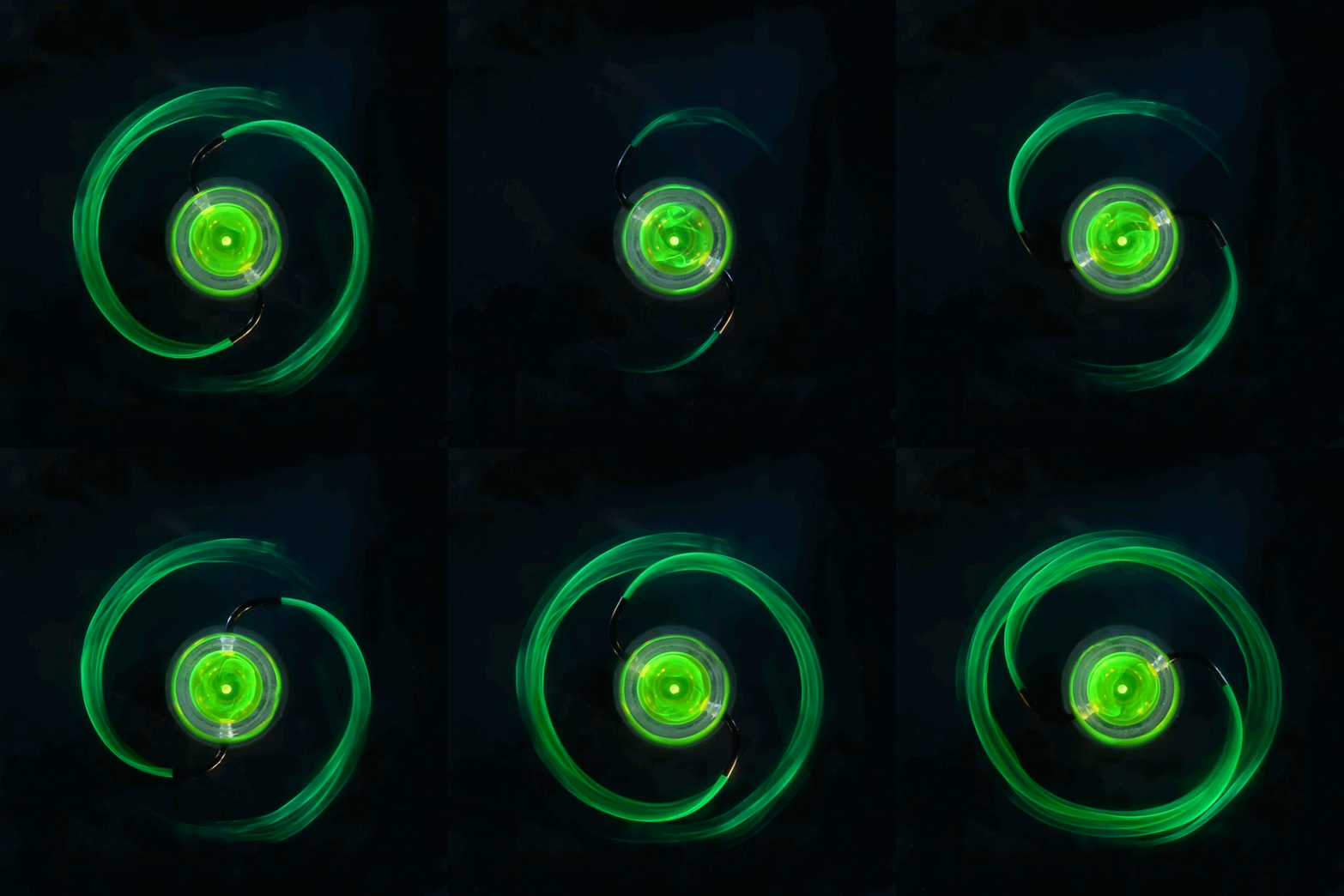
In graduate school, my advisor introduced us to a particularly vexing fluid dynamical thought experiment known as the Feynman sprinkler. After observing an S-shaped sprinkler that rotated when water shot out its arms, physicist Richard Feynman wondered what would happen if the device were placed in a tank of water with the flow reversed. If the sprinkler was sucking in water, would it rotate and, if so, in what direction?
This seemingly simple question has confounded physicists ever since, in part because you can make believable arguments for multiple different results. Attempts to build the apparatus experimentally produced differing results, too — often due to variables that don’t appear in the thought experiment, like friction in the sprinkler’s bearing. But, at long last, a group posits they have the final answer to the problem.

They cleverly built their sprinkler so that it floats in its tank, with the addition or removal of water from the sprinkler controlled by a second siphon-connected tank. With no solid-solid contacts, the sprinkler can rotate with very little friction.

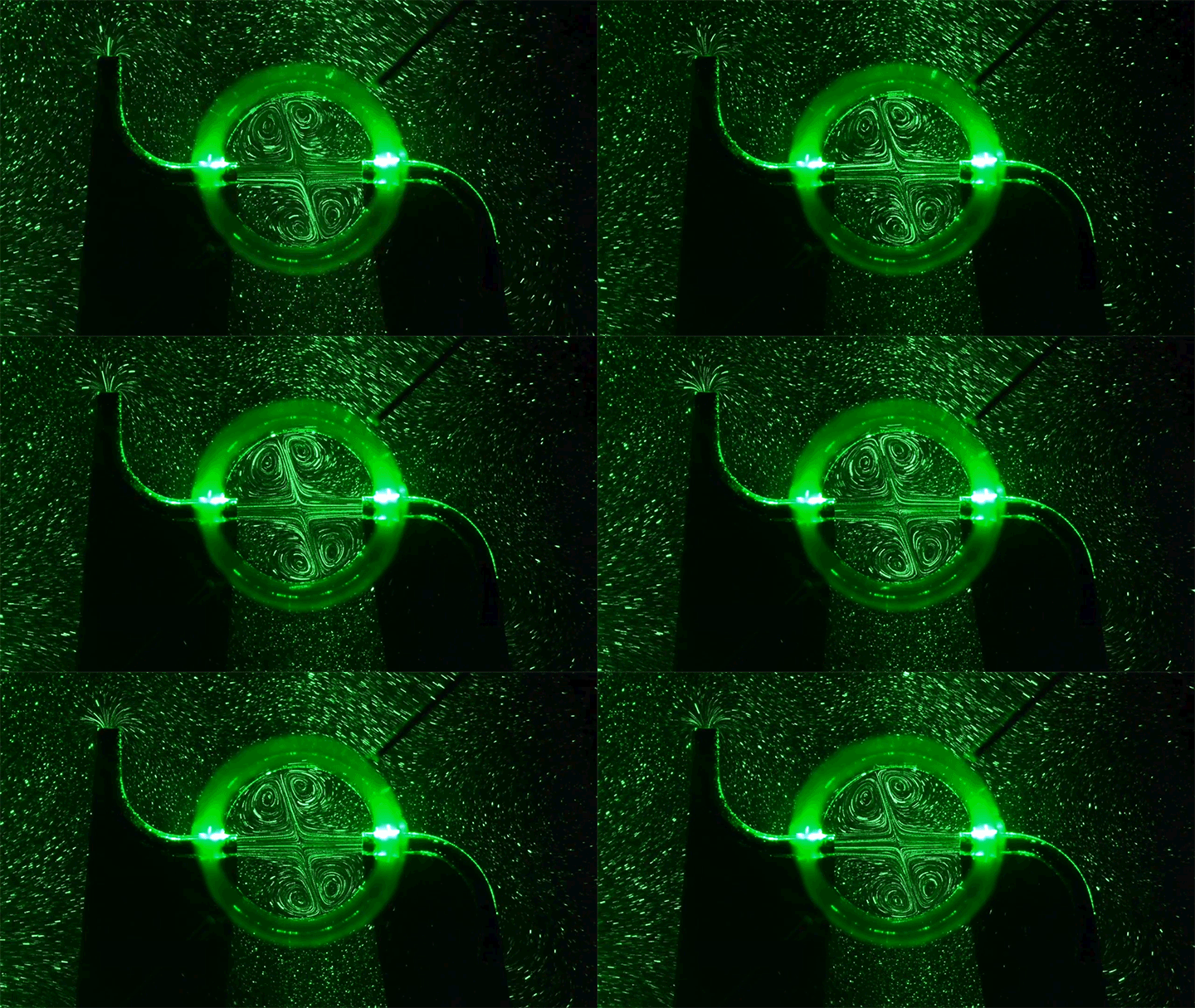
Flow visualization of the sprinkler in reverse (suction) mode. For image clarity, the device is held in place to prevent spinning. Notice how the jets coming into the hub glance off one another and form counter-rotating vortex pairs at an angle. This asymmetry is the source of the sprinkler’s rotation when allowed to move. The team found that sucking water into the sprinkler does, indeed, reverse the sprinkler’s rotation, but it’s not a simple reversal of the forward sprinkler’s flow. To see why, check out the video above, which visualizes flow inside the sprinkler during suction. For clarity, the device is held fixed in place during flow visualization. Notice that the two arms of the sprinkler sit directly opposite one another in the hub. Thus, you’d expect their two jets to collide and form counter-rotating vortices along a vertical axis. But the vortex pairs are offset from the centerline.
This asymmetry takes place because the velocity profiles of flow across the hub inlets are skewed. Instead of the largest velocity occurring on the centerline of the inlet, each occurs slightly to one side. So when the jets collide, they do so off-center and impart a torque to the sprinkler. The reason for the skewed profiles at the inlets lies further upstream in the curved arms of the sprinkler. Centrifugal force from turning the corner leaves a mark on the flow, leading, ultimately, to the skewed velocity profiles, offset jets, and spinning sprinkler. (Image and research credit: K. Wang et al.; via APS Physics)
Spreading Frost


Condensation forms beads of water on a surface. When suddenly cooled, those drops begin to freeze into frost. This video looks at the process in optical and in infrared, revealing the patterns of spreading frost and the tiny ice bridges that link one freezing drop to the next. (Video and image credit: D. Paulovics et al.)
Visualizing Changes


This rather mesmerizing video by Michiel de Boer uses a video editing technique to highlight movement and changes in video clips. From falling rain to rising mist to passing footsteps, the relatively simple technique visualizes all kinds of motion. De Boer calls it “motion extraction,” but it’s essentially a way to play with autocorrelation, a mathematical technique often used in fluid dynamics. It’s especially prevalent in turbulence, where it helps researchers identify parts of the flow that are closely related to one another. (Video and image credit: M. de Boer; via Colossal)

Parting a Flame
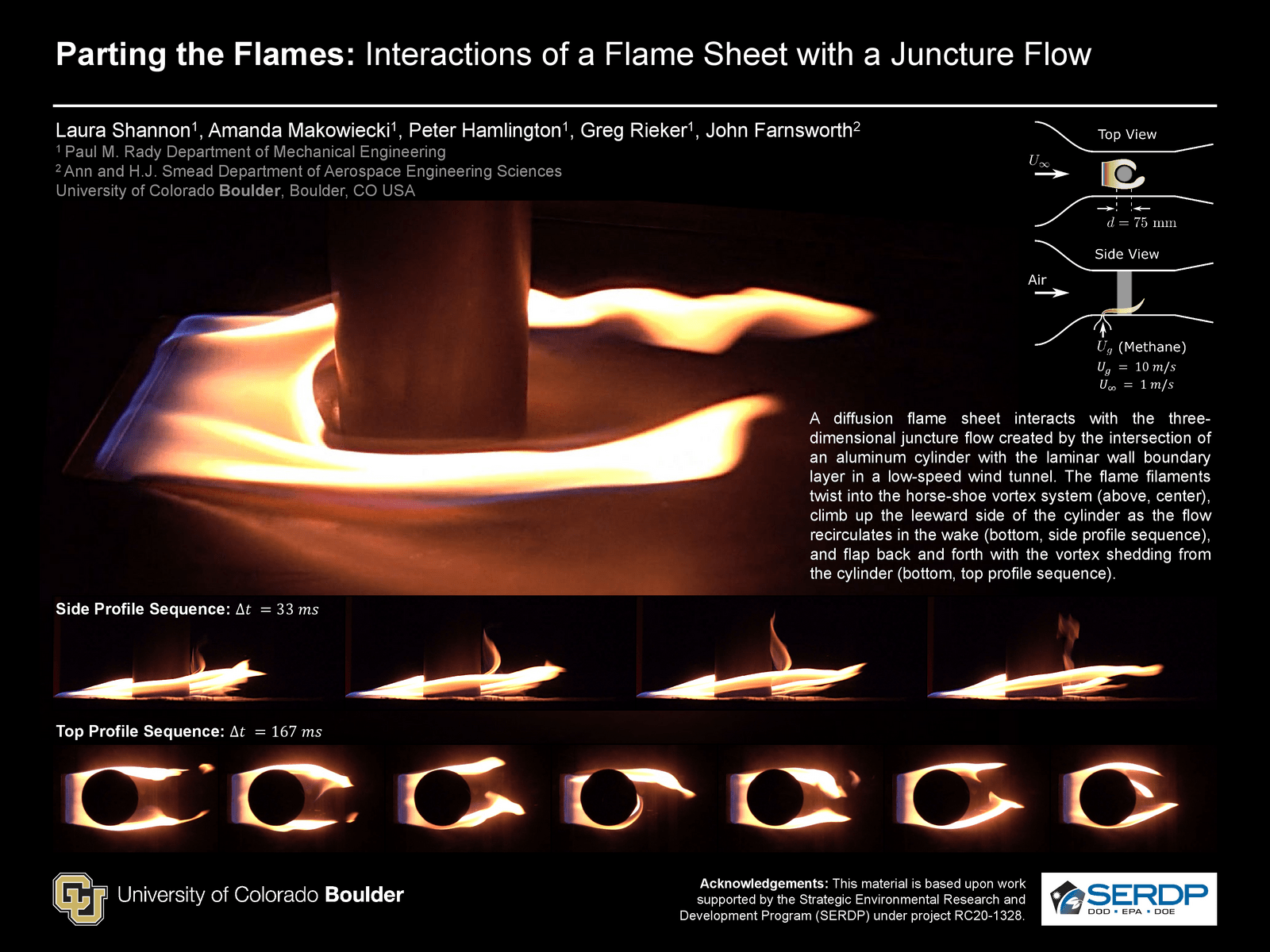
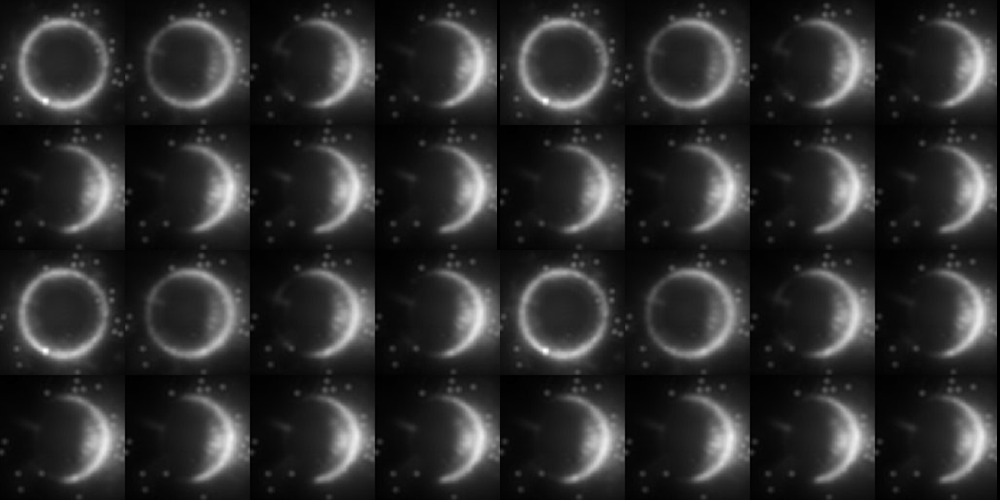
A sheet of flame splits around a cylinder in this Gallery of Fluid Motion poster. Looking at the image sequences, you can see how the flames lift up as they flow around the cylinder, following the arms of a horseshoe vortex. Researchers study situations like this one to better understand how wildfires move as they encounter obstacles. Understanding and predicting how fires flow is increasingly important with more wildfires encountering human-built infrastructure. (Image credit: L. Shannon et al.)
Vortex Rings From a Square Outlet


When a vortex ring forms, it’s often from fluid forced through a round outlet, whether that’s someone’s mouth, a pipe, or a dolphin’s blowhole. But vortex rings can come from other shapes, too. This video shows us several examples, including slots and square outlets. The vortex rings blown from a square outlet are messier but still recognizable. The slot-shaped outlets produce even neater results, including twin vortex rings that move parallel to one another! (Image, video, and research credit: B. Steinfurth et al.)
Corralling Corals
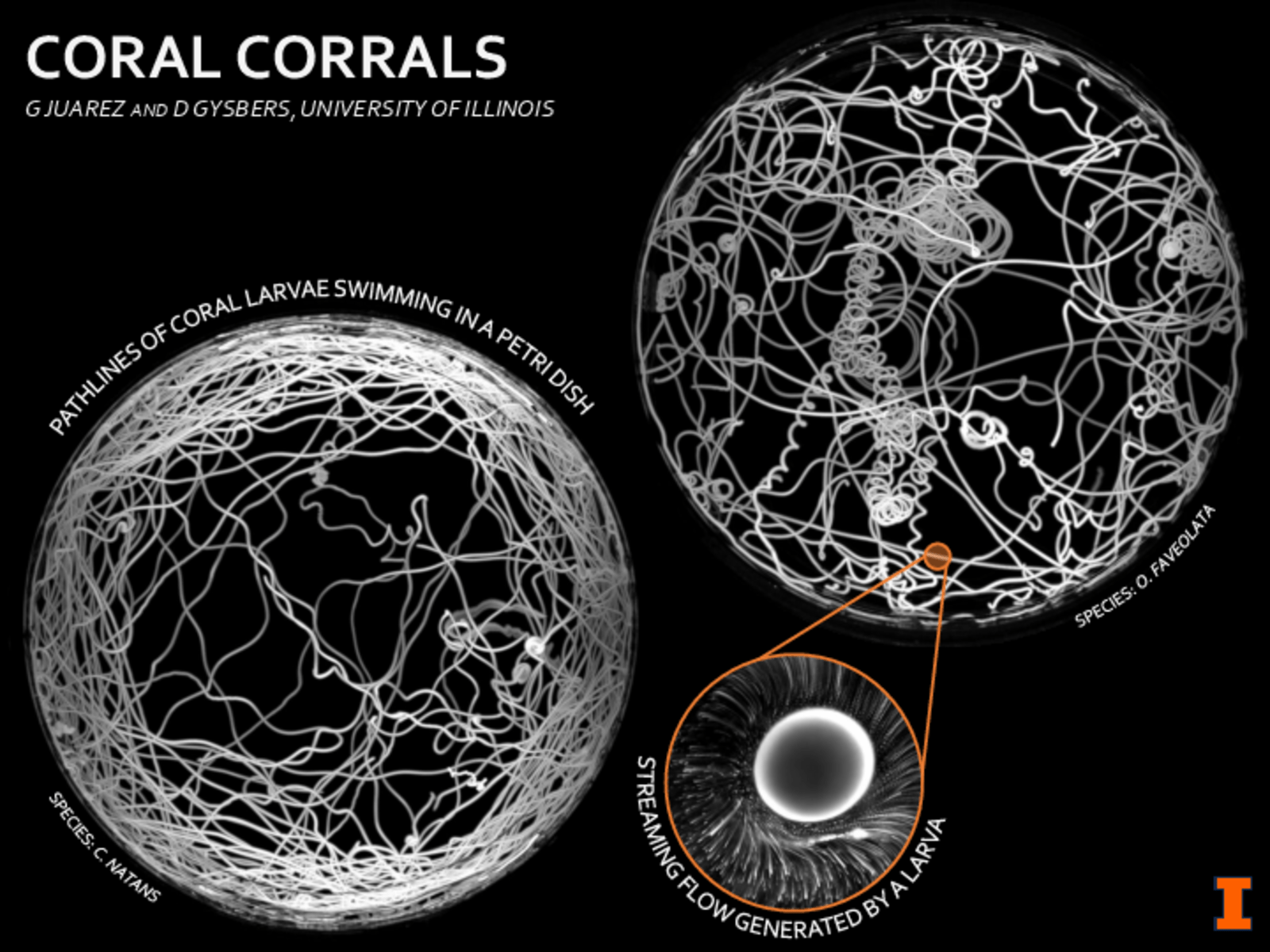
So much of fluid dynamics is seeking patterns. Shown here are two sets of patterns, each created by a different species of coral larvae. These tiny creatures form a streaming flow (orange inset) around them as they swim. Combined together in a petri dish, the larvae follow winding paths, shown in white. The overall pattern is distinctly different for the two species. One shows a clear preference for paths near the wall of the dish (left), while the other corkscrews through open spaces (right). This difference raises questions researchers can explore: do the larvae differ in their propulsion methods or in their collective behavior? (Image credit: G. Juarez and D. Gysbers)
Liquid Lace
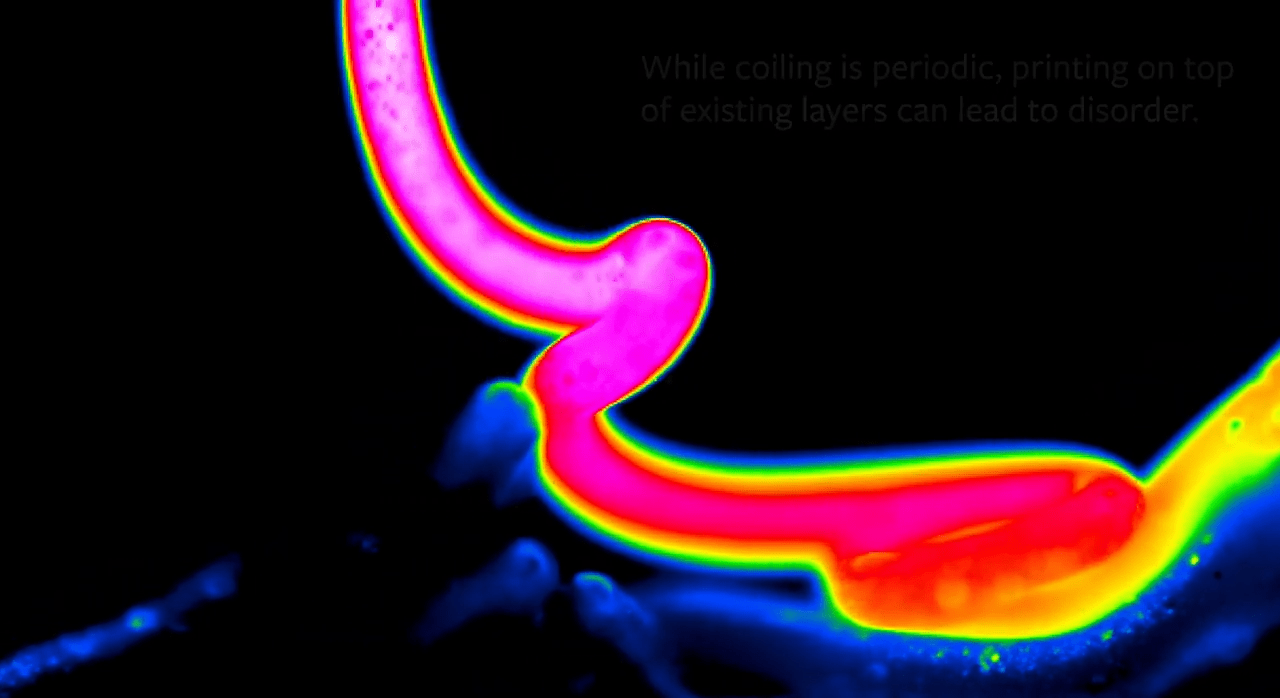

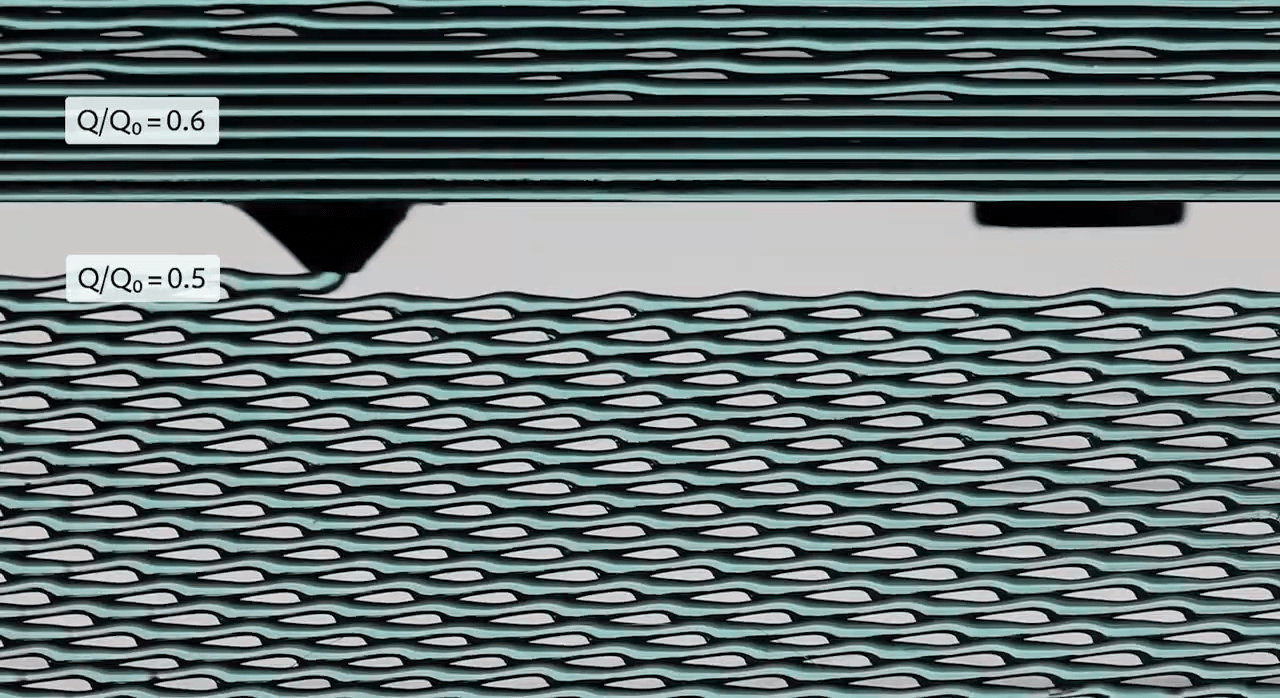
3D printers are a neat apparatus for exploring flow instabilities. If too much material is extruded compared to the speed of the printer head, coiling takes place. But under-extrusion creates patterns, too. Here, researchers show how under-extrusion can create a stable lace-like pattern. Once dried, the material can stretch, but only in certain directions, a bit like many textiles. (Video and image credit: L. Dreier et al.)

Thermal Slipping
A particle suspended in a liquid typically jitters haphazardly about as it’s struck randomly by nearby liquid molecules. But when a temperature gradient is applied to the liquid, that random motion instead becomes directional. In a recent study, researchers directly mapped the motions underlying this thermophoresis.
In their experiment, the team placed a 7-micron sphere in water laced with 500-nanometer fluorescent tracers. Using a laser, they optically trapped the sphere, pinning it in place. Then, with a second laser, they heated the water on one side of the sphere and observed, under a microscope, what happened. After a few seconds, the tracers began moving toward the hot region, creating a slip flow along the surface of the sphere. Had the sphere been able to move freely, they found, the flow would have been strong enough to move it. (Image and research credit: T. Tsuji et al.; via APS Physics)