This high-speed schlieren video reveals the ignition of a butane lighter. The schlieren optical technique exaggerates differences in refractive index caused by density variations, enabling experimentalists to see thermal eddies, shock waves, and other phenomena invisible to the naked eye. Here a jet of butane shoots upward from the lighter as a valve is released. Then the spark from the lighter ignites the butane gas near the bottom of the jet. A flame front the propagates outward and upward, completing the lighting process. (submitted by @Mark_K_Quinn)
Tag: flame

Testing Flames in Space
In microgravity, flames behave very differently than on earth due to a lack of buoyant forces. On earth, a flame can continue burning because, as the warm air around it rises, cooler air gets entrained, drawing fresh oxygen to the flame. In microgravity, both the heat from the flame and the oxygen it needs to burn move only by molecular diffusion, the random motion of molecules, or the background environmental flow (air circulation on the ISS, for example). This video shows a test of the Flame Extinguishment Experiment (FLEX) currently flying onboard the ISS. A fuel droplet is ignited, burns in a symmetric sphere and then eventually extinguishes either due to a lack of fuel or a lack of oxygen. Check out this NASA press release for more, including great quotes like this:
“As a Princeton undergrad, I saw in a graduate course the conservation equations of combustion and realized that those equations were complex enough to occupy me for the rest of my life; they contained so much interesting physics.” – Forman Williams
Mapping Flames
Combustion remains a fascinating and only partially understood phenomenon. Here scientists work to map a flame in three dimensions using high-speed cameras and digital reconstruction. (submitted by Chi M)

Microgravity Combustion
This collage of three combustion images reveals the beautiful symmetry of flames in microgravity. In the absence of gravity, flames are spherical, and, in the confines of a spacecraft, any combustion is extremely dangerous. Thus, most microgravity combustion experiments occur in drop towers. From NASA:
Each image is of flame spread over cellulose paper in a spacecraft ventilation flow in microgravity. The different colors represent different chemical reactions within the flame. The blue areas are caused by chemiluminescence (light produced by a chemical reaction.) The white, yellow and orange regions are due to glowing soot within the flame zone. #
Carboy Combustion
Lighting a thin layer of ethyl alcohol in a jug produces some beautiful pulse jets and a moving wall of flame that shifts and flows according to the changing pressures inside the jug. Like the video’s author, we do NOT recommend trying this combustion demo yourself.
As for the video’s questions, firstly, blowing into the jar helps the flame because humans do not exhale pure CO2. With regard to the second question, the interior of the jug is initially thinly coated in ethyl alcohol vapor. Combustion starts at the top of the jug and the sheet of flame moves downward as the fuel at the top is spent. As that flame moves downward, however, it’s heating the air inside the jug, which expands and is forced out the opening. When the flame goes out in the upper part of the jug, that does not mean all of the fuel has combusted, simply that the ratio of air/fuel is insufficient for continued combustion. I suspect the flame persists at this opening because the air/fuel mixture is concentrated at that point. Any residual ethyl alcohol in the container is forced out through that narrow opening, and the resulting concentration of fuel there may be high enough to keep the flame burning there. (idea submitted by davidbenque #)

Combustion
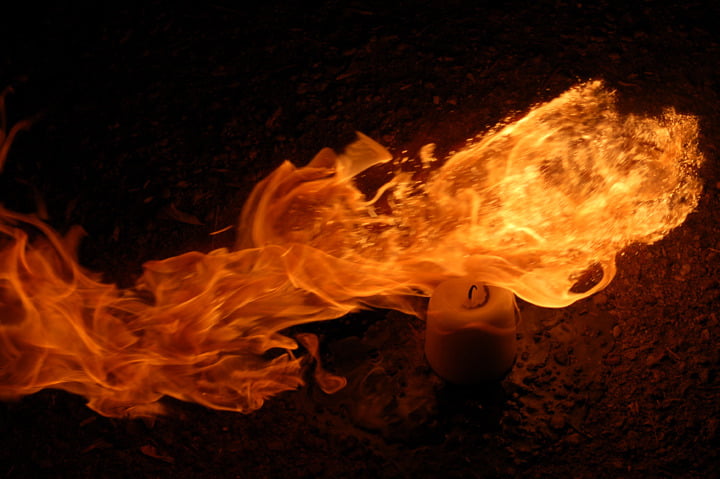
Fluid dynamics are vital to combustion. Like here, many practical flames–such as those responsible for internal combustion in automobiles, jet engines, and rockets–are turbulent. The turbulence aids mixing of the fuel and oxidizer, resulting in more complete combustion and greater efficiency. #
Combustion in Microgravity
‘Hot air rises.’ It’s common knowledge. But we usually forget that this is only true thanks to Earth’s gravity. On Earth, a candle flame’s distinctive pointed shape is due to hot air rising. Without gravity, there is no buoyant convection; hot air has no reason to rise (and no definition of what up is either!). This makes flames in microgravity spherical, as in the video above from a drop tower on earth. See also: astronaut explains fire in microgravity.