Tag: flame

  • Featured Video Play Icon

    Water in Oil

    Pouring water on an oil fire is a quick way to cause almost explosive results. Since water is denser than oil, it quickly sinks to the bottom of a container, heating up as it does. When the water reaches its boiling point, it evaporates and expands as steam. That phase change involves a huge change in volume, a fact made especially clear in the video below. The steam expands and rises, throwing droplets of oil upward and outward. These smaller atomized droplets are easier to combust, which, in the case of the video above, causes a veritable cloud of flames if a fire has already started. 

    (Video credits: The Slow Mo Guys and N. Moore)

  • Featured Video Play Icon

    Re-lighting a Candle

    When you blow out a candle, you can re-light the wick using the smoke trail left behind. This is a topic we’ve discussed before, but I’m thrilled to finally see the process in true high-speed, thanks to the Slow Mo Guys. The plume that rises from the extinguished candle is an atomized mixture of fuel (wax) and air. When you bring a new combustion source–the match–close enough, that mixture ignites and the flame spreads downward back to the wick. (Video credit: The Slow Mo Guys)

  • Featured Video Play Icon

    Extinguishing Fires With Sound

    Engineering students from George Mason University have built a fire extinguisher that uses sound to put out flames. Since sound waves are mechanical pressure waves, they can move the air surrounding a burning material. Through trial and error the students found the high-frequency sound had little effect, but at frequencies between 30-60 Hz the sound waves could jostle enough oxygen away from the flame to extinguish the fire. They’re hoping the solution is scalable and can be applied to larger fires. For other wild ideas for chemical-less fire extinguishers, check out how researchers put out fires with explosions.  (Video credit: George Mason University; submitted by @isanaht)

  • Featured Video Play Icon

    Fire-Breathing

    In this high-speed video, the Slow Mo Guys demonstrate fire-breathing. Rather than using a liquid fuel like kerosene, they utilize cornstarch, which is both easily flammable and non-volatile thanks to its powdered form. Blowing out the cornstarch creates a turbulent jet of cornstarch and air. Combine that with a combustion source, and the cornstarch quickly deflagrates, meaning that the flame propagates via heat transfer. When neighboring regions of cornstarch become hot enough, they ignite and the flame front expands. You can observe this in the flame growth shown in the video; just after ignition the cornstarch jet is much wider than the fire and it takes some time for the flames to catch up with the jet. Although a liquid-fueled fireball operates by the same principles, it can look rather different. For comparison, check out this high-speed video of a WD-40 fireball. And, hopefully it goes without saying, but don’t try this stuff at home. (Video credit: The Slow Mo Guys)

  • Propagating Flames

    Propagating Flames

    Like many flows, flames can be unstable and undergo a transition from orderly laminar flow to chaotic turbulent flow. The timelapse image above shows the propagation of a flame front travelling downward. Each blue line represents the forwardmost position of the flame at a specific time. The flame is essentially two-dimensional, held between two glass plates separated by a 5-mm gap. The V-like points in the flame front are called cusps, and if you look closely, you can see cusps forming and even merging as the flame moves downward. Also notice how the flame front is more uniform near the top of the image, but, by the bottom, it has split into many more cusps. This is one of the indications that the flame is unstable. Check out the full poster-version of the image in the Gallery of Fluid Motion. (Photo credit: C. Almarcha et al., original poster)

  • Featured Video Play Icon

    Zesty Fireballs

    Zesting the skin of a citrus fruit like oranges releases a spray of tiny oil droplets. Citrus oil has several volatile components, meaning that it evaporates quickly at room temperature. It is also a liquid with a relatively low flash point, meaning that only modest temperatures (~40-60 degrees Celsius) are needed to generate enough vapor to ignite a vapor/air mixture. With volatile and flammable liquid fuels, a spray of droplets is an ideal platform for combustion because the essentially spherical droplets have a high surface area from which they can evaporate and provide vaporous fuel.  (Video credit: ChefSteps)

  • Flames in Space

    Flames in Space

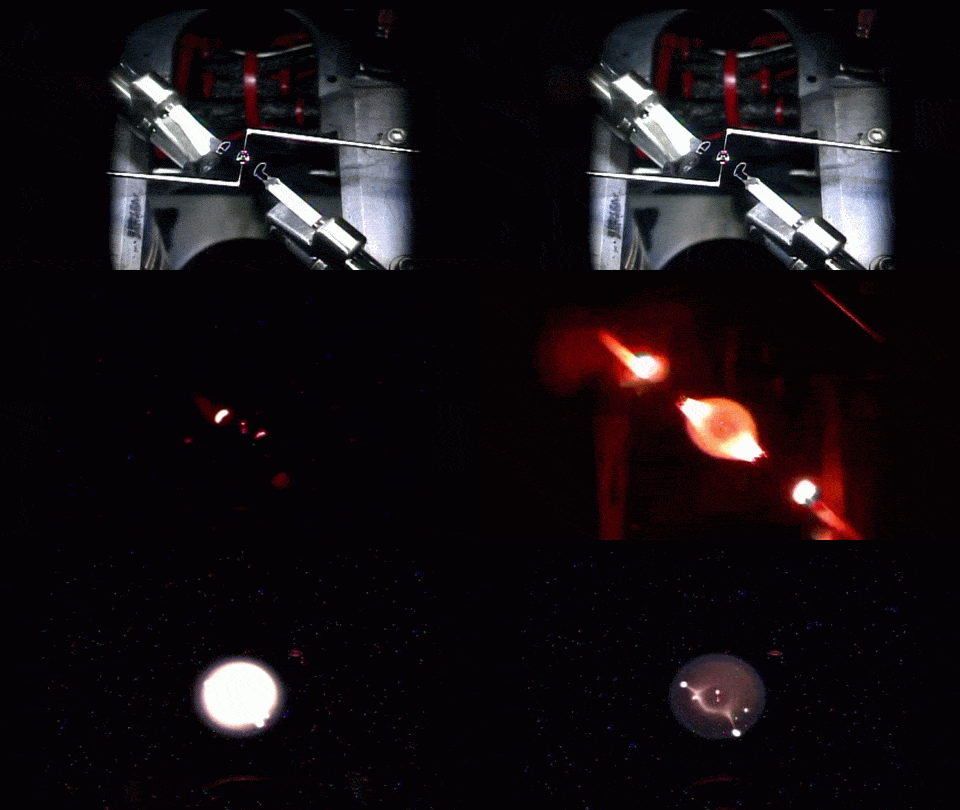
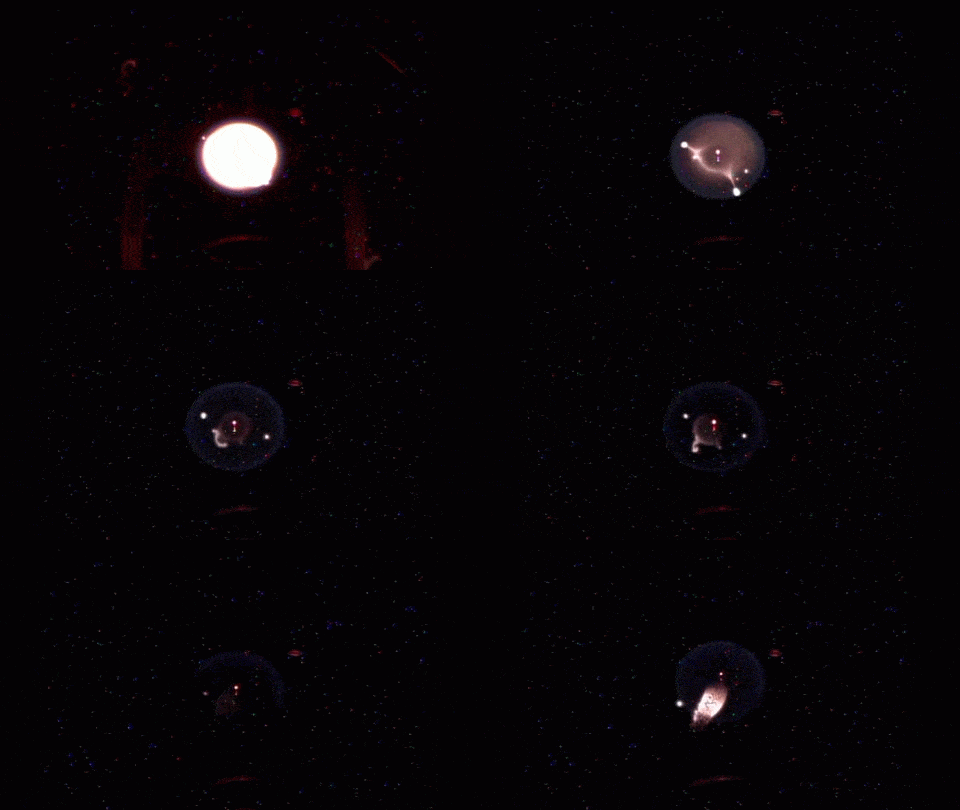
    The jellyfish-like light show in the animations above shows the life and death of a flame in microgravity. The work is part of the Flame Extinguishment Experiment 2 (FLEX-2) currently flying aboard the International Space Station. When ignited, the fuel droplet creates a blue spherical shell of flame about 15 mm in diameter. The spherical shape is typical of flames in microgravity; on Earth, flames are shaped like teardrops due to the effects of buoyancy, which exists only in a gravitational field. The bright yellow spots and streaks that appear after ignition are soot, which consists mainly of hot-burning carbon. The uneven distribution of soot is what causes the pulsating bursts seen in the middle animation. When soot products drift back onto the fuel droplet, it causes uneven burning and flame pulses. The final burst of flame in the last animation is the soot igniting and extinguishing the flame. Fires are a major hazard in microgravity, where oxygen supplies are limited and evacuating is not always an option. Scientists hope that experiments like FLEX-2 will shed light on how fires spread and can be fought aboard spacecraft. For more, check out NASA’s ScienceCast on microgravity flames. (Image credits: NASA, source video; submitted by jshoer)

  • Supernova Explosion

    Supernova Explosion

    Type 1a supernovae occur in binary star systems where a dense white dwarf star accretes matter from its companion star. As the dwarf star gains mass, it approaches the limit where electron degeneracy pressure can no longer oppose the gravitational force of its mass. Carbon fusion in the white dwarf ignites a flame front, creating isolated bubbles of burning fluid inside the star. As these bubbles burn, they rise due to buoyancy and are sheared and deformed by the neighboring matter. The animation above is a visualization of temperature from a simulation of one of these burning buoyant bubbles. After the initial ignition, instabilities form rapidly on the expanding flame front and it quickly becomes turbulent. (Image credit: A. Aspden and J. Bell; GIF credit: fruitsoftheweb, source video; via freshphotons)

  • Balloon Explosion

    Balloon Explosion

    These photos are shadowgraphs of a hydrogen flame exploding inside a balloon. The shadowgraph optical technique highlights density and temperature variations through their effect on a fluid’s refractive index. Here we see that the hydrogen flame has a strong cellular structure and is more turbulent than a methane flame. The cellular structure is a sign of an instability in the curved flame front. The instability and accompanying cellular appearance are a result of the complicated transport and reaction of fuel and oxidizer inside the flame. (Photo credits: P. Julien et al.)

  • “Aurora”

    “Aurora”

    This bulbous, ethereal shape is a spreading flame front captured by artist Fabian Oefner in his new “Aurora” series. Oefner used a few alcohol droplets in a glass vessel and ignited the volatile vapors, capturing the propagating flame. Take a look at it in action. Because the air inside the vessel is mostly still, the chemical reactions in the combustion occur much faster than the air’s motion. As a result, the flame spreads as a thin sheet instead of a uniform, widespread flame. The wrinkled and corrugated look of the flame front is due local turbulence distorting the flame. (Photo credit: F. Oefner)