Happy 4th of July.
Tag: emulsion

Stretching to Break
Have you ever wondered what happens inside a jet of fluid as it breaks into droplets? Such events are not commonly or readily measured. This video uses a double emulsion–in which immiscible fluids are encapsulated into a multi-layer droplet–to demonstrate interior fluid flow during the Plateau-Rayleigh instability. The innermost drops and the fluid encapsulating them have a low surface tension between them, thanks to the addition of a surfactant to the inner drops. As a result, the inner drops are easily deformed by motion in the fluid surrounding them. Flow on the left side of the jet is clearly parabolic, similar to pipe flow. Closer to the pinch-off, the inner droplets shift to vertical lines, indicating that the interior flow’s velocity is constant across the jet. After pinch-off, the inner droplets return to a spherical shape because they are no longer being deformed by fluid movement around them. The coiling of the inner drops inside the bigger one is due to the electrical charges in the surfactant used. (Video credit: L. L. A. Adams and D. A. Weitz)
Droplets Within Droplets
This video shows a multi-layered droplet, in which several droplets are formed one inside the other as an initial drop falls through a layer of oil sitting atop another liquid. When the drop falls, its potential energy gets transformed into interface energy, creating a fascinating interplay of surface tension, deformation, and miscibility between the fluids. Such self-contained multi-layered droplets, similar to multiple emulsions, could be helpful in pharmaceutical development. (Video credit: E. Lorenceau and S. Dorbolo 2004)
Encapsulating Droplets
In applications like drug delivery, it’s often desirable to encapsulate one or more liquid droplets in an additional immiscible fluid. These drops-within-drops, called double emulsions, are typically a multi-step process, created from the innermost drop outward. In this new microfluidic technique, though, researchers are able to create multi-component emulsions in a single step. A double-bored capillary tube creates the two inner droplets (both water, dyed different colors) while oil flows down the outside of the injection tube to encapsulate the droplets. The multi-component double emulsions then flow as one to the right in the outer carrier fluid. The spacing of the capillary tubes is critical to prevent the inner droplets from coalescing with one another. (Video credit: L. L. A. Adams et al.)

Bouncing to Mix Oil and Water
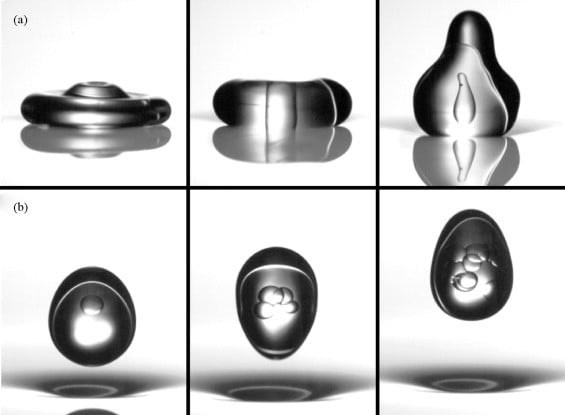
Mixing immiscible liquids–like oil and water–is tough. The best one can usually do is create an emulsion, in which droplets of one fluid are suspended in another. The series of images above shows a double emulsion consisting of oil and water that’s been formed by bouncing the compound droplet on a vibrating bath. The vibration of the liquid surface keeps the droplet from coalescing with the bath and the deformation provides mixing. The top row shows the initial impact while the bottom row of images shows the droplet after many bounces. As time goes on, the layer of oil around the compound drop becomes a cluster of tiny droplets contained within the water portion of the drop. (Photo credit: D. Terwagne et al.)
Making Mixed Emulsions
Ever tried to mix oil and vinegar? Anyone who has ever dealt with salad dressings knows the difficulty of evenly distributing immiscible fluids; the key is to shake them and create an emulsion, where droplets of one fluid are distributed throughout another. In this video, researchers create a double emulsion–oil in water in oil–without touching the two fluids. First they suspend a drop of water on a wire and then coat it with oil. Below, they place a bath of silicone oil, which they vibrate. When the oil-coated droplet falls onto the bath, it bounces on the surface rather than coalescing because a thin layer of air–constantly refreshed due to the vibration of the surface–separates the droplet from the bath. When the amplitude of the vibration is large enough, the oil coating penetrates the water during the bounce, leaving behind a tiny droplet and creating the emulsion. (Video credit: D. Terwange et al; Research paper)
Underwater Plumes
During 2010’s Deepwater Horizon oil spill there were reports of underwater plumes of oil escaping collection. This video demonstrates how such a plume can form. There are two clips shown here; in both the tank is filled with salt water of varying salinity, with denser saltwater at the bottom. The first jet is a green alcohol/water mixture and the second is a red gauge oil. Both jets have the same density and flow rate, but they vary in their Reynolds number. The first turbulent jet gets trapped at the interface between the denser and lighter saltwater while the less turbulent red jet passes the interface with no difficulty. The researchers suggest that strong turbulence can create an emulsion, a mixture of two normally immiscible fluids–imagine shaking a container of oil and vinegar really well–which can lead to underwater trapping.