Tag: elasticity

  • Hair in the Flow

    Hair in the Flow

    Humans are hairy on the inside. Not in the way that we are on the outside, but in the sense that many interior surfaces of our bodies are covered in small, flexible, hair-like protrusions like the papillae on our tongues or the cilia in our intestines. Many of these fibers are immersed in fluids, raising the question of how the flow and the hairs interact. An elastic fiber immersed in a flow will bend in the direction of the flow (bottom); this helps reduce the drag and widens the channel flow goes through compared to a stiff, upright fiber. 

    But what happens when the fibers are all mounted at an angle? In this case, researchers found an asymmetric response. If flow moves in the direction of the fibers’ bend, the hairs don’t impend the flow at all. If flow moves against that direction, however, the hairs start to stand upright, blocking the flow channel and increasing the drag. The researchers suggest this sort of mechanism could be use in micro-hydraulic devices in the same way as a diode in a circuit – allowing flow in only one direction. For another biological example of flow control, check out how a shark’s denticles can prevent flow separation. (Image credits: hairy surface – J. Alvarado et al., flow around a hair – J. Wexler et al.; research credit: J. Alvarado et al.)

  • Featured Video Play Icon

    When Fire Ants are a Fluid

    Substances don’t have to be a liquid or a gas to behave like a fluid. Swarms of fire ants display viscoelastic properties, meaning they can act like both a liquid and a solid. Like a spring, a ball of fire ants is elastic, bouncing back after being squished (top image). But the group can also act like a viscous liquid. A ball of ants can flow and diffuse outward (middle image). The ants are excellent at linking with one another, which allows them to survive floods by forming rafts and to escape containers by building towers. 

    Researchers found the key characteristic is that ants will only maintain links with nearby ants as long as they themselves experience no more than 3 times their own weight in load. In practice, the ants can easily withstand 100 times that load without injury, but that lower threshold describes the transition point between ants as a solid and ants as a fluid. If an ant in a structure is loaded with more force, she’ll let go of her neighbors and start moving around.

    When they’re linked, the fire ants are close enough together to be water-repellent. Even if an ant raft gets submerged (bottom image), the space between ants is small enough that water can’t get in and the air around them can’t get out. This coats the submerged ants in their own little bubble, which the ants use to breathe while they float out a flood. For more, check out the video below and the full (fun and readable!) research paper linked in the credits. (Video and image credits: Vox/Georgia Tech; research credit: S. Phonekeo et al., pdf; submitted by Joyce S., Rebecca S., and possibly others)

    ETA: Updated after senoritafish rightfully pointed out that worker ants are females, not males. 

  • Squishy Impacts

    Squishy Impacts

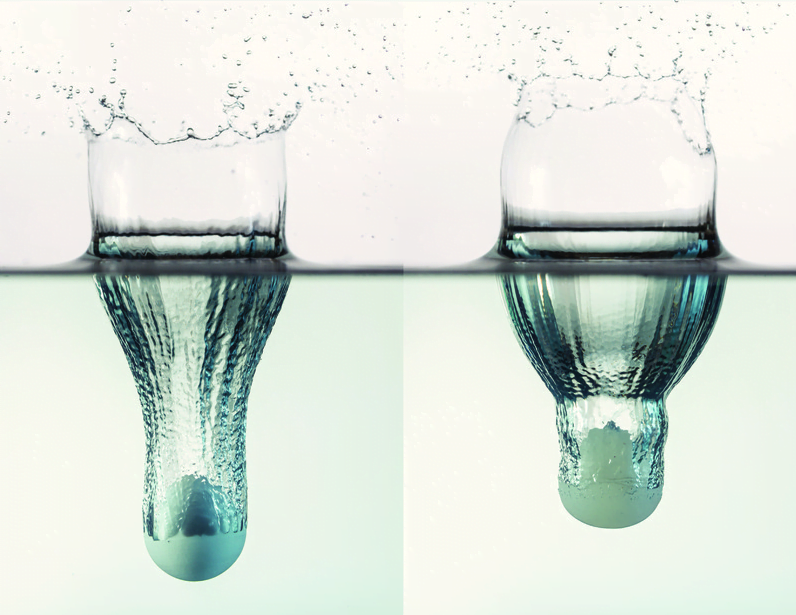
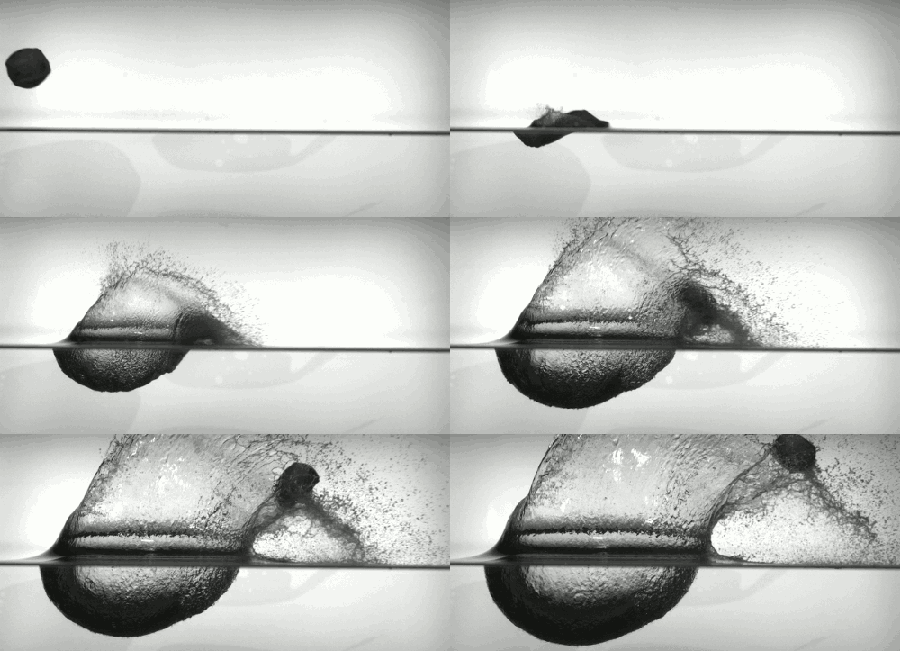
    How spheres impact water has been studied for more than a century. The typical impact for a rigid sphere creates a cavity like the one on the upper left – relatively narrow and prone to pinching off at its skinny waist. If the sphere is elastic –squishy – instead, the cavity ends up looking much different. This is shown in the upper right image, taken with an elastic ball and otherwise identical conditions to the upper left image. The elastic ball deforms; it flattens as it hits the surface, creating a wider cavity. If you watch the animations in the bottom row, you can see the sphere oscillating after impact. Those changes in shape form a second cavity inside the first one. It’s this smaller second cavity that pinches off and sends a liquid jet back up to the collapsing splash curtain

    From the top image, we can also see that the elastic sphere slows down more quickly after impact. This makes sense because part of its kinetic energy at impact has gone into the sphere’s shape changes and their interaction with the surrounding water. 

    If you’d like to see more splashy stuff, be sure to check out my webcast with a couple of this paper’s authors. (Image credits: top row – C. Mabey; bottom row – R. Hurd et al., source; research credit: R. Hurd et al.)

  • Featured Video Play Icon

    The Elastic Leidenfrost Effect

    Drop some hydrogel beads in a hot frying pan and they’ll bounce, hiss, and screech. Normally, if you drop a ball, it bounces to ever smaller heights until it comes to rest. In contrast, on a hot surface the hydrogel can bounce to a steady height for minutes at a time, raising a question: where does it get the energy for its incessant bounce? 

    Upon close examination of the impact, researchers found the hydrogel beads are actually slapping the surface over and over on each bounce. The frequency of the slapping exactly matches that of the audible screech, so what you’re actually hearing is this bounce-slap. Now what causes the slapping?

    Contact with the hot surface vaporizes some of the water inside the hydrogel. If it were a droplet, this vapor would form a thin, almost frictionless layer the droplet could glide on; that’s the classic Leidenfrost effect. Here the shell of the bead prevents that until the pressure really builds up. When the pressure gets high enough, the vapor finally escapes, opening up a gap. As the gap reaches its largest point, the bead rebounds elastically, bringing it back in contact with the surface and starting the process again. Each of these cycles acts like a tiny engine, harvesting energy that drives the larger bounce. This elastic Leidenfrost effect may be particularly helpful in soft robotics, providing robots with a new mechanism for movement. (Image and video credit: S. Waitukaitis et al.,arXiv)

  • The Kamifusen

    The Kamifusen

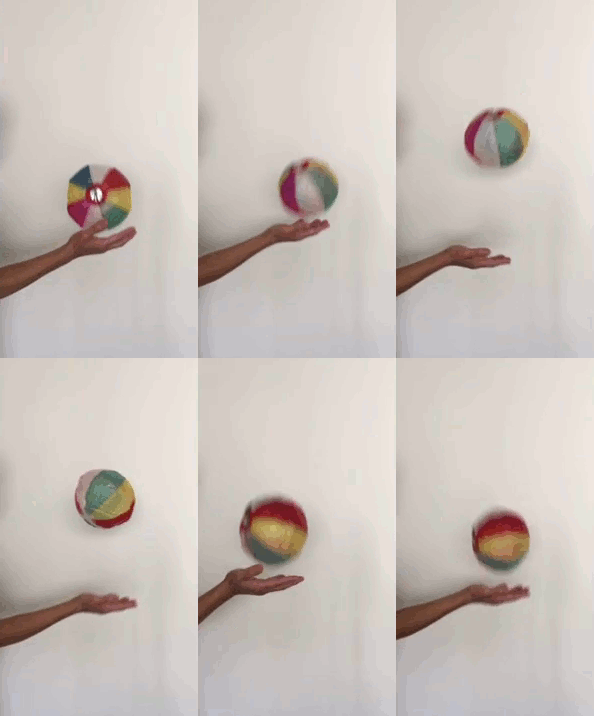
    The kamifusen is a traditional Japanese toy made of colorful paper. It resembles a beach ball, but unlike that toy, the kamifusen has an open hole at one end. Given that hole, one might expect the toy to deflate when struck, but the opposite is true – a deflated kamifusen inflates itself when bounced. The key to this counter-intuitive behavior comes from a combination of fluid dynamics and solid mechanics.

    When the kamifusen bounces off a player’s hand, it is compressed, which increases pressure inside the toy and forces some air out. Elastic waves rebound through the ball’s paper walls, much like seismic waves traveling outward from an earthquake. Those waves re-expand the toy’s walls, dropping the interior pressure and pulling air in from the outside. Although the pressure spike from impact is larger, its duration is short compared to the low pressure generated by the subsequent elastic waves. As a result, more air flows into the toy than is knocked out, and so the kamifusen inflates. For more, check out this explanation at Physics Today.  (Image and research credit: I. Fukumori, source; submitted by E. van Andel)

  • Wrapping Up

    Wrapping Up

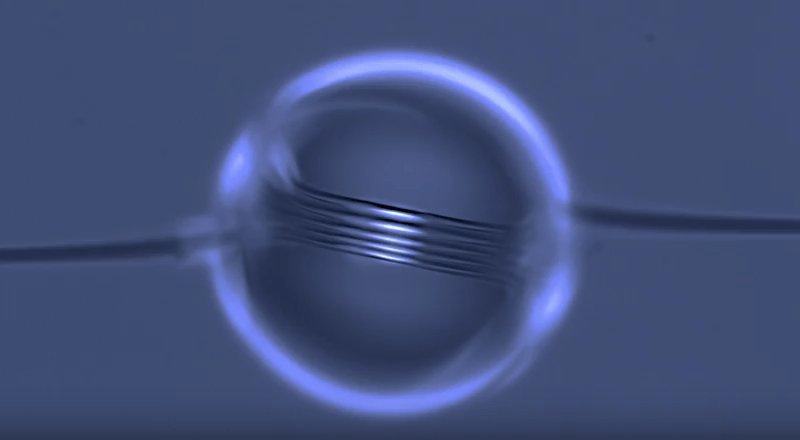
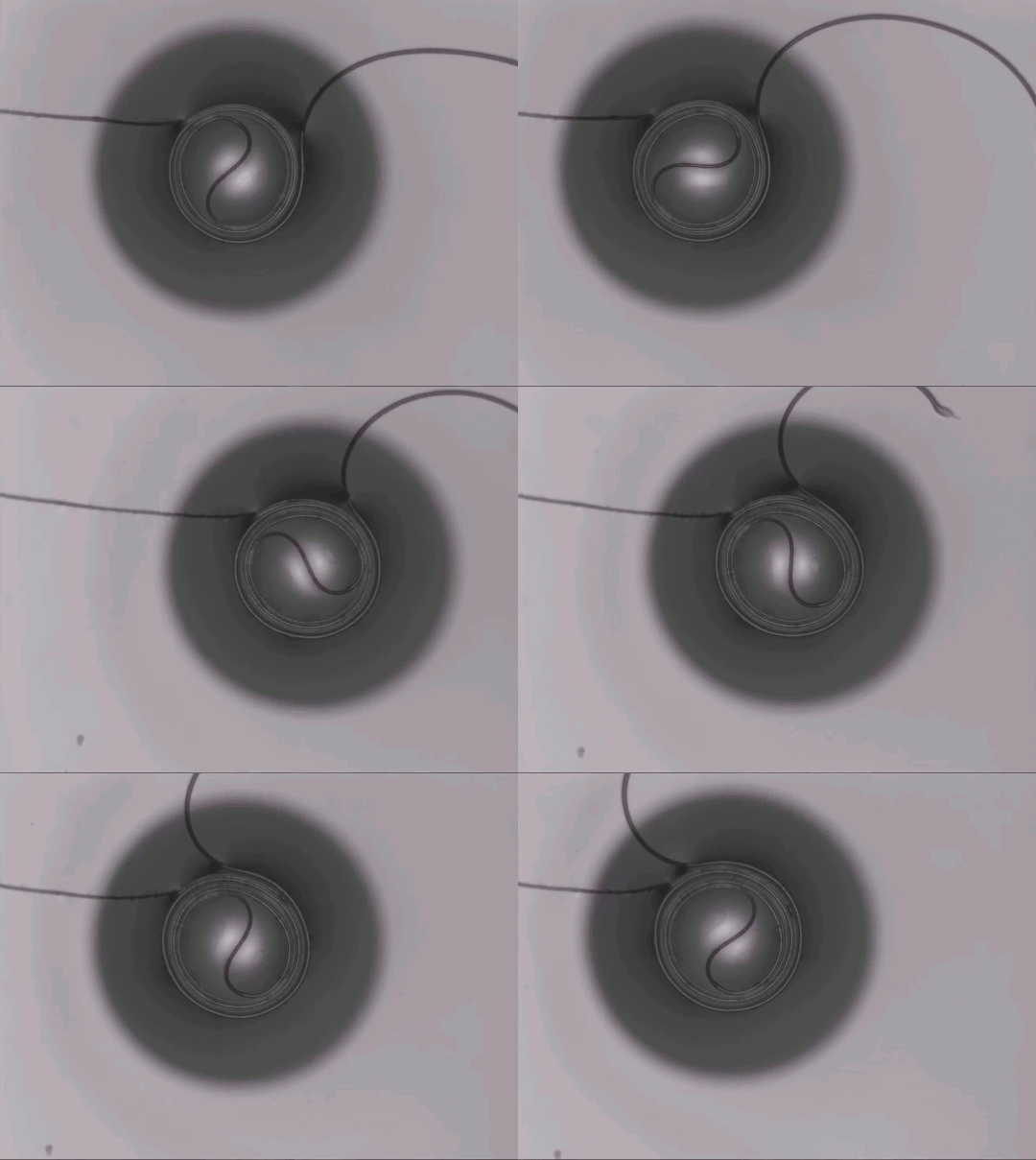
    It’s often at the intersection of topics that we can learn something new and fascinating. The latest video from The Lutetium Project shows examples of this at the intersection of solid mechanics and fluid dynamics with a look at elastocapillarity. Breaking that word down, that’s where elasticity – that stretchy quality associated with solids – meets capillarity – the surface-tension-dominated behavior of a fluid. In particular, they explore some of the mind-boggling and surprising interactions that happen between drops, bubbles, and thin flexible fibers smaller than the width of a human hair. Check out the full video below. (Images credit: K. Dalnoki-Veress et al.; video credit: The Lutetium Project)

  • Hummingbird Drinking

    Hummingbird Drinking

    Hummingbirds are master acrobats, able to hover and drink simultaneously before flitting off to the next flower. At first glance, you might expect that their tongues are simply tiny straws that use surface tension and capillary action to draw up nectar. But it turns out that process is just too slow for the fast-paced birds.

    Instead, hummingbirds use a forked tongue with a long groove on either half. When the hummingbird extends its tongue, its beak compresses the grooves and squeezes them together. Once the tongue reaches nectar, the grooves expand, which draws nectar up along the full length of the tongue grooves. This allows the bird to fill its tongue much faster than it could otherwise, enabling the hummingbird to lick up nectar more than 10 times a second.

    There’s a neat excerpt from a documentary including this research over here (Tumblr won’t allow the embedded version); the full documentary premieres today on PBS. (Image credits: A. Rico-Guevara et al., sources 1,2; submitted by mypronounsareherrchancellor)

  • Skipping Squishy Spheres

    Skipping Squishy Spheres

    Skipping a stone on water requires a flat, disk-like stone thrown at a shallow angle, but elastic spheres are remarkable skippers, too, even at higher impact angles. Researchers at the Splash Lab have just published their work on why these balls skip so well. As seen in the top animation, the elastic spheres deform on impact, flattening to a more disk-like shape that rides at an angle of attack relative to the air-water interface. Both features are important to the spheres’ enhanced skipping. By flattening, the sphere comes into greater contact with the water and by orienting at a larger angle of attack, the sphere increases the vertical component of force the water generates on the sphere. It’s this vertical force that lifts the sphere up and lets it keep bouncing.

    Because the ball is soft, it keeps deforming after its impact and bounce (see top animation). For some skips, the timescale of the sphere’s elastic waves is smaller than the length of time the sphere is in contact with the water. When this is the case, the sphere’s elastic waves will affect the impact cavity in the water, forming what the researchers call a

    matryoshka cavity, after the Russian nesting dolls. An example is shown in the second animation. For more, check out the USU press releasethe original paper, or the award-winning video they made a few years ago.  (Image credits: J. Belden et al./The Splash Lab)

    If you enjoy FYFD and want to help support it, please consider becoming a patron!

  • The Silence of Owls

    The Silence of Owls

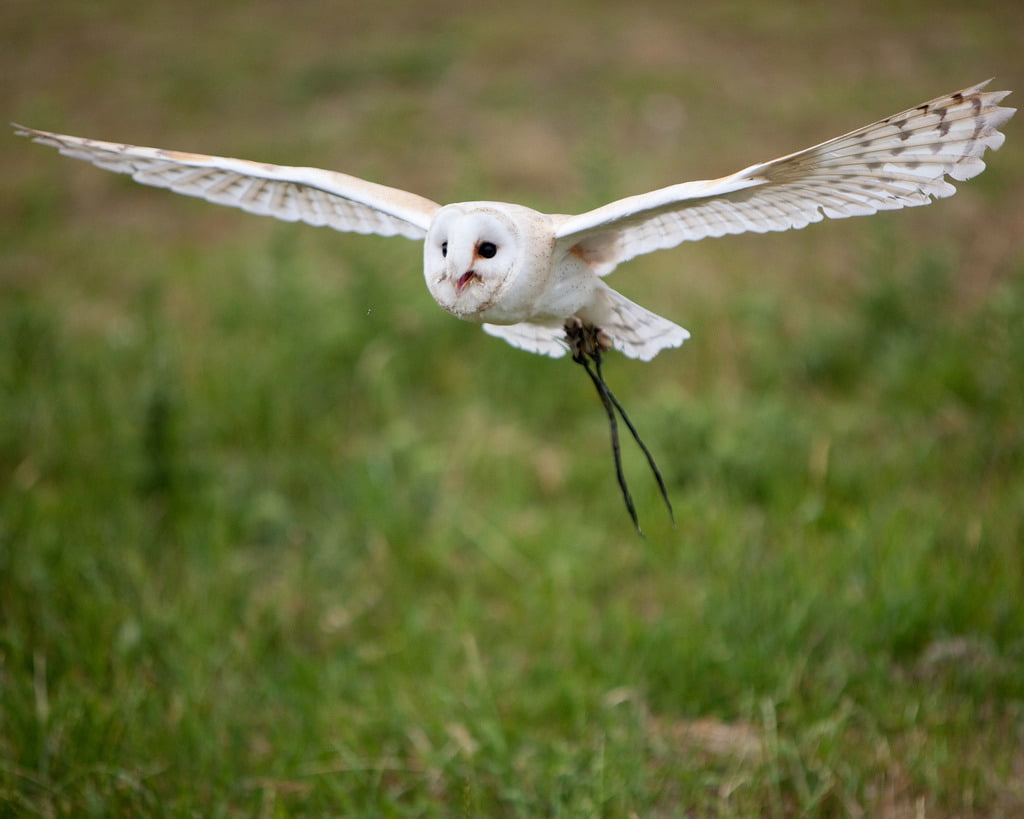
    Owls are nearly silent hunters, able to swoop down on their prey without the rush of air over their wings giving away their approach, thanks to several key features of their feathers. The trailing edge of their feathers–or any lifting body, like an airplane wing–are a particular source of acoustic noise due to the interaction of turbulence near the surface with the edge. Since owls are especially good at eliminating self-produced noise in a frequency range that overlaps human hearing, investigators want to learn what works for owls and apply to it aircraft. A recent theoretical analysis uses a simplified model of the feather as a porous, elastic plate. The researchers found that the combination of porosity with the elasticity of the trailing edge significantly reduced noise relative to a rigid edge. (Photo credit: N. Jewell; research credit: J. Jaworski and N. Peake)