The vibration caused by rubbing a Tibetan singing bowl excites standing waves in a Faraday instability on the surface of water in the bowl. As the amplitude of excitation increases, jets roil across the surface, creating a spray of droplets, some of which actually bounce on the surface as it vibrates. For more see the BBC and SciAm articles.
Tag: droplets

High Hopes
This gorgeous high-speed video captures bubbles, droplets, wakes, cavitation, coalescence, jets, and lots of surface tension at 7000 fps. The authors unfortunately haven’t indicated whether this is air in water or something more viscous, but regardless there are some great phenomena on display here. # (via Gizmodo)

Whipping Instability
A droplet of glycerol coalescing in silicone oil while subjected to strong electric fields exhibits a whip-like instability reminiscent of fireworks. Check out videos of the phenomenon or see the paper for more information. Happy Independence Day to our American readers!
For more fun, holiday-themed high-speed video, check out PopSci’s fireworks videos.

Microgravity Combustion
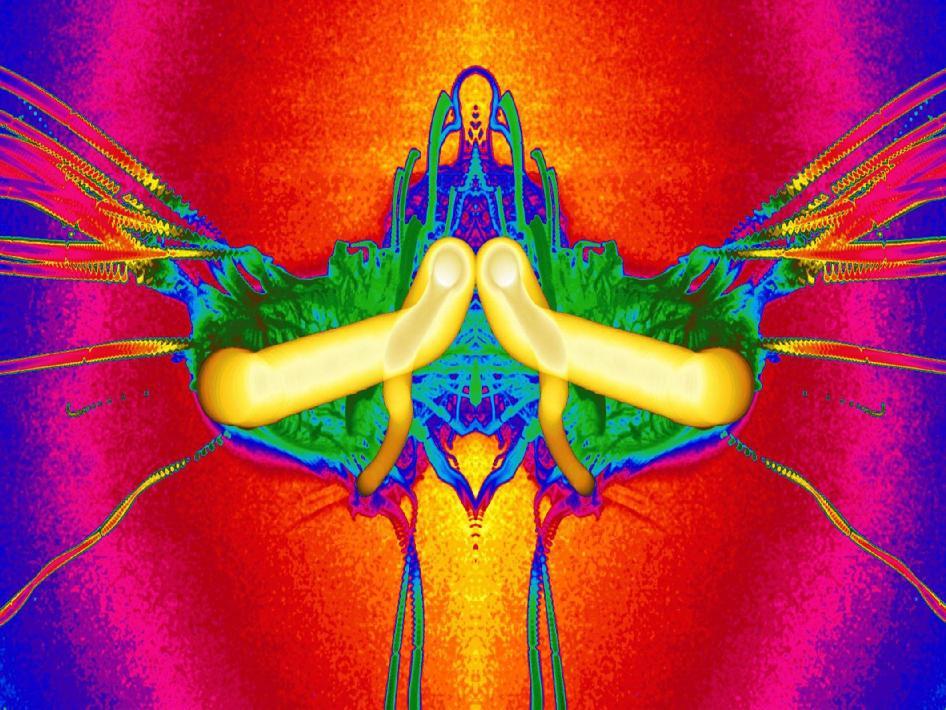
Combustion in microgravity is markedly different than that on earth, due to a lack of buoyant convection. The combustion of a droplet of heptane is shown here as a composite image. The bright yellow structure shows the path of the droplet, which gets smaller as it burns. The green structures show the initial development of soot, which eventually streams outward as long streaks. # (submitted by jshoer)

Stereo Liquid Sculpture
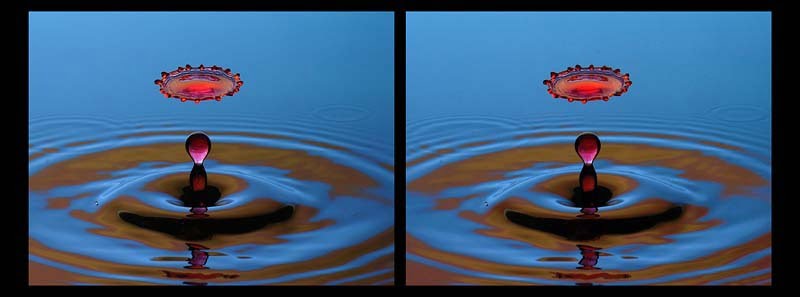
This stereo 3D photo shows the Worthington jet ejected when a droplet impacts a pool. The flat crowning drop is formed from an ejected droplet colliding with a falling droplet.
Liquids Lens Breakup
A decane liquid lens floating on water (think drops of fat in chicken soup) displays different breakup and pinch-off than seen in three-dimensional droplet breakup. The pinch-off process in two dimensions relies on line tension rather than surface tension, and the quasi-2D liquid lens system is somewhere between these. The video above is a magnification of the filament connecting one liquid lens as it is broken into two smaller liquid lenses (the dark areas on the left and right of the screen). # (via scienceisbeauty)
Liquid Acrobatics
Imagine blowing through a straw into a nearly empty glass–we probably all did this as children and sent water, milk, and soda flying everywhere! In essence, this video shows that same act, but filmed by a high-speed camera. The “straw” blows a steady stream of helium into a shallow pool of silicone oil and slowly moves so that the angle the straw makes with the pool changes. As the angle changes, different regimes are visible. First waves appear on the surface of the pool, then a bulge forms, which develops into a droplet stream, then on into the chaos of bubbles and jets. It’s good I couldn’t see this in slow motion as a child or I would have never used my straw for drinking!
Dancing Droplets
When a droplet falls onto a larger pool of the same liquid, it briefly sits on a layer of air that prevents coalescence. When that air drains away, the coalescence cascade–in which the droplet breaks into progressively smaller droplets until fully absorbed–begins. But if you vibrate the pool of liquid, the droplet bounces, effectively injecting more air between it and the pool. This prevents coalescence. What’s really neat here is that the researchers demonstrate this effect with arrays of droplets dancing in formation.
Geometrical Droplet Splashes
Sadly, this video shows no droplet impacts on a heart-shaped post, but maybe you can imagine what it would look like after seeing other geometrical shapes. Happy Valentine’s Day, guys!
High-Speed Leidenfrost Levitation
The Leidenfrost effect occurs when a liquid encounters a surface with a temperature much higher than its boiling point. Some of the liquid is instantly vaporized and then a droplet will skate across the surface on that vapor. This video shows the process at 3000 frames per second.