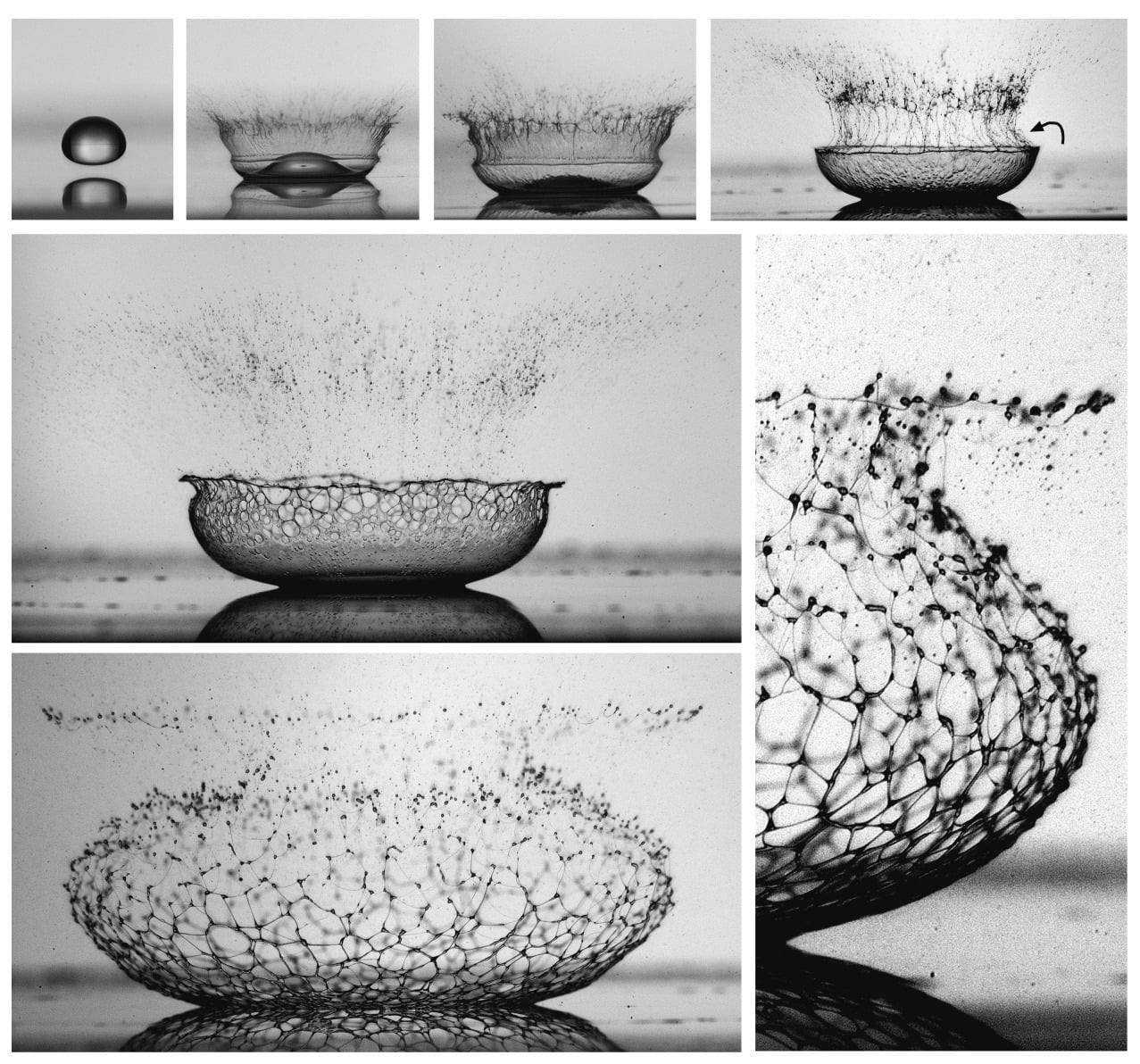
A viscous fluid droplet impacts a thin layer of ethanol, which has a lower surface tension than the viscous fluid. A spray of tiny ethanol droplets is thrown up while a bowl-shaped crown of the viscous fluid forms. As the ethanol droplets impact the bowl, the lower surface tension of the ethanol causes fluid to flow away from points of contact due to the Marangoni effect. This outflow causes holes to form in the crown, forming a network of thin fluid ligaments. For more, see this paper (PDF) and video. (Photo credit: S.T. Thoroddson et al)
Tag: droplets

Vibration-Induced Atomization
Atomization–breaking a liquid into a fine spay of droplets–is common in engines, printers, and in the shower. Here a droplet of water is placed on a thin metal diaphragm that is vibrated at 1 kHz with increasing vibrational amplitude. Capillary waves form on the droplet, and once a critical vibrational amplitude is achieved, tiny droplets are ejected. Full atomization of the original droplet is achieved in about 0.3 seconds real-time. #
The Coalescence Cascade
When a droplet impacts a pool at low speed, a layer of air trapped beneath the droplet can often prevent it from immediately coalescing into the pool. As that air layer drains away, surface tension pulls some of the droplet’s mass into the pool while a smaller droplet is ejected. When it bounces off the surface of the water, the process is repeated and the droplet grows smaller and smaller until surface tension is able to completely absorb it into the pool. This process is called the coalescence cascade.

Impinging Without Coalescing
Three impinging jets of silicone oil rebound without coalescence due to thin-film lubrication between the jets. The motion of the oil replenishes the thin layer of air separating the streams. The same phenomenon keeps droplets from coalescing as well. (Photo credit: BIF Lab, Department of Engineering Science and Mechanics, Virginia Tech) #

Water Spray from a Tire
The spray thrown up by a rolling tire is simulated in the lab by running a single-grooved tire (top) against a smooth tire (bottom) that simulates the road. A supply of water flows from the left at the speed of the rolling tires (6 m/s). The resultant sheet of water is a familiar site to motorists everywhere. Holes in the the sheet of water collide to form the smallest droplets, whose diameters are comparable to the thickness of the sheet, of the order of 100 microns. Thicker parts of the sheet form ligaments and break down into large droplets through the Plateau-Rayleigh instability. (Photo credit: Dennis Plocher, Fred Browand and Charles Radovich) #

Fishbone Jet Collision
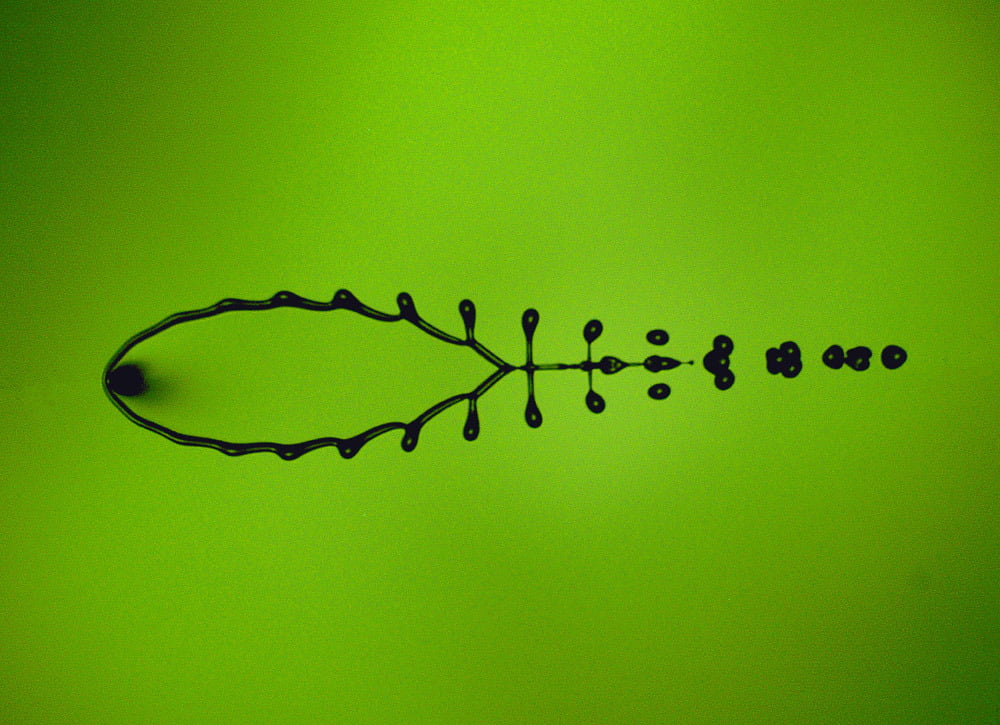
The collision of two jets of radius 420 μm results in a fishbone-like structure. The fluid contains a dilute polymer mixture whose viscoelastic effects resist the tendency of the droplets to detach from the ligaments. The breakup of the jets into droplets is important for applications in inkjet printing. The photo has been rotated 90-degrees for effect. (Photo credit: Sungjune Jung)

Fluid Sculpture
Droplet collisions captured instantaneously create beautiful fluid sculptures that, though common, are too fast for the human eye. Here a bubble was blown onto the surface of the fluid, then a droplet was released to fall into the center of the bubble, bursting it. As that droplet rebounded in a Worthington jet, a second droplet was released and impacted the jet, creating the umbrella-like shape in the center. See Liquid Droplet Art for more photos. (Photo credit: Corrie White and Igor Kliakhandler) #
How Coffee Rings Form
Coffee rings (an ubiquitous feature of academia) are formed by the deposition of particles as the liquid evaporates. When a coffee drop evaporates, capillary action draws the coffee particles toward the edges of the drop, where they congregate into a ring. Research now suggests that this is due to the spherical nature of the particles. Ellipsoidal particles, in contrast, clump together and result in a uniform stain once their carrier liquid evaporates. The effect seems to be due to the particles’ effects on surface tension; the ellipsoidal particles deform the surface of the droplet as it evaporates such that they are not pulled to the edges. Adding a surfactant, like soap, that decreases surface tension caused the ellipsoidal particles to form rings just as the spherical particles do. (submitted by Neil K) #
The Dance of Jets and Droplets
Placing a prism upside down in a bath of silicone oil creates a trapped bubble of air inside the prism. When oscillated above a critical amplitude, the corners of the prism, the oil, and the air perform an intricate dance of bubbles, singularities, jets, and droplets. Read more in the research paper. #

Paint Vibrations
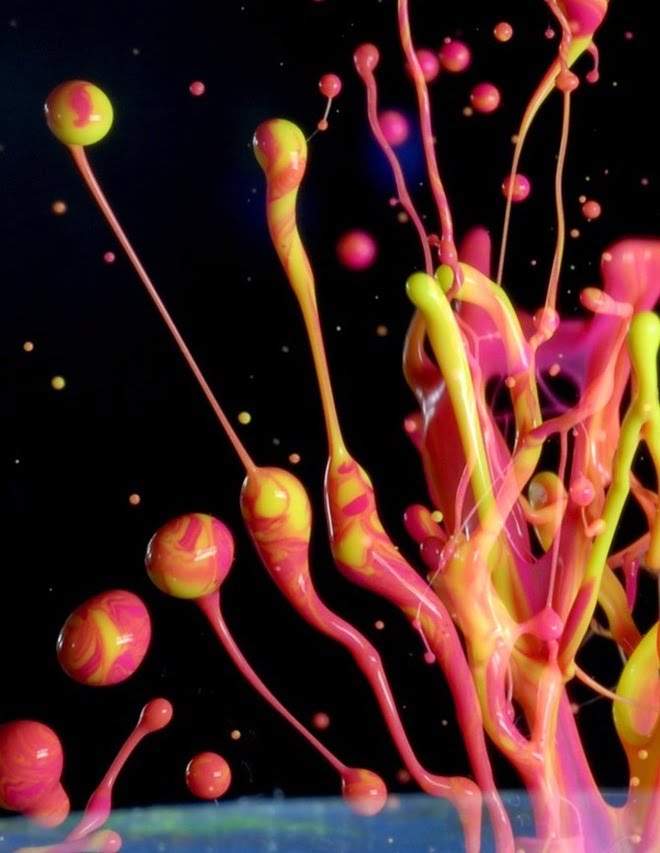
Paint vibrated on a loud speaker explodes in multi-colored jets and droplets. Most paints are shear-thinning non-Newtonian fluids (like ketchup, shampoo, or whipped cream), meaning that their viscosity decreases as they are sheared. This allows them to flow more readily once they are perturbed. #