Tag: drag reduction

  • Cycling Skinsuits and Vortex Generators

    Cycling Skinsuits and Vortex Generators

    It didn’t take long for an aerodynamic controversy to crop up in this year’s Tour de France. At the 14km individual time trial, riders from Team Sky wore custom Castelli skinsuits with integrated dot-like patterns on their upper arms (shown above). By the next day, a sports scientist with a competing team cried foul play, claiming that these fabrics could have given Team Sky as much as 25 seconds’ advantage over other riders. The Sky team finished with 4 out of the top 10 places on the time trial, and their leader, three-time Tour winner Chris Froome, finished some 35 seconds ahead of his expected competitors for the yellow jersey.

    Vortex generators explained

    So how could a few dots make a measurable difference? These protrusions are vortex generators meant to modify flow around a cyclist. Humans are not aerodynamic and what typically happens when air flows over a cyclist’s arms is shown in the flow visualization above: the air follows the curve of the arm part way, then it separates from the body, leaving a region of recirculation that increases drag. Vortex generators can help prevent or delay that drag-inducing flow separation by adding extra energy and turbulence to the air near the arm’s surface. Because turbulent boundary layers can follow a curve longer before separating, this helps reduce the drag by reducing the recirculation zone.

    About that time savings

    Aerodynamically speaking, those vortex generators can make a difference, but the question is, how much? In his complaint, Grappe cites a 2016 paper by L. Brownlie et al. that wind-tunnel tested different vortex generator patterns for use in running apparel. The speeds tested included those relevant to cycling. The specific numbers Grappe quotes aren’t directly relevant, however:

    As noted above, race garments that contain VG provide reductions in Fd of between 3.7 and 6.8% compared to equivalent
    advanced race apparel developed for the 2012 London Olympics which in turn provided substantially lower drag than
    conventional race apparel.

    the effectiveness of 5, 10 and 15 cm wide strips of VG applied to each flank of a sleeveless singlet revealed that the 5 cm wide
    strips provided between 3.1 and 7.1% less Fd than the 10 cm wide strips and between 1.9 and 4.3% less Fd than the 15 cm wide
    strips.  

    Here Brownlie et al. are specifically describing the savings for running apparel, which uses vortex generators in very different places than you would on a cyclist. Note the second quote even refers to a sleeveless singlet, so the vortex generators measured are definitely not in the same place as these skinsuits!

    The bottom line

    I fully expect that vortex generators give a marginal aerodynamic edge, which is why Sky and other teams have already been using them in competition. But I hesitate to declare that the savings is as high as 5-7%, and I have no way to verify Grappe’s subsequent claims that this translates to 18-25 seconds in the time trial. Those are numbers he gives without citing what model is being used to translate drag gains into time.

    In the end, what is needed is clarification of the rules. As they stand, one rule seems to allow the skinsuits because the vortex generators are integrated into the fabric, whereas another states clothing is forbidden “to influence the performances of a rider such as reducing air resistance”. Those two stances seems contradictory, and, for now, the race officials’ verdict to allow the suits stands.

    If you want to learn more about aerodynamics and cycling, be sure to check out my latest FYFD video. (Image credits: B. Tessier/Reuters; Getty Images; L. Brownlie et al. 2009; h/t to W. Küper)

  • How Cycling Position Affects Aerodynamics

    How Cycling Position Affects Aerodynamics

    New FYFD video! How much does a rider’s position on the bike affect the drag they experience? To find out I teamed up with folks from the University of Colorado at Boulder and at SimScale to explore this topic using high-speed video, flow visualization, and computational fluid dynamics. 

    Check out the full video below, and if you need some more cycling science before the Tour de France gets rolling, you can find some of my previous cycling-related posts here. (Image and video credit: N. Sharp; CFD simulation – A. Arafat)

    ETA: Please note that the video contained in this post was sponsored by SimScale.

  • Reducing Drag with Bubbles

    Reducing Drag with Bubbles

    Large ships experience a great deal of drag due to friction between their hull and the water. One method shipbuilders are considering to combat this drag is the use of bubbles, which have been found to reduce drag by up to 40%. The physical mechanism behind this drag reduction is not yet understood, but a recent study suggests that bubble size and bubble coalescence play an important role.

    Researchers introduced surfactants into bubbly boundary layers and found that the reductions in drag evaporated as soon as the surfactants spread. Adding only 6 parts per million of the surfactant decreased average bubble size from 1 mm to 0.1 mm and helped prevent the bubbles from growing via coalescence. The implications are that bubble-induced drag reduction could be extremely sensitive to water conditions. (Image credit: G. Kiss; research credit: R. Verschoof et al.)

  • Featured Video Play Icon

    Living Fluid Dynamics

    This short film for the 2016 Gallery of Fluid Motion features Montana State University students experiencing fluid dynamics in the classroom and in their daily lives. As in her previous film (which we deconstructed), Shanon Reckinger aims to illustrate some of our everyday interactions with fluids. This time identifying individual phenomena is left as an exercise for the viewer, but there are hints hidden in the classroom scenes. How many can you catch? I’ve labeled some of the ones I noticed in the tags. (Video credit: S. Reckinger et al.)

  • Rio 2016: Track Cycling

    Rio 2016: Track Cycling

    Track cycling is a sport where speed is everything. As much as 90% of the resistance a rider has to overcome is aerodynamic drag. To minimize drag, riders wear form-fitting one-piece skinsuits and wear special, streamlined helmets. They have aerodynamic bikes (unique left-side-drive ones, if you’re the Team USA women) and ride with their arms close together and thrust in front of them to minimize the frontal area they expose. 

    Even the tactics of racing rely heavily on aerodynamics. In events like team pursuit cyclists stay extremely close to the wheel of the rider ahead of them in order to remain in that rider’s slipstream and experience less drag. When switching off the position of lead rider, cyclists use the curvature of the track to help them move to the back of the paceline quickly to minimize the time spent outside of their teammate’s draft. (Image credits: GettyImages via the Guardian and the IOC, source)

    Previously: Cycling’s aero equipment helps them beat the clock; the effect of cyclists being followed by a motorbike or car

    Join us throughout the Rio Olympics for more fluid dynamics in sports. If you love FYFD, please help support the site!

  • Rio 2016: Cycling

    Rio 2016: Cycling

    Today marks the official start of the 2016 Summer Olympics in Rio. Here at FYFD we’ll be celebrating by taking a look at how fluid dynamics affects Olympic sports. You can check out our previous series on the London Olympics here. Since this weekend features the men’s and women’s cycling road races, we’ll get started with cycling!

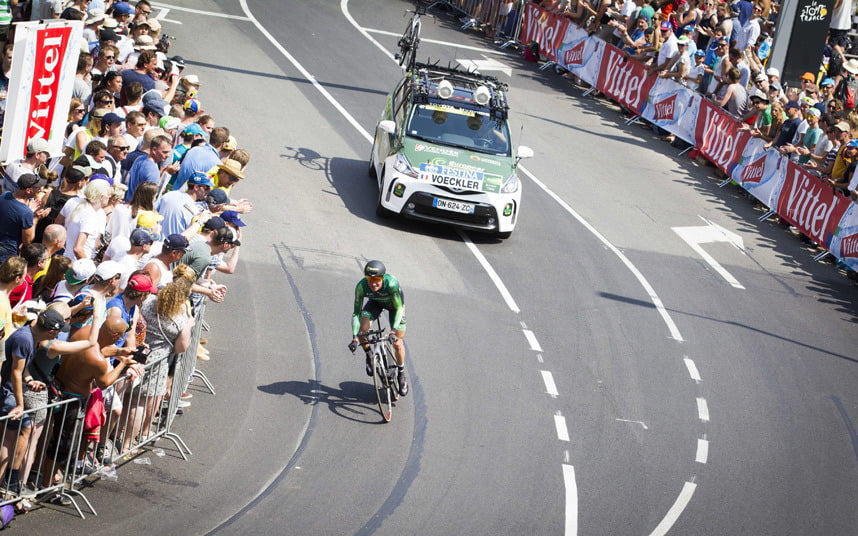
    In road cycling, equipment and race strategy are all built around aerodynamic efficiency. It’s understood that following a car or motorbike gives a cyclist an unfair advantage, and officials can be quick to punish infractions. What the rules don’t account for, though, is the advantage a cyclist gets when they’re followed by a motorbike (or car). These vehicles are significantly larger than a cyclist, and when they are trailing a cyclist, they have a significant upstream effect. Essentially the higher pressure traveling ahead of the motorbike will counter the low pressure region immediately behind the cyclist. The result is that the cyclist, despite being in front, experiences less drag than they would if the motorbike weren’t there.

    The difference isn’t tiny either: if a motorbike follows a rider at a distance of 0.5 m for just 1 km, the rider saves more than 2 seconds. When events can be won or lost by fractions of a second, those gains are significant. (Image credits: DCMS; B. Blocken et al., GettyImages, Reuters; research credit: B. Blocken et al.; submitted by Marc A.)

  • Sharks Swimming Sideways

    Sharks Swimming Sideways

    Like many sharks, the great hammerhead shark is negatively buoyant, meaning that, absent other forces, it would sink in water. To compensate, sharks generate lift with their pectoral (side) fins to offset their weight. Their dorsal (top) fin is used to generate the horizontal forces needed for control and turning. However, both captive and wild great hammerhead sharks tend to swim rolled partway onto their sides. The reason for this unusual behavior is hydrodynamic – it is more efficient for the shark. Unlike other species, the great hammerhead has a dorsal fin that is longer than its pectoral fins. By tipping sideways, the shark effectively creates a larger lifting span and is able to induce less drag than when it swims upright. Models show that swimming on their sides requires ~8% less energy than swimming upright! (Image credit: N. Payne et al., source)

  • The Leidenfrost Dunk

    The Leidenfrost Dunk

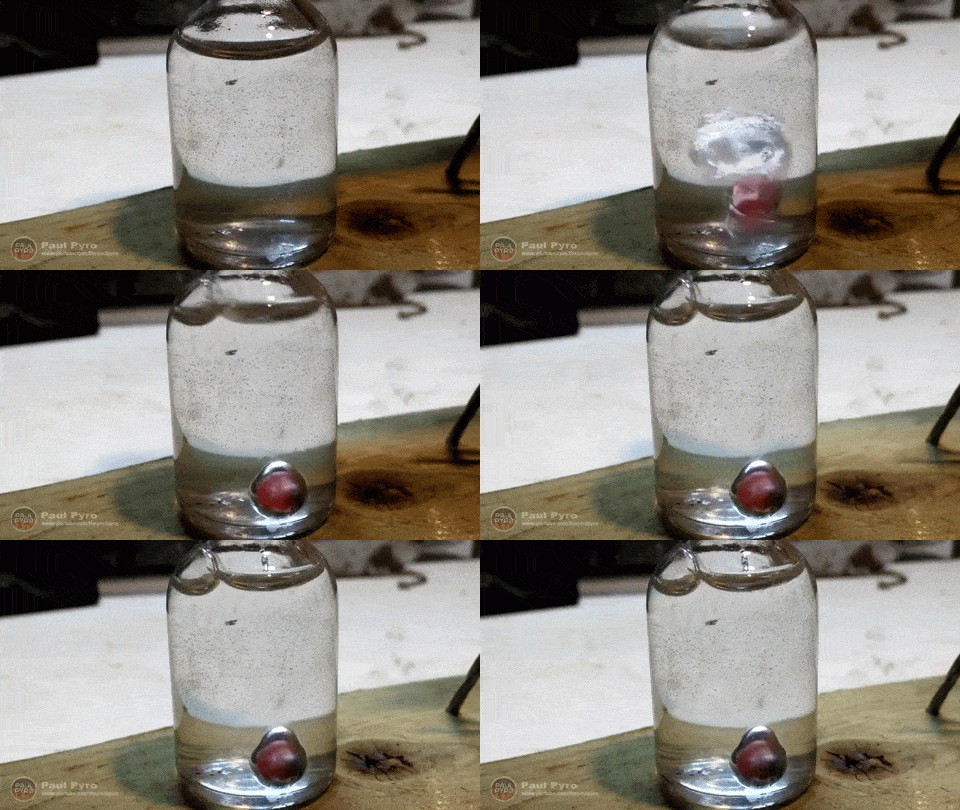
    The Leidenfrost effect occurs when a liquid is exposed to a surface so hot that it instantly vaporizes part of the liquid. It’s typically seen with a drop of water on a very hot pan; the drop will slide around, nearly frictionless, upon a cushion of its own vapor. You can see the effect when plunging a hot object into a bath of liquid, too. This is what happens when you quickly dunk a hand in liquid nitrogen (not recommended, incidentally) or when you drop a red hot steel ball into water like above. In this case, the object is so hot that it gets encased in a layer of water vapor. If you could maintain the temperature difference necessary to keep the vapor layer intact, you could move underwater at high speeds with low drag, similar to the effects of supercavitation. (Image credit: Paul Pyro, source)

    If you enjoy FYFD, please consider supporting the site by becoming a patron!

  • Cars Helping Cyclists

    Cars Helping Cyclists

    This year’s Tour de France opened with an individual time trial stage in which riders competed solo against the clock. But, according to numerical simulations, some riders may get an unfair aerodynamic advantage in the race if they have a following car. The top image shows the pressure fields around a rider with a car following 5 meters behind versus 10 meters behind. The size of the car means that it displaces air well in advance of its arrival. By following a rider closely, that car’s high pressure region can help fill in a cyclist’s wake, thereby reducing the drag the rider experiences. For a short time trial like the 13.8 km race that kicked off this year’s tour, a rider whose car follows at 5 meter could save 6 seconds over one whose car followed at the regulation 10 meter distance. (As it happens, the stage was decided by a 5 second margin.) Since not all riders get a team follow car, it’s especially important to ensure that those who do aren’t receiving an additional advantage. For more about cycling aerodynamics, check out our previous cycling posts and Tour de France series. (Image credit: TU Eindhoven, EPA/J. Jumelet; via phys.org; submitted by @NathanMechEng)

  • Brazuca

    Brazuca

    Since 2006, Adidas has unveiled a new football design for each FIFA World Cup. This year’s ball, the Brazuca, is the first 6-panel ball and features glued panels instead of stitched ones. It also has a grippy surface covered in tiny nubs. Wind tunnel tests indicate the Brazuca experiences less drag than other recent low-panel-number footballs as well as less drag than a conventional 32-panel ball. Its stability and trajectory in flight are also more similar to a conventional ball than other recent World Cup balls, particularly the infamous Jabulani of the 2010 World Cup. The Brazuca’s similar flight performance relative to a conventional ball is likely due to its rough surface. Like the many stitched seams of a conventional football, the nubs on the Brazuca help trip flow around the ball to turbulence, much like dimples on a golf ball. Because the roughness is uniformly distributed, this transition is likely to happen simultaneously on all sides of the ball. Contrast this with a smooth, 8-panel football like the Jabulani; with fewer seams to trip flow on the ball, transition is uneven, causing a pressure imbalance across the ball that makes it change its trajectory. For more, be sure to check out the Brazuca articles at National Geographic and Popular Mechanics, as well as the original research article. (Photo credit: D. Karmann; research credit: S. Hong and T. Asai)