Researchers studying the use of fire whirls to burn off oil spills have discovered a new type of fire whirl – the blue whirl. Their results are currently reported in a pre-print paper on arXiv and await peer-review. In their experiment, the scientists ignited a puddle of fuel floating atop water. Compared to a typical flame, they observed that a tightly-spinning fire whirl burns hotter and produces less soot by burning more of the fuel. To the researchers’ surprise, their lab-scale yellow fire whirl evolved into a compact, bright blue whirl. The blue whirl has a laminar flame and makes little to no noise. Its bright blue color indicates even more efficient combustion than the yellow fire whirl. The lack of yellow color means the whirl is burning without producing any soot, a by-product of incomplete combustion. The authors hope a better understanding of blue whirls will lead to better methods for responding to oil spills. (Image credit: H. Xiao et al.)
Tag: combustion

Fluids Round-up
Last week was supposed to have a fluids round-up, but we were having too much fun walking on water instead. So here it is now!
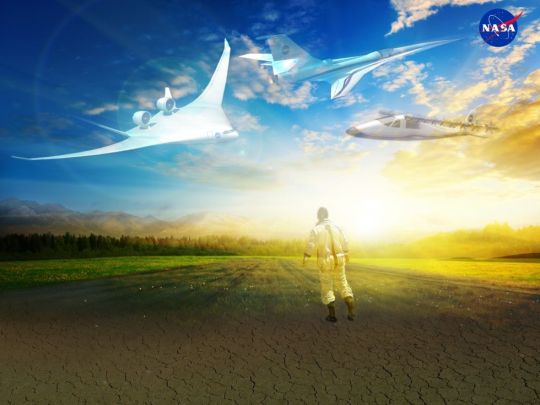
– NASA has asked Congress for funding for new X-plane programs to explore solutions for greener airliners and quieter sonic booms to enable next-generation air travel. Popular Science, Gizmodo, and Ars Technica take a closer look at the proposed projects. I won’t lie – as an aerospace engineer I am hugely in favor of this. The first ‘A’ in NASA has been neglected for quite a while and projects like these are needed if we want to advance the state-of-the-art in aeronautics.
– The New York Times’ ScienceTake video series took a look back at their most popular videos, and 3 of the top 5 videos are fluid dynamics-related. Because we are just that awesome. (via Rebecca M)
– I made a guest appearance on last week’s Improbable Research podcast, where we talked about bizarre experiments trying to unravel swimming.
– Physics Girl shows us 5 weird ways to blow out a candle. There’s some neat and potentially non-intuitive fluid dynamics involved!
– SciShow offers an explanation of why we sneeze. Spoiler alert: it’s more than just to get rid of irritants.
– Fluid dynamics made the short list for NPR’s Golden Mole awards with the discovery of dancing droplets. Here’s Skunkbear’s take on it.
– Ernst Mach, of Mach number fame, was also a bit of an artist and philosopher. (via @JenLucPiquant)
– It’s not quite fluid dynamics, but this Slow Mo Guys video of spinning burning steel wool might be their most beautiful video yet. Check it out!
(Image credit: NASA)

Fire Tornado
Fire tornadoes, despite their name, are more like dust devils than your typical tornado. In nature, they’ll often form in wildfires, but here the Slow Mo Guys simulate one for the high-speed cameras using a ring of box fans set up to provide rotational flow, or vorticity, around a kerosene fire. As the fire burns, the warm air over the flame moves upward due to buoyancy. This creates a low-pressure area around the fire that draws in the spinning air from further out. Like an ice skater who pulls her arms in when spinning, the rotating air spins faster as it moves in toward the fire, resulting in a swirling turbulent vortex of flame. Hopefully it goes without saying, but, seriously, don’t try this at home. (Video credit: Slow Mo Guys; submitted by Chris S.)

Ignition
Shown here are the first instants after a bubble full of methane gas is ignited via laser. Using the schlieren optical method and a high-speed camera, scientists recorded the deflagration at 10,000 frames per second. Because schlieren imaging is very sensitive to small changes in density, we see not only the expanding flame front as the methane ignites but also the subtle waviness of the methane expanding into the surrounding air as the bubble bursts. (For comparison, check out what bursting a water balloon looks like at high-speed.) Be sure to head over to ScienceTake for the full schlieren video, and also check out this award-winning video of a match lighting made by the same researcher. (Image credit: V. Miller et. al.; full video: The New York Times; submitted by Rebecca M.)
ETA: An earlier version of this post mistakenly said the demo used a balloon full of methane rather than a bubble. Thanks to jump-first-think-later for the correction.
Bullet-Time Inferno
Remember the bullet time effect from The Matrix? This spectacular video gives you a similar effect with the turbulent flames created by firebreathers. To capture this level of detail, Mitch Martinez uses an array of 50 cameras placed around the performers, allowing him to reconstruct the full, three-dimensional representation of the flames. Similarly, some scientists use arrays of high-speed video cameras to collect 3D, time-resolved data about phenomena like combustion. Because these flows are so complex in terms of their fluid dynamics and chemistry, capturing full 3D data is important to help understand and model the flow better. (Video credit: M. Martinez; via Rakesh R.)
Extinguishing Flames
Putting out fires can be a difficult, water-intensive task. In this video, scientists demonstrate how using a non-Newtonian fluid can make it easier to extinguish and suppress flames. Where water tends to splatter and scatter against an object, a yield-stress fluid can cling and coat to smother the flame. The fluid used here is water with a 0.1% polymer additive, which is enough to significantly change the fluid’s rheological properties. Pre-treating flammable objects with the fluid is also effective at suppressing combustion, raising additional possibilities for using such techniques in fighting the spread of wildfires. (Video credit: B. Blackwell et al.)
Water in Oil
Pouring water on an oil fire is a quick way to cause almost explosive results. Since water is denser than oil, it quickly sinks to the bottom of a container, heating up as it does. When the water reaches its boiling point, it evaporates and expands as steam. That phase change involves a huge change in volume, a fact made especially clear in the video below. The steam expands and rises, throwing droplets of oil upward and outward. These smaller atomized droplets are easier to combust, which, in the case of the video above, causes a veritable cloud of flames if a fire has already started.
(Video credits: The Slow Mo Guys and N. Moore)
Re-lighting a Candle
When you blow out a candle, you can re-light the wick using the smoke trail left behind. This is a topic we’ve discussed before, but I’m thrilled to finally see the process in true high-speed, thanks to the Slow Mo Guys. The plume that rises from the extinguished candle is an atomized mixture of fuel (wax) and air. When you bring a new combustion source–the match–close enough, that mixture ignites and the flame spreads downward back to the wick. (Video credit: The Slow Mo Guys)
Extinguishing Fires With Sound
Engineering students from George Mason University have built a fire extinguisher that uses sound to put out flames. Since sound waves are mechanical pressure waves, they can move the air surrounding a burning material. Through trial and error the students found the high-frequency sound had little effect, but at frequencies between 30-60 Hz the sound waves could jostle enough oxygen away from the flame to extinguish the fire. They’re hoping the solution is scalable and can be applied to larger fires. For other wild ideas for chemical-less fire extinguishers, check out how researchers put out fires with explosions. (Video credit: George Mason University; submitted by @isanaht)
Fire-Breathing
In this high-speed video, the Slow Mo Guys demonstrate fire-breathing. Rather than using a liquid fuel like kerosene, they utilize cornstarch, which is both easily flammable and non-volatile thanks to its powdered form. Blowing out the cornstarch creates a turbulent jet of cornstarch and air. Combine that with a combustion source, and the cornstarch quickly deflagrates, meaning that the flame propagates via heat transfer. When neighboring regions of cornstarch become hot enough, they ignite and the flame front expands. You can observe this in the flame growth shown in the video; just after ignition the cornstarch jet is much wider than the fire and it takes some time for the flames to catch up with the jet. Although a liquid-fueled fireball operates by the same principles, it can look rather different. For comparison, check out this high-speed video of a WD-40 fireball. And, hopefully it goes without saying, but don’t try this stuff at home. (Video credit: The Slow Mo Guys)