The space shuttle, despite three decades of service, remains a triumph of engineering. Although it is nominally a space vehicle, fluid dynamics are vital throughout its operation. From the combustion in the engine to the overexpansion of the exhaust gases; from the turbulent plume of the shuttle’s wake to the life support and waste management systems on orbit, fluid mechanics cannot be escaped. Countless simulations and experiments have helped determine the forces, temperatures, and flight profiles for the vehicle during ascent and re-entry. Experiments have flown as payloads and hundreds of astronauts have “performed experiments in fluid mechanics” in microgravity. Since STS-114, flow transition experiments have even been mounted on the orbiter wing. The effort and love put into making these machines fly is staggering, but all things end. Godspeed to Discovery and her crew on this, her final mission!
Tag: combustion

Colorful Computational Combustion
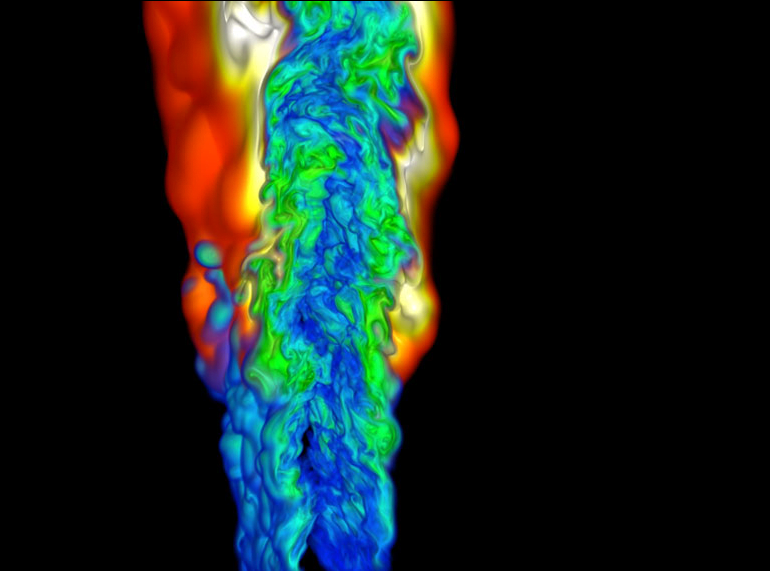
Many fluid dynamics problems are so complicated that they require supercomputers to calculate the mathematical and physical details. This image shows a computer simulation of a cold ethylene jet combusting in hot air. Different colors indicate different combustion by-products. Researchers use simulations like this one to investigate ideal flames that improve efficiency in applications like cars or jet engines. #

Combustion in Microgravity
‘Hot air rises.’ It’s common knowledge. But we usually forget that this is only true thanks to Earth’s gravity. On Earth, a candle flame’s distinctive pointed shape is due to hot air rising. Without gravity, there is no buoyant convection; hot air has no reason to rise (and no definition of what up is either!). This makes flames in microgravity spherical, as in the video above from a drop tower on earth. See also: astronaut explains fire in microgravity.