Tag: combustion

  • Understanding Wildfire

    Understanding Wildfire

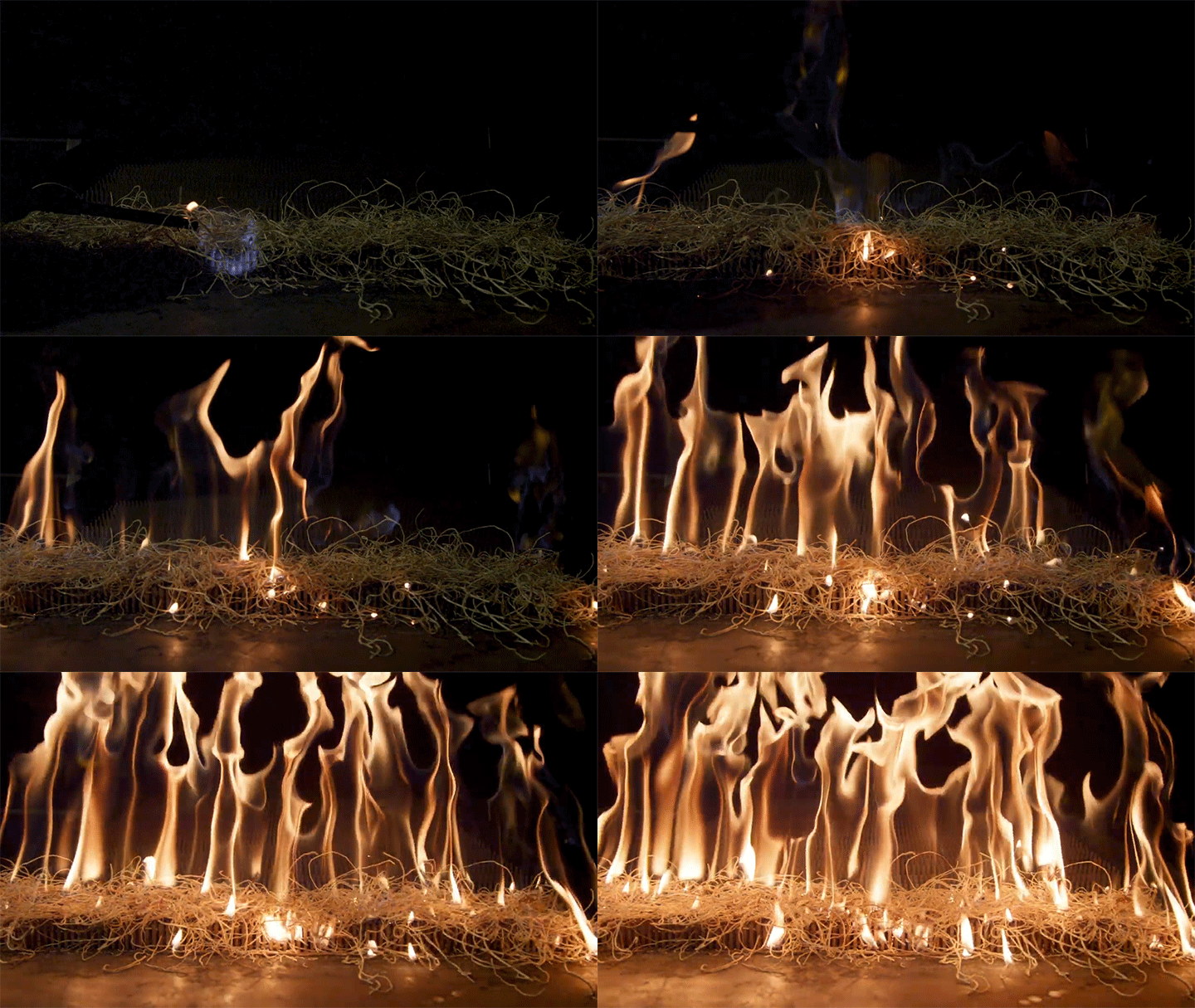
    Wildfires are an ongoing challenge in the western United States, where droughts and warmer conditions have combined with a century of fire suppression to form perfect conditions for monstrous fires. It’s long been understood that ambient winds can drive spreading fire, but the connection between wildfire and wind is more complicated than this.

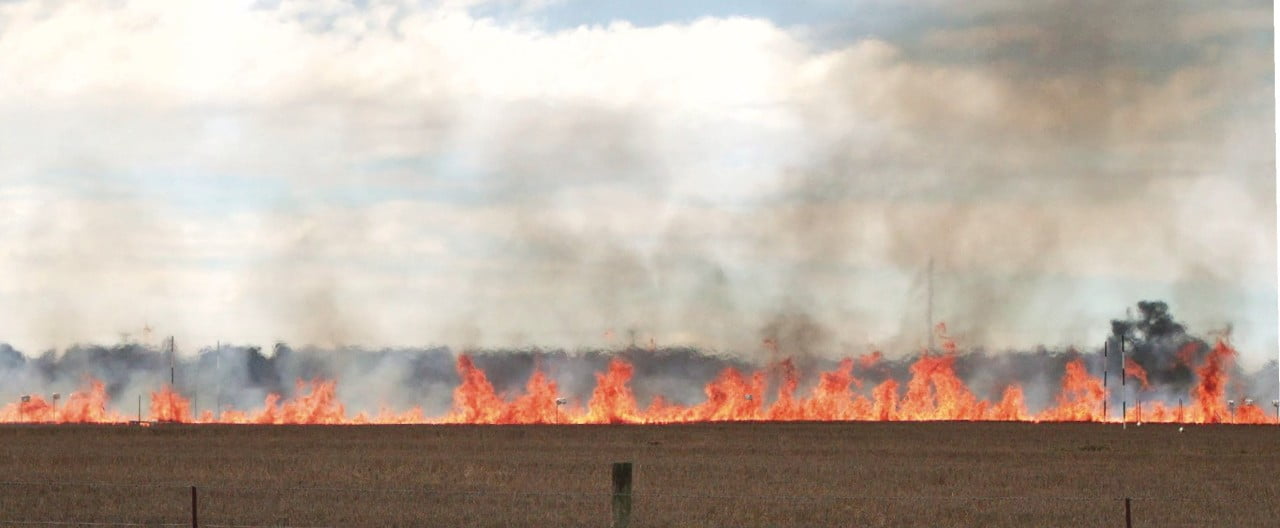
    The heat of a fire drives buoyant air to rise, creating tower-like updrafts in a flame front. We see this both in the shape of the grass fire above, and in the wind vectors of a simulated grass fire in the lower image. Between those towers are troughs where cooler ambient wind is drawn in to replace the rising air. How a fire spreads will depend on the speed, direction, and temperature of these winds. A hot wind fed by the fire’s heat will raise the temperature of fuel in unburned areas, bringing it closer to ignition. In contrast, cooler ambient winds can hinder a fire by keeping nearby grass and twigs too cool to ignite. (Image credit: fire – M. Finney/US Forest Service; simulation – R. Linn; research credit: R. Linn et al.; for more, see Physics Today)

  • Featured Video Play Icon

    Streaming Fire

    I’m just going to start this one with a blanket statement: DO NOT TRY THIS. Instead, enjoy the fact that the Internet enables us to enjoy the sight of burning gasoline in slow mo without any danger to ourselves.

    In this video, Gav and Dan capture a burning bucket of gasoline as it’s thrown against glass. One thing this stunt really highlights is that it’s not the liquid gasoline that burns, it’s the vapor. However, since gasoline is volatile – in other words, it evaporates easily – the fire is quick to spread, especially as the toss atomizes droplets near the edge of the fluid. That’s why you see distinct streaks near the edge of the spreading flame and a non-burning liquid in the center. (Image and video credit: The Slow Mo Guys)

    Flaming gasoline flies toward the viewer and spreads against glass in slow motion
  • Explosive Flame Fronts

    Explosive Flame Fronts

    Though they look like jellyfish or space creatures, these images from photographer Linden Gledhill are actually explosions. What you’re seeing is the detonation of hydrogen gas with oxygen. The teal sphere with its wavy surface marks the flame front, and the crisp, stringy edges seen here and there in the foreground are the remains of a soap bubble that held the hydrogen before it sparked. You can see a similar set-up (using methane rather than hydrogen) in action here, and you can see other artistic takes on combustion in previous posts like this one. (Image credit: L. Gledhill, Flickr)

  • Catching Fire

    Catching Fire

    Citrus fruits like oranges house tiny pockets of oil in their peels. When squeezed, the oils jet out in tiny micro-jets that are about the width of a human hair. Despite their small size, the jets reach speeds of about 30 m/s and quickly break into a stream of droplets. When exposed to the flame of a lighter, like in the animation above, those microdroplets combust easily, creating a momentary fireball used to augment some cocktails. For more on how the citrus peel generates these jets, check out this previous post. (Image credit: Warped Perceptionsource; research credit: N. Smith et al.)

  • Featured Video Play Icon

    Experimenting with Speakers

    In her ongoing quest to explore natural resonance, Dianna has enlisted some very nice, very expensive speakers to find out just what happens when the bass drops. If you ever wondered what the natural frequency of your eyeballs is, then this one’s for you.

    If you’re more intrigued by the idea of putting out fires with sound (and/or explosions), I’ve got some posts on that including a sound-based fire extinguisher and a supersonic cannon capable of blowing out fires. (Video credit: Physics Girl)

  • Featured Video Play Icon

    Fiery Backdraft

    Combustion is ultimately a chemical reaction, and like any chemical reaction, it requires the right balance of ingredients. The only way to completely exhaust the reaction is to have the perfect amount of fuel (i.e. stuff to burn) and oxidizer (i.e. oxygen). When those ratios don’t match, the reaction can slow down or even appear to end, but that doesn’t mean a fire’s gone out.

    Firefighters face one of the dangerous consequences of this situation in the form of backdrafts. When a fire has been burning in a sealed container and exhausted its oxygen supply, it can get extremely hot even if the flames seem to have died down. When oxygen is added back by opening a door or window, the fire can react explosively, as the Slow Mo Guys demonstrate above. The good news is that backdrafts are relatively rare and there are steps you can take to avoid them. (Image and video credit: The Slow Mo Guys)

  • Featured Video Play Icon

    The Beauty of Flames

    The flickering yellow and orange flames most of us are used to thinking of are rather different from the flames researchers study. In this video, the Beauty of Science team offers a short primer on different flame shapes studied in combustion, including laminar, swirling, and jet flames. Each has its own distinctive character and may be advantageous or not, depending on the application for the flame. A laminar flame, for example, is steady, which might make it a good choice for something like a Bunsen burner, where consistency is needed. Whereas a turbulent flame is better capable of mixing fuel and oxidizer, which is key in applications like rocket engines, where that mixing can be a limiting factor in the engine’s efficiency. (Image and video credit: Beauty of Science)

  • Patterns of Flame

    Patterns of Flame

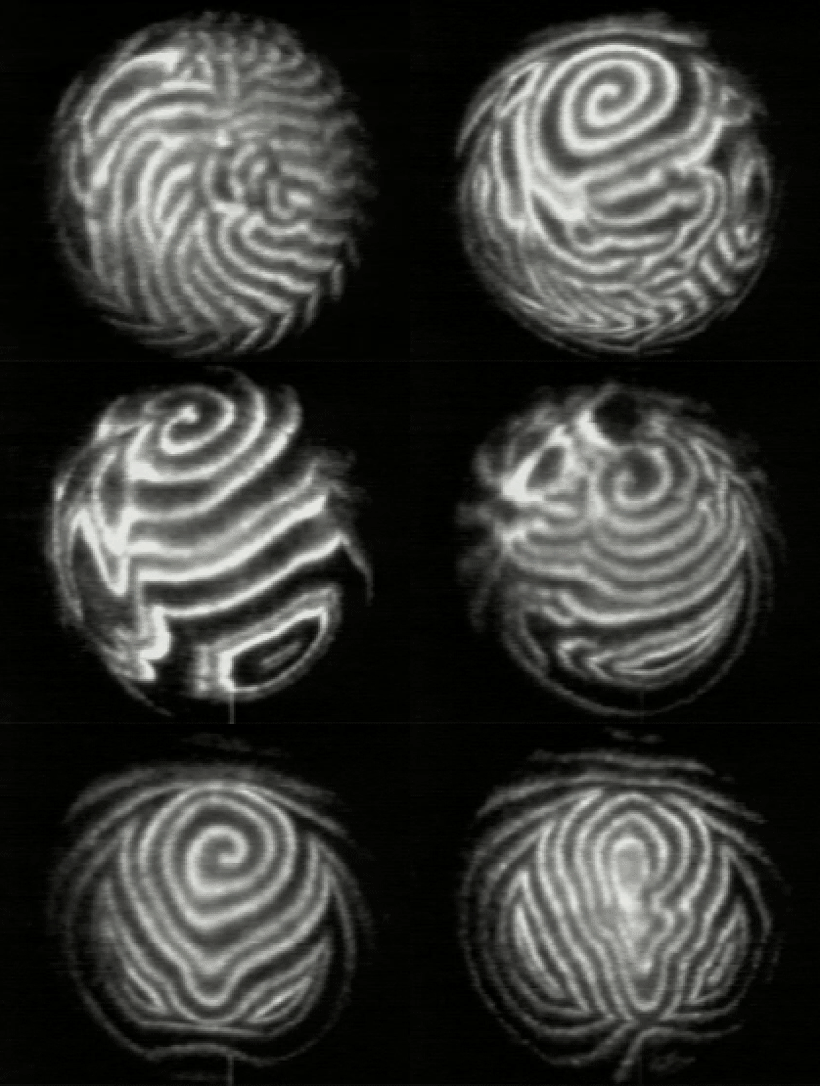
    In nature, the way a system behaves often depends on multiple competing factors. This is particularly apparent for chemical reactions, some of of which can oscillate in wild patterns as different forces compete. Similar patterns can occur in combustion, as shown above.

    What you see here are patterns formed on a flame propagating down a tube. They’re a result of what’s known as a thermal-diffusive instability. Flames like these typically propagate by conducting heat into the fuel-air mixture ahead of the flame front, thereby raising its temperature, while, simultaneously, fuel and air diffuse into the flame to sustain the chemical reactions. If the rates of heat transfer and chemical diffusion are balanced, the flame moves steadily. But if there’s an imbalance between those factors, instabilities occur.

    In this case, the temperature rises much faster than the time needed for fresh fuel to move into the flame. As the temperature goes up, the reaction rate increases exponentially, and the flame surges forward. But the slow resupply of fuel makes the reaction rate drop, causing the flame’s progress to stall. This interplay results in the complex, pulsating instabilities we see here. (Image and submission credit: H. Pearlman; research credit: H. Pearlman and D. Ronney)

  • Featured Video Play Icon

    Tornadoes, Fire, and Ice

    It’s time for another look at breaking fluid dynamics research with the latest FYFD/JFM video! This time around, we tackle some geophysical fluid dynamics, like listening to the sounds newborn tornadoes make below the range of human hearing; studying how melting ice affects burning oil spills; and how salt sinking from sea ice affects the ocean circulation. Check out the full video below for much more! If you’ve missed any of the previous videos in the series, you can check them out here. (Image and video credit: T. Crawford and N. Sharp)

  • Featured Video Play Icon

    360 Fireball

    Flames are inherently fascinating to watch. Most of the ones we see regularly, like candle flames and campfires, tend to flicker unsteadily due to their turbulence. But larger fires have a spell-binding nature all their own, one that’s highlighted in slow motion. Here the Slow Mo Guys take flame-gazing to a new level by circling a fireball with a high-speed camera. In the resulting footage, you can admire the incredible expansion of the flame front, and the beautiful, detailed turbulence that creates all the myriad tiny eddies you see in the slow motion. It’s well worth watching more than once! (Video and image credit: The Slow Mo Guys)