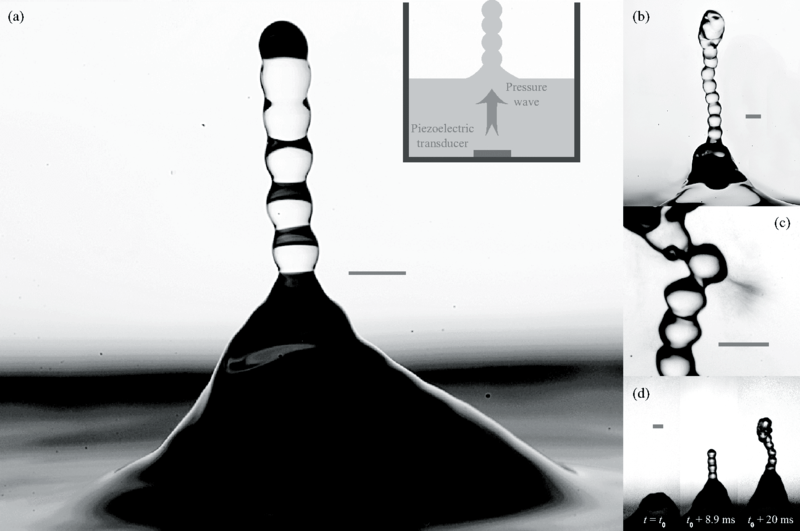
After this, you may never look at a humidifier the same way again. Ultrasonic humidifiers generate tiny droplets using piezoelectric transducers. When the humidifier is on, the ultrasonic vibrations of the piezoelectric transducer create a pressure wave that forces the water above into a hill with a string of liquid droplets extending upward. For a sense of the scale, the gray bars shown in each image above represent 1mm. The super-fine droplets the humidifier produces come from cavitation of these larger drops, as shown in image c). Image d) shows snapshots of the formation of the droplet string over a matter of milliseconds. (Image credit: S. J. Kim et al., original poster)
Tag: cavitation

Fluids Round-up
Here’s to another fluids round-up, our look at some of the interesting fluids-related stories around the web:
– Above is a music video by Roman Hill that relies on mixing and merging different fluids and perturbing ferrofluids for its visuals as it re-imagines the genesis of life.
– GoPro takes viewers inside a Category 5 typhoon with 112 mph (180 kph; 50 m/s) winds.
– Astronaut Scott Kelly demonstrates playing ping pong with a ball of water in space. (via Gizmodo)
– See fluid dynamics on a global scale with Glittering Blue. (via The Atlantic)
– To make a taller siphon, you have to find a way to avoid cavitation.
– Speaking of siphons, Randall Munroe tackles the question of siphoning water from Europa over at What If? (submitted by jshoer)
– The Mythbusters make a giant tanker implode using air pressure.
– Sixty Symbols explores how tiny things swim.
– What happens when you bathe in 500 pounds of putty? Let’s just say that bathing in an extremely viscous non-Newtonian fluid is not recommended. (via Gizmodo)
(Video credit and submission: R. Hill et al.)
Don’t forget to check out our Patreon page. Please help support FYFD by becoming a patron.

Why Joints Pop
Joints like our knuckles are lubricated with liquid called the synovial fluid. When manipulated, these joints can pop or crack audibly. For half a century, researchers have thought the cracking sound joints under tension make was the result of bubbles in the synovial fluid collapsing. But a new cine magnetic resonance imaging (MRI) study shows that the sound is generated during bubble inception and that the cavity persists after the sound. When the bones of the joint are pulled, viscous forces resist their separation. With enough force, the joints separate suddenly, causing a pressure drop in the synovial fluid that forms a vapor-filled cavity in the joint. According to the real-time MRI observations, this is when the sound is generated. The cavity does eventually dissipate, they found, but only well after the pop. The whole joint-cracking process is consistent with the tribonucleation mechanism seen in machinery. (Image credit: G. Kawchuk et al.; GIF via skunkbear, source video)
Cavitation
[original media no longer available]
Cavitation–the formation and collapse of vapor-filled cavities within a liquid–occurs in a variety of natural and manmade applications. It can shatter bottles, wreak havoc with boat impellers, is used as a hunting mechanism by several shrimp species, and can even generate light and sound. It is the collapse of the cavitation bubble that can be so damaging, and this video shows how. In the experiment, researchers generate a cavitation bubble near the free surface–or, in other words, near the air-water interface. Pressure in the bubble is much lower than the pressure of the surrounding liquid, so the bubble collapses after the momentum from its initial generation is spent. Interaction with the surface generates a jet that projects downward and pierces the cavitation bubble as it collapses. As seen from 0:54 onward, the bubble’s collapse generates a shock wave that propagates outward from the bubble site. It’s this shock wave that so effectively damages materials and stuns underwater prey. (Video credit: O. Supponen et al.)

Hydrofoil Cavitation
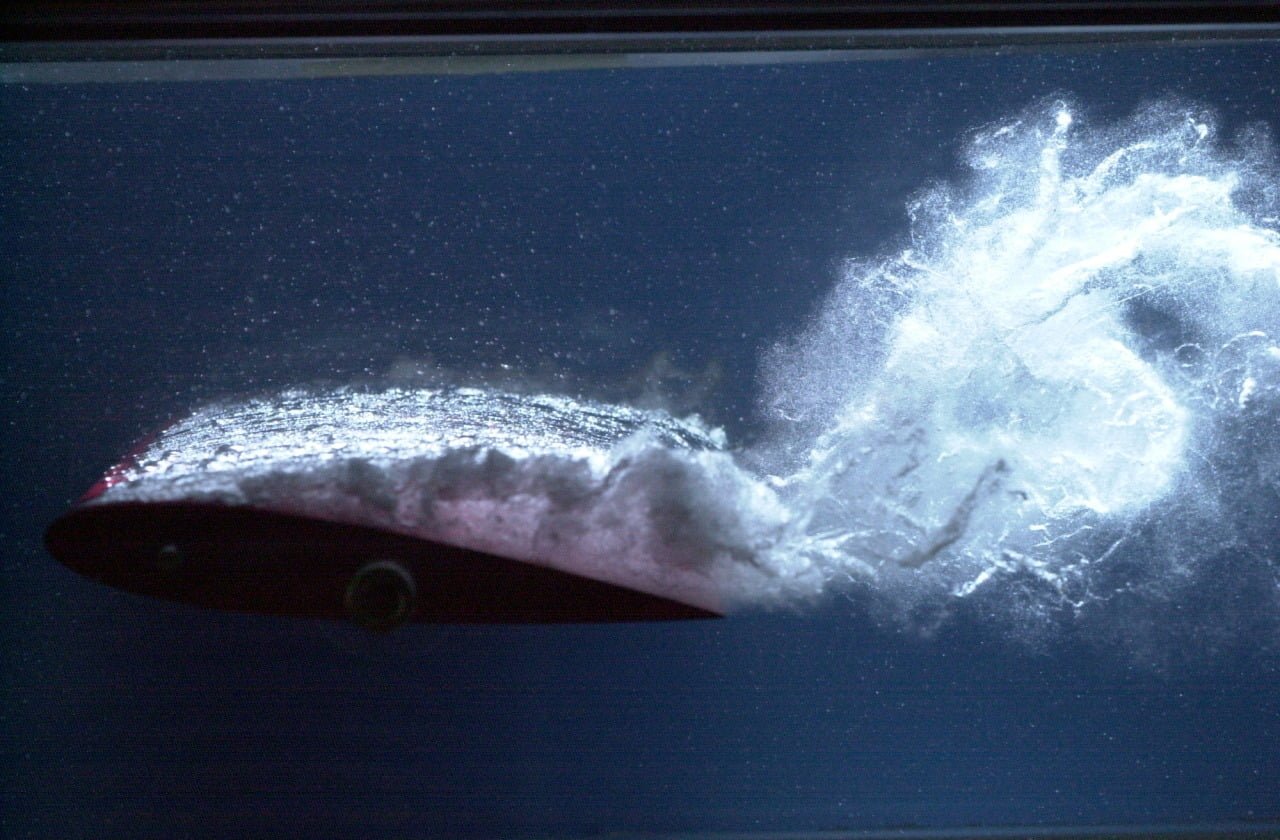
A cavitation-induced bubbly sheet flows over the upper surface of a hydrofoil in the image above. Cavitation can occur when local pressure in a liquid drops below the vapor pressure, causing a cavity to form. Due to its angle of attack, water flowing over the upper surface of the hydrofoil is accelerated. The high flow velocities and accompanying low pressures over the top of the hydrofoil produce cavitation bubbles which continue to flow over and off the surface. Because cavitation bubbles implode when the pressure again increases, they can cause serious damage to solid surfaces. This is why generating cavitation can damage propellers or shatter a bottle. (Photo credit: R. Arndt et al.)
Why Do Joints Pop?
Joint popping is one of those things some people revel in and others detest. What you may not have realized, though, is that fluid dynamics are responsible for the sound. Joints contain a non-Newtonian liquid called synovial fluid to lubricate them. When you manipulate the joint to stretch it, pressure in the fluid drops and gases dissolved in the synovial fluid are released, forming a cavitation bubble. The creation and collapse of this bubble are what cause the audible popping. (Video credit: SciShow)
4th Birthday: Mantis Shrimp
Undoubtedly one of the most mind-boggling instances of fluid dynamics I’ve learned about in writing FYFD is that of sonoluminescence – an effect in which light is produced from imploding cavitation bubbles. In a laboratory, the effect is usually initiated with acoustic waves. A bubble can be forced to oscillate and collapse periodically when forced by the sound. During the collapse, the vapor inside the bubble reaches temperatures of the order of thousands of Kelvin, and light is produced. What is far more wild, though, is that the effect occurs in nature as well. Both the pistol shrimp and the mantis shrimp produce the effect. As shown in the video above, the mantis shrimp swings its club-like arm with such speed that the local pressure drops below the vapor pressure, causing a cavitation bubble to form and sonoluminescence to occur. Some real Mortal Kombat finishing move s&#% there, indeed. (Video credit: Z. Frank)
Steam Hammer
The steam hammer phenomenon–and the closely related water hammer one–is a violent behavior that occurs in two-phase flows. Nick Moore has a fantastic step-by-step explanation of the physics, accompanied by high-speed footage, in the video above. Pressure and temperature are driving forces in the effect, beginning with the high-temperature steam that first draws the water up into the bottle. As the steam condenses into the cooler water, the steam’s pressure drops, drawing in more water. Eventually it drops low enough that the incoming water drops below the vapor pressure. This triggers some very sudden thermodynamic changes. The drop in pressure vaporizes incoming water, but the subsequent cloud cools rapidly, which causes it to condense but also drops the pressure further. Water pours in violently, cavitating near the mouth of the bottle because the acceleration there drops the local pressure below the vapor pressure again. The end result is a flow that’s part-water, part-vapor and full of rapid changes in pressure and phase. As you might imagine, the forces generated can destroy whatever container the fluids are in. Be sure to check out Nick’s bonus high-speed footage to appreciate every stage of the phenomenon. (Video credit and submission: N. Moore)
Cavitation in a Bottle
This high-speed video shows the cavitation that occurs when a bottle of water is struck. The impact accelerates the bottle downward, generating localized vacuums between the glass and the liquid. These are cavitation bubbles, which expand until the pressure of the water surrounding them is too great. This outside pressure triggers an implosion of the bubble, which collapses until the pressure within the bubble makes it expand again. These rapid oscillations in pressure can often shatter the glass bottle. Cavitation can also generate extremely high temperatures and even trigger luminescence. It’s used by both pistol shrimp and mantis shrimp to hunt their prey. (Video credit: P. Taylor)

Fluids Round-up – 11 January 2014
It’s a big fluids round-up today, so let’s get right to it.
- Over at txchnologist, there’s a great article on controlling combustion instabilities in rocket engines with sound.
- Quanta Magazine asks if knot theory can help unravel turbulence. (submitted by iamaponyrocket)
- SciAm takes a look at how FIFA finally got their aerodynamics right so that their video game football (soccer) balls fly correctly.
- The Smithsonian considers an important question: can you fry foods in space?
- The Navy unveiled a fantastic new facility for simulating ocean waves (via J. Ouellette)
- At SciAm, there’s a nice explanation of the polar vortex and its effects on recent freezing weather. For additional background, check out this excerpt from a presentation by meteorology professor Jennifer Francis. (via Nicholas Travers)
- Cold weather also brings a host of new viral videos; NatGeo explains some of the science behind instant snow, ice fog, and frozen bubbles. See also: our own explanation of the instant snow phenomenon.
- io9 looks at the physics of knuckleballs.
- Over at Wired, Rhett Allain questions whether dwarves should stand in floating barrels. Also on the subject of The Hobbit, here’s an analysis of fire-breathing in dragons.
- At SciAm, Kyle Hill explains how inertia lets one pour a drink toward the sky.
- SciAm reports on a manufacturing process for superhydrophobic paper.
- I don’t know what banking has to do with a pool of non-Newtonian fluids, but this Malaysian ad sure makes it look fun. (via physicsphysics and jmlinhart)
- Wired has a great write-up on the mantis shrimp, which kills its prey with cavitation.
- io9 tackles explaining one of the most vexing brain teasers in fluid dynamics, the Feynman sprinkler.
- Finally, today’s lead image comes from our friends at Think Elephants, who study elephant intelligence over in Thailand and occasionally capture the animals’ mastery of fluid dynamics. Be sure to check them out and follow them on Twitter and Facebook.
(Photo credit: Think Elephants International/R. Shoer)