Birds can be incredibly clever about using their surroundings to enhance their flight. Pelicans will even surf! As a line of waves rolls toward shore, it pushes a small updraft ahead of it – just like a line of mountains creates a windy updraft. Pelicans save energy by riding the updraft just like a surfer would ride the swell. Once the wave breaks, the air and water become turbulent and less useful, so the pelican cuts away to find his next ride. (Image and submission credit: N. Yarvin, source)
Tag: birds

The Seabird That Can’t Get Wet
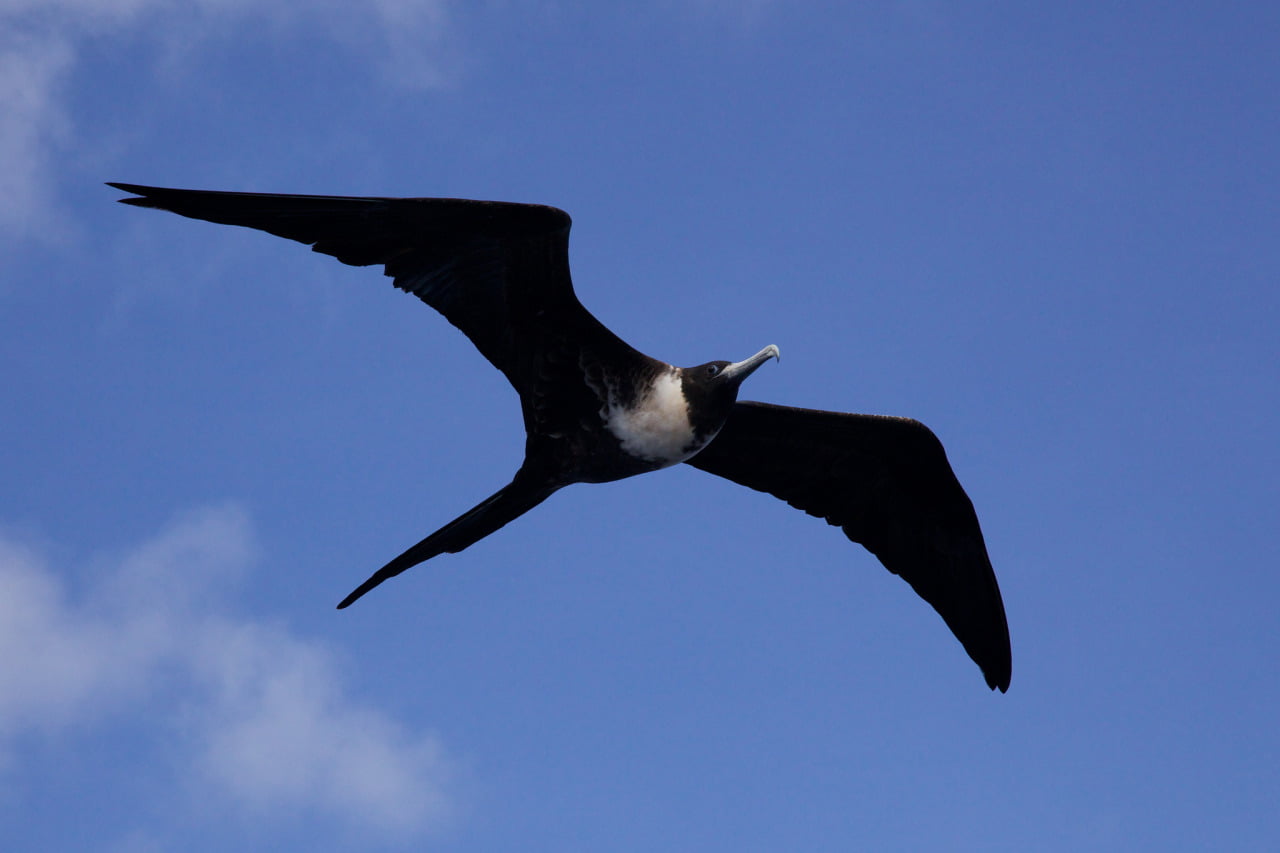
Unlike most seabirds, the frigatebird does not have waterproof feathers. Landing in the water during a transoceanic flight would quickly drown the bird, so instead they stay aloft. But until recently, scientists did not realize just how adept the birds are. Studying tagged frigatebirds in flight, researchers found that the birds could reach altitudes of 4000 meters and that they could soar without flapping for up to 64 kilometers! They achieve these heights by seeking out clouds, which mark strong atmospheric updrafts. The birds ride these thermals up to the cloud tops – well into freezing conditions – and then glide slowly back down.
Their bodies are impressively built for slow glides. Frigatebirds boast a low body weight for their large wing area. This ratio is known as wing loading, and it’s a fundamental characteristic of any flier, avian or otherwise. Low wing loading is key to gliding longer because it reduces the speed at which a glider loses altitude. (Image credit: D. Brossard; research credit: H. Weimarskirch et al.; via @skunkbear)

Flying in Cramped Quarters
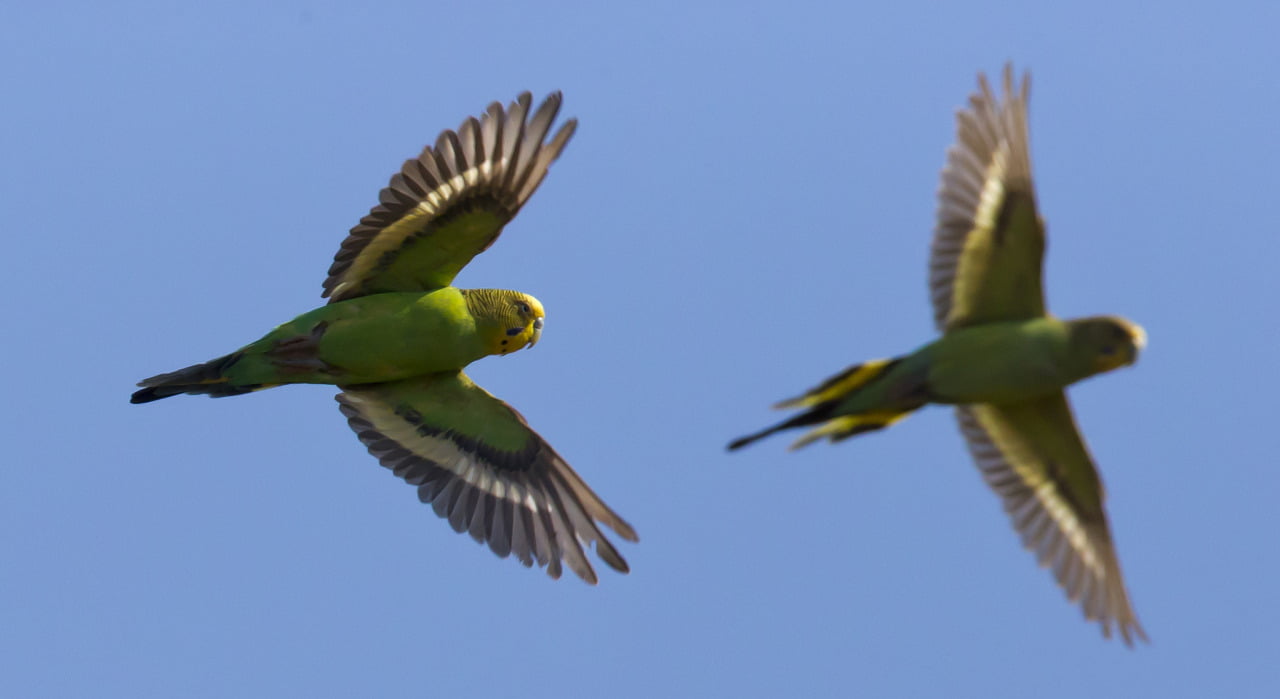
A new study has found that budgerigars (also commonly known as parakeets or budgies) fly at only two distinct speeds. The researchers flew the birds in a tapered tunnel to see how they navigated in response to widening or narrowing paths. What they found, regardless of the flight direction in the tunnel, is that the birds fly at approximately 9.5 m/s in areas wider than 2.5 times their wingspan and drop suddenly to a speed about half that when in narrower areas. The higher speed falls within the bird’s most energy-efficient range, suggesting that the birds may prefer flying at this condition. Insects like bumblebees also change speeds when entering cluttered environments, but the insects do so gradually, not suddenly like the budgerigars. The reason for this difference is not yet known, but it could relate to how the animals sense their environment or to differences in their flight efficiency when varying speed. (Image credit: J. Bendon; research credit: I. Schiffner and M. Srinivasan; submitted by Marc A.; h/t to Irmgard B.)

Fluttering Feathers
Birds do not always vocalize in order to make their songs. The male African broadbill, shown in the top video above, makes a very distinctive brreeeet in its flight displays, but as newly published research shows, the sound comes from its wings, not its voice. During the display, the broadbill spreads its primary feathers and sound is produced on the downstroke, when wingtip speeds reach about 16 m/s. By filming a broadbill wing with a high-speed camera in a wind tunnel at comparable air speeds, researchers could localize the sound production to the 6th and 7th primary feathers.
In the second video above, you can see these feathers twisting and fluttering in the breeze. This is an example of aeroelastic flutter, a phenomenon in which aerodynamic and structural forces couple to induce oscillations. The same phenomenon famously caused the collapse of the Tacoma Narrows Bridge in 1940. In the birds, however, the flutter is non-destructive and the vibration produces audible sound which the other feathers modulate into the calls we hear. Broadbills aren’t the only birds to use this trick; some species of hummingbirds use flutter in their tail feathers during mating displays. (Video, image, and research credits: C. Clark et al.; additional videos here)

Grebe Rushing Physics
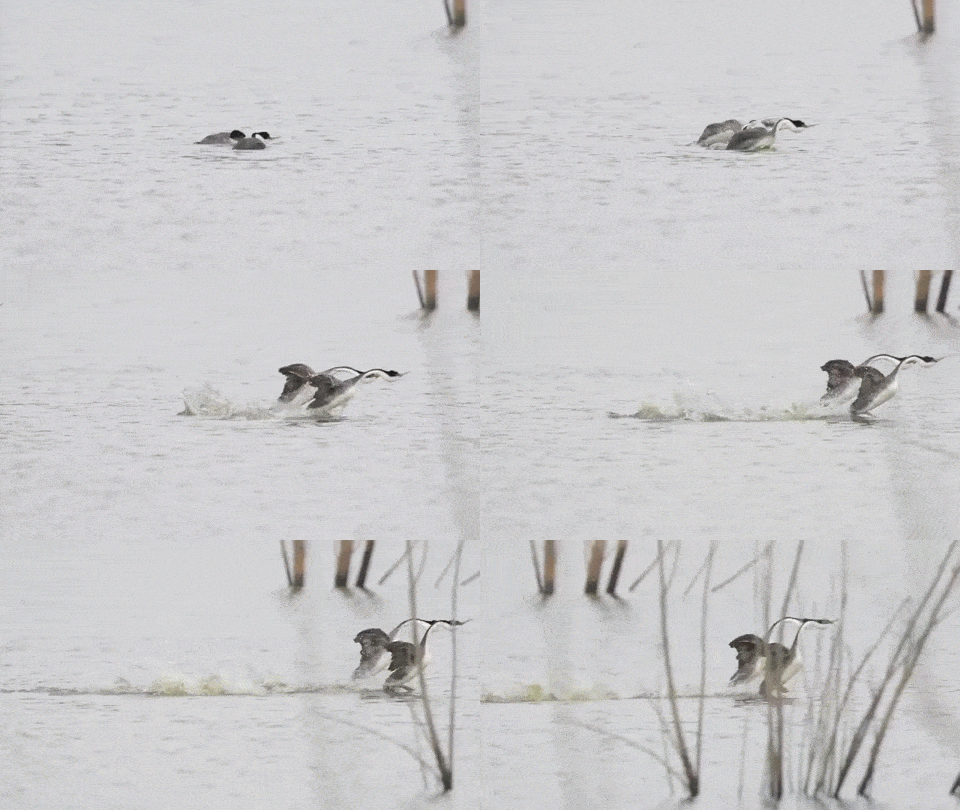
As capable a water-runner as the common basilisk is, the western and Clark’s grebe is even more impressive. Not only do these birds weigh up to three times as much as an adult basilisk, but they start their water-walking from inside the water, which requires overcoming much more hydrodynamic force.
Like the lizards, grebes must slap the water with their feet to generate upward forces capable of supporting their weight above water. The birds take as many as 20 steps a second – an incredible and unmatched stride rate for a creature their size. Their feet impact the water at up at 4.5 m/s, which generates an impulse equivalent to 30-55% of the grebe’s weight. The rest of the necessary impulse comes from the stroke phase, where the bird pushes its foot down against the water.
When retracting its foot, the grebe extracts the foot with a sideways motion through the water – unlike the basilisk which pulls its foot out through the air cavity its stroke created. In order to reduce drag, the grebe’s foot collapses into a more streamlined shape as it gets pulled from the water, letting the bird set up for the next step. (Image/video credit: B. Struck, source; research credit: G. Clifton et al.)
This week FYFD is exploring the physics of walking on water, all leading up to a special webcast on March 5th with guests from The Splash Lab. The live webcast will be open to all FYFD patrons, so be sure to sign up if you want to tune in.
Perching Physics
Compared to birds, manmade aircraft tend to be quite limited and inelegant. Fixed-wing aircraft, for example, require long, flat areas for take-off and landing, whereas birds of all sizes are adept at maneuvers like perching. This video examines the perching behaviors of large birds and extends the physics to a small unmanned aerial vehicle (UAV). As a bird approaches a perching location, it pitches its body and wings upward. This places the bird in what’s known as deep stall, where air flowing over the upper surface of the wing separates just after the leading edge. This move dramatically increases drag on the bird, slowing it for landing. At the same time, the speed of the pitch maneuver generates a vortex on the wing that helps the bird maintain lift despite the drop in speed. With the help of both forces, the bird can make a graceful, controlled landing in only a short distance. (Video credit: J. Mitchell et. al.)
Falcon vs. Raven
Earth Unplugged has posted some great high-speed footage of a peregrine falcon and a raven in flight. Notice how both birds draw their wings inward and back on the upstroke. By doing so, they decrease their drag and thus the energy necessary for flapping. On the downstroke, they extend their wings fully and increase their angle of attack, creating not only lift but thrust. The falcon boasts an incredibly streamlined shape, not only along its body but also along its wings. In contrast, the raven has broader wings with large primary feathers that fan out near the tips. Splaying these large feathers out decreases the strength of the bird’s wingtip vortices, thereby reducing downwash and increasing lift, much the same way winglets do on planes. That extra lift and control the big primaries provide is important for the raven’s acrobatic skill. (Video credit: Earth Unplugged; via io9)

Turning Sound Into Imagery




The acoustic signatures of many animals contain features we humans cannot appreciate, given the limited range of frequencies we can hear. In fluid dynamics and many other fields, scientists and engineers have to find ways to analyze and decompose time-series data–like acoustic pressure signals–into useful quantities. Mark Fischer uses one tool for such analysis, a wavelet transform, to turn the calls of whales, birds, and insects into the colorful snapshots seen here. Wavelet transforms are somewhat similar to Fourier transforms but represent a signal with a series of wavelets rather than sinusoids. They’re also widely used for data compression. (Image credits: M. Fischer/Aguasonic Acoustics; via DailyMail)
Hummingbirds Singing with their Tail Feathers
Aeroelastic flutter occurs when fluid mechanical forces and structural forces get coupled together, one feeding the other. Usually, we think of it as a destructive mechanism, but, for hummingbirds, it’s part of courtship. When a male hummingbird looks to attract a mate, he’ll climb and dive, flaring his tail feathers one or more times. As he does so, air flow over the feathers causes them to vibrate and produce noise. Researchers studied such tail feathers in a wind tunnel, finding a variety of vibrational behaviors, including a tendency for constructive interference–in other words two feathers vibrating in proximity is much louder than either individually. For more, check out the original Science article or the write-up at phys.org. (Video credit: C. Clark et al.)

Evolving Flight
Flapping wings while running may have helped the evolutionary ancestors of birds develop flight. Experiments with modern birds show that flapping wings while running helps even flight-capable birds ascend slopes and uses only 10% as much power as actual flight along a 65-degree incline. #