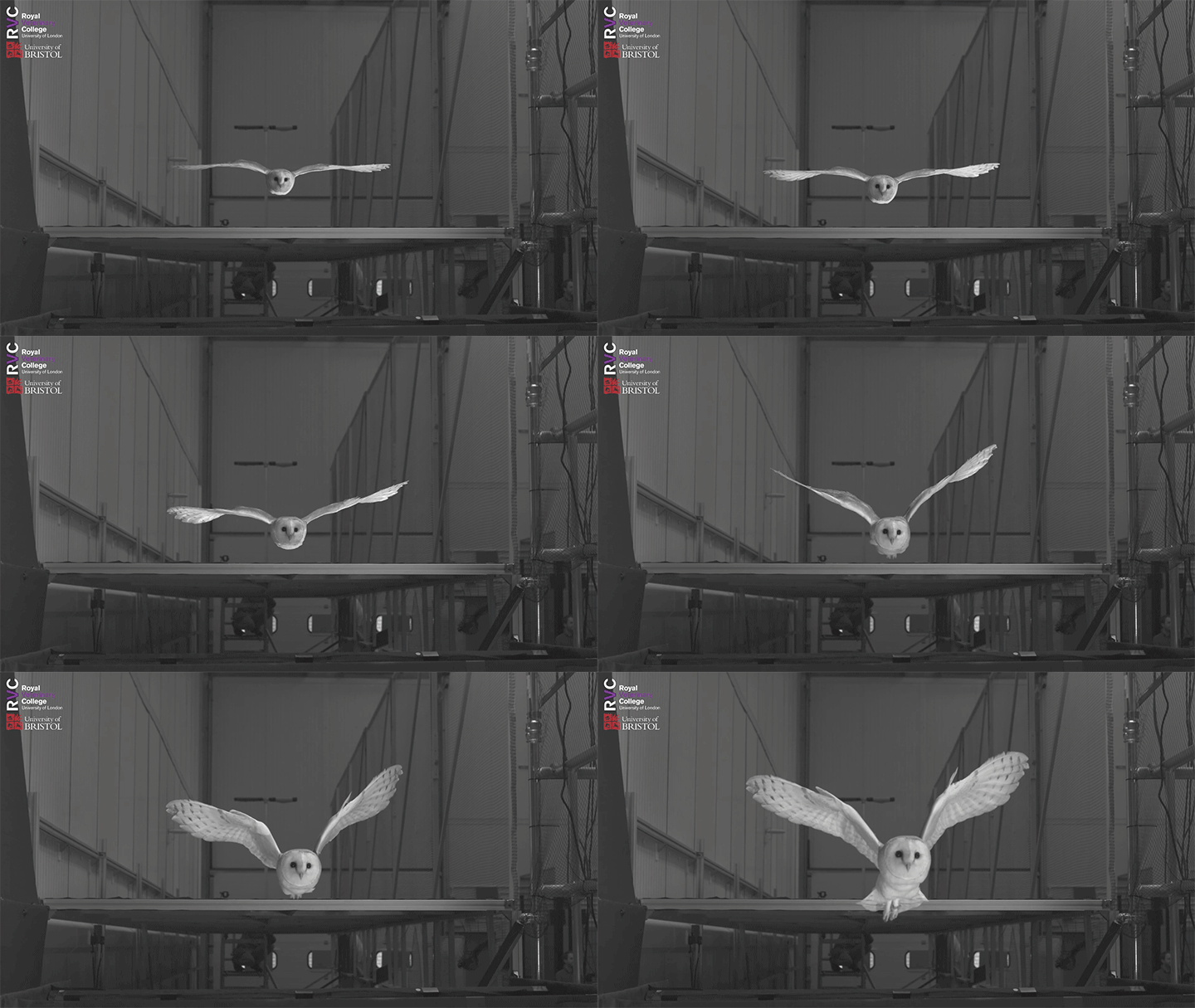
In flight, birds must adjust quickly to wind gusts or risk crashing. Research shows that the structure of birds’ wings enables them to respond faster than their brains can. The wings essentially act like a suspension system, with the shoulder joint allowing them to lift rapidly in response to vertical gusts. This motion keeps the bird’s head and torso steady, so they can focus on more complex tasks like landing, obstacle avoidance, and prey capture. (Image and research credit: J. Cheney et al.; submitted by Kam-Yung Soh)
Tag: birds

The Best of FYFD 2020

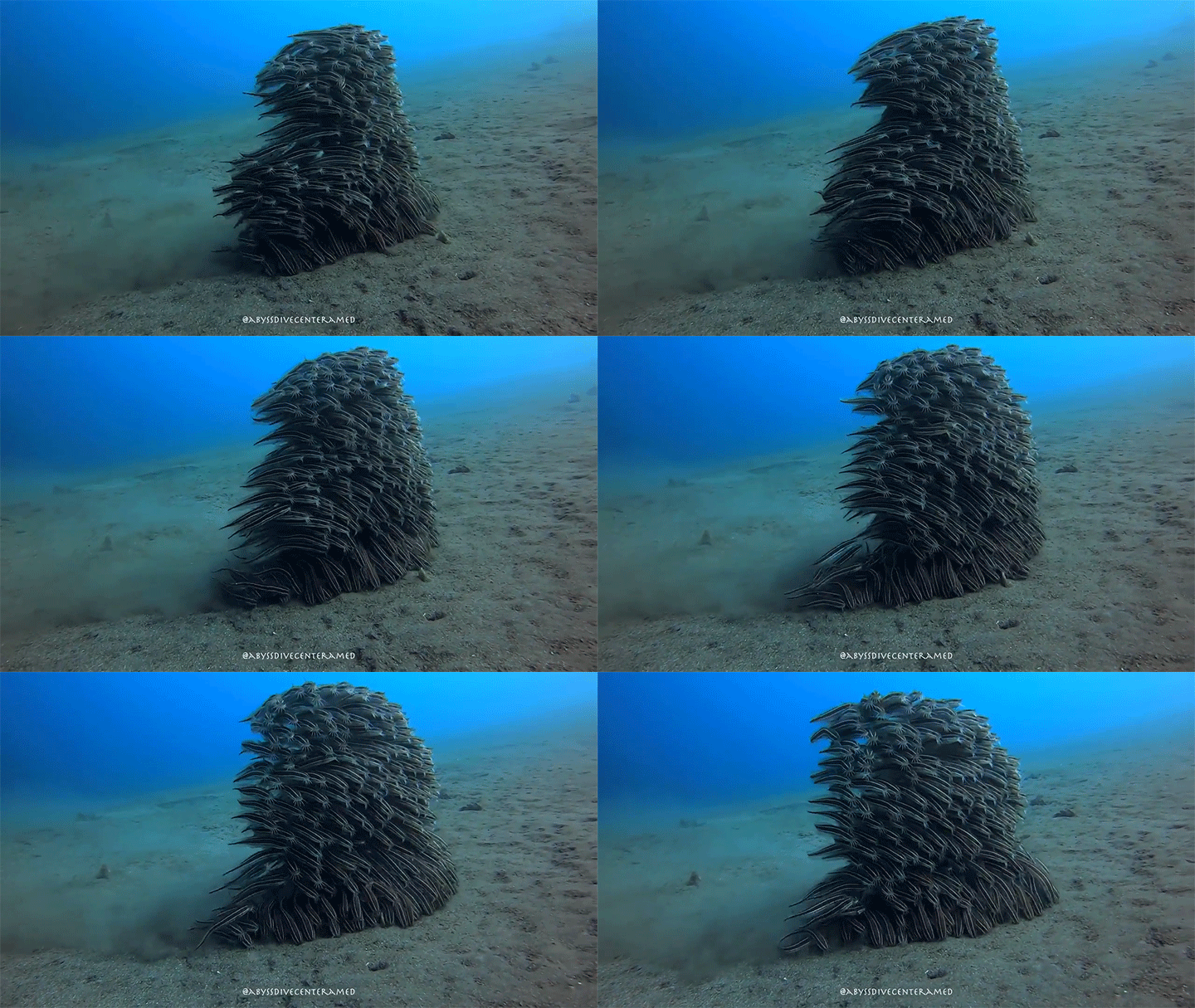


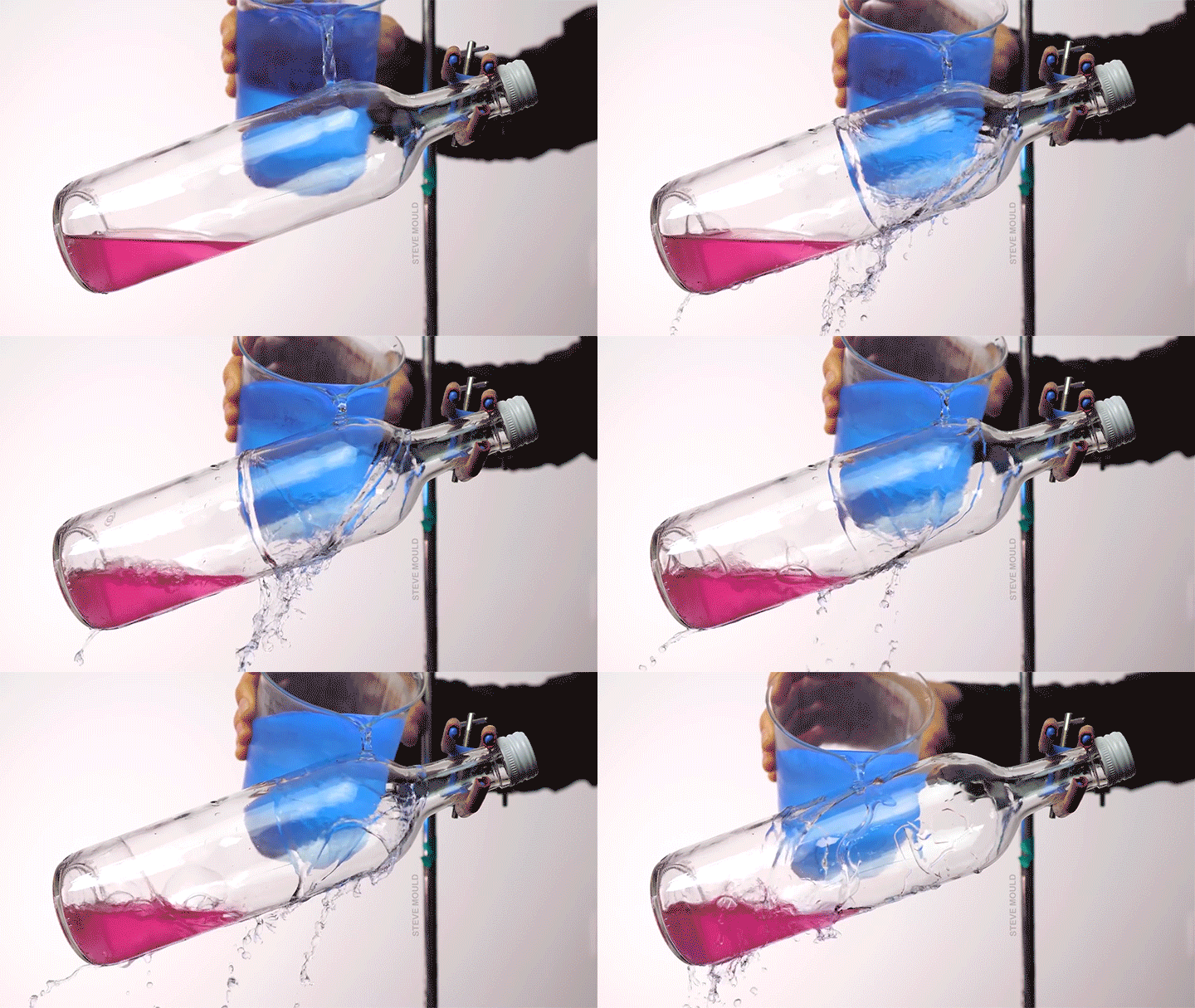


2020 was certainly a strange year, and I confess that I mostly want to congratulate all of us for making it through and then look forward to a better, happier, healthier 2021. But for tradition and posterity’s sake, here were your top FYFD posts of 2020:
- Juvenile catfish collectively convect for protection
- Gliding birds get extra lift from their tails
- How well do masks work?
- Droplets dig into hot powder
- Updating undergraduate heat transfer
- Branching light in soap bubbles
- Boiling water using ice water
- Concentric patterns on freezing and thawing ice
- Bouncing off superhydrophobic defects
- To beat surface tension, tadpoles blow bubbles
There’s a good mix of topics here! A little bit of biophysics, some research, some phenomena, and some good, old-fashioned fluid dynamics.
If you enjoy FYFD, please remember that it’s primarily reader-supported. You can help support the site by becoming a patron, making a one-time donation, buying some merch, or simply by sharing on social media. Happy New Year!
(Image credits: catfish – Abyss Dive Center, owl – J. Usherwood et al., masks – It’s Okay to Be Smart, droplet – C. Kalelkar and H. Sai, boundary layer – J. Lienhard, bubble – A. Patsyk et al., boiling – S. Mould, ice – D. Spitzer, defects – The Lutetium Project, tadpoles – K. Schwenk and J. Phillips)

Audubon Photography Awards


Several of this year’s Audubon-Photography-Award-winning photos feature birds interacting with fluids. The Grand Prize Winner, by Joanna Lentini, features a diving double-crested cormorant. Like many other species, these cormorants launch themselves into shallow waters from above and endure some incredible forces to do so. They’re no slackers underwater, either; when I encountered a flightless cormorant while snorkeling in the Galapagos, it outswam me in an instant.
The other prize winners above are a little more splashy. The American dipper’s splash curtain comes from sticking its head underwater in search of prey. The Anna’s hummingbird seen in the last image is playing in the spray of a fountain and showing off its aerial agility while doing so! (Image credits: cormorant – J. Lentini, dipper – M. Fuller-Morris, hummingbird – B. Ghosh; via DPReview; submitted by Kam-Yung Soh)

How Animals Stay Dry in the Rain


Getting wet can be a problem for many animals. A wet insect could quickly become too heavy to fly, and a wet bird can struggle to stay warm. But these animals have a secret weapon: tiny, multi-scale roughness on their wings, scales, and feathers that helps them shed water. Watch the latest FYFD video to learn how! (Image and video credit: N. Sharp; research credit: S. Kim et al.)
Gliding Birds Get Extra Lift From Their Tails


Gorgeous new research highlights some of the differences between fixed-wing flight and birds. Researchers trained a barn owl, tawny owl, and goshawk to glide through a cloud of helium-filled bubbles illuminated by a light sheet. By tracking bubbles’ movement after the birds’ passage, researchers could reconstruct the wake of these flyers.
As you can see in the animations above and the video below, the birds shed distinctive wingtip vortices similar to those seen behind aircraft. But if you look closely, you’ll see a second set of vortices, shed from the birds’ tails. This is decidedly different from aircraft, which actually generate negative lift with their tails in order to stabilize themselves.
Instead, gliding birds generate extra lift with their maneuverable tails, using them more like a pilot uses wing flaps during approach and landing. Unlike airplanes, though, birds rely on this mechanism for more than avoiding stall. It seems their tails actually help reduce their overall drag! (Image and research credit: J. Usherwood et al.; video credit: Nature News; submitted by Jorn C. and Kam-Yung Soh)
Morphing Wings Using Real Feathers


Although humanity has long been inspired by bird flight, most of our flying machines are nothing like birds. Engineers have struggled to recreate the ease with which birds are able to morph their wings’ characteristics as they change from one shape to another. Now researchers have built a biohybrid robot, PigeonBot, that uses actual pigeon feathers as part of its morphing design.
Many species of birds, including pigeons, have Velcro-like hooks in the microstructure of their feathers. These hooks help the flight feathers stick to one another and create a continuous wing surface that air cannot easily slip through, even as the wing drastically changes shape. By using actual feathers, PigeonBot shares this advantage.
PigeonBot also has a somewhat minimalist design in its articulation, using only a wrist and finger joint in each wing to control shape. The feathers are connected through an elastic ligament, which — along with their microstructure — allows them to smoothly change shape under aerodynamic loads. The end result is a remarkably capable and agile biorobot researchers can use to better understand how birds control their flight. (Image and research credit: L. Matloff et al. and E. Chang et al.; via NPR and Gizmodo)

The Best of FYFD 2019


2019 was an even busier year than last year! I spent nearly two whole months traveling for business, gave 13 invited talks and workshops, and produced three FYFD videos. I also published more than 250 blog posts and migrated all 2400+ of them to a new site. And, according to you, here are the top 10 FYFD posts of the year:
- The perfect conditions make birdsong visible
- Pigeons are impressive fliers
- The water anole’s clever method of breathing underwater
- 100 years ago, Boston was flooded with molasses
- The BZ reaction is some of nature’s most beautiful chemistry
- The labyrinthine dance of ferrofluid
- 360-degree splashes
- The extraordinary flight of dandelion seeds
- Dye shows what happens beneath a wave
- Bees do the wave to frighten off predators
Nature makes a strong showing in this year’s top posts with five biophysics topics. FYFD videos also had a good year: both my Boston Molasses Flood video and dandelion flight video made the top 10!
If you’d like to see more great posts like these, please remember that FYFD is primarily supported by readers like you. You can help support the site by becoming a patron, making a one-time donation, or buying some merch. Happy New Year!
(Image credits: birdsong – K. Swoboda; pigeon take-off – BBC Earth; water anole – L. Swierk; Boston molasses flood – Boston Public Library; BZ reaction – Beauty of Science; ferrofluid – M. Zahn and C. Lorenz; splashes – Macro Room; dandelion – N. Sharp; dyed wave – S. Morris; bees – Beekeeping International)

“Ornitographies”


If birds left trails in the sky, what would they look like? This is the question that haunted photographer Xavi Bou and inspired him to create his “Ornitographies” series. Using video of birds in flight, he combines frames to construct these snapshots of flight. In them, birds become streaklines feathered with wingbeats.
I love how the technique highlights the patterns of flapping flight. A bird flying steadily over a lake becomes a wavy line with consistent, perfectly matched up- and downstrokes, whereas a bird just taking off has short, fast wingbeats that slowly lengthen and steady out as the bird gets aloft. Flocks of birds turn into a tornado of swirling lines as they land or take-off en mass. (Image credit: X. Bou; via Flow Vis)
Seeing the Song
We can’t always see the flows around us, but that doesn’t mean they’re not there. Audobon Photography Award winner Kathrin Swaboda waited for a cold morning to catch this spectacular photo of a red-winged blackbird’s song. In the morning chill, moisture from the bird’s breath condensed inside the vortex rings it emitted, giving us a glimpse of its sound. (Image credit: K. Swaboda; via Gizmodo; submitted by Joseph S and Stuart H)
Pigeon Flutter
Birds are well-known for their vocalizations, but this isn’t their only way to produce noise. A new study on crested pigeons finds that the birds’ wings produce distinctive high and low notes during take-off. A low note takes place during each upstroke, and a high note is heard during the downstroke. A major source of the noise is the highly modified P8 feather. When airflow over the feather is fast enough, it sets off twisting and torsion in the feather through aeroelastic flutter. It’s this vibration that causes the noise. By playing back the notes at different speeds, researchers found that the crested pigeons use the notes’ timing as an alarm. When the cycle of high and low repeats in quick succession, they respond by taking off to escape the perceived danger.
Other bird species are also known to use aeroelastic flutter to make noise. Check out these hummingbirds, which use flutter in their mating displays. (Video credit: Science; research credit: T. Murray et al.)


