Krill and other tiny marine zooplankton make daily migrations to and from the ocean surface. Previously, models of ocean mixing ignored these migrations; these animals are tiny, researchers argued, so any effects they could have would be too small to matter. But zooplankton make these migrations in huge swarms, and studies of a laboratory analog of their migrations (using brine shrimp rather than krill) reveal that, when moving en masse, these tiny swimmers create turbulent jets and eddies far larger than an individual. Their collective motion is enough to mix salty water layers 1000 times faster than molecular diffusion alone! Learn more in the latest FYFD video, embedded below. (Image and video credit: N. Sharp; research credit: I. Houghton et al.; h/t to Kam-Yung Soh)
Tag: biology

“Flowers and Colors”


Many children have done the simple experiment of placing a cut flower in dyed water and watching as it changed color. The latest video from Beauty of Science relies on some related physics. Since the color of flowers typically depends on acidity, immersing a flower in dilute acid will change its color from pinks and purples to yellows and greens. Watching this transformation, we can learn about how fluids get transported through flowers.
Like the leaves on a tree, flowers are covered in tiny cells called stomata that can open and close. In the daytime, stomata are typically open to allow carbon dioxide to diffuse into the plant. (At the same time, water pulled up from the roots is evaporating out the stomata, as seen previously.) Once immersed in acid, the open stomata are no longer bringing in carbon dioxide; instead, the acid is diffusing in and slowly spreading through the petals. In the timelapse video, some areas of the petal change faster than others. This could indicate more open stomata in the regions that change first or even that some areas inside the petal transport water (and acid) better than others. (Video and image credit: Beauty of Science; see also Making Of)

What Makes Joints Pop?
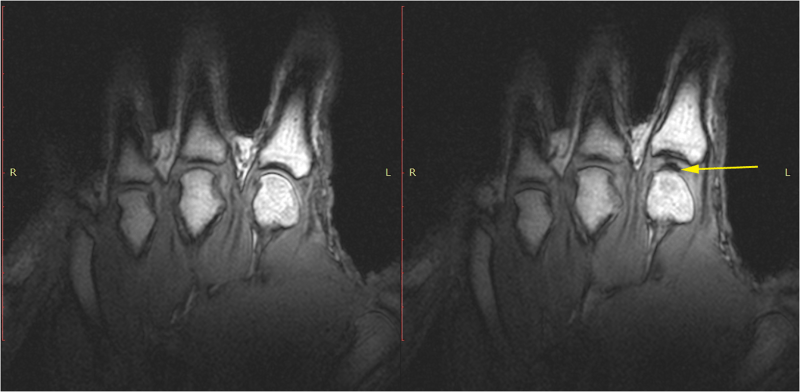
Cracking one’s knuckles produces an unmistakable popping noise that satisfies some and disconcerts others. The question of what exactly causes the popping noise has persisted for more than fifty years. It’s generally agreed that separating the two sides of a joint causes low enough pressures to form a cavitation bubble in the sinovial fluid of the joint. But researchers have been divided on whether it’s the formation or the collapse of this bubble that’s responsible for the sound. Studying the phenomenon firsthand is difficult with today’s imaging technologies – none of them are fast enough to capture a behavior that takes only 300 milliseconds. As a result, scientists are turning to mathematical modeling and numerical simulation.
A recent study tackled the problem by modeling a joint that already contains a bubble and examining the bubble’s response to changes in pressure inside the joint. The pressure changes alter the bubble’s size and cause it to generate sound. When compared to experiments of people cracking their knuckles, the simulated sounds are remarkably similar in both amplitude and frequency. It’s not even necessary for the bubble to collapse completely to make the noise. Just a partial collapse is enough to sound just like that old, familiar pop. (Image credit: G. Kawchuk et al.; research credit: V. Chandran Suja and A. Barakat; via Gizmodo)

How Trees Pull Water
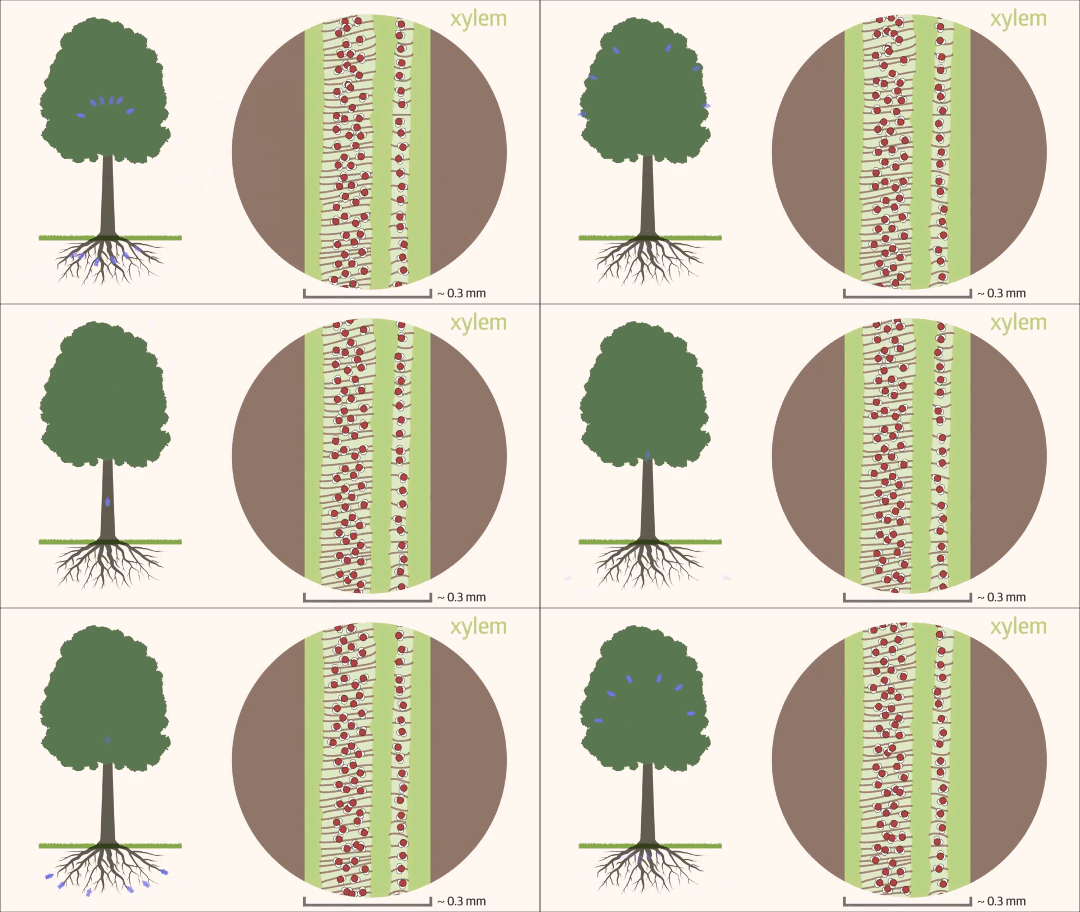


Trees are incredible organisms, and the physics behind them baffled scientists until relatively recently. Inside trees, there is a constant flow of water up from the roots, through the xylem and out the leaves. We often think of atmospheric pressure and capillary action as the mechanisms for pushing water up against the force of gravity, but this is not how trees work. Instead, the evaporation of water from the tree’s leaves actually pulls the entire water column up the tree. Water molecules really like sticking to one another, which actually allows them to hold together under this tension.
The result of all this pulling is a negative pressure inside the tree, and, with some clever manipulation, it’s possible to measure just how negative the pressure inside a tree is using a device called a pressure bomb. You can see the whole process in action in the Science IRL video below. The magnitude of a tree’s negative pressure fluctuates over a day, depending on how quickly it’s losing water, but typical values can range from 2-3 atmospheres of negative pressure to 17 or more! To get the equivalent (positive) pressure, you’d have to be nearly 2.7 kilometers under water. (Image and video credit: Science IRL)
Fly Away!
Spiders are often among the first colonists on newly formed volcanic islands. Thanks to their aerial skills, they are able to travel nearly anywhere by ballooning on strands of their own silk. Exactly how spiders as large as 20 milligrams manage this is still relatively known. A new study shows that crab spiders, like any careful aviator, use a foreleg to monitor wind conditions for 5 or more seconds before attempting take-off. The spiders will only spool out ballooning threads if the wind is warm and gentle. Wind speeds higher than 3 meters per second are an automatic no-go. When the spider decides conditions are favorable, they release as many as 60 nanoscale fibers that are several meters in length. The wind catches the silks and lifts them away to their next adventure. (Image credit: Science Magazine, source; research credit: M. Cho et al.)

The Hairyflower Wild Petunia
Dispersing seeds is a challenge when you’re stuck in one spot, but plants have evolved all sorts of mechanisms for it. Some rely on animals to carry their offspring away, others create their own vortex rings. The hairyflower wild petunia turns its fruit into a catapult. As the fruit dries out, layers inside it shrink, building up strain that bends the fruit outward. Once a raindrop strikes it, the pod bursts open, flinging out around twenty tiny, spinning, disk-shaped seeds. That spin is important for flight. The best-launched seeds may spin as quickly as 1600 times in a second, which helps stabilize them in a vertical orientation that minimizes their frontal area and reduces their drag. Researchers found that these vertically spinning seeds have almost half the drag force of a spherical seed of equal volume and density. That means the hairyflower wild petunia is able to spread its seeds much further without a larger investment in seed growth. (Image and research credit: E. Cooper et al., source; via NYTimes; submitted by Kam-Yung Soh)

Hairy Tongues Help Bats Drink
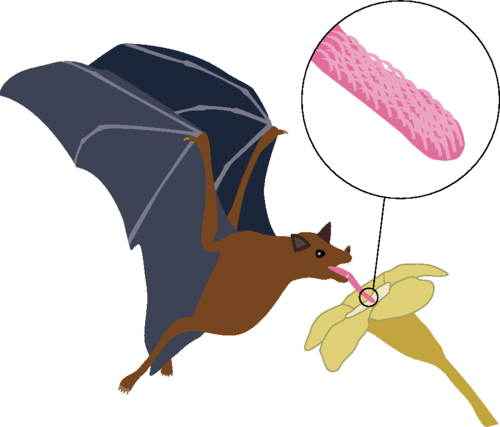
Nectar-drinking bats, honey possums, and honeybees all use hair-like protrusions on their tongues to help them drink. In bats, these papillae have blood vessels that swell when drinking, stiffening the hairs. To investigate this drinking mechanism, researchers built their own version of a bat tongue by fabricating hairy surfaces and testing how well they trapped viscous oil when dipped and withdrawn. Through a combination of experiment and mathematical modeling, the researchers found that the optimal fluid uptake depended on the density of hairs, fluid viscosity, and the withdrawal speed. When they compared their results to actual bats, honey possums, and honeybees, they found that those animals’ tongues have hair densities very close to the predicted optimal value, suggesting that their model is capturing the important physical mechanisms that have driven evolutionary advantages for these species. (Image and research credit: A. Nasto et al.; submitted by Kam-Yung Soh)

Prehistoric CFD
Computational fluid dynamics (CFD) has been a valuable tool in engineering for decades, but its use is spreading to other fields as well. The image to the left shows a reconstruction of Parvancorina, a shield-shaped marine creature that lived some 550 million years ago. Fossil evidence alone cannot tell paleontologists whether this extinct creature could move through the water, and there are no living relatives that resemble the creature that scientists could study as an analogue. Instead, researchers turned to CFD to simulate flow over and around Parvancorina. They found that Parvancorina’s shape caused fast flow over the outer portions of its body and the slowest flow near its mouth. The results suggest that, not only was the creature mobile in the water, but that it was able to adjust its orientation to drive flow to different areas of its body. Paleontologists have only been using CFD for a decade or so, but already it’s giving us valuable insight into the creatures that roamed our planet hundreds of millions of years ago. (Image credit: M. De Stefano/Muse, I. Rahman; via Physics Today)
Jumping Larvae
Gall midge larvae, despite their lack of legs, are prodigious jumpers. These worm-like creatures use hydrostatic pressure to jump more than 30 body lengths. To do so, the larva curls itself into a loop, latching its mouth to its tail. It then shifts the fluids inside its body, flattening itself as the pressure builds. When the larva releases its tail, it flies into the air at about 1 m/s. The human equivalent of a gall midge larva’s jump would be about 60 meters, far beyond the world record long jump of less than 9 meters (with a running start). The larva’s technique is a relatively simple but highly effective one that might be useful in applications like soft robotics. (Video credit: Science; research credit: G. Farley et al.)
Withstanding Windstorms
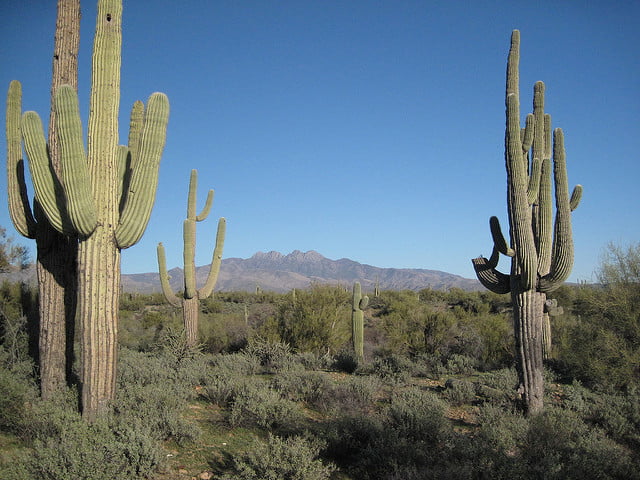
Saguaro cacti can grow 15 meters tall, and despite their shallow root systems can withstand storm winds up to 38 meters per second without being blown over. Grooves in the cacti’s surface may contribute to its resilience, by adding structural support and/or through reducing aerodynamic loads. The latter theory mirrors the concept of dimples on a golf ball; namely, grooves create turbulence in the flow near the cactus, which allows air flow to track further around the cactus before separating. The result is less drag for a given wind speed than a smooth cactus would experience.
Indeed, recent experiments on a grooved cylinder with a pneumatically-controlled shape showed exactly that; the morphable cylinder’s drag was consistently significantly lower than fixed samples. Cacti do change their shapes somewhat as their water content changes, but they don’t have the ability for up-to-the-minute alterations. Nevertheless, their adaptations can inspire engineered creations that morph to reduce wind impact. (Image credit: A. Levine; research credit: M. Guttag and P. Reis)