Dispersing seeds is a challenge when you’re stuck in one spot, but plants have evolved all sorts of mechanisms for it. Some rely on animals to carry their offspring away, others create their own vortex rings. The hairyflower wild petunia turns its fruit into a catapult. As the fruit dries out, layers inside it shrink, building up strain that bends the fruit outward. Once a raindrop strikes it, the pod bursts open, flinging out around twenty tiny, spinning, disk-shaped seeds. That spin is important for flight. The best-launched seeds may spin as quickly as 1600 times in a second, which helps stabilize them in a vertical orientation that minimizes their frontal area and reduces their drag. Researchers found that these vertically spinning seeds have almost half the drag force of a spherical seed of equal volume and density. That means the hairyflower wild petunia is able to spread its seeds much further without a larger investment in seed growth. (Image and research credit: E. Cooper et al., source; via NYTimes; submitted by Kam-Yung Soh)
Tag: biology

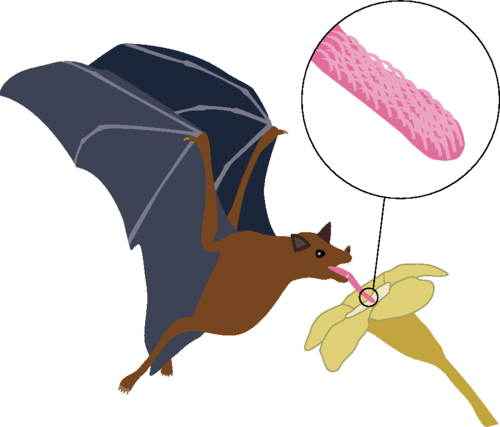
Hairy Tongues Help Bats Drink
Nectar-drinking bats, honey possums, and honeybees all use hair-like protrusions on their tongues to help them drink. In bats, these papillae have blood vessels that swell when drinking, stiffening the hairs. To investigate this drinking mechanism, researchers built their own version of a bat tongue by fabricating hairy surfaces and testing how well they trapped viscous oil when dipped and withdrawn. Through a combination of experiment and mathematical modeling, the researchers found that the optimal fluid uptake depended on the density of hairs, fluid viscosity, and the withdrawal speed. When they compared their results to actual bats, honey possums, and honeybees, they found that those animals’ tongues have hair densities very close to the predicted optimal value, suggesting that their model is capturing the important physical mechanisms that have driven evolutionary advantages for these species. (Image and research credit: A. Nasto et al.; submitted by Kam-Yung Soh)

Prehistoric CFD
Computational fluid dynamics (CFD) has been a valuable tool in engineering for decades, but its use is spreading to other fields as well. The image to the left shows a reconstruction of Parvancorina, a shield-shaped marine creature that lived some 550 million years ago. Fossil evidence alone cannot tell paleontologists whether this extinct creature could move through the water, and there are no living relatives that resemble the creature that scientists could study as an analogue. Instead, researchers turned to CFD to simulate flow over and around Parvancorina. They found that Parvancorina’s shape caused fast flow over the outer portions of its body and the slowest flow near its mouth. The results suggest that, not only was the creature mobile in the water, but that it was able to adjust its orientation to drive flow to different areas of its body. Paleontologists have only been using CFD for a decade or so, but already it’s giving us valuable insight into the creatures that roamed our planet hundreds of millions of years ago. (Image credit: M. De Stefano/Muse, I. Rahman; via Physics Today)

Jumping Larvae
Gall midge larvae, despite their lack of legs, are prodigious jumpers. These worm-like creatures use hydrostatic pressure to jump more than 30 body lengths. To do so, the larva curls itself into a loop, latching its mouth to its tail. It then shifts the fluids inside its body, flattening itself as the pressure builds. When the larva releases its tail, it flies into the air at about 1 m/s. The human equivalent of a gall midge larva’s jump would be about 60 meters, far beyond the world record long jump of less than 9 meters (with a running start). The larva’s technique is a relatively simple but highly effective one that might be useful in applications like soft robotics. (Video credit: Science; research credit: G. Farley et al.)

Withstanding Windstorms
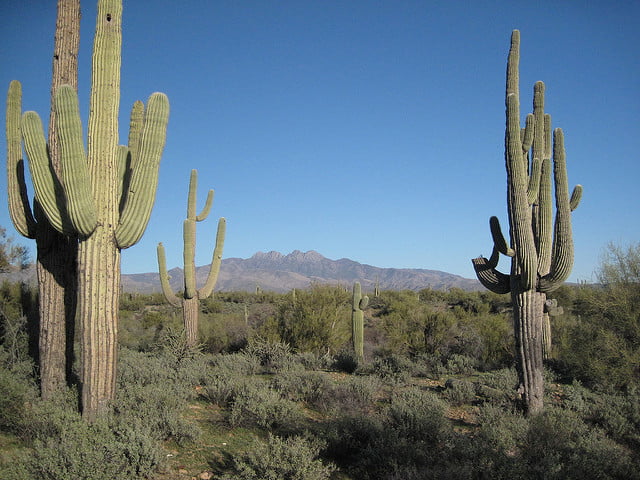
Saguaro cacti can grow 15 meters tall, and despite their shallow root systems can withstand storm winds up to 38 meters per second without being blown over. Grooves in the cacti’s surface may contribute to its resilience, by adding structural support and/or through reducing aerodynamic loads. The latter theory mirrors the concept of dimples on a golf ball; namely, grooves create turbulence in the flow near the cactus, which allows air flow to track further around the cactus before separating. The result is less drag for a given wind speed than a smooth cactus would experience.
Indeed, recent experiments on a grooved cylinder with a pneumatically-controlled shape showed exactly that; the morphable cylinder’s drag was consistently significantly lower than fixed samples. Cacti do change their shapes somewhat as their water content changes, but they don’t have the ability for up-to-the-minute alterations. Nevertheless, their adaptations can inspire engineered creations that morph to reduce wind impact. (Image credit: A. Levine; research credit: M. Guttag and P. Reis)

Gliding Lizards
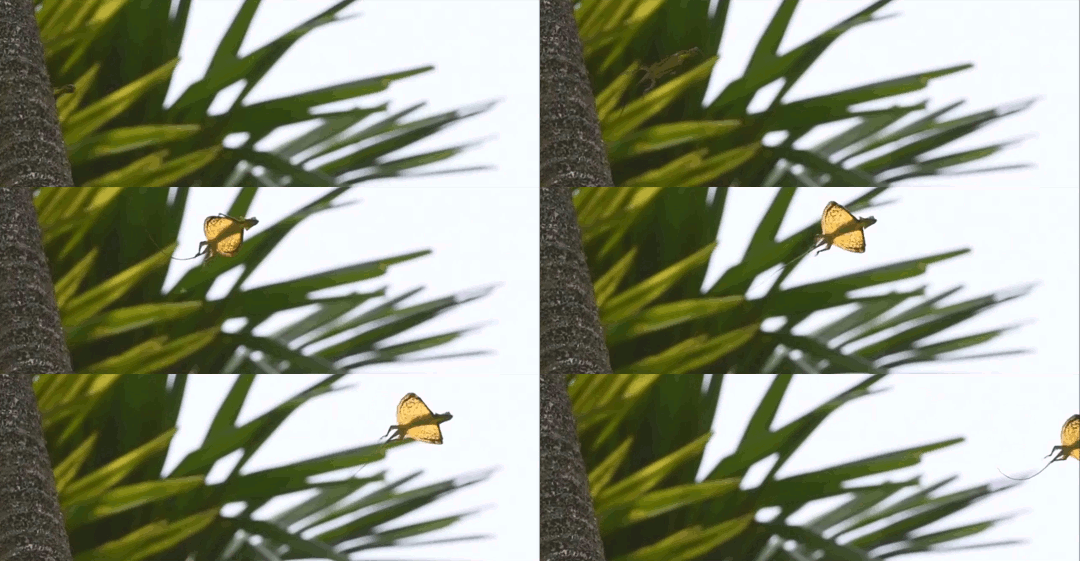
Flying lizards are truly gliders, but that doesn’t mean they’re unsophisticated. Newly reported observations of the species in the wild show that flying lizards don’t simply hold their forelimbs out a la Superman. Instead, they reach back with their forelimbs, pressing their arms into the underside of the thin patagium that serves as their flight surface while rotating their hands to grasp the upper side of the patagium. This forms a composite wing with a thicker leading edge and seems to be how the lizards control their glide. Close observation of their flight shows that, while holding their patagium, the lizards actively arch their backs to camber their composite wing. This can increase their maximum lift coefficient, allowing them to glide longer distances. (Image and research credit: J. Dehling, source)

Flow Inside the Heart
Inside each of us is a remarkable and constant flow, driven by a muscle that’s always at work. As blood circulates through our bodies, it goes through a surprisingly varied journey. In the heart, as seen above, blood flow is very unsteady and quite turbulent, due to the beating pulse of the heart. As valves open and close and the muscle walls constrict and relax, the rushing blood moves in eddy-filled spurts. In the outer reaches of our capillaries, however, the nature of the flow is quite different. Thanks to smaller vessel sizes and other factors, capillary blood flow is much steadier and more laminar. Viscosity becomes more important, as do the non-Newtonian properties of components in our blood. (Image credit: mushin111/YouTube, source; via Science; submitted by Gary N.)
Pigeon Flutter
Birds are well-known for their vocalizations, but this isn’t their only way to produce noise. A new study on crested pigeons finds that the birds’ wings produce distinctive high and low notes during take-off. A low note takes place during each upstroke, and a high note is heard during the downstroke. A major source of the noise is the highly modified P8 feather. When airflow over the feather is fast enough, it sets off twisting and torsion in the feather through aeroelastic flutter. It’s this vibration that causes the noise. By playing back the notes at different speeds, researchers found that the crested pigeons use the notes’ timing as an alarm. When the cycle of high and low repeats in quick succession, they respond by taking off to escape the perceived danger.
Other bird species are also known to use aeroelastic flutter to make noise. Check out these hummingbirds, which use flutter in their mating displays. (Video credit: Science; research credit: T. Murray et al.)

Schooling Together
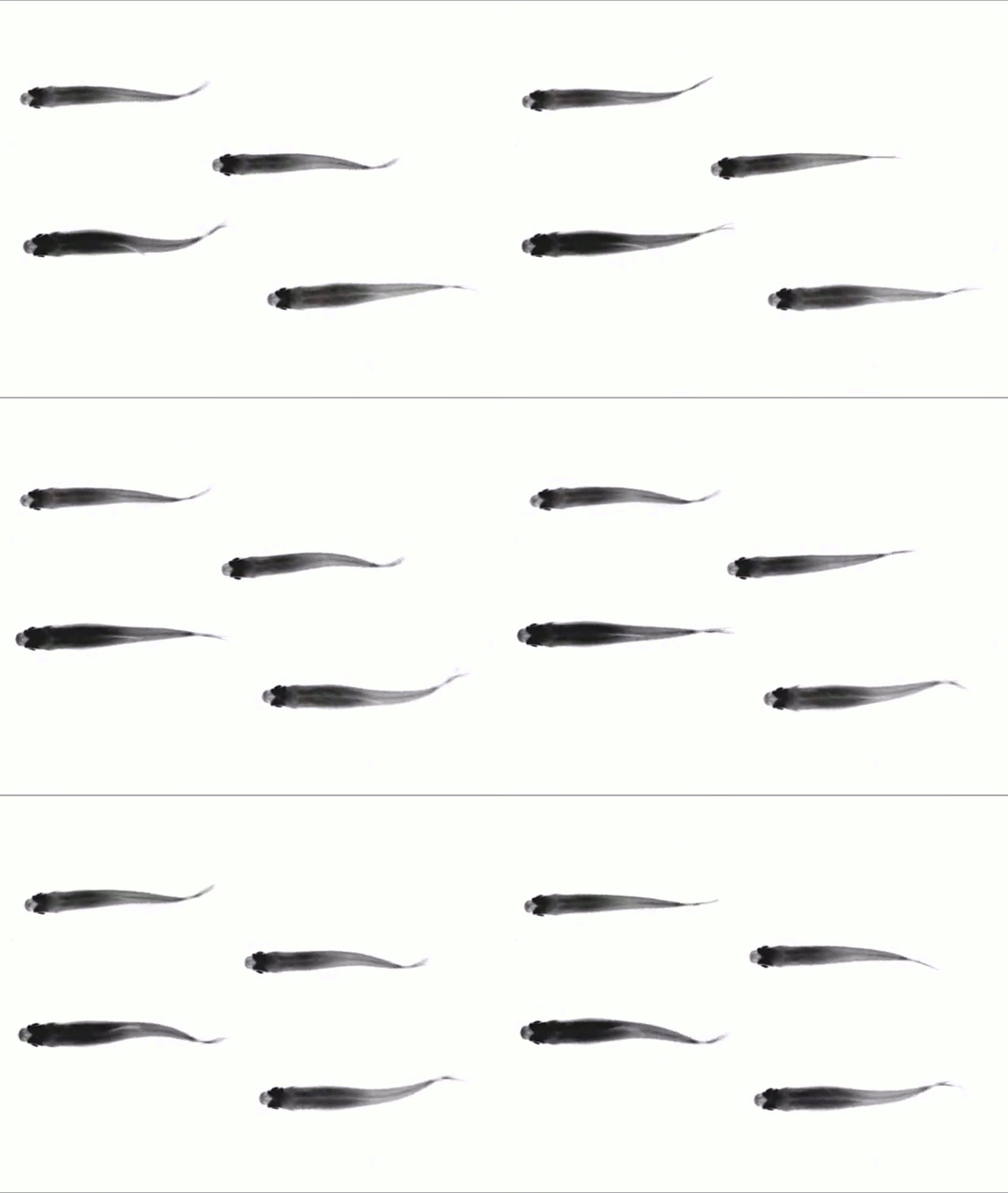

Since the 1970s, fluid dynamicists have chased the idea that fish swim in schools for hydrodynamic advantage. The original 2D conception of the idea placed fish in a diamond pattern so that their wakes would constructively interfere and improve swimming efficiency. In nature, that exact pattern is rarely seen, possibly due to 3D effects or the difficulty of maintaining the exact orientation. Fish do, however, show signs of grouping themselves for efficiency – especially when they’re forced to swim quickly.
A recent study found that tetras, a type of small fish often used as pets, prefer a staggered diamond configuration (left) when free-swimming at low speeds around one body length per second. At higher speeds, around four body lengths per second, groups of tetras preferred a side-by-side or “phalanx” configuration (right). Here the fish tended to synchronize their tail-beat frequency with their neighbors, essentially working together for a mutually beneficial wake structure. The researchers found that this configuration was much more efficient than a lone swimmer or uncoordinated group, implying that fish do school for energy-savings when they’re swimming fast. (Image and research credit: I. Ashraf et al., source; via Hakai; submitted by Kam-Yung Soh)
Bioluminescent Plankton


In nutrient-rich marine waters, dinoflagellates, a type of plankton, can flourish. At night, these tiny organisms are responsible for incredible blue light displays in the water. The dinoflagellates produce two chemicals – luciferase and luciferin – that, when combined, produce a distinctive blue glow. The plankton use this as a defense against predators, creating a flash of blue light when triggered by the shear stress of something swimming nearby. The dinoflagellates respond to any sudden application of shear stress this way, so they glow not only for predators, but for any disturbance – mobula rays (above), sea lions, boats, or even just a hand splashing in the water. In person, the experience feels downright magical. I had the opportunity to experience bioluminescence in the Galapagos last year. The light from the dinoflagellates is incredibly difficult to film because it can be so dim, but as the BBC demonstrates, it’s well worth the effort it takes to capture. (Image credit: BBC from Blue Planet II and Attenborough’s Life That Glows; video credit: BBC Earth)