Tag: atmospheric science

  • Featured Video Play Icon

    The Polar Vortex

    Every year or two, the Northern Hemisphere gets treated to a bout of intensely cold temperatures thanks to the polar vortex. What you may not realize, though, is that it’s not the polar vortex that causes this cold weather – it’s the vortex breaking down. As Simon Clark explains in this video, the polar vortices (one at each pole) are intense and powerful regions of circulation in the stratosphere, or mid-atmosphere. They’re largely responsible for keeping cold air trapped in the Arctic and Antarctic. But occasionally, this region of the atmosphere will suddenly get warmer – to the tune of increasing by 80 degrees Celsius in less than a week! When this happens, a polar vortex will deform and potentially even split into smaller vortices, as seen below. When this happens, the vortex loses its hold on the cold air near the surface, allowing Arctic air to sneak as far south as Texas. After a couple of weeks of affecting our weather, the polar vortex will typically reform and we’ll return to normal. In the meantime, stay warm! (Video and image credit: S. Clark; submitted by Nikhilesh T.)

  • Waves

    Waves

    Photographer Ray Collins is known for his striking portraits of waves, some of which I’ve featured on previous occasions. Collins is colorblind, so he focuses heavily on shape and texture in the wave, which produces some stunningly dramatic views of moving water frozen in time. There’s great power and beauty in breaking waves, and researchers are still actively learning just how significant they are to our planet’s cycles. 

    Note the spray blurring the edges of every wave here; these are some of the largest droplets the wave will make. As it crashes forward, the wave traps pockets of air, and, as those bubbles burst, they will create a spray of tinier droplets that carry moisture and salt into the atmosphere to seed clouds and, eventually, rain.

    Collins’ work reminds us both of the ocean’s power and its fragility as it undergoes rapid changes due to humanity’s influence. For more photos as well as a great interview with Collins, check out My Modern Met. (Image credit: R. Collins; via My Modern Met and James H.)

  • Featured Video Play Icon

    “Haboob”

    Mike Olbinski’s latest storm chasing timelapse, “Monsoon V,” is once again spectacular. Although I do think the name could have been “Haboob” instead, given how many sweeping dust clouds encroach on the viewer. These towering wall clouds of dust can form from downdrafts at the leading edge of a cold front, or from the fading remains of a thunderstorm. In dry, dusty regions like Arizona, the strong downward winds spread outward as they near the ground, picking up dust and sand. Below you can see two examples of haboobs racing ahead of fronts. 

    The middle image shows a microburst, where a sudden, localized downdraft falls out of the storm. Notice how the wind and rain sweep outward as they near the ground. This is typical of any flow heading straight toward a wall! Check out the full video for lots more gorgeous fluid dynamics in action. (Video and image credit: M. Olbinski)

  • Understanding Jupiter

    Understanding Jupiter

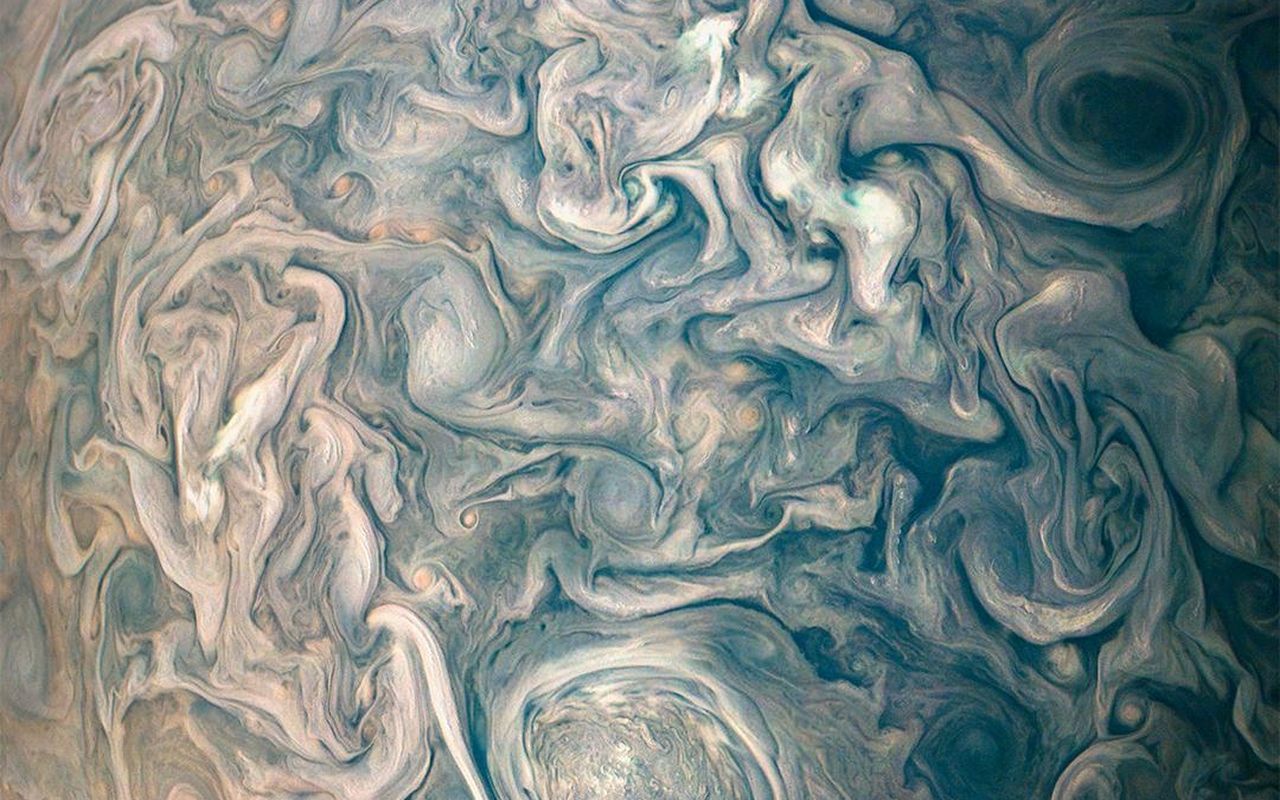
    The swirling clouds of Jupiter hide a complicated and mysterious interior. For decades, scientists have worked to puzzle out the inner dynamics of Jupiter’s atmosphere and what could be going on inside it to generate the flows we see visibly. Near Jupiter’s equator, we see strong jets that flow either east or west, depending on their latitude; this creates the stunning cloud bands we’re used to seeing on the planet. Toward the poles, though, things look more like what we see above – swirling but unbanded.

    Through theory, experiments, and simulations, scientists have tried to work out exactly what ingredients are necessary to make Jupiter look this way, but it’s pretty tough to recreate the conditions simply because Jupiter is so extreme. You need a lot of rotation, a lot of turbulence, and a way to stretch that turbulence if you want to imitate Jupiter. There’s been progress recently, though, and it suggests that the jets we see on Jupiter are far more than skin-deep. Instead, they likely stretch deep into the Jovian atmosphere at the equator and ride somewhat shallower toward the poles. (Image credit: NASA JPL; research credit: S. Cabanes et al.)

  • Featured Video Play Icon

    Rivers in the Sky

    The water cycle is quite a bit more complicated than what we learn in elementary school, and the environment around us contributes to that cycle in invisible but vital ways. In this video, Joe Hanson of It’s Okay to Be Smart pulls back the veil on this in the context of the Amazon river basin and how the Amazon rainforest itself creates an atmospheric river that carries more water than its namesake river.

    Trees release water into the air almost constantly as they transpire. And to trigger that water to fall as rain, trees can release other compounds that serve as a nucleus around which raindrops can form. The condensing raindrops form clouds, which lower the air pressure and create winds, thereby creating an atmospheric river flowing from the Atlantic back up the Amazon River. That stream carries rain that feeds the rainforest and the Amazon River, continuing the cycle. (Video and image credit: It’s Okay to Be Smart)

  • Featured Video Play Icon

    The Show in the Sky

    There is a constant drama playing out overhead, though most of us do not take the time to watch. Fortunately, a few, like Blaž Šter, do and make timelapse videos that allow us to enjoy hours of atmospheric drama in only a few minutes. This timelapse shows a cloudy and rainy mid-July day in Slovenia, where an unstable atmosphere leads to turbulent and dramatic clouds. In an unstable atmosphere, it’s easier for vertical motion to take place between altitudes. For example, a parcel of warm air displaced upward will continue to rise because it will be lighter and more buoyant than the surrounding air. This is key to the strong convection that can generate thunderstorms. (Image and video credit: B. Šter, source)

  • Visualizing Aerosols

    Visualizing Aerosols

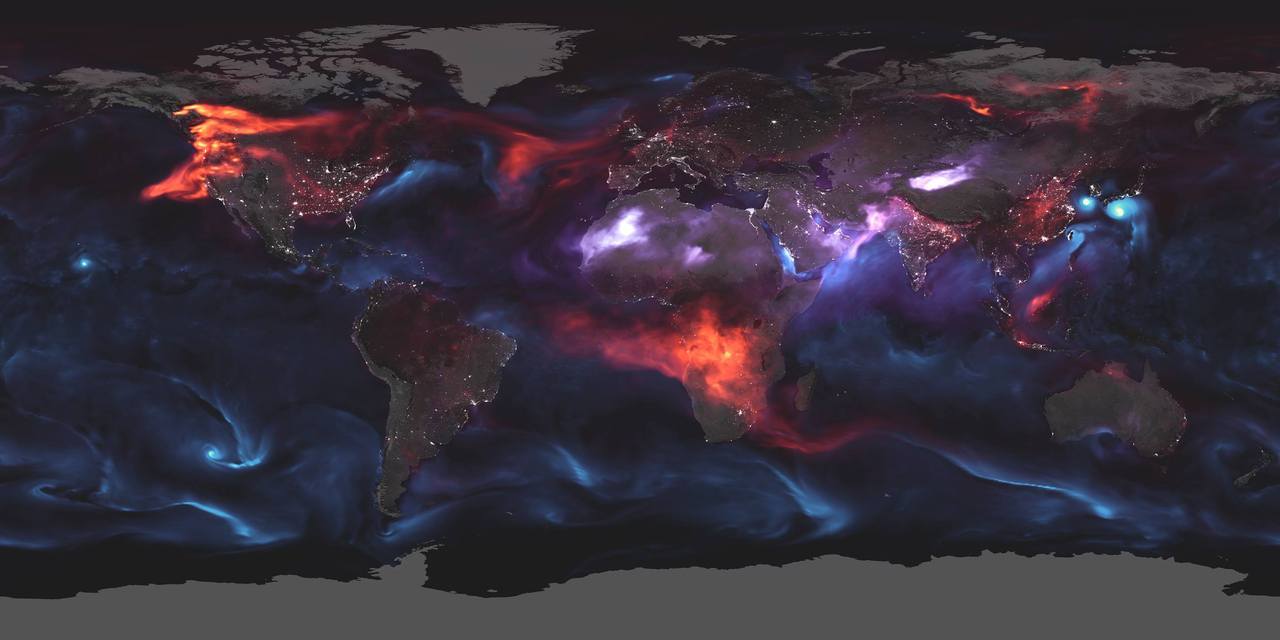
    Aerosols, micron-sized particles suspended in the atmosphere, impact our weather and air quality. This visualization shows several varieties of aerosol as measured August 23rd, 2018 by satellite. The blue streaks are sea salt suspended in the air; the brightest highlights show three tropical cyclones in the Pacific. Purple marks dust. Strong winds across the Sahara Desert send large plumes of dust wafting eastward. Finally, the red areas show black carbon emissions. Raging wildfires across western North America are releasing large amounts of carbon, but vehicle and factory emissions are also significant sources. (Image credit: NASA; via Katherine G.)

  • Zones and Stars

    Zones and Stars

    Large-scale rotating flows, like planetary atmospheres, tend to organize themselves into zones. Within a zone, flow remains essentially in an east-west direction and serves as a barrier that keeps heat or other elements from mixing from one zone to another. This is, for example, how the tropical trade winds work here on Earth.

    Stars, on the other hand, don’t show this kind of zonal behavior. The reason, it turns out, is their magnetic fields. When there’s no magnetic influence, even weak shear in a rotating flow is enough to start organizing turbulent fluctuations and grow a zonal flow. This tendency toward growth is known as the zonostrophic instability. But when you add a magnetic field, instead of organizing the hydrodynamic disturbances, that weak shear strengthens the magnetic ones, which in turn suppress the flow fluctuations. As a result, the hydrodynamic disturbances cannot grow and no zonal flow forms.

    Researchers think this mechanism can explain both why stars have no zonal flows and just how deep zones can penetrate inside the atmospheres of gas giants like Jupiter and Saturn before their planet’s magnetic field suppresses them. (Image credit: NASA; research credit: N. Constantinou and J. Parker, arXiv; via LLNL News; submitted by Stephanie N.)

  • 2D Turbulence

    2D Turbulence

    Turbulence, the chaotic regime of fluid dynamics, is a complicated beast. It’s hard to analyze or predict, but we do understand some general ideas about it, like the fact that energy starts out in large eddies, cascades down smaller and smaller ones, and finally gets dissipated at the smallest scales, where viscosity snuffs them out. But that’s only true in three dimensions.

    Two-dimensional turbulence – what you get when you confine your fluid to a flat plane – is even weirder. When turbulence is flat, you can actually get an inverse energy cascade, where the energy of small eddies can add up to feed bigger ones. For awhile, this was treated as a mathematical curiosity; after all, we live in a three-dimensional world. But there are situations in life that are nearly two-dimensional, like the surface of a soap bubble or the atmosphere of a planet (which is typically exceptionally thin compared to the planet’s radius). And, little by little, scientists are collecting evidence that this inverse cascade – a flow of energy from small scales to larger ones – does actually happen in the real world. Understanding how this works may explain why hurricanes can intensify even when conditions are “wrong” and how Jupiter’s Great Red Spot has persisted for centuries. To learn more, check out Quanta Magazine’s full article on the work. (Image credit: NASA et al., M. Appel; via Quanta; submitted by Kam-Yung Soh)

  • Night Shine

    Night Shine

    Noctilucent – literally night-shining – clouds are a phenomenon unique to high latitudes during the summer months. Too dim and sparse to see in daylight, these clouds shine at night because their altitude of around 80 km allows them to catch sunlight long after dusk has fallen at the surface. They form when temperatures in the summer mesosphere drop to nearly -150 degrees Celsius, driven by perturbations that can originate in lower layers of the atmosphere on the opposite side of the Earth. Complex interactions and feedback between atmospheric waves, buoyancy, and Coriolis effect circulate those disturbances in such a way that the summer mesosphere can reach temperatures colder than any other place on Earth. Those frigid temperatures allow clouds to form even in this dry region near the edge of space. (Image credit: S. Stephens; see also: B. Karlsson and T. Shepard)