NASA’s Solar Dynamics Observatory (SDO) is our premiere source for data on the sun. In honor of its five-year anniversary, NASA released this beautiful video compiling some of the highlights among the 2600 terabytes of data the spacecraft has recorded. SDO has captured some truly stunning footage over the years of sunspots, prominences, and eruptions. The latter two are examples of plasma flows and visible magnetohydrodynamics. SDO’s observations are also helping researchers determine what goes on just beneath the sun’s surface, where convection and buoyancy are major forces in the transport of heat generated from fusion in the star’s core. Incidentally, SDO’s launch featured some uncommonly stunning fluid dynamics as well. (Video credit: NASA Goddard)
Tag: sun

Convection on the Sun

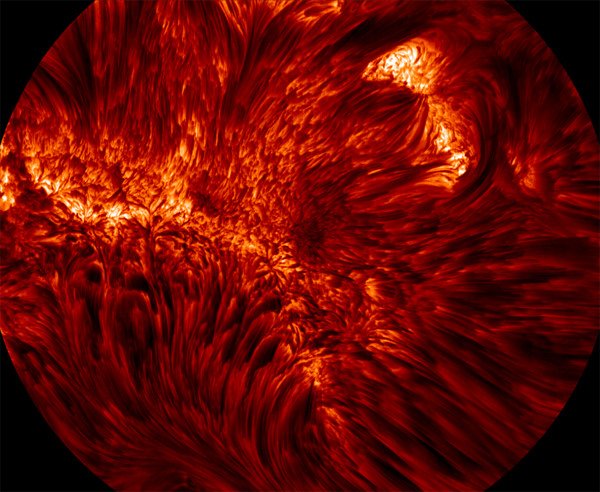
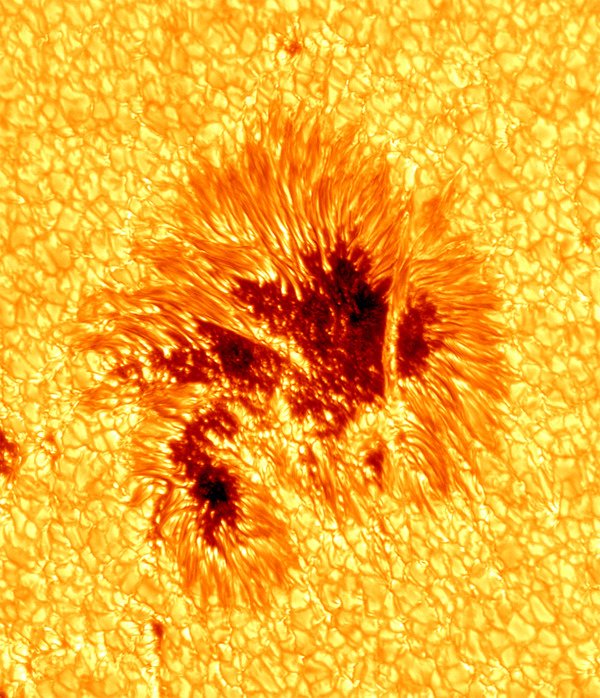
New photographs showing ultra-fine structure in the sun’s chromosphere and photosphere have been released. They offer a fascinating view into the magnetohydrodynamics of the sun, where the fluid behaviors of plasma are constantly modified by the sun’s magnetic field. The left image shows fine-scale magnetic loops rooted in the photosphere, while the right image shows our clearest photo yet of a sunspot. The dark central portion is the umbra, where magnetic field lines are almost vertical; it’s surrounded by the penumbra, where field lines are more inclined. Further out, we see the regular convective cell structure of the sun. (Photo credit: Big Bear Solar Observatory/NJIT; via io9 and cnet)

Turbulence and Magnetic Field Lines
During a solar flare, magnetic field lines on the sun are often visible due to the flow of plasma–charged particles–along the lines. According to theory, these magnetic lines should remain intact, but they are sometimes observed breaking and reconnecting with other lines. An interdisciplinary team of researchers suggests that turbulence may be the missing link. In their magnetohydrodynamic simulation, they found that the presence of chaotic turbulent motions made the magnetic line motion entirely unpredictable, whereas laminar flows behaved according to conventional flux-freezing theory. (Photo credit: NASA SDO; Research credit: G. Eyink et al.; via SpaceRef; submitted by jshoer)

How the Sun Drives the Earth
This video describes how the sun’s energy drives wind and ocean currents on earth. As solar winds stream forth from the sun, our magnetosphere deflects the brunt of the impact (creating auroras at the poles) while the atmosphere, land masses, and oceans absorb thermal energy from the sun’s light. Because of our cycles of day and night and the differences in how land, water, and ice absorb heat, temperature differentials around the earth drive a massive heat engine, causing the circulation of water and wind all around our world. Numerical simulations like the ones underlying this video are vital for the prediction of climate and weather, as well as for developing models and techniques that can be applied to other problems in science and engineering. (Video credit: NASA; via Gizmodo)
Astronomical Jets
Researchers have pieced together Hubble images of jets from newborn stars into timelapse movies that reveal the interstellar fluid mechanics responsible for the formation of stars like our sun. These jets stream out clumps of matter that has fallen on the new star. When faster moving eddies impact slower ones, bow shocks can form, much like shockwaves running before an airplane. See more HD video of these jets and bow shocks here. #
Glorious Coronal Mass Ejection
In early June, NASA’s Solar Dynamics Observatory recorded a stunning coronal mass ejection, in which larger than usual quantities of cool (relatively speaking) plasma erupted from the surface of the sun and rained back down along magnetic field lines. Plasma is an ionized gas-like state of matter subject to the same laws that govern more familiar fluids like water or air, with the additional caveat that, being electrically conductive, plasmas also obey Maxwell’s equations. #
Coronal Waves
NASA’s Solar Dynamics Observatory has found evidence of Kelvin-Helmholtz waves in the sun’s corona. These waves, which occur between two fluids of different densities or moving at different speeds, are similar to the iconic waves surfers ride. Researchers suspect that this turbulent motion may help explain why the corona is 1,000 times hotter than the surface of the sun. #

Calcium Plasma on the Sun
This high-resolution photo of our sun shows the structure of calcium plasma on the surface of the sun. Plasmas are governed by the same physics as our familiar earthbound fluids but are also extremely sensitive to magnetic fields. Their branch of fluid dynamics is often referred to as magnetohydrodynamics (MHD), where the Navier-Stokes equations have to be solved in conjunction with Maxwell’s equations. (via Bad Astronomy)
Benard Cells
When a fluid in a gravitational field is heated from below, it can develop a Rayleigh-Benard instability which causes the formation of convection cells as in the video above. The hexagonal shape of the cells is due to the boundary conditions of the fluid. It’s possible to form other shapes like spirals. The same mechanism drives the formation of granules on the photospheres of stars like our sun.