The sun‘s surface and atmosphere are endlessly dynamic, with magnetic lines, plasma, and convection creating a constant churn. In this photo by astrophotographer Eduardo Schaberger Poupeau, a curving question-mark-like filament appears above the sun’s surface. Even with decades of high-resolution data from recent solar probes, we struggle to understand the complex physics that feed structures like these. (Image credit: E. Poupeau; via 2023 Astronomy POTY)
Tag: sun

Solar Coronal Heating
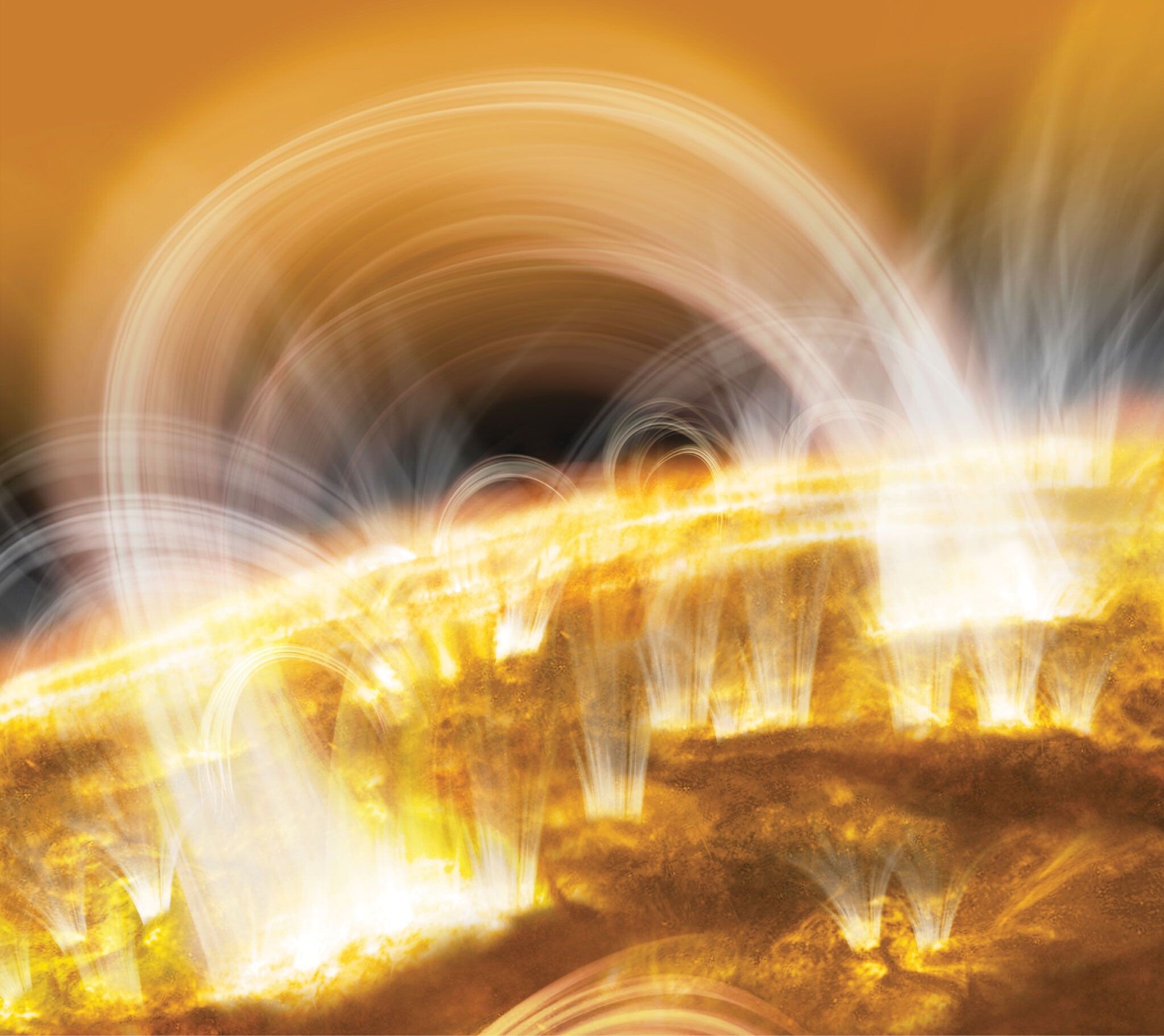
Our Sun‘s visible surface, the photosphere, is about 5800 Kelvin, but the temperature of the wispy corona is far hotter, reaching a million Kelvin in some places. Why the corona is so hot remains something of a mystery. Scientists have theorized multiple culprits for the extreme temperatures found in the corona, but the full details of the phenomenon are still unclear.
Recent solar missions and observations are increasingly identifying small but widespread solar activities, like the nanoflares shown above. Unlike the monstrous coronal loops researchers focused on previously, these flares are tiny and occur in regions without discernible solar flare activity. The nanoflares are brief but they can reach temperatures above a million Kelvin. Since nano- and even picoflares have been observed across the full Sun, they likely play a significant role in the overall picture of coronal heating. (Image credit: ISAS/JAXA; see also L. Sigalotti and F. Cruz)

“Fusion of Helios”


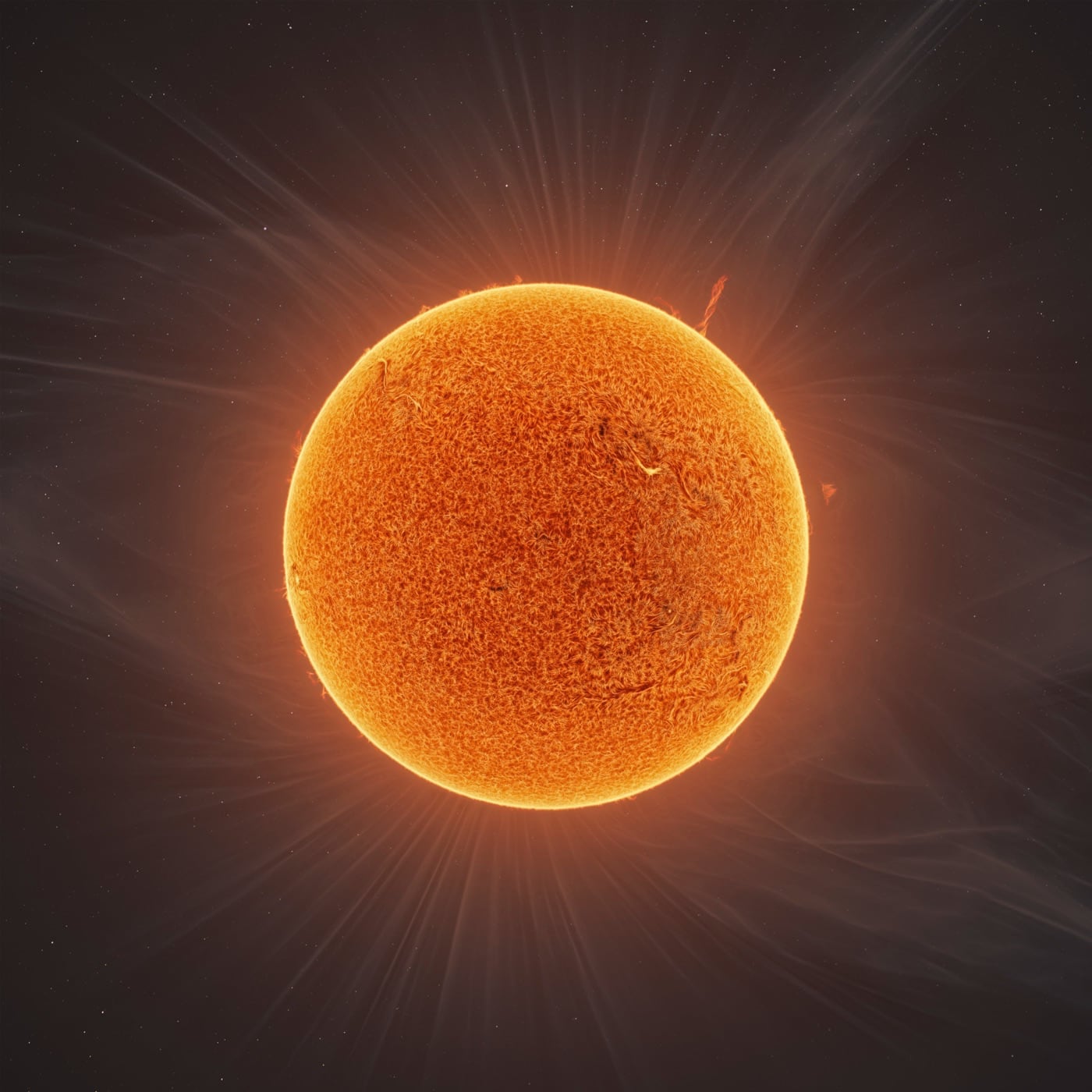
Built from approximately 90,000 individual images, “Fusion of Helios” reveals the wisp-like corona of our Sun. Astrophotographers Andrew McCarthy and Jason Guenzel joined forces to combine eclipse images with data from NASA to build this fusion of art and science. Jets of plasma, known as spicules, dot the sun’s surface, and a towering tornado of plasma shoots off one side. For scale, that vortex stretches as far as 14 Earths stacked atop one another. (Image credit: A. McCarthy and J. Guenzel; via Colossal)

“One Month of Sun”
Get lost in the beauty of our star with Seán Doran‘s film “One Month of Sun”. Constructed from more than 78,000 NASA Solar Dynamics Observatory images, the video shows solar activity from August 2014, particularly the golden coronal loops that burst forth from the sun’s visible surface. These bursts of hot plasma follow the sun’s magnetic field lines, often emerging from sunspots. (Image and video credit: S. Doran, using NASA SDO data; via Colossal)


“Fire and Fusion”

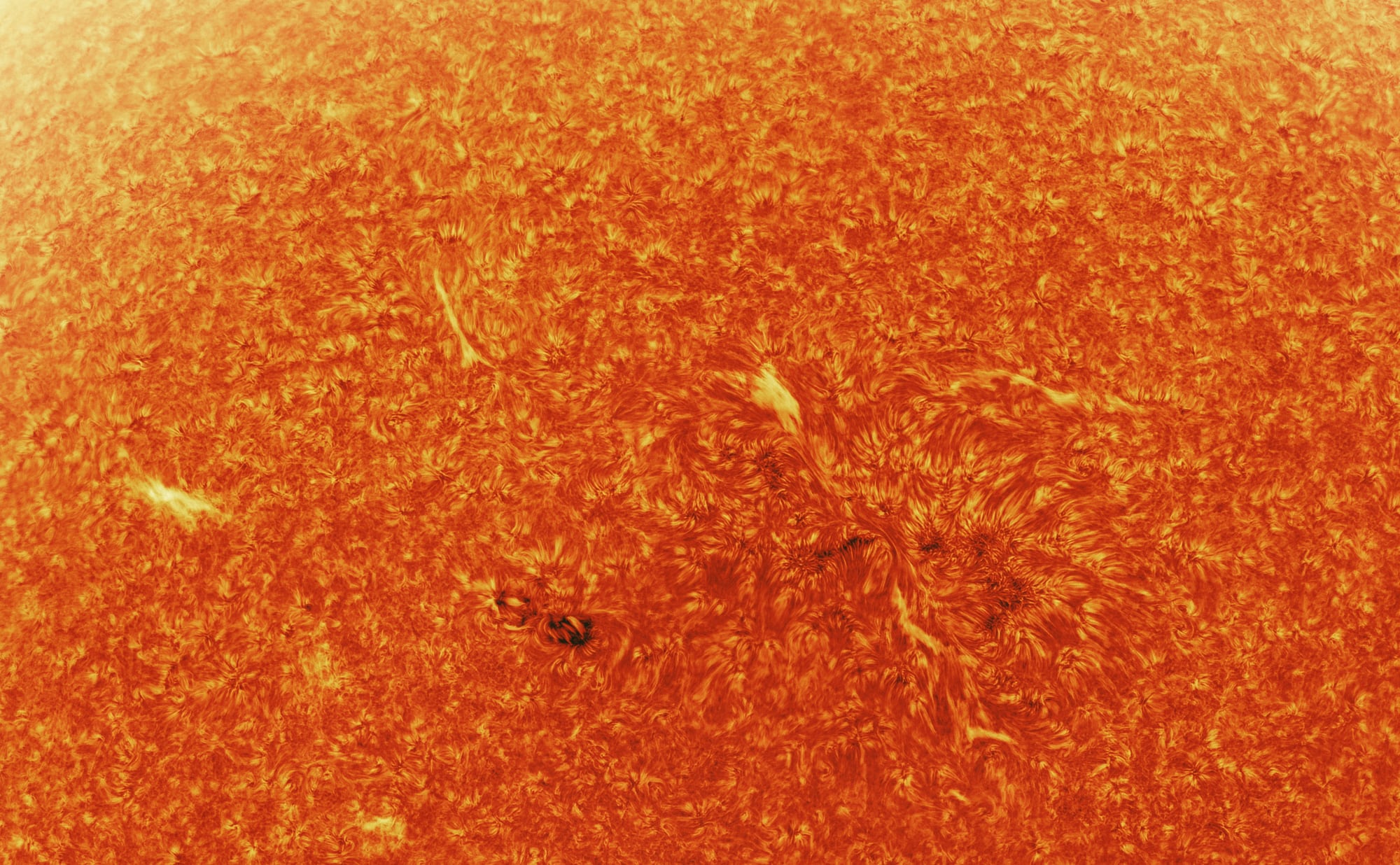

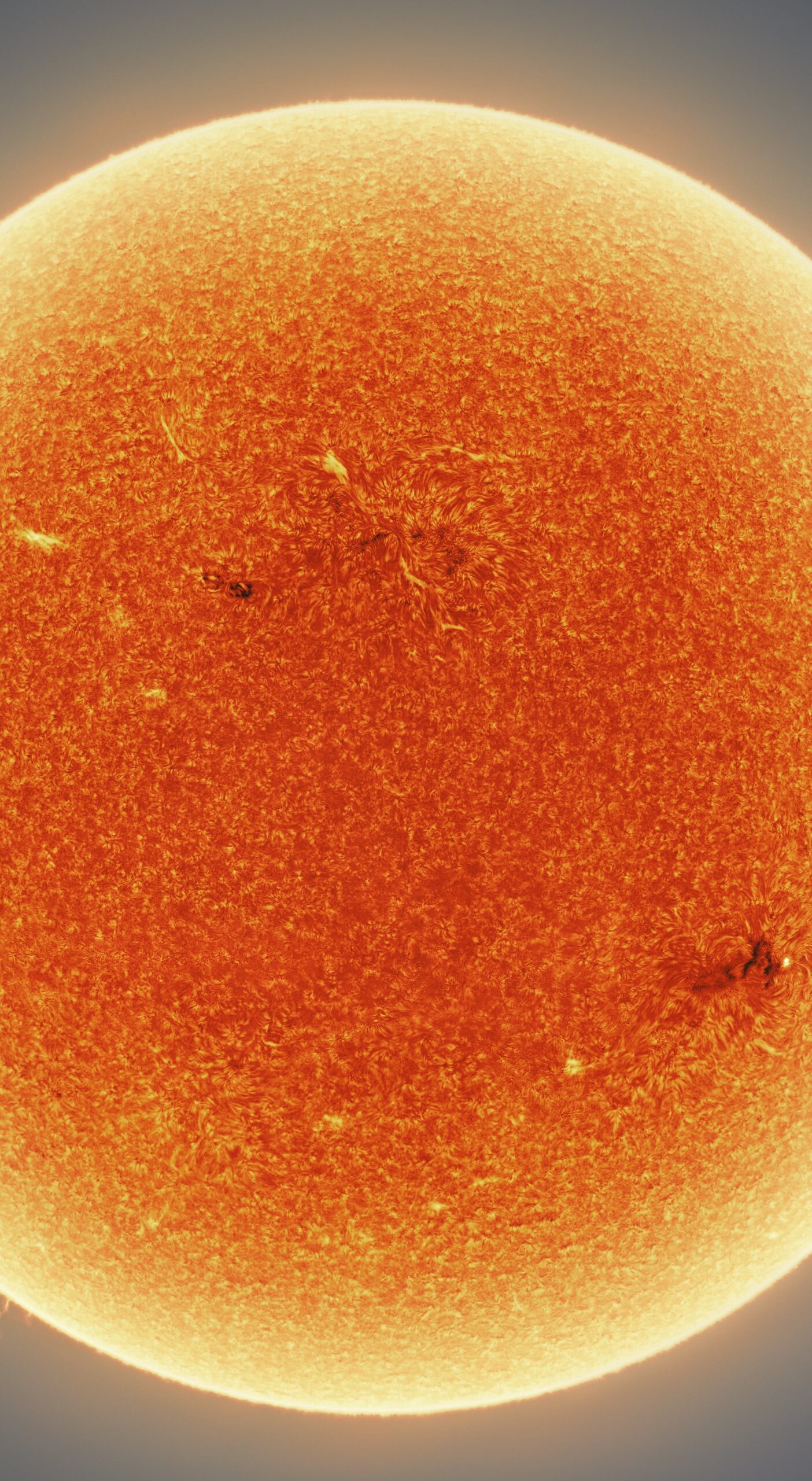

Photographer Andrew McCarthy constructed this spectacular 300-megapixel image of our sun by compositing thousands of individual images. Sunspots, coronal mass ejections, and feathery convective swirls abound. Check out his site for prints of this and other celestial images! (Image credit: A. McCarthy; via Colossal)

Eyes on the Sun
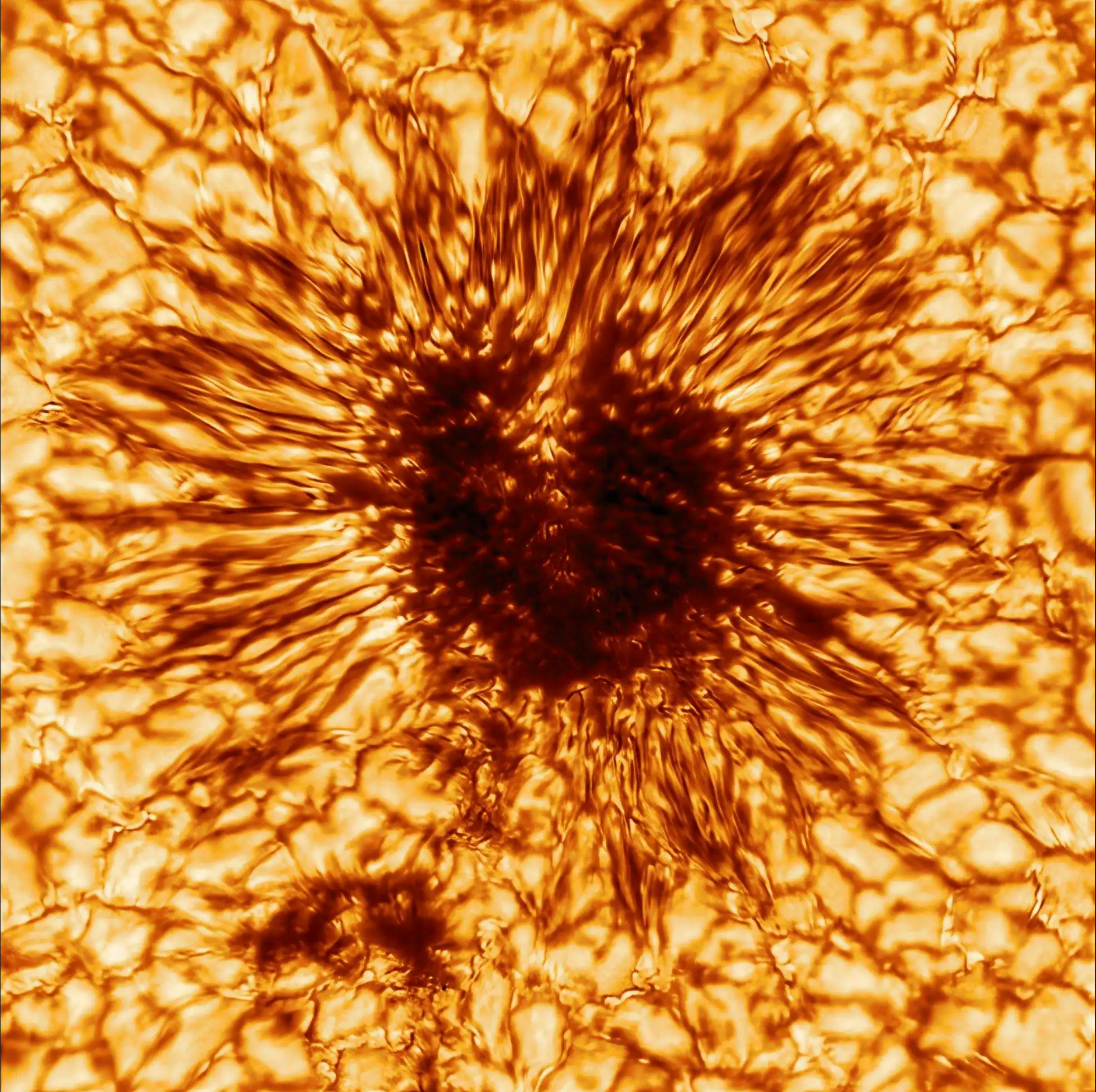
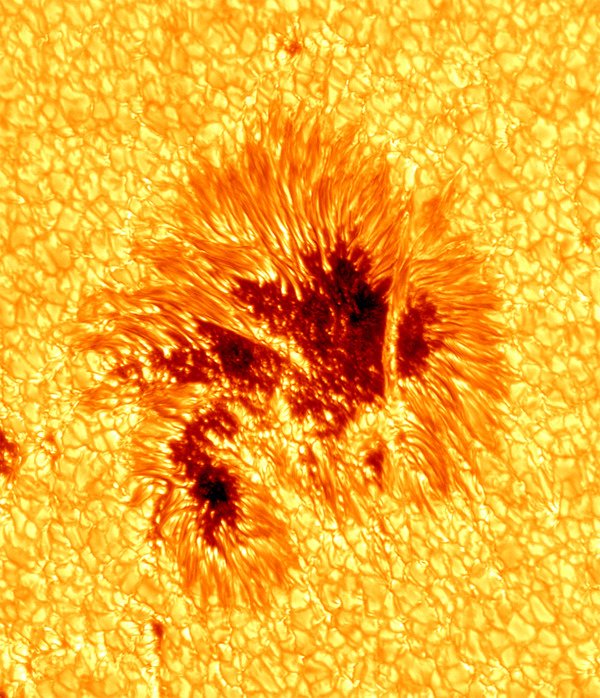
Though it may look like the Eye of Sauron, this image is actually one of our best-ever glimpses of a sunspot. Captured by the Daniel K. Inouye Solar Telescope, this sunspot is larger than our entire planet, yet we can see details as small as 20km across. The dark central region of the image is the sunspot’s umbra, surrounded by the lighter, streakier penumbra. Along the edges of the image, you see a more typical pattern of bright convection cells. Compared to the rest of the sun’s surface, sunspots are cool — about 1,000 K cooler — due to their intense magnetic field flux inhibiting convection. (Image credit: NSO/AURA/NSF; via Bad Astronomer; submitted by Kam-Yung Soh)
Sunlight Is Older Than You Think


Joe Hanson over at “It’s Okay to Be Smart” has a great video on the random walk photons have to make to escape the core of the sun and other stars. Because the high-energy photons born in the star’s core have to bounce their way out rather than flying in a straight line, those photons can spend thousands of years escaping the sun. After that, the eight-and-a-half minute trip to Earth is nothing.
But there’s a key element missing in this explanation: convection! That radiative random walk photons do doesn’t last all the way from the core of the sun to its surface. From a depth of about 200,000 km onward, the dominant mode of transport in the sun is convection, actual fluid motion that carries heat and light much faster than simple molecular diffusion, or Brownian motion, does. That’s why the surface of the sun shines with convection cells similar to the ones you’ll see in your skillet when heating a layer of oil.
Fluid motion beyond molecular diffusion is also a big part of the other flows Joe describes in the video. If you had to wait on Brownian motion in order to smell your morning coffee, it would be cold long before you knew it was there! (Video and image credit: It’s Okay to Be Smart; sun surface image credit: Big Bear Solar Observatory/NJIT)


Magnetic Storms
Periodically, our sun releases plasma in a coronal mass ejection. Afterwards, the local magnetic field lines shift and reorganize. We can see that process in action here because charged particles spin along the magnetic lines, outlining them as bright loops in this imagery. This sequence – one of the best examples of this phenomenon to date – was captured by NASA’s Solar Dynamics Observatory in early 2017. To understand behaviors like these, scientists use magnetohydrodynamics, a marriage of the equations of fluid mechanics with Maxwell’s equations for electromagnetism. (Image credit: NASA SDO, source)

Solar Eclipses and Coronal Mass Ejections
Observations of many solar phenomena have only become accessible to humans relatively recently with the advent of satellites. Prior to that, it simply wasn’t feasible to observe dynamics in the sun’s atmosphere, like solar prominences or coronal mass ejections – the sun was simply too bright to see them – except during the occasional total solar eclipse!
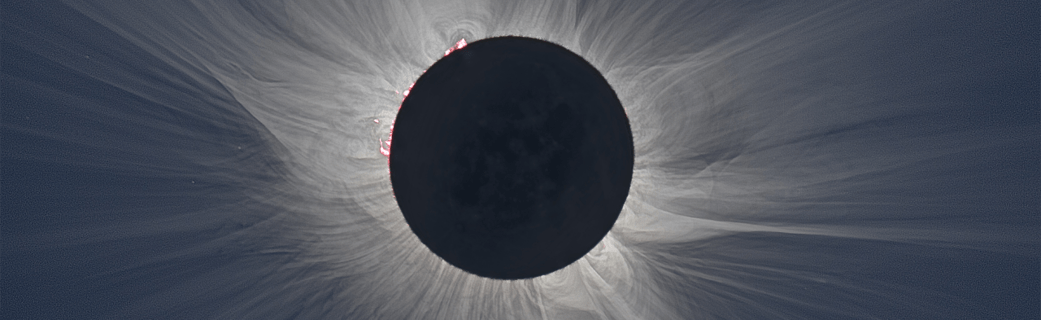
In the 1970s, scientists identified massive bursts of solar plasma as coronal mass ejections. These solar storms are responsible for so-called space weather and, when directed toward Earth, can pose a hazard to technologies on the ground and astronauts in orbit. Scientists initially thought this was the first time such storms had been observed, but they later recognized that photographs and sketches of an 1860 total eclipse revealed that humanity had seen a coronal mass ejection more than 100 years before! Check out the NASA video below for the full story. You can also learn about some of the science that will be going on in today’s eclipse. And, for those in the U.S. today, have a fun and safe time viewing the ecliipse! (Image credit: S. Habbal, M. Druckmüller and P. Aniol, source; video credit: NASA Goddard)
Where Does the Sun End?
How do you define the edge of our sun? There’s a distinct surface to it, but our star is also surrounded by the corona, an even hotter region of plasma twisted by magnetic fields. The corona is sort of like the sun’s atmosphere. Farther out in the solar system, we receive a constant barrage of charged particles, known as the solar wind, that streams out from the sun. So where does the corona end and the solar wind begin?
Scientists have been studying the flow structure of the solar wind in search of an answer to this question, and they’ve found that there’s a clear transition point about 32 million kilometers from the sun. At this distance, the sun’s magnetic field weakens to the point where it no longer exerts the same hold on the solar particles and they begin to move turbulently, behaving more like a gas than a plasma. With special measurements and image processing, scientists were able to actually see this flow change in the solar wind! (Video/image credit: NASA; research credit: C. DeForest et al.; via FlowViz)