Computational fluid dynamics (CFD) has been a valuable tool in engineering for decades, but its use is spreading to other fields as well. The image to the left shows a reconstruction of Parvancorina, a shield-shaped marine creature that lived some 550 million years ago. Fossil evidence alone cannot tell paleontologists whether this extinct creature could move through the water, and there are no living relatives that resemble the creature that scientists could study as an analogue. Instead, researchers turned to CFD to simulate flow over and around Parvancorina. They found that Parvancorina’s shape caused fast flow over the outer portions of its body and the slowest flow near its mouth. The results suggest that, not only was the creature mobile in the water, but that it was able to adjust its orientation to drive flow to different areas of its body. Paleontologists have only been using CFD for a decade or so, but already it’s giving us valuable insight into the creatures that roamed our planet hundreds of millions of years ago. (Image credit: M. De Stefano/Muse, I. Rahman; via Physics Today)
Tag: CFD

Adaptive Meshing
The use of numerical simulations in fluid dynamics has exploded over the past half century with new computational techniques being developed constantly. Most methods involve solving the equations of motion (or an approximation thereof) on a grid of points known as a mesh. To accurately capture the physics, meshes must often be quite closely packed in areas where detail is needed, but they can be more widely spaced in areas where the flow is not changing quickly. An increasingly common technique is adaptive meshing in which the mesh of grid points shifts between time steps; this places more grid points where the flow requires them and removes them from less important areas in order to reduce computational time.
An example of adaptive meshing is shown above. On the left particles are falling into salt water. The colors show the concentration of particles. The right side shows the solid particles and the fluid mesh around them. Notice how the grid shifts as the particles fall. (Image credit: C. Jacobs et al., source)

Inside Earth’s Core
Without our magnetic field, life as we know it could not exist on Earth. Instead, our atmosphere would be stripped away and the surface would be bombarded by charged particles in the solar wind. Relatively little is known about the dynamo process that governs our magnetic field, though it’s thought to be the result of liquid iron moving in the Earth’s outer core. The video above shows a slice of a recent 3D simulation of this liquid iron segment of our core. The colors show variations in the temperature, revealing vigorous convection in the core. This motion, combined with the spinning of the Earth, is the likely source of our magnetic field. Researchers hope that simulations like these can help us understand features we observe in our magnetic field – like local variations in field strength and the pole reversals in our geological record. (Video credit: N. Schaeffer et al.; CNRS via Gizmodo)

Break-Up of the Chelyabinsk Meteor
In 2013, a meteor about 20-meters in diameter broke up over Chelyabinsk, Russia in a dramatic display that damaged buildings within 100 km and injured more than 1200 people. To better understand the threat presented by such objects, NASA has been conducting 3D, hypersonic simulations like the one shown here. The meteor material is shown in gray and black. Brighter colors like red and yellow indicate the hot, high-pressure shock wave caused when the meteor slams into the atmosphere. Aerodynamic effects quickly erode the meteor, ripping it into pieces that disperse energy explosively in the atmosphere. While you might think the meteor breaking up is good for us, it’s actually the blast waves from its break-up that cause the most damage. (Image and video credit: NASA, source; via Gizmodo)

How Cycling Position Affects Aerodynamics


New FYFD video! How much does a rider’s position on the bike affect the drag they experience? To find out I teamed up with folks from the University of Colorado at Boulder and at SimScale to explore this topic using high-speed video, flow visualization, and computational fluid dynamics.
Check out the full video below, and if you need some more cycling science before the Tour de France gets rolling, you can find some of my previous cycling-related posts here. (Image and video credit: N. Sharp; CFD simulation – A. Arafat)
ETA: Please note that the video contained in this post was sponsored by SimScale.

Simulating Thunderstorms
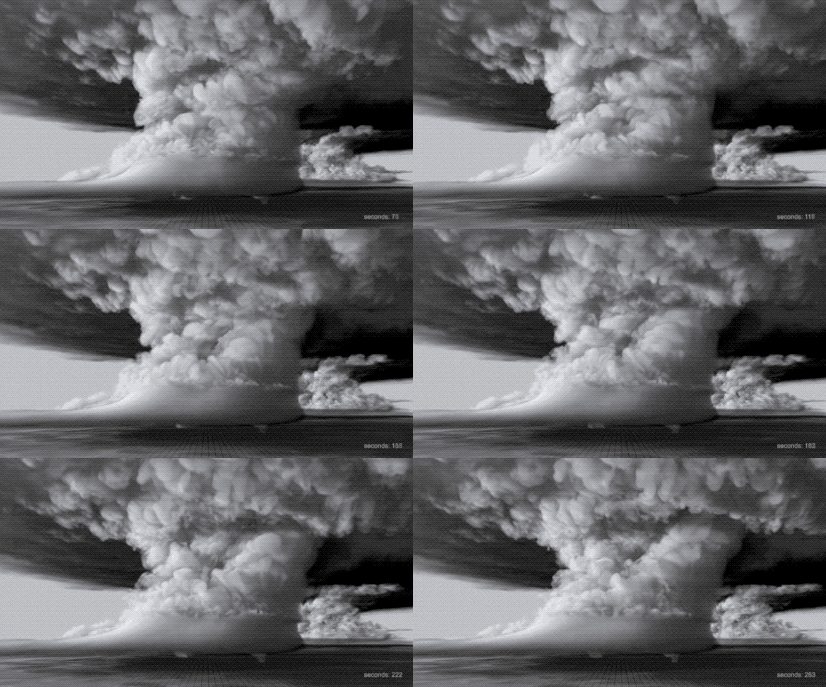
With today’s supercomputing power, it’s possible to simulate entire thunderstorms to study how and why some of them can spawn deadly tornadoes. The animation above comes from a computer simulation of a supercell thunderstorm. The simulation uses initial conditions from a 2011 storm that produced an EF-5 tornado – the highest category of tornado, based on its wind speeds. To see more of the simulation, check out the video below. One thing that might surprise you is just how enormous the towering supercell clouds are compared to the tornado produced in the simulation. Often what we can see of a storm from the ground is only the tiniest part of what goes into producing it. (Image credit: L. Orf et al., source; GIF via @popsci; video credit: UWSSEC)

Windy Urban Corridors (*)


For pedestrians, windy conditions can be uncomfortable or even downright dangerous. And while you might expect the buildings of an urban environment to protect people from the wind, that’s not always the case. The image above shows a simulation of ground-level wind conditions in Venice on a breezy day. While many areas, shown in blue and green, have lower wind speeds, there are a few areas, shown in red, where wind speeds are well above the day’s average. This enhancement often occurs in areas where buildings constrict airflow and funnel it together. The buildings create a form of the Venturi effect, where narrowing passages cause local pressure to drop, driving an increase in wind speed. Architects and urban designers are increasingly turning to numerical simulations and CFD to study these effects in urban environments and to search for ways to mitigate problems and keep pedestrians safe. (Image credits: CFD analysis – SimScale; pedestrians – Saltysalt, skolnv)
(*) This post was sponsored by SimScale, the cloud-based simulation platform. SimScale offers a free Community plan for anyone interested in trying CFD, FEA and thermal simulations in their browser. Sign up for a free account here.
For information on FYFD’s sponsored post policy, click here.

Creating Moana’s Ocean



Hopefully by now you’ve had an opportunity to see Disney’s film Moana. Fluid dynamics play a central role in the movie, and Disney’s animators faced the challenge of hundreds of shots requiring special effects to animate water, lava, waves, and wind. Science Friday has a great segment interviewing a couple of Moana’s animators, in which they discuss the process of turning the ocean itself into a character.
Because the physics of fluids is so complex, scientists and animators differ in the way they approach simulations. Scientists usually try to capture a full physical representation of a flow, simulating every detail to the smallest scale and time step. Animators, on the other hand, are interested in capturing a realistic feel for a flow. For an animator, the simulation should be exactly as complex as necessary to make the water move in a way a person believes it should. With Moana, animators had the extra challenge of melding the ocean character’s actions with appropriate water physics–think bubbles, drops, and splashes. The results are impressive and exceptionally fun. (Image credits: Disney/Science Friday; via Jesse C.)

Rio 2016: The Swimming Pool Controversy
Statistical analysis suggests possible current in the Rio Olympics swimming pool
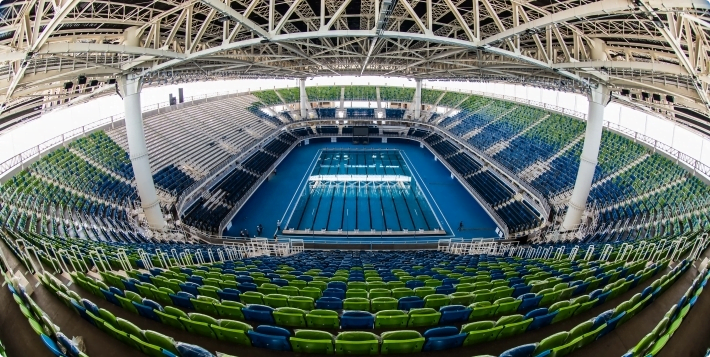
Several news outlets, beginning with The Wall Street Journal, are reporting that the swimming pool in Rio may have had a current that biased athletes’ performances. This is based on a statistical analysis of athlete performances across the meet, conducted by Indiana University’s Joel Stager and his coworkers. According to WSJ, Stager et al. analyzed times of athletes in the preliminary, semifinal, and final races of the 50m, 800m, and 1500m events and found consistent evidence that swimmers in the higher numbered lanes swam faster when moving toward the starting block and swimmers in the lower numbered lanes swam faster when moving toward the turn end of the pool. A separate analysis by Barry Revzin at Swim Swam came to similar conclusions about the direction and magnitude of lane effect in Rio.
Past questions about lane bias
This is not the first time questions have been raised about a current-induced bias in competition pools. In fact, Stager and his colleagues published an analysis in 2014 that suggested a similar bias in the pool used for the 2013 World Championships in Barcelona. That pool was a temporary pool built specifically for the competition by Myrtha Pools and was disassembled immediately after, before Stager et al.’s analysis was published.
A more recent paper by Stager and his colleagues found that lane bias seems to be more prevalent in temporary pools than in permanent ones. The Rio Olympics pool, like the 2013 Worlds pool, is a temporary pool also built by Myrtha Pools.
Myrtha Pools responds to the criticism
Myrtha responded to both WSJ and Swim Swam by sharing videos (1, 2) of their current test, which was conducted before the competition and on Day 3 of competition. The videos show a floating object in one of the outside lanes; neither video shows any noticeable movement of the object.
Fluid dynamics and swimming pool design
Competitive swimming pools are complicated recirculating systems that can contain special structures intended to minimize interactions between competitors. Myrtha has built many special event pools in recent years, including ones where the results did not show a bias. According to their website, Myrtha has fluid dynamicists on staff and uses computational fluid dynamics (CFD) to analyze pool performance during design, although they only show examples of freeform pools – not competition pools.
In fact, I have found remarkably few CFD analyses of swimming pools in the literature. Most papers seem to focus on distribution of disinfectants in pools or in predicting evaporation rates – both practical problems but ones with limited relevance to this particular question.
So, is there a current in the Rio pool?
It’s tough to say with certainty that there is a current in Rio’s pool. The performance analyses by Stager et al. and by Revzin do show anomalies in the times of athletes in Rio based on their swim lane, and they show that those anomalies do not exist in many other recent competitions.
I also do not think Myrtha’s current test constitutes evidence of a lack of current. Their floating object is only indicative of conditions at the air-water interface. Swimmers ride lower in the water and spend significant time completely underwater. Lane markers may also damp any flow effects near the surface.
I think introducing dye underwater in the pool would do more to reveal any flow that may exist, and this would be a worthwhile test to conduct prior to the deconstruction of the Rio Olympic pool. Additionally, it would be wonderful to see a CFD analysis of the swimming pool, but this would require significant detail about the pool’s design (inlet and outlet locations, etc.) some of which is likely proprietary information.
Neither dye visualization nor CFD simulation will change the results of this competition, but it may help reveal underlying issues in temporary pool designs so that any bias can be avoided in future competitions.
(Image credit: Rio City Government)
Special thanks to @MicahJGreen for bringing this story to my attention and to Dave B. for his assistance.

Turbulence in the Solar Wind
One of the key features of turbulent flows is that they contain many different length scales. Look at the plume from an erupting volcano, and you’ll see eddies that are hundreds of meters across as well as tiny ones on the order of millimeters. This enormous difference in scale is one of the major challenges in simulating turbulent flows. Since energy enters at the large scale and is passed to smaller and smaller scales before being dissipated at the tiniest scales of the flow, properly simulating a turbulent flow requires resolving all of these length scales. This is especially challenging for applications like the solar wind – the stream of charged particles that flows from the sun and gets diverted around the Earth by our magnetic field. The image above shows some of the turbulence in our solar wind. The structures seen in the flow range from the size of the Earth all the way to the scale of electrons! (Image credit: B. Loring, Berkeley Lab)