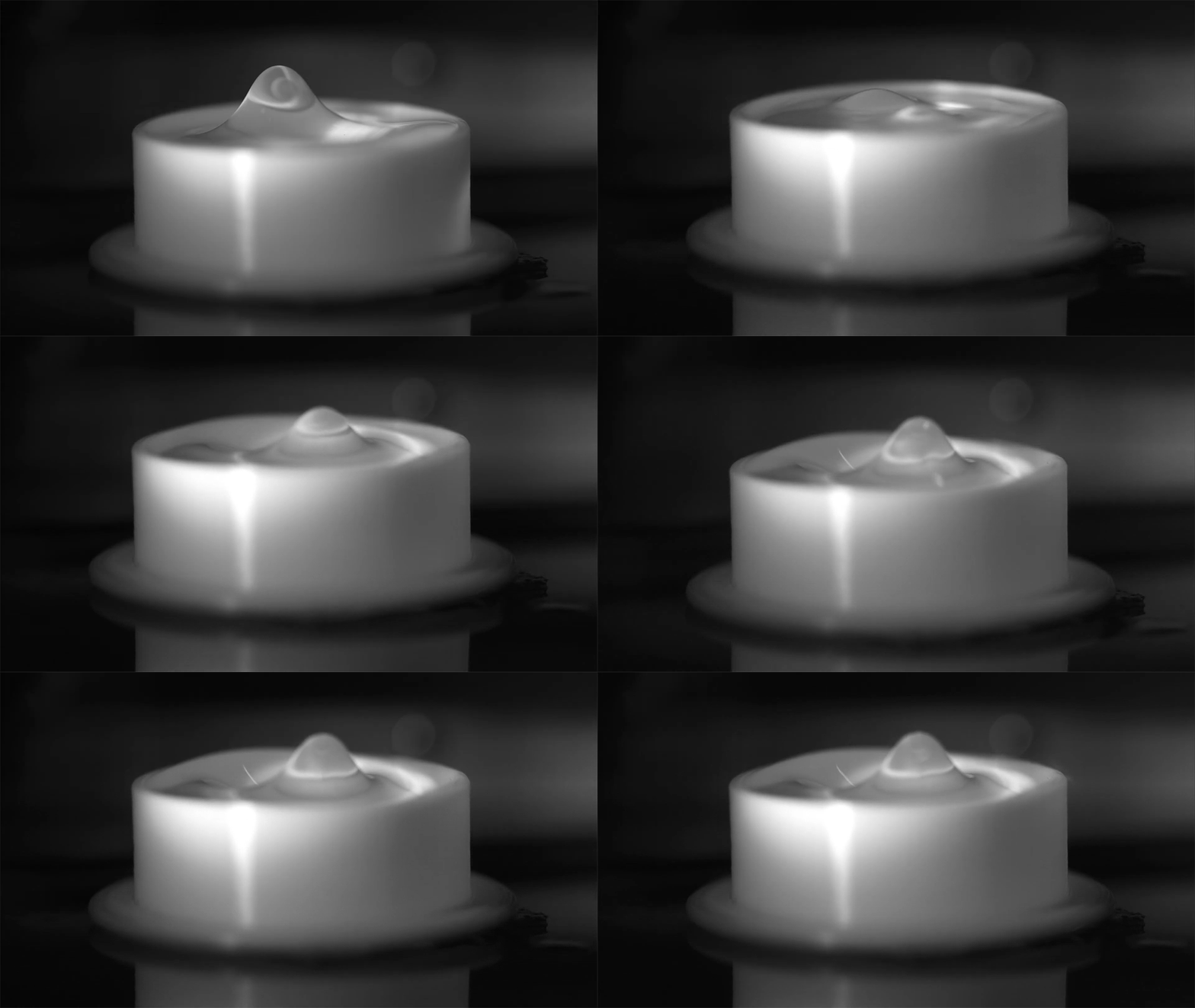
Vibrate a liquid, and you’ll get a pattern of standing waves known as Faraday waves. In this project, artist Linden Gledhill adds a twist to the usual view of these waves by capturing them in plastic. As the polymer liquid vibrates, Gledhill uses a flash of UV light to cure the polymer, freezing the wave pattern. Check out the original video for an even better look. (Image, video, and submission credit: L. Gledhill, 1, 2, 3, 4)
In the ocean, breaking waves trap air into bubbles that then cluster into foam, but conventional simulations don’t capture this foaminess. For bubbles to cluster into foam, there has to be a force preventing — or at least delaying — their coalescence. Typically, this is caused by impurities in the water that help lower the surface tension and thereby lengthen the bubbles’ lifespans. When these features get added to simulation models, bubbles begin to cluster and breaking waves become foamy. (Image and video credit: P. Karnakov et al.)
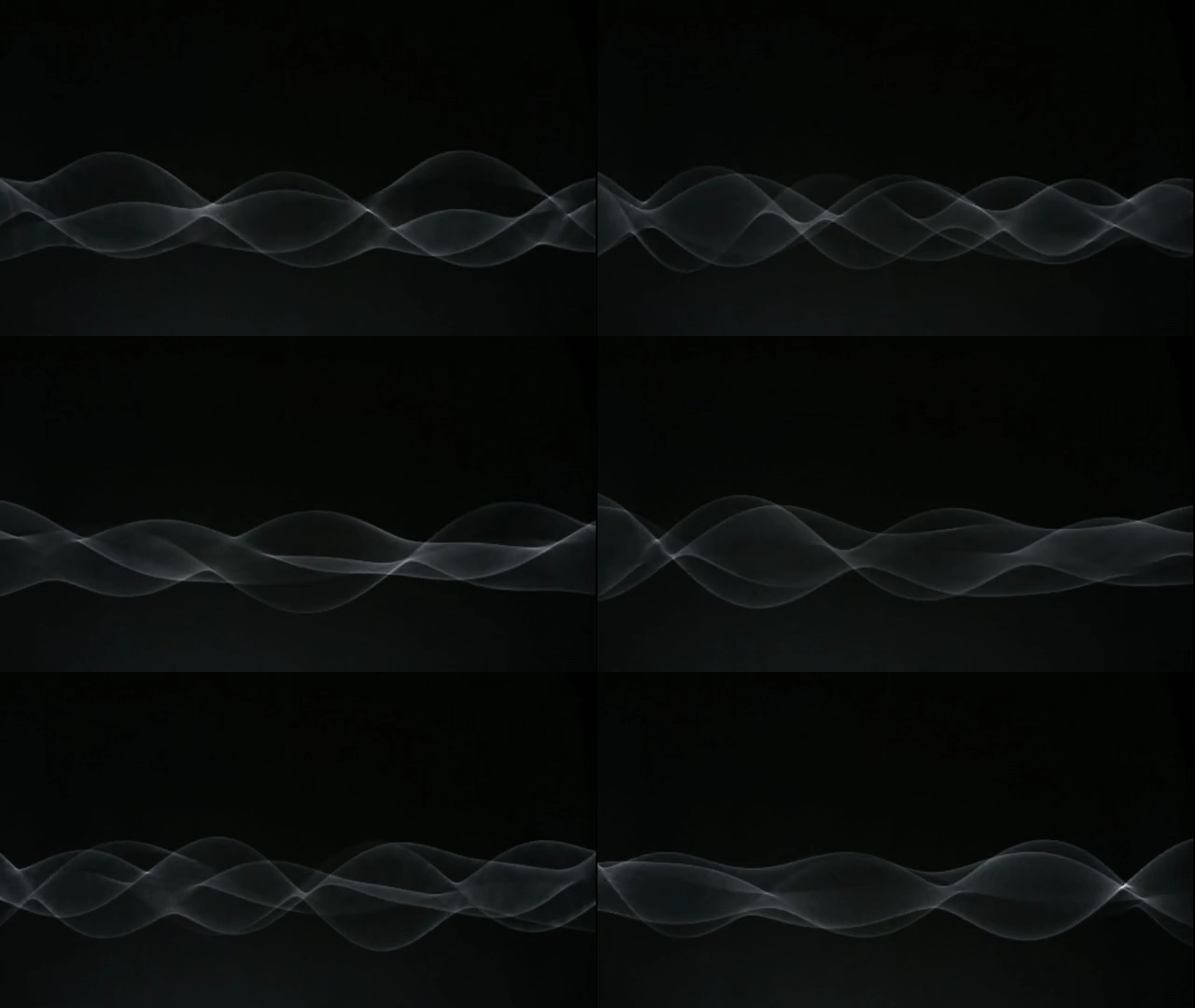
The “Waves” installation by artist Daniel Palacios appears deceptively simple, just a rope mounted between two motors. But once the motors start spinning, it is anything but. The installation shifts in response to those around it, creating varying numbers of steady, standing waves or even wildly chaotic ones that whistle through the air. It’s a neat visualization of one of the most commonly-measured quantities in physics: the changes in a wave with time. (Video and image credit: D. Palacios; via Flow Vis)
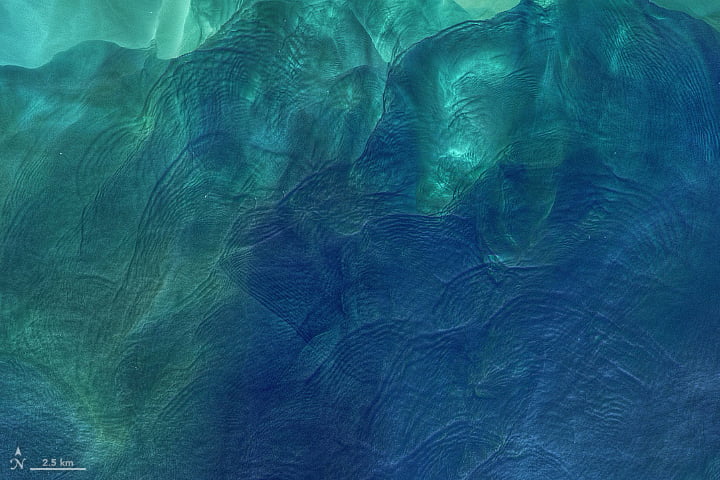
Differences in temperature and salinity create distinct layers within the ocean. When combined with flow over submerged topography — underwater canyons, mountains, and reefs — it makes waves. But those waves aren’t always apparent when sitting at the surface. Instead, they travel along those ocean layers as internal waves that can be as tall as hundreds of meters in height.
When the sun glints just right off the ocean, these massive internal waves can be caught by satellite imagery, as shown in the above image of the Andaman Sea near Thailand and Myanmar. Even seemingly calm waters can roil in the deep. (Image credit: USGS; via NASA Earth Observatory)
The Seoul Aquarium is now home to an enormous crashing wave, courtesy of design company d’strict. Check out several different views of the anamorphic illusion in their video above. There’s no word on the techniques used to generate the animation, but it’s certainly a cool visual! (Image and video credit: d’strict; via Colossal)
New observations of nova V906 Carinae have provided some of the first direct evidence that the observed brightening of these stellar objects is driven by shock waves. Novae form when hydrogen from a companion star settles onto a white dwarf. Once enough material accumulates, the white dwarf blows out the excess hydrogen in a donut-shaped shell moving about the speed of a typical solar wind.
Next, another outflow — likely triggered by residual nuclear reactions on the dwarf’s surface — slams into the denser shell at about twice the speed. This collision triggers shock waves that emit light in the gamma and visible wavelengths. Weeks later, a third, even faster outflow expanded into the cloud, generating more shock waves and measurable flares. (Video credit: NASA Goddard; research credit: E. Aydi et al.)
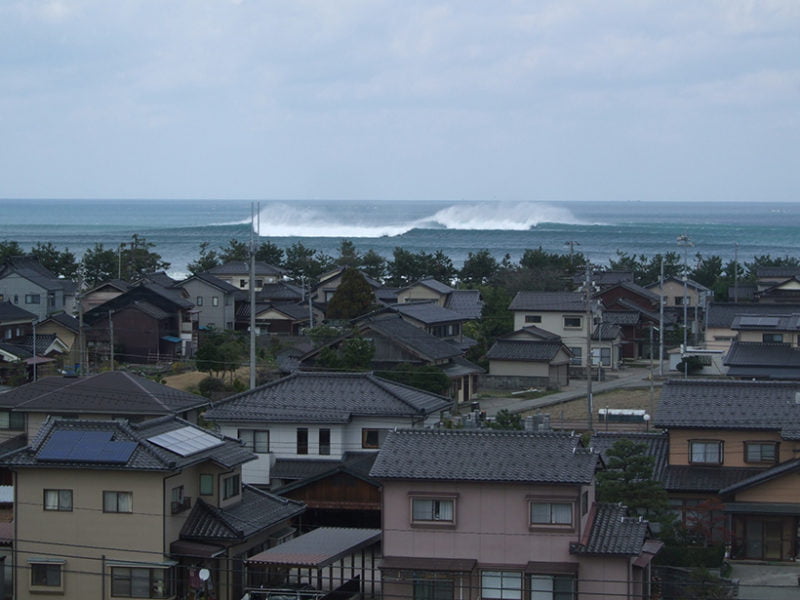
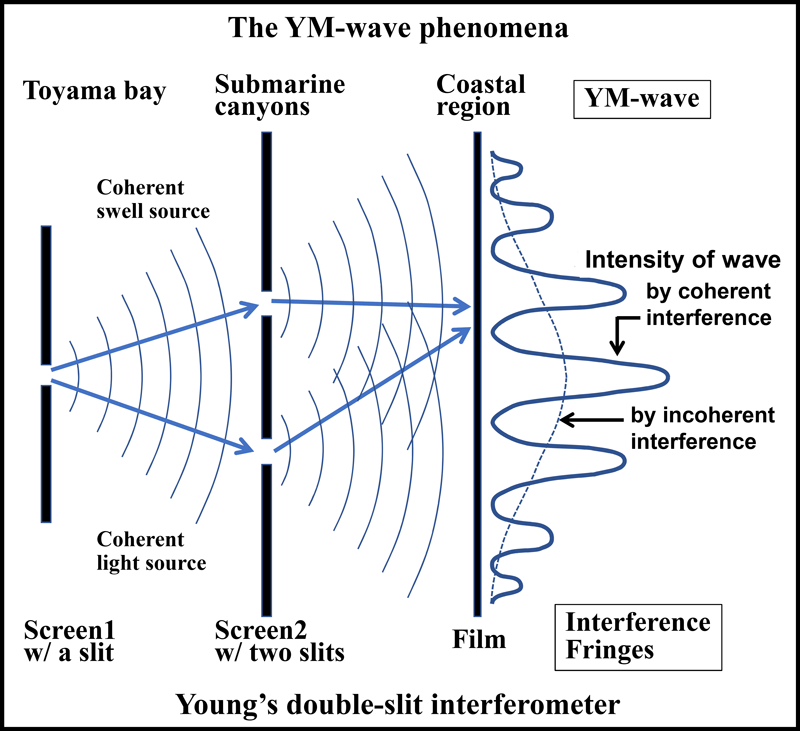
In winter months Toyama Bay in Japan can get hammered by waves nearly 10 meters in height. These waves, known as YoriMawari-nami, pose dangers to both infrastructure and citizens, and, thus far, are not captured by typical forecasting models.
A new study indicates that these waves have their origin in the particular topography of Toyama Bay and the physics behind the double-slit experiment. The shape of Toyama Bay is such that only waves from the north-northeast can propagate all the way to shore. That restriction essentially creates a single, coherent source for waves in the bay.
The bay is also home to submarine canyons that stretch like underwater valleys from the continental shelf down toward the deeper ocean. To the incoming waves, these canyons act much like the slits in the double-slit experiment, creating two sets of waves whose fronts can interfere. In some positions, a wave crest will combine with a wave trough, cancelling one another out. But in other spots, two wave crests will meet and combine, creating the much larger YoriMawari-nami wave.
Toyama Bay is not the only spot in the world where this phenomenon happens. The same physics is behind some of the most popular surf spots in the world, including Half-Moon Bay in California and Nazaré, Portugal. In all of these cases, properly predicting wave heights requires tracking an extra variable — wave phase — that most models leave out. That’s why forecasters have struggled with Toyama Bay’s waves. (Image credit: wave – M. Kawai, diagram – H. Tamura et al.; research credit: H. Tamura et al.; via AGU Eos; submitted by Kam-Yung Soh)