Search results for: “water balloons”

  • Capsule Impact and Bursting

    Capsule Impact and Bursting

    Nature and industry are full of elastic membranes filled with a fluid, from red blood cells to water balloons. A new study looks at how these capsules deform — and sometimes burst — on impact. The researchers created custom elastic shells that they filled with various fluids like water, glycerol, and honey, then used the impacts to build a model of capsule deformation.

    They found that there’s significant overlap between droplet impacts and capsule impacts, with a few key differences; instead of surface tension, capsules resist deformation through their elastic shell’s surface modulus — a combination of its elasticity and thickness. Capsules, unlike droplets, can also burst. To study this, the researchers used water balloons, which they were able to pre-stretch more easily than their custom shells. They found that their model could accurately predict the conditions under which the balloons burst.

    The authors hope the model will be helpful both in designing capsules intended to burst — like a fire-fighting projectile — and in creating safety measures to prevent capsule burst — like car-crash standards that protect from organ damage. (Image and research credit: E. Jambon-Puillet et al.; via Physics World; submitted by Kam-Yung Soh)

  • The Best of FYFD 2017

    The Best of FYFD 2017

    2017 was a busy, busy year here at FYFD, but a lot of that happened behind the scenes with multiple collaborations that were months in the planning. You’ll start to see the results of those collaborations here in January, starting this Friday. I’m really excited for you all to see what I’ve been up to!

    In the meantime, we’ll take our traditional look back at the top 10 FYFD posts of 2017, according to you:

    1. Cinemagraph of a breaking wave
    2. Visualizing radiation in a cloud chamber
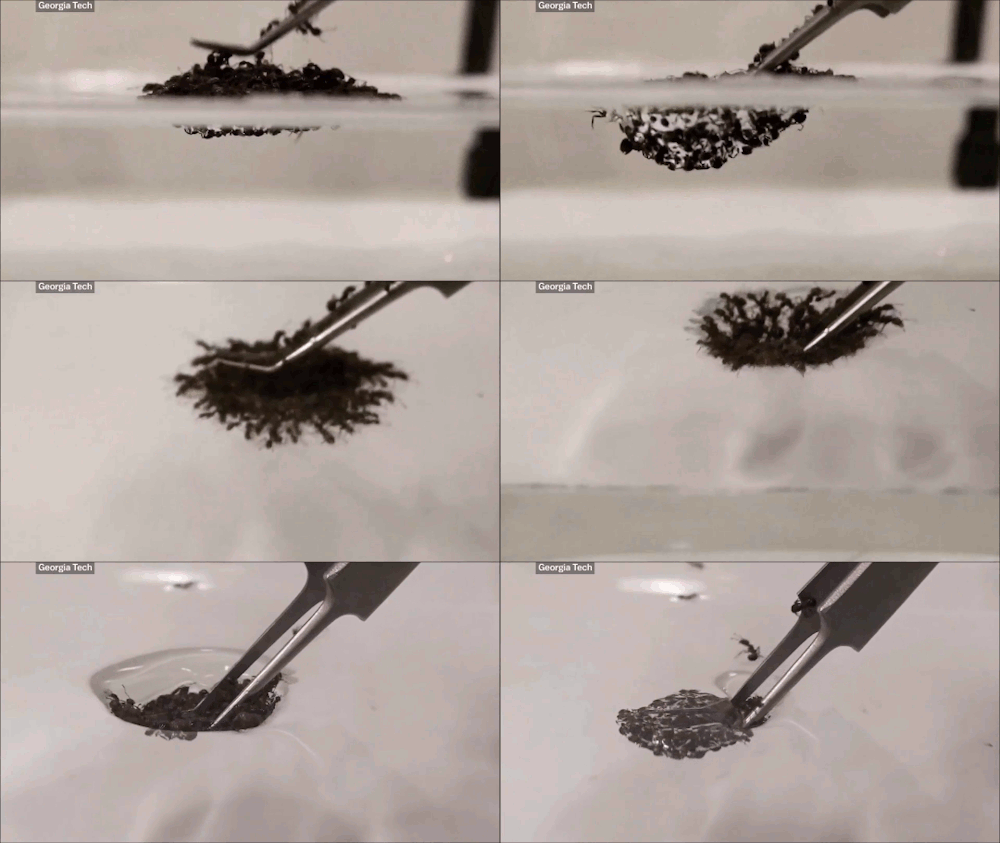
    3. Fire ants as a fluid
    4. The water music of Vanuatu
    5. How hummingbirds drink nectar
    6. When vortex rings collide
    7. How water balloons can bounce off a bed of nails
    8. Spinning ice disks form on freezing rivers
    9. A hot-tub-sized fluidized bed
    10. The physics of fluidized beds

    Lots of crazy, cool stuff in there! Special congrats to The Splash Lab for making the top 10 two years in a row. Stay tuned in 2018 for more exciting fluid dynamical developments, and if you’d like to help support FYFD, remember that you can always become a patron, make a one-time donation, or purchase some merch!

    (Image credits: R. Collins / J. Maria; Cloudylabs; Vox/Georgia Tech; R. Hurd et al.; A. Varma; A. Lawrence; T. Hecksher et al.; K. Messer; M. Rober; R. Cheng

  • The GE Show

    [original media no longer available]

    While this video is not strictly about fluid dynamics, there are some pretty cool high-speed fluids moments in it. Watch the reaction of the gelatins as objects hit them and observe the deformation of the water balloons as they strike. (via JetForMe)

  • Featured Video Play Icon

    Popping an Oil Balloon

    Oil and water don’t mix — or at least they won’t without a lot of effort! In this video, we get to admire just how immiscible these fluids are as oil-filled balloons get burst underwater.

    Visually, the two bursts are quite spectacular. In the first image, the initial balloon has a sizeable air bubble at the top, which rises even more rapidly than the buoyant oil, creating a miniature, jelly-fish-like plume that reaches the surface first. The large oil plume follows, behaving similarly to the balloon burst without an added air bubble.

    The last of the oil in both cases comes from a cloud of smaller droplets formed near the bottom of the balloon. Being smaller and less buoyant, these drops take a lot longer to rise to the surface and remain much closer to spherical as they do. I suspect these smaller droplets form due to the forces created by the fast-moving elastic as it tears away. (Video and image credit: Warped Perception)

  • Featured Video Play Icon

    Why Fishing with Dynamite is So Harmful

    In some countries, there are still people using dynamite to catch fish. This practice is incredibly destructive, not just to adult fish but to the entire marine ecosystem. A blast wave traveling through air loses some its energy to the compression of the gas. Water, on the other hand, is incompressible, so the blast wave’s energy just keeps going, expanding its destructive radius. Many fish contain swim bladders, gas-filled organs the fish use to regulate their depth. When a shock wave passes through the fish, the gas in the swim bladder will expand and contract violently, much like the balloons shown underwater in the animation below. This typically ruptures the swim bladder and surrounding tissues.

    Fish without swim bladders will often hemorrhage after being struck by a blast wave. The sudden changes in pressure create bubbles in the dissolved gases collected in their gills. Those bubbles tear apart the fish’s blood vessels.

    Blasting is effective but entirely indiscriminate. It kills adults and juveniles of all species, not just the ones a fisherman can sell. Simultaneously, it destroys the slow-growing coral reefs that are key habitats for these populations. It’s an incredibly short-sighted practice that guarantees there will be no fish to catch in years to come. (Video credit: National Geographic; image credit: M. Rober, source; research credit: K. Dunlap, pdf)

  • Reader Question: Hot Air Balloon Physics

    lazenby asks:

    and boyancy in air? is the lifting capacity of a hot air balloon equal to the modulo of the weight of the air in the balloon with the weight of the same volume of air outside the balloon?

    for that matter, does the lift of a big helium weather balloon decrease as air pressure, and so weight of the air outside the balloon, drops? and is this exactly counterbalanced by the lessening density of the helium in the balloon?

    all of these things keep me awake.

    Hopefully you won’t be sleepless much longer. Buoyancy in air follows the same principles as buoyancy in water. Determining the lifting capacity of a balloon is a matter of determining how heavy the balloon can be before the buoyant force is equal to the weight. See the free body diagram and little derivation below to see what the maximum payload mass is for a helium balloon. You can click on the picture to enlarge it.

    What is the lifting capacity of a balloon in air?

    The second part of your question raises some interesting points. As a balloon’s altitude increases, the atmosphere around it gets colder and less dense, all of which should reduce the buoyant force. At the same time, the balloon itself expands to equalize the pressure inside and outside of the balloon, which should increase the buoyant force. (At some point the pressure drops sufficiently that the tensile strength of the balloon material is unable to cope with that expansion and the balloon bursts, but we’ll ignore that here.) For this problem, we’d want to know what payload the balloon can carry without losing lift, and, with a couple assumptions, that’s pretty easy to figure out. I’ve done that derivation below.

    What payload can a helium balloon carry without stalling?

    The real key to the calculation is assuming that the helium in the balloon maintains the same temperature as the air outside. Since balloons rise slowly, this seemed a more reasonable assumption than imagining that the balloon remains warm compared to its surroundings. That calculation is doable as well but requires more than a couple lines, unfortunately! Thanks for your questions!