A 4-minute, unedited one-shot video of colorful paint sliding down a sheet? Yes, please.
Beautiful visuals aside, there are some really interesting physics involved here. It’s unclear whether the there’s any change in the speed at which paint gets deposited at the top of the incline over the course of the video, yet we see huge changes in the visual patterns. This happens, in part, because the layer of paint is getting thicker and heavier over time, changing the dynamics of its slide under gravity. There may even be some shear-thinning going on, given that paint is usually non-Newtonian. I can imagine some connections to landslides, avalanches, and other gravity currents with non-Newtonian fluids. (Video and image credit: R. De Giuli)
One proposed method for improving bulletproof armor is adding a layer of non-Newtonian fluid that can help absorb and dissipate the kinetic energy of impact. Thus far researchers have focused on shear-thickening fluids – like cornstarch-based oobleck – filled with particles that jam together if anything tries to deform them quickly. But is it really the shear-thickening properties that matter for high-speed impacts?
To test this, researchers studied projectile impact on three fluids: water (left), a cornstarch mixture (not shown), and a shear-thinning polymer mixture (right). Water is Newtonian, and it slows down the projectile but doesn’t stop it. Both the shear-thickening cornstarch and the shear-thinning polymer mixture do stop the projectile. And by modeling the impacts, researchers concluded that the key to that energy dissipation isn’t their shear-related behaviors: it’s the fact that both fluids are viscoelastic.
That means that these fluids show both viscous (fluid-like) and elastic (solid-like) responses depending on the timescale of an impact. The high speed of the impact triggered a strong viscous response in both fluids, bringing the projectile to a halt. And if, as the researchers suggest, it’s a fluid’s viscoelasticity that matters most, that widens the field of candidates when it comes to developing a fluid-based armor. (Image and research credit: T. de Goede et al.)
Fluids like air and water are Newtonian, which means that the way they deform does not depend on how the force on them gets applied. Many other fluids, however, are non-Newtonian. How they behave depends on how force is applied to them. The Internet’s favorite non-Newtonian fluid is probably oobleck, a mixture of cornstarch and water with some fairly extreme properties. When deformed quickly, like when struck with a bat, oobleck doesn’t flow; it shatters.
What’s happening at the microscopic level is that the cornstarch particles in the oobleck are jamming together. They simply cannot move quickly and avoid one another. When they jam together, the friction between them goes way up and so does the apparent viscosity of the oobleck. Because it doesn’t have time to flow, all that energy goes into breaking off “solid” chunks instead. Once they hit the ground, the pieces of oobleck will puddle, just like any other liquid. (Image and video credit: Beyond the Press; via Nerdist)
Inkjet printing and other methods for directing and depositing tiny droplets rely on the force of gravity to overcome the internal forces that hold a liquid together. But that requires using a liquid with finely tuned surface tension and viscosity properties. If your fluid is too viscous, gravity simply cannot provide consistent, small droplets. So researchers are turning instead to sound waves.
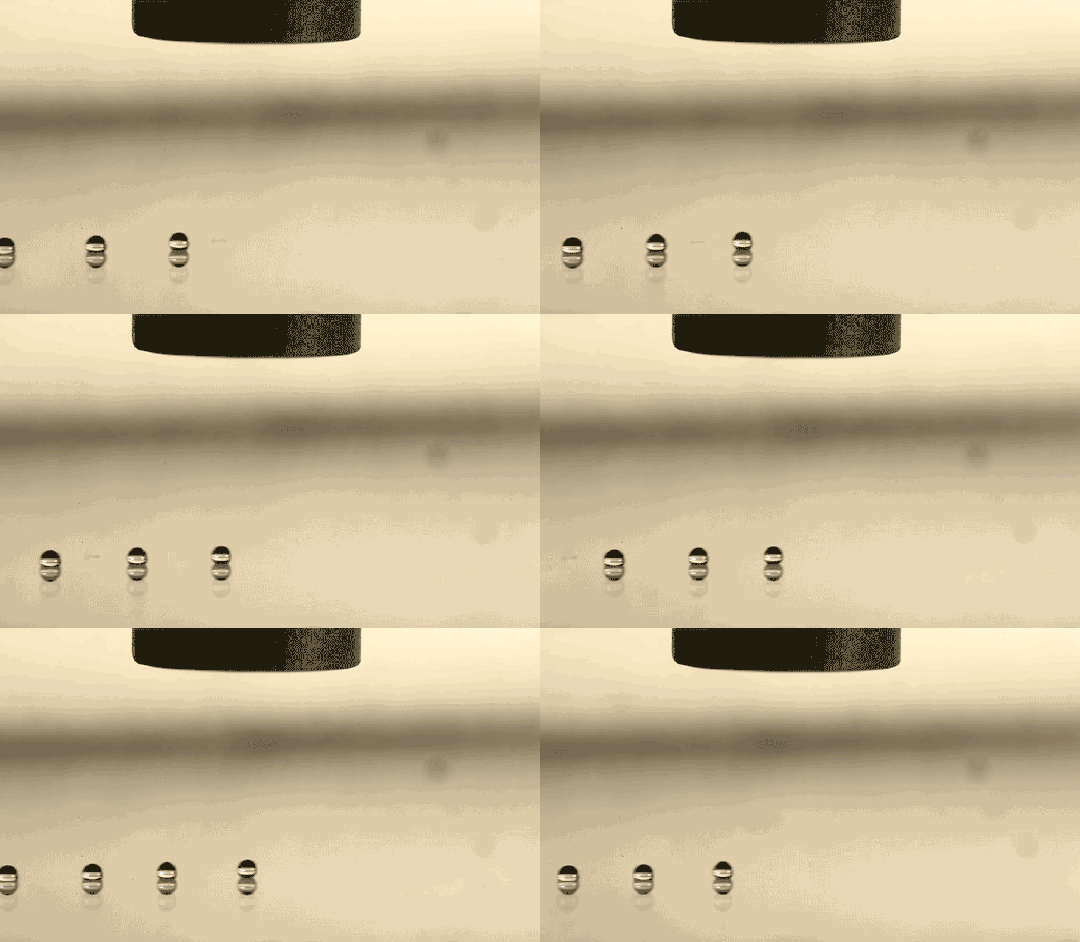
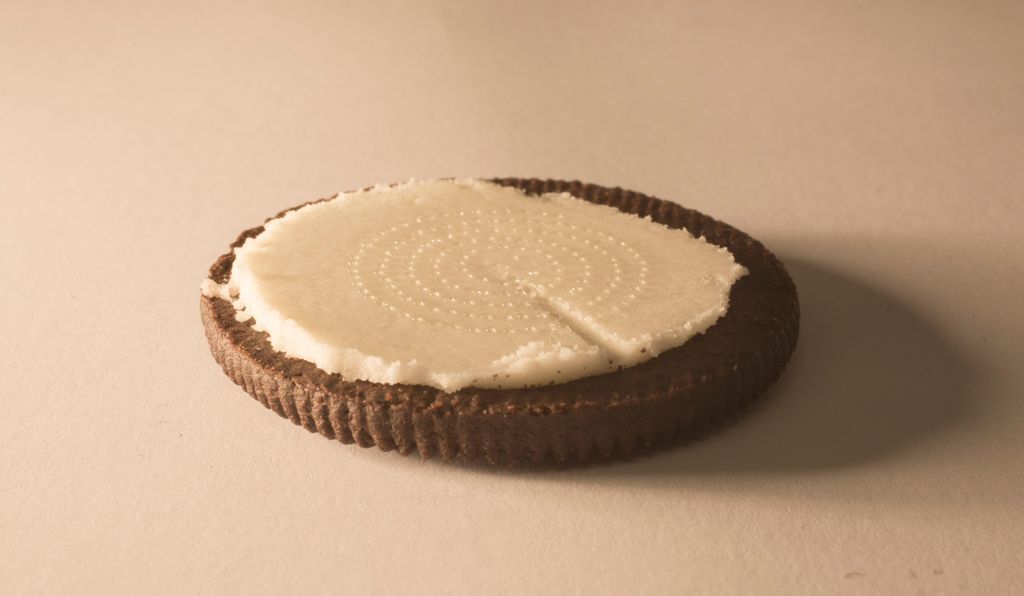
Using an acoustic resonator, scientists are able to generate forces up to 100 times stronger than gravity, allowing them to precisely and repeatably form and deposit micro- and nano-sized droplets of a variety of liquids. In the images above, they’re printing tiny drops of honey, some of which they’ve placed on an Oreo cookie for scale. The researchers hope the technique will be especially useful in pharmaceutical manufacturing, where it could precisely dispense even highly viscous and non-Newtonian fluids. (Image and research credit: D. Foresti et al.; via Smithsonian Mag; submitted by Kam-Yung Soh)
In their continuing quest to squish all the things, the Hydraulic Press channel recently debuted a tool with a series of small holes they can extrude various substances through. The video features several great extrusions, including oobleck, temperature-sensitive putty, cheese, and crayons (above). Most of these substances are non-Newtonian fluids of some kind, and the extreme forces the hydraulic press causes makes for some wild effects.
Many of the substances, including the crayons above, display signs of the sharkskin instability in their rough edges. When non-Newtonian fluids (like the paraffin wax in crayons) get extruded quickly, the material at the edges experiences a lot of friction and shear when trying to flow along the wall of the hole. When the fluid finally breaks free, the region along the outside accelerates to match the speed of fluid at the center of the extrusion. Parts of the mixture may resist that acceleration, resulting in the uneven edges seen above. (Video credit: Hydraulic Press Channel; GIF via Colossal)
Asteroid impacts are a major force in shaping planetary bodies over the course of their geological history. As such, they receive a great deal of attention and study, often in the form of simulations like the one above. This simulation shows an impact in the Orientale basin of the moon, and if it looks somewhat fluid-like, there’s good reason for that. Impacts like these carry enormous energy, about 97% of which is dissipated as heat. That means temperatures in impact zones can reach 2000 degrees Celsius. The rest of the energy goes into deforming the impacted material. In simulations, those materials – be they rock or exotic ices – are usually modeled as Bingham fluids, a type of non-Newtonian fluid that only deforms after a certain amount of force is applied. An everyday example of such a fluid is toothpaste, which won’t extrude from its tube until you squeeze it.
The fluid dynamical similarities run more than skin-deep, though. For decades, researchers looked for ways to connect asteroid impacts with smaller scale ones, like solid impacts on granular materials or liquid-on-liquid impacts. Recently, though, a group found that liquid-on-granular impacts scale exactly the way that asteroid impacts do. Even the morphology of the craters mirror one another. The reason this works has to do with that energy dissipation mentioned above. As with asteroid impacts, most of the energy from a liquid drop impacting a granular material goes into something other than deforming the crater region. Instead of heat, the mechanism for dissipation here is the drop’s deformation. The results, however, are strikingly alike.
For more on how asteroid impacts affect the moon and other bodies, check out Emily Lakdawalla’s write-up, which also includes lots of amazing sketches by James Tuttle Keane, who illustrates the talks he hears at conferences! (Image credits: J. Keane and B. Johnson; via the Planetary Society; additional research and video credit: R. Zhao et al., source; submitted by jpshoer)
Oobleck is probably the Internet’s favorite non-Newtonian fluid. People vibrate it, run across it, shoot it, drop it, and even use it to fix potholes. But how does oobleck hold up to a hydraulic press? Fortunately, that’s been covered, too. Oobleck is a mixture of cornstarch and water, and it’s a bit unusual in that it is a shear-thickening material. That means that the faster you try to deform it, the more it will resist that deformation. Knowing this makes the above video’s results make more sense. When they try to crush the balloon full of oobleck, the deformation happens pretty slowly, so the fluid just flows away.
The same thing happens initially with the pot full of oobleck; it overflows much like any other liquid. But as the press pushes deeper, the oobleck gets confined by the pot’s walls and things change. Research has shown that the shear-thickening of oobleck comes from cornstarch particles jamming up in the fluid. By confining the oobleck, the pot and hydraulic press magnify this jamming effect, causing a spurt of semi-solid cornstarch fingers and leaving the press tool thoroughly trapped by the jammed particles. (Video credit: Hydraulic Press Channel)
Mixing cornstarch and water creates a fluid called oobleck that has some pretty bizarre properties. Oobleck is a shear-thickening, non-Newtonian fluid, which means its viscosity increases when you try to deform it with a shearing, or sliding, force. But as the Backyard Scientist demonstrates above, striking oobleck with a solid object produces some spectacular and very non-fluid-like results. The golf ball’s impact blows the oobleck into pieces that look more like solid chunks than liquid droplets. This solid-like behavior occurs because the impact jams the suspended cornstarch particles together, creating a solidification front that travels ahead of the golf ball. Imagine how a snow plow pushes a denser region of snow ahead of it as it drives; the cornstarch behaves similarly but only in a region near the impact. Once that impact force dissipates, the particles unjam and the mixture responds fluidly again. (Image credit: The Backyard Scientist, source; research credit: S. Waitukaitis and H. Jaeger, pdf)
Paint getting flung from a spinning drill bit can create some incredible art. Here the Slow Mo Guys recreate the effect in high-speed video. What we’re seeing is tug of war between centrifugal force, which tries to fling the paint outward, and internal forces in the paint, which struggle to hold the the fluid together. Primarily, it’s surface tension keeping the fluid together, but, depending on what sort of non-Newtonian fluid the paint may be, there could be other internal forces helping keep the paint intact. In this case, centrifugal force is clearly winning out, though the paint stretches pretty far before it thins enough to break. It would be interesting to see how the balance plays out with the drill bit spinning at a lower RPM. (Image credit: Slow Mo Guys, source)
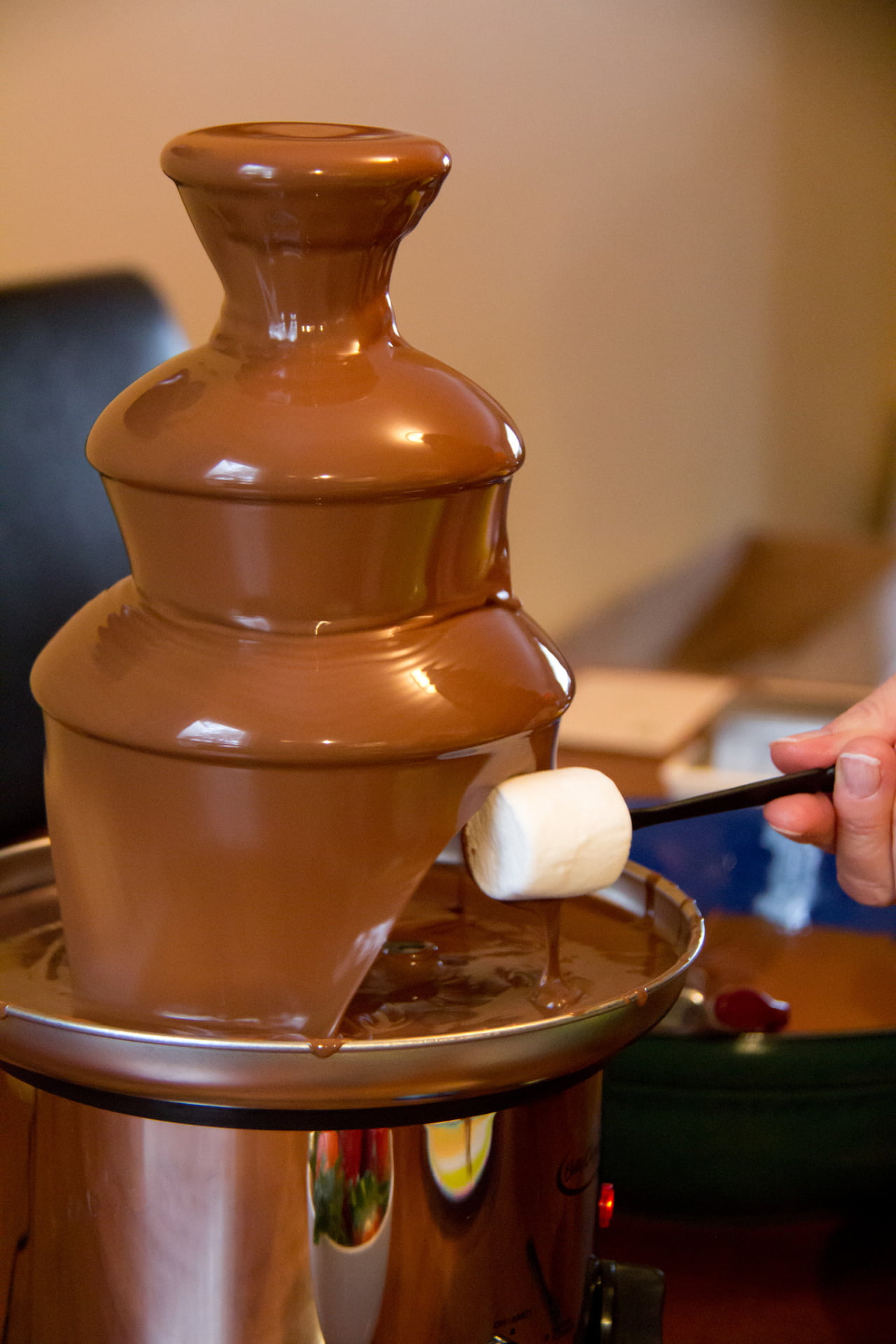
Amidst your holiday celebrations, you may have encountered a chocolate fountain. In a recent paper, applied mathematicians have laid out the physics behind these delicious decorations, and it turns out they are an excellent introduction to many fluids concepts. Molten chocolate is a mildly shear-thinning, non-Newtonian fluid, meaning that it becomes less viscous when deformed. This adds a wrinkle to the mathematics describing the flow, but only a little one. The researchers divide the flow into three regimes: pipe flow driving the chocolate up the inside of the fountain, thin-film flow over the fountain’s domes, and, finally, the curtain of falling chocolate where foodstuffs are dipped. The final regime is the most mathematically challenging and may be the most fascinating. The authors found that the free-falling curtain of liquid pulls inward as it falls due to surface tension. Their paper is quite approachable, and I recommend those of you with mathematical inclinations check it out. (Image credit: P. Gorbould; research credit: A. Townsend and H. Wilson)