
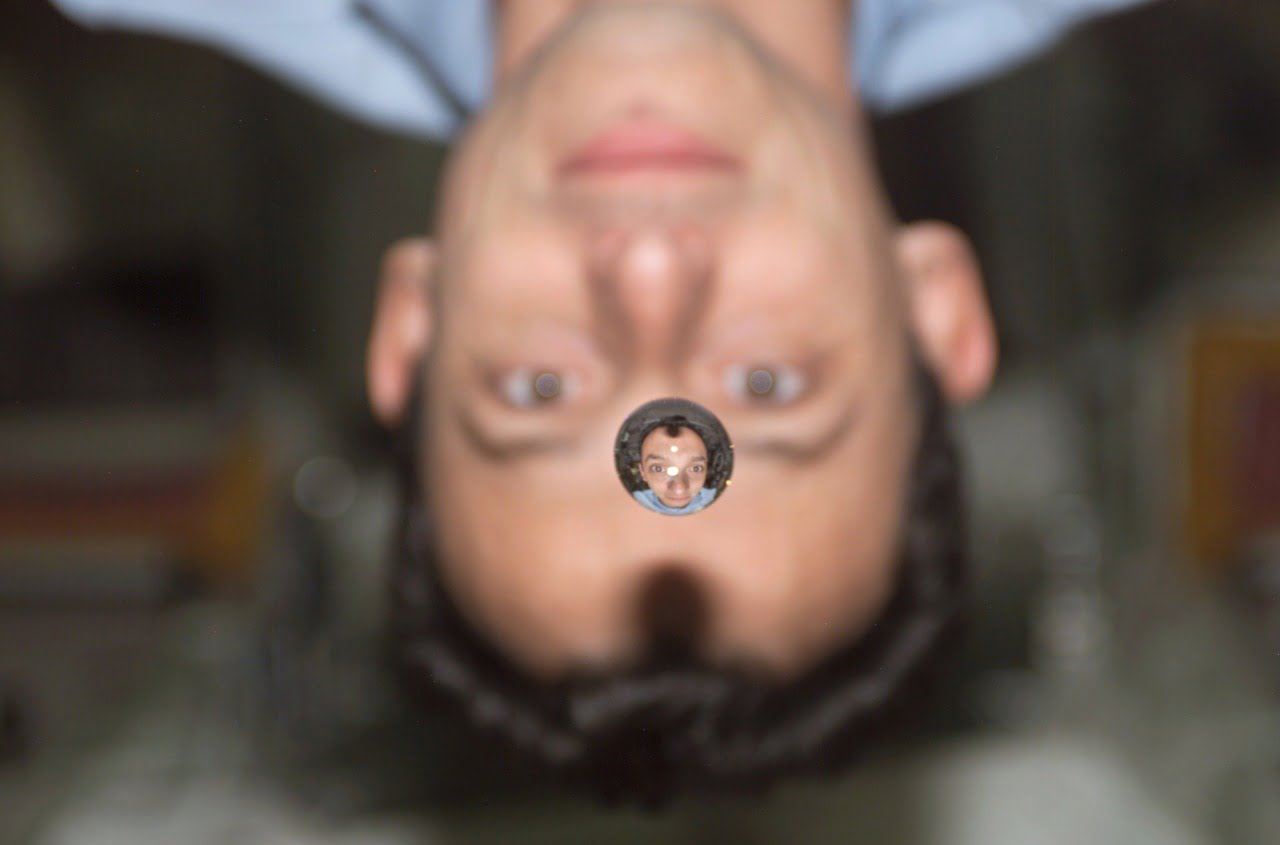
Here astronaut Andre Kuipers demonstrates fluid dynamics in microgravity. A roughly spherical droplet of water acts as a lens, refracting the image of his face so that it appears upside down. The air bubble inside the droplet refracts the image back to our normal perspective again. (Photo credit: Andre Kuipers, ESA; via Bad Astronomy)
Search results for: “microgravity”

Astro Puffs
Microgravity continues to be a fascinating playground for observing surface tension effects on the macroscale without pesky gravity getting in the way. Here astronaut Don Pettit has created a sphere of water, which he then strikes with a jet of air from a syringe. Initially, the momentum from the jet of air creates a sharp cavity in the water, which rebounds into a jet of water that ejects one or more satellite drops. Surface waves and inertial waves (inside the water sphere) reflect back and forth until the fluid comes to rest as a sphere once more. Note how similar the behavior is to the pinch-off of a water column. Both effects are dominated by surface tension, but on Earth we can only see this behavior with extremely small droplets and high-speed cameras! (Video credit: Don Pettit, Science Off the Sphere)
Space Didgeridoo
This week astronaut Don Pettit is playing with acoustic oscillators on the space station. He and Dan Burbank transform some of their vacuum cleaner tubes into didgeridoo-like instruments. By buzzing into the tube, Pettit is creating an acoustic standing wave, and, depending on the geometry at the far end, the wavelength of the standing wave and thus pitch of the sound is shifted.
Breaking Water with Sound
Previously we saw how vibration could atomize a water droplet, breaking it into a spray of finer droplets. Here astronaut Don Pettit shows us what the process looks like in microgravity using some speakers and large water droplets. At low frequencies the water displays large wavelength capillary waves and vertical vibrations. Higher frequencies–like the earthbound experiment on much smaller droplets–cause fine droplets to eject from the main drop when surface tension can no longer overcome their kinetic energy. (submitted by aggieastronaut, jshoer and Jason C)
(Source: /)Science Off the Sphere: Liquid Lenses
Astronaut Don Pettit delivers more “Science Off The Sphere” in his latest video. Here he demonstrates diffusion and convection in a two-dimensional water film in microgravity. He notes that the viscous damping in the water is relatively low and that, left undisturbed, mixing in the film will continue for 5-10 minutes before coming to rest, which tells us that the Reynolds numbers of the flow are reasonably large. The structures formed are also intriguing; he notes that drops mix with mushroom-like shapes that are reminiscent of Rayleigh-Taylor instabilities and cross-sectional views of vortex rings. It would be interesting to compare experiments from the International Space Station with earthbound simulations of two-dimensional mixing and turbulence, given that the latter behaves so differently in 2D.
Science off the Sphere: Thin Films
Stuck here on Earth, it’s hard to know sometimes how greatly gravity affects the behavior of fluids. Fortunately, astronaut Don Pettit enjoys spending his free time on the International Space Station playing with physics. In his latest video, he shows some awesome examples of what is possible with a thin film of water–not a soap film like we make here on Earth–in microgravity. He demonstrates vibrational modes, droplet collision and coalescence, and some fascinating examples of Marangoni convection.
Viscoelastic Fluids in Space
In honor of astronaut Don Pettit’s launch to the International Space Station (and in the hope that he’ll do more neat microgravity fluids demonstrations while in space!), here’s a look a the behavior of viscoelastic fluids in microgravity. The elasticity of these fluids means that, when strained, the fluid deforms instantaneously and then returns to its initial shape when the strain is removed. Pettit demonstrates both Plateau-Rayleigh instability behavior, where a column of fluid breaks apart due to surface tension variations, and die swell, where a fluid jet expands beyond the diameter of nozzle from which it was extruded. Such swelling is commonly caused by the stretching and relaxation of polymers in the fluid as they react to forces caused by the nozzle opening.
Testing Flames in Space
In microgravity, flames behave very differently than on earth due to a lack of buoyant forces. On earth, a flame can continue burning because, as the warm air around it rises, cooler air gets entrained, drawing fresh oxygen to the flame. In microgravity, both the heat from the flame and the oxygen it needs to burn move only by molecular diffusion, the random motion of molecules, or the background environmental flow (air circulation on the ISS, for example). This video shows a test of the Flame Extinguishment Experiment (FLEX) currently flying onboard the ISS. A fuel droplet is ignited, burns in a symmetric sphere and then eventually extinguishes either due to a lack of fuel or a lack of oxygen. Check out this NASA press release for more, including great quotes like this:
“As a Princeton undergrad, I saw in a graduate course the conservation equations of combustion and realized that those equations were complex enough to occupy me for the rest of my life; they contained so much interesting physics.” – Forman Williams
Mixing in Space
Living here on earth, we are so accustomed to gravity’s effects on fluid behaviors that it’s not always obvious how microgravity will affect them. Here astronaut Richard Garriott demonstrates mixing and separating immiscible liquids in space.
Happy Anniversary
ESA astronaut Pedro Duque shown refracted through a water droplet in microgravity. Today marks the 50th anniversary of human space flight. #